
Live a richer life. Independent financial guidance for smarter decisions.

Advertiser Disclosure

Search results for: “index fund”

  • Fix Your 401(k) with Blooom (Review)

    Fix Your 401(k) with Blooom (Review)

    blooom-review

    InvestorMint provides personal finance tools and insights to better inform your financial decisions. Our research is comprehensive, independent and well researched so you can have greater confidence in your financial choices.

    blooom is unique among robo-advisors because it specializes in helping investors manage employer-sponsored retirement plans automatically.

    Like other robo-advisors, blooom Inc uses computer algorithms to build retirement portfolios. And it goes a step further by connecting customers to financial advisors, who are available by chat, email, and phone during weekdays.

    During our blooom review, we were pleasantly surprised to discover that the cost of managing a 401(k) starts as low as $95 per year. The low fee is compelling, especially when you consider that most other robo-advisors steer clear of defined contribution plans.

    And unlike some robo-advisors, blooom won’t penalize newcomers with any account minimum hurdle. In fact, when you weigh up the pros and cons, it’s easy to see why blooom offer tremendous value.

    Blooom Promo Code

    BLOOOM SPOTLIGHT
    blooom logo

    InvestorMint Rating

    4 out of 5 stars

    • Management Fee: $95 – $250
    • Account Minimum: $0

    via Blooom secure site

    How blooom Works

    You can create a blooom account and connect easily to your existing 401(k), 403(b), 401(a), 457 or TSP plans. blooom will then analyze your portfolio for free.

    If you are not sure whether your portfolio is optimized for your age, risk, and goals, blooom evaluates it using proprietary computer algorithms at no cost.

    Here is a quick demo and overview of how blooom works:

    Although blooom can analyze and make changes to your portfolio, it cannot withdraw funds from your account.

    Once your account analysis has been completed, blooom factors in your age and timeline to retirement in order to build a target portfolio for you.

    After blooom reviews your portfolio composition, it recommends investments from up to 14 asset classes.

    Where blooom adds value to you is by crunching through thousands of options to select the optimal investment in each asset class to meet your needs.

    Usually, low-cost index funds are favored but every once in a while blooom will select an actively-managed fund if it is a better match for your risk level and retirement goals.

    Finally, blooom reviews your portfolio to ensure the portfolio built by its algorithms is indeed a match for you and fund changes are made.

    Every 90 days, your portfolio will be re-analyzed to ensure portfolio weightings align with your capacity for risk and financial goals. And each time a change is made, blooom alerts you to the funds which are replaced.

    blooom Inc Cost & Features

    Low Annual Fee As low as $95
    Minimum Investment $0
    Automatic Management YES
    Portfolios Rebalanced Every 90 days
    Workplace Retirement Plans 401(k), 403(a), 403(b)
    Thrift Savings Plan YES
    Client Fees Saved > $600 million+
    blooom BBB Rating A+

    blooom Review: Is It Right For You?

    blooom is designed for price-sensitive investors who want to hand off portfolio management to a financial advisor. 

    Risk-Seeking Vs Risk-Averse Investors

    When you join you will be invited to enter your birth date and specify when you plan to retire. With this information, blooom knows your age and the duration before you retire. It then constructs a portfolio to match your capacity for risk and financial aims.

    blooom leans somewhat aggressive in its portfolio composition. Equities are weighted heavily until about 20 years out from retirement when bonds feature in the mix more prominently.

    Because of the higher exposure to stocks, blooom is ideal for investors who are more risk-seeking than risk-averse.

    Investors Seeking Professional Portfolio Management

    Many research studies have shown that investors who receive professional financial advice outperform those who invest alone.

    The reason so many investors fall short of the mark without advice is because, according to blooom, they make three major errors.

    The first is to build a portfolio of bonds and stocks that have an incorrect mix compared to their risk tolerances and financial goals.

    Next, investors frequently fail to diversify their 401k plans and instead invest heavily in a single company. Usually they are biased towards investing in the company that employs them.

    And lastly, they don’t want to face the challenge of managing their retirement accounts, so they stick their heads in the sand like an ostrich!

    Price Sensitive Investors

    For investors who see the value of expert financial advice and care about the cost of receiving it, blooom is hard to beat because it charges a low annual fee.

    For a low annual fee, blooom will identify areas of improvement in your existing 401(k) portfolio, make changes, and provide ongoing management of your existing portfolio.

    Investors Seeking Alternative To Financial Advisors

    Unless you pay a financial advisor a much higher fee (most likely), blooom is a compelling alternative. Not only is it an excellent option for investors who don’t want to pay a dedicated financial advisor, but it is also unique among robo-advisors.

    Few robo-advisors dabble in 401(k)s because they can be a nuisance to manage. Each employer has its own set of limited securities in which employees can invest and it’s a difficult challenge to automate portfolio management of defined contribution plans.

    For this reason, even the robo-advisors who advise on 401(k) plans, like Personal Capital, won’t manage them for you.

    In fact, if you want your 401(k) plan managed automatically, blooom is really your only option.

    blooom is best for:

    • Retirement-focused investors
    • Beginner investors
    • Fee-conscious investors
    • Hands-off investors
    • Investors who are more risk-seeking than risk-averse

    blooom Fees Are Low

    According to blooom, the average client could save over $60,000 in hidden fees over their working life based on a balance of $43,310 and an average annual contribution of $5,000.

    blooom charges an annual fee that starts from as low as $95 for its Essentials package to as much as $25o for its Unlimited package.

    The lifetime savings by choosing blooom amount to an astonishing $60,000 in fees based on an average balance of around $43,000.

    To save you so much money, you might assume that blooom costs a fortune but in fact the flat annual fee is very affordable, especially for large accounts.

    blooom fees

    • $95 – $250 Annual Management Fee
    • $0 Account Minimum

    Compared to traditional financial advisors or other robo-advisors, this fee is very competitive. The $95 fee gets you a personalized portfolio but lacks the auto optimization.

    The Standard package will include all the features of the Unlimited package but without the priority advisor access.

    For $250 a client receives:

    • Personalized Portfolio
    • Auto Optimization
    • Transaction Activity Alerts
    • Advisor Access
    • Priority Advisor Access

    That still compares well to a human advisor but it’s higher than Betterment and others charge to manage IRA and taxable portfolios.

    The gotcha is the only place to manage your 401(k) automatically is blooom so choosing another robo-advisor is not a viable choice.

    In our view, the fee is fair given the unique service blooom offers and the fact that clients have access to live advisors by email, chat, and phone.

    How Are blooom 401k Portfolios Invested?

    blooom analyzes your existing 401k, removes portfolio holdings that don’t align with your objectives or cost too much, and replaces funds with others that better align with your target allocation and financial aims. 

    The following algorithm is applied to assess and optimize your portfolio:

    1. blooom analyzes your existing 401k and remove funds that don’t make sense.
    2. To keep fees low, blooom generally selects index funds but, every once in a while, actively-managed funds are chosen.
    3. After selecting funds that align with your target allocation, computer algorithms select investments to optimize for expense ratios and fund manager experience.
    4. Finally, blooom verifies the results and compares the new portfolio with your recommended 401(k) allocation.

    Every 90 days thereafter, your portfolio is re-analyzed to ensure selections and weightings are optimal. If needed, your portfolio will be automatically rebalanced.

    As you come closer to retirement, blooom will automatically modify the weighting of stocks in your portfolio to create a more conservative portfolio.

    blooom App & Tools
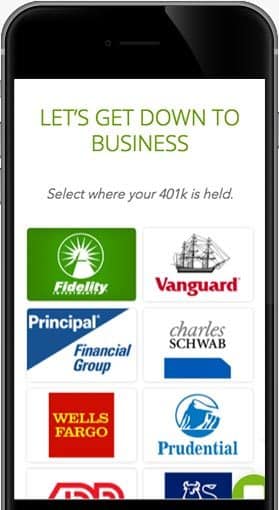
    You can link an existing 401(k) account to blooom in order to measure fees, and evaluate its composition, and allocation.

    blooom makes it simple to analyze an existing 401(k).

    Simply link to your existing provider after setting up your blooom account in order to view how well your current 401(k) is performing.

    Hands-off investors can leave it to blooom to manage their 401(k) while self-directed investors can act on the recommendations provided.

    Where blooom earns a few extra brownie points is its risk tolerance assessment.

    Risk tolerance measures are factored into the sign up process using an adjustable slider that allows you to change your allocation by up to 20% either way from the suggested allocation.

    blooom Pros and Cons

    blooom charges a low, flat annual fee. The onboarding process is easy and it’s free to analyze your existing portfolio.  If blooom were to be docked a few points, it would be the high fee as a % of assets under management on smaller account sizes.

    blooom Pros blooom Cons
    Low Management Fees: blooom charges a flat annual fee starting as low as $95, which is a steal when compared to the costs charged by traditional financial advisors to manage defined contribution plans, and compares favorably to the fees charged by other robo-advisors. Large Cash Holdings: blooom structures portfolios with heavy weightings of equities which doesn’t account for the differing risk tolerance levels of clients and caters more towards risk-seeking than risk-averse investors.
    Financial Advisors: Clients have access to financial advisors by email, phone and live chat during weekday business hours. Small Account Sizes Penalized: While fees are low as a % of assets under management for large account sizes, they are not insignificant for small account sizes, though still generally competitive when compared to traditional financial advisors, who often charge north of 1%.
    Automatic Rebalancing: When fund weightings drift too far from the recommended allocation, blooom rebalances the portfolio. Automatic rebalancing is done every 90 days.
    401(k) Assessment: blooom makes it easy to link to an existing 401(k) in order to assess whether expense ratios can be optimized and portfolio compositions can be improved.
    No Account Minimums: blooom allows clients to sign up with no account balance minimum.

    blooom Fees & Minimums

    blooom imposes no account balance minimum, charges a low annual fee for account management and automatic rebalancing.

    Category Fees
    Account Management Fees $95 – $250
    (annually)
    Account Minimum $0
    Automatic Rebalancing YES
    (every 90 days)
    Annual, Transfer, Closing Fees $0

    blooom Account Types

    blooom supports employer-sponsored plans: 401(k), 403(b), 401(a), 457 and TSP.

    Type Capability
    401(k) YES
    403(b) YES
    401(a) YES
    457 YES
    TSP YES

    blooom Review Summary

    Unlike most robo-advisors, which focus on taxable and IRA accounts, blooom is unique because it manages 401(k) plans automatically for a low yearly flat fee.

    By imposing no account minimum, blooom makes it easy to get started. And by charging nothing to analyze your 401(k), there is no reason not to give it a whirl.

    If you are like the average blooom client, you will experience instant fee savings and, over the life of the account, potentially save as much as $60,000.

    The bottom line is if you have a defined contribution plan, like a 401(k), 403(b), or 401(a), blooom offers compelling value at a fair and flat yearly rate.


  • AskFinny Review – Money Guides For Your Finances

    AskFinny Review – Money Guides For Your Finances

    It’s an unfortunate truth that a majority of Americans struggle with financial planning. According to research from Gallup, just 32 percent of households have a budget, and only 30 percent have a long-term financial plan.

    When it comes to emergency savings, 19 percent of Americans have nothing at all set aside, and 31 percent have $500 or less in savings. 

    More than 75 percent of the American workforce reports living paycheck to paycheck and struggling to make ends meet. Nearly half say they are “concerned, anxious or fearful” about the present state of their finances.

    ASKFINNY SPOTLIGHT

    InvestorMint Rating

    5 out of 5 stars

    • Manage Your Finance & Budgets
    • Analyze Investments (Stocks & Funds)
    • $99 Yearly

    via AskFinny secure site

    Approximately 55 percent of Americans own stock, including stock held in retirement savings plans like IRAs and 401ks. However, the percentage of Americans who own investment portfolios outside of their retirement plans is far lower.

    When looking at these figures as a whole, a clear picture emerges: Americans simply don’t have the financial education, tools, and resources necessary to ensure their financial security. That’s where AskFinny comes in.

    What Is AskFinny?

    In short, AskFinny helps you better manage your finances and budgets.

    AskFinny is committed to changing the state of financial health in the US. Co-founders Chihee Kim and Milan Kovacevic know how hard it is for newcomers to get their arms around the vast array of financial products and services available, much less determine which are most appropriate for achieving individual financial goals. In an effort to make managing finances user-friendly – and fun – they created AskFinny.

    AskFinnyAskFinny Logo breaks complex financial concepts down to the basics and eliminates jargon with clear, accessible financial education, coaching, and tools. 

    Subscribers get personalized information and recommendations in a gamified setting that transforms dry, dull material into an engaging experience.

    In their letter to members, AskFinny’s founders point out:

    “Finance is very personal and shouldn’t be confusing or intimidating, so let us help you cut through all the noise and jargon so you can make better financial decisions. 

    We believe firmly in the power that education can provide. Empower yourself and start learning with Finny today!”

    Of course, the trouble is that costly financial management services are often out of reach for the people who need them most. So, what do AskFinny users get for their money? Is there value in joining the AskFinny community?

    AskFinny Review:
    What Do Users Get?

    AskFinny’s premium plan is simple. For a low annual fee, which can be paid monthly, subscribers have unlimited access to a long list of money guides that cover topics of interest to those just starting out in financial planning, as well as those who are looking to develop or improve their investment portfolios.

    In addition, AskFinny has a number of powerful analysis tools that make choosing the right assets for your portfolio simple.

    Beyond the educational resources and investment tools, AskFinny offers premium members regular newsletters that provide insight on thriving in current market conditions.

    That’s a huge benefit during turbulent economic times, because even the most sophisticated investors struggle with managing through market lows and making the most of market highs.


    Perhaps the most useful resource that AskFinny subscribers get with their membership is the “AskFinny” Q&A service. 

    Subscribers can type any financial question into the tool, and the question is answered instantly. If the automated chatbot doesn’t know the answer, you can connect with a human to get expert advice.

    Better still, the information is presented without bias, as Finny isn’t beholden to any financial institution. If you need more detail, AskFinny directs you to relevant materials on the site.

    Financial Education and
    Resources from AskFinny

    The beauty of AskFinny is its inclusive design. You don’t need any knowledge of finance, banking, or investing to get started.

    More importantly, you don’t need to be wealthy to benefit from the site. AskFinny offers education and resources that cater to all levels of knowledge and every possible financial situation.

    Whether you are well-established in your career, coping with unemployment, or ready to open your first brokerage account, AskFinny offers guidance specific to your situation.

    This is the current list of AskFinny’s Money Guides:

    • Bear Market Guide
    • Car Insurance Guide
    • Credit Report Guide
    • Credit Score Guide
    • Debt Payoff Guide
    • Financial Independence (FI) Guide
    • Frugal Living
    • Health Insurance Guide
    • Health Savings Account (HSA) Guide
    • High-Yield Checking, Savings and CDs
    • Home Insurance Guide
    • Home Ownership Guide
    • Life Insurance Guide
    • Money Guide for All Ages
    • Mortgage Guide
    • Recession Survival Guide
    • Retirement Planning Guide
    • Simple Investing
    • Spending and Budgeting
    • Student Loans Guide
    • Target-Date Fund Investing
    • Unemployment Benefits

    If you don’t see the topic you need, keep checking back – AskFinny editors are always reviewing the selection of content and adding new resources.

    AskFinny Tools for Investors

    Whether you are developing your first portfolio or you are interested in advanced investing techniques, AskFinny has exclusive analysis tools that can help.

    Each is designed to give you a balanced picture of the various strengths and weaknesses of trading a particular security or using a specific strategy in the current marketplace. Examples include:

    • Quick Take: Stock, ETF, and Mutual Fund Analysis – Pros and cons of buying or selling individual stocks, ETFs, and mutual funds. Each analysis comes complete with a Finny Score, which is not a recommendation to buy or sell – instead, it is a visual representation of the balance between the pros and cons.
    • Compare Stocks, ETFs, and Mutual Funds – Side-by-side view of two stocks, ETFs, or mutual funds of your choice, so that you can compare critical data like historical performance, expense ratios, valuation, profitability, and other financial details.
    • Alternatives and Comparables – Pulls together a list of stocks, ETFs, and/or mutual funds that are similar to the ones you are considering.
    • Top Stocks – A  roundup of the stocks that make it onto “best of” lists divided into popular categories like dividend stocks, bargain stocks, wealth creators, etc.
    • Top ETFs – A  collection of the ETFs that make it onto “best of” lists divided into popular categories, including developed and emerging markets equity, fixed income, and US equity. You can also sort by issuer, for example Schwab, BlackRock, Vanguard, and State Street.
    • Top Mutual Funds – A synopsis of the mutual funds that make it onto the “best of” lists dividend into popular categories like international equity, US equity, index funds, fixed income (taxable), and fixed income (tax-exempt).
    • US Sector Scanner – Some ETFs cover a broad swath of the market, while others focus on specific industry sectors, for example energy, finance, or technology. US Sector Scanner gives you the opportunity to compare the performance and returns of ETFs in the same sector, so you can choose the ETF that best meets your financial goals.
    • Country Scanner – If you are looking to take advantage of returns in international markets, the Country Scanner tool offers a new perspective. Compare performance and returns of relevant ETFs and ETNs to guide your decision on where to invest.
    • Large-Cap Stocks with “Unlimited” Upside – Analysts collect all available information to make their predictions about what a stock will do next. This tool puts those predictions in one place to make your life easier. Check out what industry experts are forecasting for strong companies with market caps of $10 billion or more and compare that with current stock prices to create a portfolio poised for growth.
    • Mid-Cap Stocks with “Unlimited” Upside – This tool looks at the current price of select mid-cap stocks – companies with market caps ranging from $2 billion to $10 billion – then offers you the most current information on analysts’ expectations for growth in the coming year.
    • Small-Cap Stocks with “Unlimited” Upside – Large companies aren’t the only ones that can generate value for shareholders. Many smaller companies are growing at a rapid rate. This report allows you to compare current stock prices for companies with a market cap of $300 million to $2 billion against analysts’ predictions for growth over the next 12 months.
    • Low-Cost Mutual Funds – The amount you lose to commissions and fees can dramatically affect long-term profits. This tool offers a closer look at mutual fund opportunities that limit expenses. Compare performance against the total cost of funds from major industry players like Vanguard, Fidelity, and Schwab.
    • Low-Cost ETFs – Many investors prefer exchange-traded funds to mutual funds, because they realize savings on expenses. Maximize those savings with this comparison tool that compares popular ETFs from reputable money managers like Schwab, Vanguard, and Fidelity.
    • High-Yield Mutual Funds – Comparing and contrasting mutual funds is quite a project. Obviously, you want to invest in those most likely to deliver high yields, but with so many to choose from, how can you be sure you made the right decision? The High-Yield Mutual Funds tool takes the guesswork out of buying mutual funds shares by offering comparisons within market segments, as well as across industries. This tool focuses on mutual funds that have current net assets of $1 billion or more.
    • High-Yield ETFs – Many income investors rely on exchange-traded funds (ETFs), because they tend to have lower fees than mutual funds. However, finding the one most likely to deliver strong returns can be a chore. This tool takes care of the research for you, displaying ETFs with net assets over $1 billion that have a reputation for high yields.
    • Bargain Stocks – One of the most basic tenets of investing is to buy low and sell high. That’s easier to do when you purchase shares that are priced below their value. In many cases, if you beat other investors to the stock, you will be able to sit back and watch the value of your shares rise as the rest of the market catches up. The Bargain Stocks tool uses standard valuation calculations like P/E ratios, price/book, price/sales, free cash flow, and PEG ratios to identify stocks that appear undervalued, which gives you a starting point for finding your next big winner.
    • Warren Buffett Stocks – You have likely heard of Warren Buffett, also known as the Oracle of Omaha, and you probably know he is a masterful investor. It often seems that anything Buffett touches turns to gold. Get a list of the stocks that meet Warren Buffett’s stringent criteria, then build a portfolio that is right for you.
    • Cash Cow Stocks – When free cash flows grow year-over-year, investors get excited. This tool identifies companies that have a three-to-five year history of growth in free cash flows, with cash making up 10 percent or more of total assets.
    • Overperformer Stocks – Some companies, like some people, are overachievers. They have the skill, ambition, and drive for continuous growth. This tool offers a list of companies that have made success a habit, growing their revenue for 10 or more consecutive years and delivering positive earnings along the way.
    • Benjamin Graham Stocks – Also known as “the father of value investing”, Benjamin Graham made his fortune without taking big risks. He operated on the theory that buying stocks for less than the net cash on their balance sheets was almost like getting the business free of charge. The Benjamin Graham Stocks tool gives you a chance to evaluate companies that meet Graham’s criteria. This list includes companies with lots of net cash (cash with long-term debt subtracted) – specifically, those with net cash that makes up 50 percent or more of the market cap.
    • News News News – One of the things that turns new investors off is the need to spend hours on research for each trade. Truly educated decisions require review of financial records, analyst reports, and current industry and company news from a variety of publications. This tool brings all of the most critical news together in one place, from general market developments to the latest on individual organizations. It is designed to simplify the process of staying current with the companies already in your portfolio, as well as those that you are considering for a trade.
    • Dividend Stocks – Putting together a portfolio that pays out reliably can offer you a comfortable source of income. This tool pulls together stocks that have particularly high dividend yields, with no recent history of reducing their payouts. It is updated weekly to ensure that you have the most recent information when making decisions on when and what to buy.
    • Wealth Creator Stocks – It goes without saying that as an investor, your goal is to build your wealth. This tool is designed to help you choose opportunities that have potential for strong returns in coming months and years. The criteria for being included in this category include at least 20 percent return on equity (ROE) for five or more consecutive years, as well as a positive ROE for ten consecutive years.
    • Momentum Stocks – Some stocks are relatively steady, while others surprise analysts quarter after quarter. The Momentum Stocks tools picks out companies that have managed to exceed analyst forecasts for at least four consecutive quarters, while also showing rising estimates for earnings per share (EPS). For some investors, these may offer an opportunity to get on-board with a rising star.
    • Dividend ETF Strategies – Many investors go into the market with a goal of maximizing dividends. However, this isn’t quite as straightforward as it seems on the surface. There are a number of techniques and strategies that are intended to ensure high dividends – which works best depends on who you ask. The Dividend ETF Strategies tool lets you decide for yourself. Compare performance between dividend-driven ETFs concentrating on various strategies to determine which is best for you. Examples of strategies adopted by dividend-focused ETFs include buying shares in companies that achieved the Dividend Aristocrat title, buying preferred shares in companies that pay out more to this group, or buying shares in companies that have demonstrated a commitment to consistent dividend increases.
    • Key Market Scanner – The issue with finding the right ETF or ETFs for your portfolio is that there are just so many. Picking out the one that offers maximum performance and minimum expense is a challenge. The Key Market Scanner is designed to assist with comparing ETFs in given equity and fixed income markets. That narrows down the scope of your search, which makes it easier to find the investments that work best in your portfolio.
    • Commodity Scanner – Less experienced investors often pass on opportunities for buying into commodities, because it seems awfully complicated. The Commodity Scanner takes the guesswork out of this asset class by breaking down a collection of commodity ETFs and ETNs by performance.
    • Bond Scanner – Stocks aren’t always the best way to protect your assets, as they tend to be higher risk than some of alternative options. If you want to ensure a well-balanced and diverse portfolio, you might consider adding bonds to the mix. The Bond Scanner tool gives you a clear line of sight into opportunities for investing in bond ETFs. Compare and contract fixed-income ETF performance to determine which of these products will best meet your needs.

    That’s a long list of tools for a low monthly fee. When compared to other financial education and investment advice services, AskFinny offers more high-quality information at a lower price – truly a win/win. 

    Keep in mind that no investment tool or resource can tell you what will happen next with a particular stock, fund, or ETF.

    Automated tools, industry experts, and market analysts can only look at past performance, current financial state, and any available information about the future of the company, industry, and economy to make their guesses about where growth will occur.

    AskFinny Review:
    What Do People Say?

    Overall, those who have subscribed to AskFinny’s premium service give it high marks, particularly around the simple, intuitive user interface. Some comments include:

    • Love it! I just checked my retirement/401K funds, and it confirmed what I suspected… that I’m investing in funds that have below average performance. Yuck!
    • Intriguing. Love the simplicity of the user interface. The big guys should learn from you…
    • Great stuff! I especially like your charts, nice visualization!

    While some users would like to see the service expand into international exchanges or provide detailed information on cryptocurrency, those who have used the tools available through AskFinny give high marks for accurate, balanced information, attractive visual presentation of data, and clear, user-friendly explanations of complex financial management concepts.

    AskFinny Review Summary

    The bottom line is that AskFinny is worth every penny of its low subscription fee, no matter what your current financial situation looks like.

    There are endless tips and tricks for getting your finances on track if you are struggling, as well as detailed, actionable advice on making the most of what you have.

    You can rely on AskFinny resources for the information you need to successfully achieve your short-term and long-term financial goals.

  • Vanguard VFIAX vs VOO

    Vanguard VFIAX vs VOO

    Which is better Vanguard VFIAX vs VOO? To help you decide we compare two of the top Vanguard funds to see which is best.

    It’s important to weigh returns, costs, and composition of each fund. After all, picking the right vehicle is what leads to underperformance or outperformance of the market, and few professionals can consistently beat index returns; it’s why index investing a compelling strategy. Plus, it’s simple, convenient, and worry-free.

    Vanguard is a leader in low-cost equity funds, but that doesn’t mean all products are created equal.

    With so many options, it can be a challenge to determine which fund best fits the goals of your portfolio and your preferred investment strategy. This is the breakdown you need to get a clear picture of two top contenders: the Vanguard 500 Index Fund Admiral Shares (VFIAX) and the Vanguard S&P 500 ETF (VOO).

    VFIAX vs. VOO: The Basics

    First things first. There are a few points that investors should clarify when considering and comparing any product.

    FocusVFIAX was a pioneer when it was launched on November 13, 2000. It was the first index fund in the industry that offered individuals an affordable opportunity to gain diversified exposure to the S&P 500 market.

    From an industry perspective, VFIAX is quite diverse, as it covers a collection of businesses that represent approximately 75% of the value of the US stock market.

    VOO launched on September 7, 2010, with a very similar focus – to offer individual investors affordable access to the S&P 500. However, there is an important difference between the two.

    VFIAX is a mutual fund, while VOO is an exchange-traded fund (ETF). That means there are variations in how shares are traded and evaluated.

    Mutual fund trades are executed after the market closes each day, while ETF trading goes on throughout the trading day.

    vanguard vfiax vs voo

    Mutual fund share prices are determined by the net asset value (NAV) of all holdings in the fund, while ETF share prices are determined based on the volume of trades.

    The cost of purchasing shares differs, which affects your overall expense. If you use an investment broker other than Vanguard, you will pay a fee each time you buy or sell ETF shares.

    However, with mutual funds, you typically only pay a fee once – the first time you buy shares and when you sell. You generally do not pay fees when you add additional shares.

    Expenses – When it comes to the expense ratio, there is an important distinction between VFIAX and VOO. While VFIAX comes in at 0.04%, VOO is just 0.03%.

    Minimum Investment – VFIAX requires a minimum investment of $3,000, but there is no minimum for VOO. This can be critical for small investors who want to get into the market.

    Net Holdings – Both funds have similar net holdings, with VFIAX at 459.65B and VOO at 459.65B (*at time of research).

    Yield – These are quite similar, with VFIAX coming in at 1.96% and VOO at 1.97%.

    Risk – Because both funds track the same index, both are exposed to similar levels of risk. Specifically, investors take on risk of volatility in the stock market.

    Historically, the market has always recovered from drops, but there are ups and downs along the way.

    Investors with a need to sell shares during a low point are at risk of losing principal.

    >> Compare VFIAX vs VTSAX

    VFIAX vs. VOO: Holdings

    Both options are suitable for investors who prefer a focus on organizations with proven track records, because both funds limit their holdings to S&P 500 companies.

    VFIAX and VOO are carefully designed to track the performance of the S&P 500 by investing in the same set large-cap stocks weighted in roughly the same proportion as the S&P.

    Note the similarity in each fund’s top list of top 10 holdings:

    VFIAX Top 10 Holdings

    • Microsoft Corp 3.81 percent
    • Apple 3.59 percent
    • Amazon.com 3.10 percent
    • Facebook (A) 1.68 percent
    • Berkshire Hathaway (B) 1.59 percent
    • Johnson & Johnson 1.57 percent
    • Alphabet Inc Class (C) 1.52 percent
    • Alphabet Inc (A) 1.49 percent
    • Exxon Mobil 1.44 percent
    • JPMorgan Chase 1.40 percent

    These companies make up 21.19% of VFIAX’s total assets.

    VOO Top 10 Holdings

    • Microsoft Corp 3.81 percent
    • Apple 3.59 percent
    • Amazon.com 3.10 percent
    • Facebook (A) 1.68 percent
    • Berkshire Hathaway (B) 1.59 percent
    • Johnson & Johnson 1.57 percent
    • Alphabet Inc Class (C) 1.52 percent
    • Alphabet Inc (A) 1.49 percent
    • Exxon Mobil 1.44 percent
    • JPMorgan Chase 1.40 percent

    These companies make up 21.19% of VOO’s total assets – an exact match to VFIAX.

    VFIAX vs. VOO: Returns

    In the past five years, VFIAX and VOO have outperformed other funds in the same category.

    • YTD – VFIAX 13.65% vs. VOO 13.57% vs. Category 12.94%
    • 1-Month – VFIAX 1.95% vs. VOO 1.92% vs. Category 1.29%
    • 3-Month – VFIAX 13.65% vs. VOO 13.57% vs. Category 12.94%
    • 1-Year – VFIAX 9.46% vs. VOO 9.40% vs. Category 6.90%
    • 3-Year – VFIAX 13.47% vs. VOO 13.46% vs. Category 11.84%
    • 5-Year – VFIAX 10.87% vs. VOO 10.86% vs. Category 8.91%

    Year-to-Date, VFIAX’s rank in category by total returns is 33.

    Overall, VFIAX is a good choice for investors who prefer the structure and evaluation of mutual funds. Investors relying on a broker outside of Vanguard will save on trading fees as they add shares.

    VOO makes sense for investors more comfortable with exchange-traded funds – particularly those who trade through Vanguard directly.

  • Karen Finerman Net Worth – $100,000,000

    Karen Finerman Net Worth – $100,000,000

    karen finerman net worth

    Karen Finerman over the years has become a finance mogul with a loyal following on CNBC.

    She regularly discusses the merits of investments on TV, so you might assume she knows a thing or two about how to navigate financial statements and the net worth of companies. But what is Karen Finerman’s net worth?

    Karen Finerman Education

    Karen Finerman was born on February 25, 1965 to a family of Jewish ethnicity. She is the daughter of Gerald and Jane Finerman.

    At 15, I was already destined for Wall Street“, Finerman proudly boasts on her LinkedIn page.

    Raised in Beverly Hills, California, Finerman graduated Beverly Hills High School in 1983 (her sister, Stacey, also attended the same school) and later the Wharton School of the University of Pennsylvania in 1987.

    Karen has a bachelor’s degree in economics with a concentration in finance. During college at Wharton, she was offered an internship working for a risk arbitrage fund called First City Capital under business mogul Jeffery Schwartz.

    >> What Is Becky Quick’s Net Worth?

    Karen Finerman Hedge Fund

    Following her academic life, Finerman continued to work with Swartz as an employee at First City Capital from 1987 to 1990.

    She was then offered a better job by a company known as Donaldson, Lufkin and Jenrette (DLJ) from 1990 to 1992 as a lead research analyst in their risk arbitrage department.

    In 1992, Schwartz approached Finerman to co-found a new company called Metropolitan Capital Advisors (MCA) along with a new hedge fund.

    Finerman accepted. After all, she considered Schwartz a great friend and business partner.

    The two of them started out with a hedge fund with a total value of $4 million, and Finerman moved to New York City for this new opportunity, where she still resides to this day. MCA specializes in commercial real estate and construction loans.

    Over time, Finerman and Schwartz have managed to grow their hedge fund from $4 million up to $400 million.

    The company thus far has loaned out a total of $13 billion in funds to investors and property owners.

    Finerman is currently the CEO of the company, while Schwartz has since called it a career in finance.

    >> How Much Is Carl Quintanilla Worth?

    Karen Finerman Stock Picks

    Finerman has laid out some of her top investment strategies to business owners and entrepreneurs – and even her daughters.

    For businesses who claim they don’t have the money to invest, she recommends to start with a modest goal, and there are many small-money plans out there to consider without having to pay additional fees later.

    For business owners who think they are too young to invest and think they can consider investing later, she recommends to invest anyway as compounding will allow you to earn more over a period of time than if you choose not to invest.

    For business owners who think they should invest once they earn more money, she compares this line of thinking to “I’ll go to the gym once I’m in good shape.

    She recommends to invest a little and invest more once more money is made.

    So, while Karen Finerman stock picks are a feature of her CNBC appearances, she recommends steady investing in index funds for most people.

    >> What Is Tulsi Gabbard’s Net Worth?

    Karen Finerman CNBC

    CNBC launched a new show called Fast Money in the summer of 2006, filmed in the NASDAQ MarketSite in New York City.

    The premise of the show is for four panelists to discuss strategies for a certain stock or money sector, and provide their own analysis for each other’s proposals.

    Each episode has a series of segments including “Chart of the Day“, “Street Fight“, “Page Two“, “Pops & Drops“, among many others.

    Every episode concludes with a segment called “Final Trade” where panelists discuss what their first “moves” would be the following day.

    The show was co-created by successful businessman and TV personality Dylan Ratigan, and is to this day one of the most watched business shows on American television.

    >> How Rich Is Rachael Ray?

    Karen Finerman Fast Money

    Fast Money began with Ratigan as host.

    Four panelists typically appear on the show each episode, while the network lines up a rotation of different panelists. Each panelist is typically given a nickname for the show to give them personalities along with their unique points of view.

    Finerman joined Fast Money in 2007, and was given the nickname “The Chairwoman“.

    She slotted in for another panelist, Eric “The Admiral” Bolling, who left CNBC to join the Fox Business Network.

    In 2009, Ratigan left Fast Money, provoked by controversy over the U.S. Government’s stance on the economic downturn during the previous year.

    Ratigan was replaced by CNBC anchor Melissa “The Emissary” Lee, who is still the permanent host to this day, albeit a substitute would take her place from time to time, such as Michelle “La Princesa” Caruso-Cabrera or Erin “The Heiress” Burnett.

    For its original run, Fast Money had aired every weekday for an hour at 5 P.M. EST, with Finerman being regularly rotated in and out of the panel.

    In 2010, CNBC announced that the show would be relegated to just a half-hour long on Fridays, but still starting at 5 P.M.

    >> Dr Phil’s Net Worth Is Massive!

    Fast Money vs Options Action

    Options Action debuted in the 5:30 P.M. timeslot, also starring Lee and taking place in the same studio.

    In 2011, Fast Money was removed from the 5 P.M. timeslot. Options Action moved up to 5 P.M. while a new show, Money in Motion: Currency Trading, again hosted by Lee, airing at 5.30pm.

    Fast Money was put on hiatus until 2013, returning to its Friday 5 P.M. timeslot.

    Finerman also returned to the show as a panelist. To this day, Fast Money is back airing on weekdays, rather than only on Fridays.

    Despite the exposure and recognition that she has received from this show, the money she has earned in the spotlight pales in comparison to how much she has made through MCA and other Wall Street roles.

    Indeed Karen Finerman’s net worth is estimated at over $100 million.

    >> How Much Money Does Gwen Stefani Have?

    Karen Finerman Other Ventures

    In addition to her roles in MCA and on CNBC, Finerman assumes a handful of roles in multiple other companies.

    Finerman has returned to her alma mater at Wharton, serving on their undergraduate executive board. She has been on their executive board since 2014.

    She has also a board member at GrafTech International, Ltd. This company manufactures graphite electrodes and petroleum coke.

    There is only evidence of her working for them in 2014 and 2015, but the impression is that she is no longer with this company.

    She also serves on the board for the Michael J. Fox Foundation for Parkinson’s Research, starting in 2003. This is a nonprofit venture and she works to make financial decisions for them in her free time.

    Finerman was also a member of the Montefiore Medical Center’s board of trustees, where she wore the hats of an investor and financial advisor. She was on their board from 1998 to 2013.

    >> Mariah Carey Is Astonishingly Rich!

    Karen Finerman Husband & Kids

    Finerman is married to Lawrence E. Golub, who is a Harvard Law School graduate. Together, they have raised four children: Jack, Lucy, William, and Kate.

    Finerman and Golub met on a blind date through a mutual friend. They married early in their careers in 1993 and shared a mutual interest in finance.

    They currently live in an upscale apartment complex in Upper East Side, located in the greater New York City area.

    Finerman has four siblings, all of whom are invested in the finance game or similar: Three sisters named Stacey, Leslie, and Wendy, and a brother named Mark.

    Wendy is a film producer for TV and cinema who has worked on a number of films such as Forrest Gump and The Devil Wears Prada.

    Stacey is currently vice president of Pagerduty and is a former runner and triathlete. Mark works in the real estate industry as a financier and lives in Greenwich, Connecticut.

    >> How Did Jessica Simpson Make So Much Money?

    Other Facts About Karen Finerman

    Finerman’s husband, Golub is the founder and CEO of a private equity credit company called Golub Capital.

    Golub Capital has also enjoyed tremendous success; its balance sheet is reported to be over $4 billion. The company has lent over $6 billion to businesses in the United States.

    In 2010, Finerman was given two awards. U.S. Banker named Finerman one of the most powerful women in finance.

    The Hedge Fund Journal also named her one of the top 50 women in hedge funds.

    Finerman wrote a book titled Finerman’s Rules: Secrets I’d Only Tell My Daughters About Business and Life, which went on to become a New York Times Bestseller.

    In this book, Finerman discusses how women can succeed in business in three key areas: Career, money, and relationships. The book was released in 2013.

    Finerman is considered bilingual, also speaking Spanish. She had learned Spanish during her years at Wharton in order to broaden her communication skills.

    >> Jennifer Lawrence Salary Is Mind-Blowing!

    Karen Finerman
    Net Worth Summary

    Her ventures into finance and network TV have garnered her an astonishing estimated $100 million-dollar net worth.

    But she didn’t acquire this from her TV work. A panelist for CNBC earns an average salary of about $62,000 per year – though it’s fair to assume Finerman’s longstanding and prominent role means she commands a substantially higher sum.

    While one would think that this is a huge step down, she is still involved in her role as CEO of her financial firm, so her gig on network TV is considered a stream of supplemental income as well as a “passion project” for her.

    She reportedly makes $5 million per year as her role as CEO of her firm. Add to that her other roles in other businesses and you can see how Finerman could have grown her net worth to such a vast amount over the past few decades.

    Finerman also accepts bookings through AAE Speakers, and charges around $10 → $20 thousand per event.

    >> Is Ashley Tisdale Really Worth That Much?

    >> How Rich Is Matthew McConaughey?

    >> What Is Anthony Hopkins Worth?

  • How Old Do You Have To Be To Invest In The Stock Market?

    How Old Do You Have To Be To Invest In The Stock Market?

    how old to invest in stock market

    Investing in the stock market is much easier today than in decades gone by. You don’t need to sign a bunch of paperwork, write a check, and jump through other hurdles as you did a couple of decades ago. Nowadays you can trade commission-free on your mobile phone on the Robinhood app.

    Not only is it easier than ever to trade, it’s cheaper than ever. Even if you want to buy and sell options, the prices are rock bottom. Look no further than tastyworks to see how cheap it is to enter covered calls, straddles, and butterfly spreads.

    Whether you are trading stocks or options, or futures or forex, how old do you have to be to invest in the stock market? It turns out there’s a short answer and a slightly longer one, let’s dive in.

    What Age Do You Have To Be To Invest?

    You can invest in stocks at any age, whether young or old. The legal age to own stock market accounts is between 18 and 21 years, depending on your state.

    Laws governing stock markets state that children below the legal age need an adult, either a parent or legal guardian, to invest.

    Kids cannot enter into legal agreements, and a custodian is needed on their behalf.

    Lawmakers emphasize the importance of a custodian to protect children. However, the custodian of the account can be removed after the kid attains the minimum legal age of stock market investment.

    >> How To Buy Albertsons Stock

    Can Kids and Teenagers Invest In the Stock Market?

    Did you know that even kids in elementary school can invest in the stock market?

    Yes, kids can hold their favorite stocks, whether Netflix or Facebook or Google, before reaching the legal age of 18 years.

    In most cases children won’t have earned enough money from odd jobs to build a savings account large enough to invest but they can still inherit a trust, real estate, or simply common stocks. This means that children of any age can own stock certificates in their names.

    In situations where children own stocks, parents or guardians open and operate the accounts on their behalves.

    A parent or guardian can open a child’s investment account using;

    In a Guardian stock account, the names of the guardian and the child feature in the investment account.

    All titles of equities and legal ownership in the account are assigned to the guardian. The guardian must be of the legal age as per the state law.

    In this account, the parent or guardian can exercise legal control over any activities in the account. Also, future capital gains and tax liabilities are assigned to the guardian. In the event of death, all assets pass directly to the child.

    A guardian stock account ends upon court order. At times, guardians might be required to issue the court with periodic reports and details of the account.

    In a custodial account, both names of the minor and the guardian or parent are listed.

    Unlike in the Guardian’s stock account, the child holds the legal title to the assets. The parent or guardian has legal control over the account’s legal investment decisions but not ownership.

    How Do I Open A Custodial Account?

    Charles Schwab is one of the best brokerages for custodial accounts.

    With about a half century’s worth of experience in the investment industry, Schwab is the go-to resource for any beginner investor.

    It offers clients a vast range of investment products, including stocks, fixed income products, money market funds, and insurance and annuities.

    Both the Uniform Transfer to Minors Act and Uniform Gift to Minors Act establish the legality of custodial accounts.

    Custodial accounts terminate upon the child’s attainment of the minimum legal age. Generally, these accounts are more flexible since they have harbor no legal supervision.

    In case there are no taxable wages of income, the Uniform Gift to Minors Act provides the chance to open a custodial brokerage account.

    The account bears the name of the legal custodian until the child attains the minimum set age.

    If the child has taxable earnings, a custodial IRA is ideal – the child’s contributions grow tax-free.

    >> How To Buy Cargill Stock

    Investing In The Stock Market Above 18 Years

    Some states permit investors who are at least 18 years old to invest in stock markets legally. In other states, the minimum age is 21.

    After attaining the minimum age, you can enter into any legal agreement. At this age, you don’t need anyone to control your decisions or act on your behalf.

    If you are risk-averse or inexperienced, you can hire a financial advisor to help you make wise investment decisions.

    E*Trade is one of the best trading platforms for beginners. It has an intuitive interface and top-notch tools to give traders an intuitive experience.

    >> How To Buy Enterprise Stock

    What Is The Best Age To Start Investing?

    Do you feel too young to begin your investment journey? It’s never too early as long as you have attained the minimum age allowed by your state.

    The earlier you start investing, the better the outcomes get – at least statistically. The younger you are the more you have time on your side. And time really does equal money in the investing game.

    The power of stock investing lies in compounding. You might not see the impact from one day to the next because the greatest effect of compounding kicks in over longer durations. But once the stocks start growing exponentially, the returns on investment can be surprisingly good.

    A classic example is Warren Buffett’s Berkshire Hathaway stocks. For ever $1,000 invested in 1964, a whopping $124 million of value was created about a half century laster.

    Earning $124 million from a mere $1,000 sounds great, but it needs time and patience. Stock investments are subject to booms and busts, but historically the rewards have outweighed the risks.

    Investing early gives you the chance to retire early, unlike investing during old age. The sooner compound interest works in your favor the sooner you get to enjoy your golden years.

    >> How To Buy EY Stock

    How Old Do You Have To Be To Buy Stocks

    To purchase stocks on your own, you have to reach the minimum legal age of either 18 or 21 years, depending on the state laws. However, there is no maximum age requirement. The majority of states allow stock investment after 18 years of age.

    All states accept investors who are at least 18 years old with the exception of the following states, which have higher age minimums.

    State Minimum Age To Invest
    Nebraska 19
    Mississippi 21
    Delaware 19
    Alabama 19

    If you have not attained the minimum age, you can invest through a parent or guardian- no worries.

    You don’t have to wait to be worth substantial amounts of money to start investing.

    >> How To Buy Koch Industries Stock

    How to Invest When You Are Young

    The most appropriate way to invest in the stock market is through a Roth IRA account.

    In a Roth IRA, you pay tax before putting in money. All your compound gains grow tax-free. Also, at a young age, you are in a low tax bracket, hence pay lower taxes.

    Perhaps you could persuade your guardian to open a Roth IRA on your behalf. Warren Buffett started investing at just 11 years of age.

    The only problem with a Roth IRA is that you can only pull out your investment at 59.5 years for non-educational/first home expenses.

    Stock investing can be used to cater to educational costs, the purchase of a first home, or as a store of wealth. 

    >> How To Buy Deloitte Stock

    Best Way to Invest for Beginners

    Investing in the stock market is not an easy task; neither is it necessarily an uphill battle.

    At a young age, you might not have the best investment knowledge, so it’s good read a lot. For example, here are some finance books worth getting your hands on.

    Here are some quick tips for beginner investors:

    • Invest with a quality brokerage firm
    • Self-directed investors should learn about company moats before buying
    • Passive investors should look to low-cost index funds
    • Study the effect of taxes on your trading transactions
    • Journal regularly to record why you buy and sell in order to learn faster

    For passive investors, one of the best ways to get started investing is with a robo-advisor.

    Robo-advisors simplify the process of investing. Instead of paying financial advisors a hefty fee or figuring out what stocks to buy now, automated algorithms will build a portfolio for you that matches your goals and risk tolerance.

    Betterment is among the very best robo-advisors in the stock market industry. It offers a personalized retirement plan, automatic rebalancing, and tax-loss harvesting.

    When using Betterment, you own all assets and securities in your portfolio. With a premium package, you can access human advisors.

    BETTERMENT SPOTLIGHT
    betterment

    InvestorMint Rating

    5 out of 5 stars

    • Promo: Up to 1 Year Free Management
    • Management Fee: 0.25% – 0.40%
    • Account Minimum (Betterment Digital): $0
    • Account Minimum (Betterment Premium): $100,000

    via Betterment secure site

    Ellevest is another stand-out robo-advisor that can help you with goal-based investing.

    Ellevest is not just for women. In fact, it’s financial planning tools are ideal for any hands-off investor.

    Whether you have single or multiple investment goals, Ellevest offers you the platform to attain financial security.

    ELLEVEST SPOTLIGHT
    ellevest logo

    InvestorMint Rating

    4.5 out of 5 stars

    • Ellevest Essential: $1/mo
    • Ellevest Plus: $5/mo
    • Ellevest Executive: $9/mo

    via Ellevest secure site

    For a more hands-on, white-glove experience, consider Personal Capital.

    It is more of a digital asset management service with personalized advice. If you are a high net-worth investor, it might be the best option for you.

    Personal Capital offers comprehensive personal financial management and has better service than robo-advisors.

    The downside of Personal Capital is that you must have a minimum of $100,000 in your investment account to get started.

    >> How To Buy SpaceX Stock

    How Old Do You Have To Be To Invest In The Stock Market?

    Investing in the stock market is possible theoretically at any age but to open a brokerage account in most states you will need to be at least 18 years old.

    Some states like Nebraska, Delaware, Mississippi, and Alabama have higher minimums.

    Regardless of your age, the sooner you begin, the sooner the power of compounding can work in your favor.

    Traders who want to get started buying and selling options will find tastyworks more than fits the bill.

    And for passive investors, robo-advisors like Betterment are an excellent way to begin investing in the stock market.

    tastytrade SPOTLIGHT
    tastytrade (previously known as tastyworks)

    Investormint Rating

    4.5 out of 5 stars

    • Commissions: Closing trades for Stocks & ETFs and Options are commission-free
    • Account Balance Minimum: $0
    • Commissions: $0 flat rate for stocks

    via tastytrade secure site
  • Lessons From Warren Buffett’s Annual Shareholder Letter 2017

    Lessons From Warren Buffett’s Annual Shareholder Letter 2017

    american football players

    InvestorMint provides personal finance tools and insights to better inform your financial decisions. Our research is comprehensive, independent and well researched so you can have greater confidence in your financial choices.

    Warren Buffett earned his nickname The Oracle of Omaha for consistently producing stellar investment returns, which have compounded at an average annual rate of 19% since 1965. Initial Berkshire Hathaway (tickers: BRK.A or BRK.B) shareholders have enjoyed a percentage gain on investment of 884,319%!

    To put that in perspective, here is a chart of what $1,000 turns into with various percentage gains:

    Gain % $1,000 Turns Into
    100% $2,000
    1,000% $20,000
    10,000% $200,000
    100,000% $2,000,000
    1,000,000% $20,000,000

    A $1,000 investment in Berkshire Hathaway in 1964 has increased in value to almost $20,000,000 in just over half a century.

    Buffett’s company, Berkshire Hathaway, is compounding gains so fast that by the time you read this article, gains of 1,000,000% since inception might well have been reached.

    Buffett and his business partner, Charlie Munger, have said in annual shareholder meetings that the percentage rate at which Berkshire Hathaway will grow in the future will diminish as the company grows. So new shareholders cannot expect to enjoy the same returns by investing in Berkshire Hathaway today as early investors previously enjoyed.

    However, you can still discover time-tested ways to make money by reading the treasure trove of investing wisdom contained in Buffett’s letters to shareholders.  Contained in these famous Berkshire Hathaway letters are money-making  and money-saving principles any investor can apply to build more wealth.

    Money Managers Make Money For Money Managers

    Portfolio management fees and expense ratios can significantly harm long-term returns for the average investor. Warren Buffett recommends low-fee, passively managed index funds for most stock market investors.

    The headline Money Managers Make Money for Money Managers might sound like a tongue twister but the lesson of how fees charged by money managers can hurt your net worth over time is perhaps the most important lesson of all.

    Money management fees often seem small at first glance. After all, if your money manager charges you 1.5% annually but you make 8% each year, what’s not to like? Well, it turns out there is more to this simple calculation than meets the eye.

    The first eye-opening surprise in store for investors who hand their money over to a professional is that portfolio management fees are just one of the major costs incurred.

    A traditional financial advisor who manages your retirement nest-egg, such as an IRA or 401(k) account, may charge on average fees of 1.25%. Generally, your money will be invested in mutual funds that have ongoing expense ratios. When you factor in the total fees from portfolio management, expense ratios, and transactions, you might pay as much as 2% or more annually.

    A managed portfolio incurring 2% annual fees growing at an average 8% per annum over a 30 year period grows to be about half as large as a self-directed brokerage account with no equivalent fees.

    In the table below, you can see a no-fee $100,000 portfolio grows to the size of approximately $1,000,000 whereas the seemingly small 2% annual fee ended up costing the investor about $450,000 over the 30 year duration!

    Expense Ratio
    Year Annual Gain (8%) 0.50% 1.00% 1.50% 2.00%
    0 $100,000 $100,000 $100,000 $100,000 $100,000
    1 $108,000 $107,500 $107,000 $106,500 $106,000
    2 $116,640 $115,560 $114,485 $113,415 $112,350
    3 $125,971 $124,222 $122,488 $120,771 $119,070
    4 $136,049 $133,529 $131,045 $128,595 $126,180
    5 $146,933 $143,532 $140,193 $136,917 $133,702
    6 $158,687 $154,279 $149,974 $145,768 $141,660
    7 $171,382 $165,828 $160,429 $155,180 $150,078
    8 $185,093 $178,238 $171,605 $165,187 $158,980
    9 $199,900 $191,571 $183,551 $175,828 $168,395
    10 $215,892 $205,897 $196,319 $187,141 $178,350
    11 $233,164 $221,290 $209,965 $199,168 $188,875
    12 $251,817 $237,827 $224,550 $211,952 $200,002
    13 $271,962 $255,594 $240,136 $225,540 $211,763
    14 $293,719 $274,682 $256,790 $239,981 $224,193
    15 $317,217 $295,188 $274,587 $255,328 $237,329
    16 $342,594 $317,217 $293,602 $271,635 $251,209
    17 $370,002 $340,881 $313,918 $288,962 $265,873
    18 $399,602 $366,302 $335,622 $307,370 $281,363
    19 $431,570 $393,608 $358,809 $326,925 $297,725
    20 $466,096 $422,939 $383,578 $347,697 $315,004
    21 $503,383 $454,443 $410,035 $369,759 $333,251
    22 $543,654 $488,282 $438,293 $393,189 $352,516
    23 $587,146 $524,626 $468,474 $418,070 $372,853
    24 $634,118 $563,661 $500,705 $444,489 $394,320
    25 $684,848 $605,583 $535,125 $472,537 $416,976
    26 $739,635 $650,605 $571,879 $502,313 $440,883
    27 $798,806 $698,955 $611,124 $533,920 $466,108
    28 $862,711 $750,878 $653,024 $567,467 $492,718
    29 $931,727 $806,634 $697,757 $603,069 $520,786
    30 $1,006,266 $866,507 $745,511 $640,848 $550,388

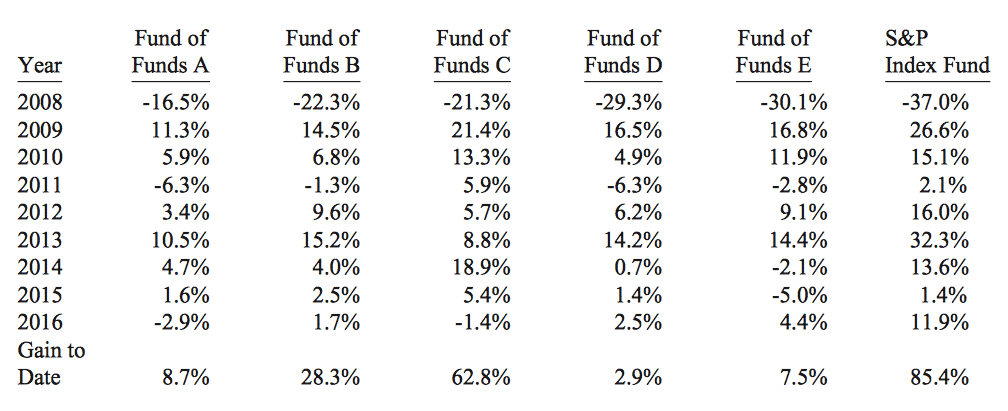
    In his Berkshire Annual Shareholder letter, Buffett discusses a bet he placed with money managers because he was so certain that, when factoring in fees and active management, they would underperform a passive fund designed to track the general market. Here is what he wrote:

    “Now, to my bet and its history. In Berkshire’s 2005 annual report, I argued that active investment management by professionals – in aggregate – would over a period of years underperform the returns achieved by rank amateurs who simply sat still. I explained that the massive fees levied by a variety of “helpers” would leave their clients – again in aggregate – worse off than if the amateurs simply invested in an unmanaged low-cost index fund.

    Subsequently, I publicly offered to wager $500,000 that no investment pro could select a set of at least five hedge funds – wildly-popular and high-fee investing vehicles – that would over an extended period match the performance of an unmanaged S&P-500 index fund charging only token fees. I suggested a ten-year bet and named a low-cost Vanguard S&P fund as my contender. I then sat back and waited expectantly for a parade of fund managers – who could include their own fund as one of the five – to come forth and defend their occupation. After all, these managers urged others to bet billions on their abilities. Why should they fear putting a little of their own money on the line?

    What followed was the sound of silence. Though there are thousands of professional investment managers who have amassed staggering fortunes by touting their stock-selecting prowess, only one man – Ted Seides – stepped up to my challenge. Ted was a co-manager of Protégé Partners, an asset manager that had raised money from limited partners to form a fund-of-funds – in other words, a fund that invests in multiple hedge funds.

    Here are the results for the first nine years of the bet – figures leaving no doubt that Girls Inc. of Omaha, the charitable beneficiary I designated to get any bet winnings I earned, will be the organization eagerly opening the mail next January.” – Warren Buffett

    fund results for the first nine years

    The takeaway is clear. If you hand over your money to professional money managers, your portfolio may outperform over a short time period. But over the long term, a low-fee passive fund will almost certainly outperform a high-fee actively managed fund.

    In his subsequent shareholder meeting, Buffett described money managers as one of the few professions where the professionals don’t add value in aggregate. Compared to doctors, nurses, engineers and a host of other professions where the professionals add value to clients and customers, money managers tend to line their own pockets at the expense of clients. It is for this reason that low-fee robo-advisors, such as Betterment and Wealthfront, have become so popular.

    Focus On Intrinsic Value

    Share price only tells you how much you pay, but intrinsic value tells you how much a company is worth. When you know what a company is worth, you can recognize when stocks are on sale, and when they are overvalued. You will be less likely to let greed affect your buying decisions and fear affect your selling decisions.

    In Warren Buffett’s 2017 Annual Shareholder Letter, he wrote:

    “Over time, stock prices gravitate toward intrinsic value”

    But what is intrinsic value? And how do you discover it without opening up a spreadsheet and building a discounted cash flow forecast model like a Wall Street analyst?

    Perhaps the best way to think of intrinsic value and share price is by way of example. Imagine for a moment that you wanted to buy a car. On Monday, you arrive to a dealership to make your purchase.

    You have done your homework and know the car is worth $20,000 but when you get to the dealership the price listed is $23,000. Seems overvalued, so you leave.

    The next day you come back and the price is now $26,000. Now, it is very overvalued, so you walk away in disgust.

    But what if you come back Wednesday and discover the car is on sale for $15,000?

    The price you pay for the car is akin to share price. And the intrinsic value is what the car is actually worth, $20,000 in this example.

    Every day a different sale price was displayed on the car, just as every day a company’s stock price will display a different number. But what remained constant was what the car was actually worth.

    Similarly, a company’s intrinsic value will remain fairly constant from one day to the next. Each quarter, the company will announce rising or falling earnings which will affect its intrinsic value, but for the most part you can think of intrinsic value as a fairly fixed benchmark. It helps you to gauge what a company is really worth, irrespective of the price the stock market displays each day.

    HOW TO CALCULATE INTRINSIC VALUE

    Intrinsic value is the value of a company determined through fundamental analysis and independent from its market value. To calculate intrinsic value, you estimate and sum the discounted future income generated by the company’s assets to obtain the present value.

    If that sounds like a lot of hard work, it can be. But fear not, there is an easier way. For example, this tool below calculates the fair value of a company based on various valuation models. Once you enter the stock symbol, the fair value can be seen right away.

    Now let’s revisit Buffett’s comment that over time, stock prices gravitate toward intrinsic value. This short statement encompasses many lessons. It is noteworthy that he does not say stock prices will reflect intrinsic value, but rather that they will gravitate toward intrinsic value.The message he is conveying is that the share price will fluctuate over time, but the intrinsic value is like a homing beacon that attracts the share price to it over the long term.

    Knowing a company’s intrinsic value gives you confidence that even if a share price is severely depressed short-term, it will most likely end up bouncing back and converging on a price that more accurately reflects fair value.

    If you know a company’s intrinsic value, you can ignore the worry of day-to-day market fluctuations and instead trust that, in the end, the market price and the fair value will match each other fairly closely.

    If a stock has been sold off for a reason unrelated to its fundamentals then every dollar it falls lower is a greater opportunity to make more money in the end. Like in the example above with the car, if you could buy the car for half what it is worth you would be excited.

    In the stock market, investors often see a stock on sale and run the other way for fear the price might be lower the next day. But if you know where the stock is headed in the end, you can have greater courage of your convictions.

    The way Buffett describes this opportunity is:

    “Every decade or so, dark clouds will fill the economic skies, and they will briefly rain gold. When downpours of that sort occur, it’s imperative that we rush outdoors carrying washtubs, not teaspoons.” – Warren Buffett

    Warren Buffett Investment Strategy

    Sometimes, the greatest upside in the stock market is when widespread fear has set in among investors. If you follow the Warren Buffett investment strategy to buy when others are fearful and sell when others are greedy, you will likely move the odds in your favor of making more money over the long term.

    You may know now to avoid paying high fees to money managers who invest in high fee mutual funds and that it is best for long-term wealth accumulation to pay a price below intrinsic value for stocks, but when should you buy them?

    Theoretically, buying a stock anytime it is worth less than its intrinsic value should work out profitably in the end. But the best time to buy might be observed by paying close attention to Warren Buffett’s investment strategy.

    If just one word had to be chosen to describe the Warren Buffett investment strategy, it would be rational. He lies in wait like a predator, waiting for the stock market to sell off, and for panic to set in. When it does, he pounces and makes large purchases in quick succession. He knows when everybody is fearful, the opportunity is greatest.

    “First, widespread fear is your friend as an investor, because it serves up bargain purchases. Second, personal fear is your enemy. It will also be unwarranted.” – Warren Buffett

    He went on to note that investors who hold a collection of large American business with conservative financials (not overly indebted) are virtually certain to do well as long as they avoid high and unnecessary fees and other costs.

    If you can overcome your own fear while recognizing the widespread fear in the market, and take action when it is at a peak, you might not see the reward in the short-term but fast forward a few years, and it is likely that you will look back fondly at having pulled the trigger just when it was most difficult to do so.

    If historically you have had a hard time mastering your emotions, but want to stay fully invested for the long-term to take advantage of Buffett’s advice without paying a fortune in fees, a robo-advisor might be a good option for you. Robo-advisors tend to invest in low-fee exchange-traded funds, and charge management fees that are substantially lower than traditional financial advisors.

    >> View 21 Legendary Investing Quotes

    >> Discover Which Stocks To Buy Now

    >> Find Out How To Make A Will


  • QPlum Review – Wealth Management Powered By A.I.

    QPlum Review – Wealth Management Powered By A.I.

    qplum review

    Investormint provides personal finance tools and insights to better inform your financial decisions. Our research is comprehensive, independent and well researched so you can have greater confidence in your financial choices.

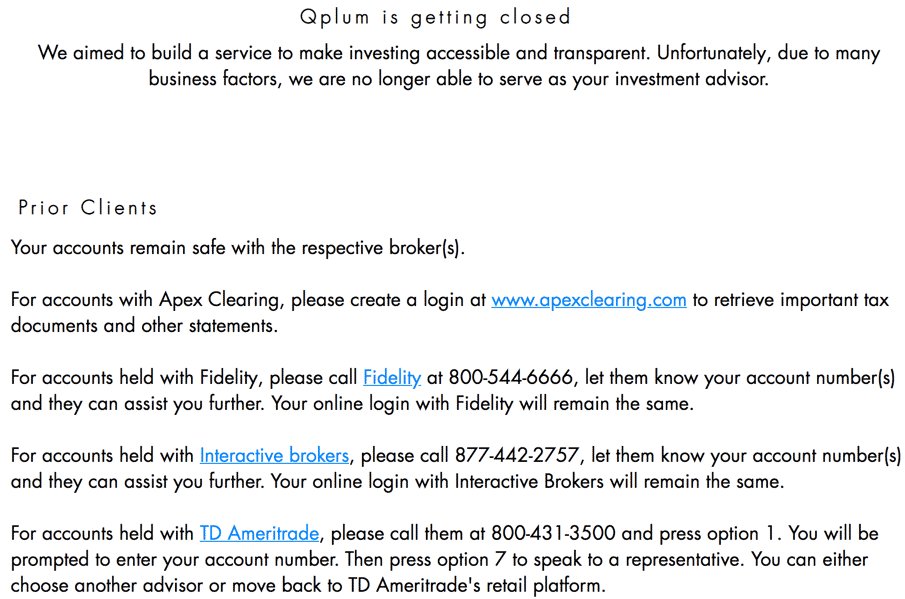
    Last Updated: Aug 26 2019 – Qplum has announced that they are no longer able to serve as an investment advisor.

    qplum shutting down

    Sitting in front of a computer all day managing your nest-egg isn’t fun for most investors, which is why robo-advisors have become so popular in recent years.

    When you hand over your savings to a digital money manager, the investing experience is placed on auto-pilot.

    But what if you want to speak with an advisor? Elsewhere you may be limited to a few complimentary planning sessions and then be charged fees to maintain access to real people.

    However at qplum, you get the best of both worlds: automated investment management plus human advice.

    And like the big-name robo-advisors, the frills of tax-loss harvesting, automated trading, and wealth management tools are provided at no extra cost.

    But before switching, let’s see what else you need to consider in this qplum review.

    qplum Fees

    QPLUM SPOTLIGHT
    qplum logo

    InvestorMint Rating

    4 out of 5 stars

    • Annual Fees: 0.50%
    • Personalized Advice: YES
    • A.I. Driven Investment Portfolios: YES

    via qplum secure site

    What Is qplum?

    qplum is an online investment advisory firm that combines machine learning and artificial intelligence-based portfolios with human advice.

    When qplum co-founders, Mansi Singhal and Gaurav Chakravorty, began in 2015, they had a vision to approach investing as a science, not a game.

    qplum portfolios are built with a focus on risk-management, smart execution, and tax-loss harvesting.

    Portfolios are driven by artificial intelligence. And high frequency trading techniques are used to save you money.

    Perhaps most importantly, qplum doesn’t shy away from the human element that so many investors still want.

    Every customer receives personalized advice and enjoys 1-to-1 walk through sessions with a financial advisor.

    qplum Management Fees

    Before the Great Recession, the only ways to get professional investing advice were to pay a financial advisor a hefty fee on assets managed, north of 1% typically, or be an accredited investor and pay a hedge fund 2% of assets plus 20% of profits annually.

    Those hefty fees combined with shoddy performance returns led to technological innovations when Betterment, Wealthfront, and Personal Capital came on the scene.

    The wave of new robo-advisors led to lower management fees across the board. All of a sudden, you could invest your money for as little as 0.25% annually versus 1.00%+ via a traditional financial advisor.

    But management fees alone don’t reveal the whole story.

    When you pay the lowest rates, you generally receive the most basic service level: digital money management only.

    If you want a financial advisor dedicated to you, Personal Capital will charge you over 3x that basic fee rate.

    So where can you find reasonable rates plus human advice?

    Enter qplum!

    qplum Traditional Advisor Typical Robo Advisor Quant Hedge Fund
    Annual Fees 0.50% 1.00%+ 0.25% → 0.75% 2% + 20% of profits

    How Does qplum Invest Your Money?

    Qplum offers five types of portfolios:

    Portfolio Type Description
    Aggregate
    • Targets long-term goals like retirement
    • Target risk = 10%
    Flagship
    • Seeks high growth
    • Invests in stocks, bonds, real estate ETFs & low-cost index funds
    • Target risk = 10%
    Fairway
    • Low risk objective
    • Goal to produce low but stable income
    • Target risk = 3%
    Lotus
    • Targets medium growth
    • Target risk = 6%
    Sunflower
    • Aggressive growth target
    • Risk = 15%

    qplum Performance Returns

    At the time of research, the performance returns generated by qplum portfolios were as follows:

    Portfolios Aggregate Flagship Fairway Lotus Sunflower
    Annualized Return 10.3% 11.0% 4.7% 5.9% 10.4%
    Cumulative Return 26.9% 28.8% 7.8% 10.8% 22.3%

    *Last Updated: July 9, 2018

    Aside: Don’t let the lower returns from the Fairway portfolio fool you into thinking it’s a bad investment opportunity.

    The Fairway portfolio seeks income and stable returns more so than upside growth. So, if you are nearer retirement or simply seeking an income stream, it may be better suited than the higher growth portfolios, like Sunflower.

    Can You Trust Your Money To
    Artificial Intelligence?

    qplum makes the bold prediction that, over the next decade, investors will become as comfortable with artificial intelligence investing strategies as they currently are trusting mapping technology.

    By way of example, qplum cites a portfolio manager who refused to trust a human for directions when visiting New York for the first time but instead put his faith in Google Maps.

    As qplum explains, 10x more artificial intelligence is used in Google Maps technology than A.I.-based investing technology currently yet people are willing to trust it more because they are more familiar with it.

    As time goes by and artificial intelligence investing becomes more widespread, it won’t be surprising to see it adopted by ever more investors.

    qplum Pros and Cons

    qplum Pros qplum Cons
    Management Fees: Annual fees are right in line with the costs of other leading robo-advisors for the level of service provided. New Entrant: qplum is a new entrant in the robo-advisor space so time will tell how well portfolios do during downturns.
    Human Advice: 1-to-1 financial planning sessions are provided to all clients. Customized Naming Convention: We see the logic behind qplum giving its portfolios custom names but believe it confuses newbies more so than standard names, like high growth.
    Smart HFT Execution: To save on costs, qplum uses high frequency trading techniques to place orders.
    Tax-loss Harvesting: Efficient matching algorithms are used to lower your tax liability.
    Wealth Management Tools: Provide insights to compare your portfolio with the market and much more.
    Automated Risk Management: Seeks to protect you from market downturns and pounce on opportunities when prices move higher.
    Account Types: Standard taxable, Roth IRA, SEP IRA and traditional IRA accounts are offered.
    Customer Support: Available by phone, email, or chat.

    qplum Minimums

    Portfolio Type Minimum Recommended
    Flagship
    • $10k+ non-retirement
    • $1k+ retirement
    Fairway
    • $10k+ non-retirement
    • $1k+ retirement
    Lotus
    • $10k+ non-retirement
    • $1k+ retirement
    Sunflower
    • $10k+ non-retirement
    • $1k+ retirement

    qplum Account Types

    Type Capability
    Standard Taxable YES
    Traditional IRA YES
    Roth IRA YES
    SEP IRA YES
    401(k) NO

    qplum Review Summary

    qplum is one of a growing list of digital money managers offering a compelling value proposition: automated money management plus human advice at low cost.

    With much less money in its coffers than its rivals it seems, qplum has admirably built an advanced investment platform powered by machine learning and artificial intelligence.

    Like its peers, it provides all the bells and whistles you might expect, including tax-loss harvesting, automated investment management, automated trading, and wealth management tools.

    And it goes a step further by using high-frequency trading techniques to optimize order placement so clients save money. It also distinguishes itself from its peers in two key areas:

    1. Automated risk-management;
    2. Dynamic asset allocation.

    Dynamic asset allocation means your portfolio’s composition changes as market conditions change. After all, why should your portfolio be a static mix when conditions change?

    It makes little sense to keep a portfolio of say 60% stocks 40% bonds at all times when the reality is a heavier weighting towards different asset classes produces a more optimal mix in different economic and market environments. qplum leads the way in pioneering this innovation among robo-advisors.

    Arguably, qplum has delivered on the promise of AI investing already by producing handsome returns since inception, but whether it will continue to do so remains to be seen.

    The bottom line is if you want automated investment management and the comfort of knowing you can connect with a real human when you wish, qplum has much to offer.

  • How To Invest In The Stock Market For Beginners

    How To Invest In The Stock Market For Beginners

    betterment brokers trading system robo adviser

    InvestorMint provides personal finance tools and insights to better inform your financial decisions. Our research is comprehensive, independent and well researched so you can have greater confidence in your financial choices.

    If you are a beginner trying to figure out how to invest in the stock market, you have a dizzying array of options from which to choose – which we will simplify here.

    Stock market beginners are often told to invest in what they know.

    You might be told “if you tweet regularly, buy Twitter.” Or if you are a car buff to “buy Autozone.

    This “invest in what you know” stock market advice is quite smart because if you are a happy customer of a brand, the likelihood is lots of others will be too. And as Warren Buffett famously once said “it’s very rare for a company with millions of happy customers to go out of business.

    But finding a company with a good brand and happy customers isn’t sufficient to plop down your money and start investing. Some other steps are needed to invest in the stock market successfully.

    How To Invest In The Stock Market For Beginners: Step 1

    The first step in learning how to invest in the stock market for beginners is to choose whether you are a self-directed investor, who wants to manage your own portfolio, or prefer the support of a financial advisor to manage your portfolio on your behalf.

    When investing in the stock market, the first step is to figure out whether you want to be a self-directed investor selecting your own stocks or want a financial advisor to invest money on your behalf.

    SELF-DIRECTED INVESTOR

    Self-directed investors choose which investments to make on their own. Generally, this requires more time commitment to read about companies showing up on your investment radar.

    But the payoff can be alluring. When you choose which investments to make, you have a chance to beat the market.

    The downside as a self-directed investor is that you take on more risk when you choose to invest in a few stocks as opposed to a highly diversified portfolio of stocks that track the general market.

    Another approach preferred by hands-off investors is to select financial advisors, who invest money on behalf of clients.

    INVEST WITH A FINANCIAL ADVISOR

    If you choose a financial advisor to help you invest in the stock market, you will first be asked suitability questions, such as:

    • What is your age?
    • What is your investing time horizon?
    • What is your risk tolerance?
    • What are your expenses?
    betterment

    Once your financial advisor understands your financial goals and needs, your money will be invested according to a certain reward to risk profile.

    Traditional financial advisors can be a good option for individuals or families with complex financial circumstances. They generally charge handsome fees, so other choices should be evaluated before signing on the dotted line with a financial advisor.

    For beginners, a better option may be to choose among the many leading robo advisors, who offer a low-cost, hands-off approach to long-term investing.

    Robo advisors generally have much lower management fees than human advisors, and have grown in popularity because of an extensive range of additional services offered, including:

    >> Related: How To Invest Money Wisely

    Step 2: Select A Broker

    If you choose a self-managed investment approach, the next step is to select a broker that caters to your needs, whether that means focusing on stock investing or index funds, low costs or full-service, and autonomous order placement or broker-assisted customer support.

    If you chose a self-directed investment management approach, the next step is to select a broker.

    Brokers have different specialties. Full-service brokers allow you to trade autonomously but also provide help if you need assistance placing trade orders.

    They generally have more tools, research and education too. Typically, they offer a range of securities in which you can invest, including stocks, bonds, mutual funds, options, futures and forex.

    Discount brokers generally have lower transaction costs but have fewer support services too. Many offer great online tutorials to get you up to speed even if you are just starting out, so as a beginner you don’t necessarily need all the bells and whistles of a full-service broker.

    Some brokers cater well to stock and options traders but don’t offer mutual funds. While still others support low-fee index funds and don’t advocate frequent trading.

    Here are some options for you to consider depending on your investment objectives and preferences.

    FREE STOCK TRADING

    The competition among brokers is so fierce that some even offer free stock trading. For example, Robinhood is a mobile app that lets you trade stocks online without paying a dime in commissions costs.

    If you wish to trade on-the-go, Robinhood is a good option, but it doesn’t have the depth of resources of bigger firms as you might expect given the low costs.

    For the hands-off investor looking for a robo advisor charging no management fees, Schwab Intelligent Portfolios has a very popular automated investment management offering.

    SCHWAB INTELLIGENT PORTFOLIOS
    charles schwab

    InvestorMint Rating

    4.5 out of 5 stars

    • Management Fee: 0.0%
    • Account Minimum: $5,000

    via Schwab secure site

    FULL SERVICE BROKERS

    Full-service brokers not only offer more resources than discount online brokers but they generally have extensive lists of no-transaction-fee mutual funds and commission-free ETFs.

    They have the best of both worlds: it is low on costs and has an extensive range of services, including:

    • Supporting a wide range of securities
      • Stocks
      • Bonds
      • Options
      • Mutual funds
      • ETFs
      • Futures
      • Forex
    • Extensive research
    • Mobile trading platform designed for beginners
    • Real-time data
    • 24/7 customer support

    >> Check out a full list of the best online stock brokers for new traders

    INDEX FUND INVESTING

    The founder of index fund investing was Jack Bogle, who founded Vanguard. Bogle realized how hard it is to beat the market picking stocks as part of a concentrated portfolio, and created low-cost index funds to allow casual investors to build diversified portfolios without being charged an arm and a leg.

    Vanguard advocates so strongly for the benefits of index funds that track underlying benchmarks, such as the S&P 500, it structures its commissions to penalize frequent traders (most brokers offer volume discounts).

    The goal at Vanguard is to encourage clients to become buy-and-hold investors, so they don’t churn their accounts with high transaction costs.

    Vanguard also provides hands-off investors, who prefer an automated investment approach, a robo advisor solution called Vanguard Personal Advisory Services.

    The minimum hurdle to get started is high but, unlike many robo advisor rivals, Vanguard also makes live advisors available as part of its core service.

    VANGUARD PERSONAL ADVISOR SERVICES
    vanguard investments

    InvestorMint Rating

    4.5 out of 5 stars

    • Management Fee: 0.30%
    • Account Minimum: $50,000

    via Vanguard secure site

    A testament to Vanguard is its fund fees are so low that many top robo advisors use Vanguard funds for their client portfolios.

    >> Discover The Best Robo Advisors For Fees

    OPTIONS PLATFORMS

    Beginners learning how to invest in the stock market generally start with stocks and index funds. But if you think as time goes by that you might want to learn how to hedge your portfolio during stock market crashes, then selecting an options trading platform at the outset might be your best bet.

    Good options platforms usually cater to a broad range of securities over and above stocks. For example, TastyWorks lets investors purchase stocks and options – though they don’t facilitate mutual funds – because the founding team believes the fees charged by actively managed mutual funds hurt clients over the long term.

    >> Discover Mutual Funds Expense Ratio Costs

    tastytrade SPOTLIGHT
    tastytrade (previously known as tastyworks)

    Investormint Rating

    4.5 out of 5 stars

    • Commissions: Closing trades for Stocks & ETFs and Options are commission-free
    • Account Balance Minimum: $0
    • Commissions: $0 flat rate for stocks

    via tastytrade secure site

    >> Get Started With Options Trading For Dummies

    Step 3: How Much Should You Invest In The Stock Market?

    After your day-to-day living expenses, one-time costs and a rainy day fund have been calculated, a portion of excess savings can be used to invest in the stock market.

    To calculate how much you should invest in the stock market, a good rule of thumb is to first set aside the amount you need monthly for day-to-day expenses, provision for unexpected costs, such as healthcare, and look ahead to one-time annual costs, including presents, and wedding gifts.

    It’s nice to build up a rainy day fund for unforeseen circumstances too. Generally, it’s best not to invest every penny of your excess savings.

    Personal Capital has an excellent mobile app that lets you link your bank accounts and investment accounts to automatically track budgeting, spending, and net worth.

    With a good handle on your monthly and one-time costs, you can take a portion of your savings and invest in the stock market.

    You may wish to select from the brokers or platforms above or consider among the many pioneering companies who make investing easy and low cost. For example, a company that lets you bundle securities together to invest thematically, such as in clean energy, at low cost is Stash.

    Step 4: What Should You Invest In?

    With your budget calculated, and your brokerage account open you can get started investing. But what you should invest in: stocks, ETFs, index funds, or mutual funds?

    If you are not sure where to begin, a steady investment over the long term in index funds or ETFs is generally the best choice for beginners.

    ETFs and index funds generally track benchmarks, such as the S&P 500, and many commission-free, low cost funds are available to choose.

    When you invest in individual stocks, the risks you take on go up in a hurry compared to those assumed by an investor with exposure to the broad market.

    Perhaps the biggest takeaway for stock investors is to avoid putting all your eggs in one basket.

    History is full of regretful investors who worked at big-name companies that went bankrupt and lost everything because they had their entire wealth tied up in those companies.

    If there were only one golden rule, it would be to diversify your investments.

    Even if the allure of beating the market is too great to avoid, it is a good idea to diversify across many stocks in a portfolio as opposed to making big bets on just a few companies.

    If you choose to invest in individual stocks, the key to success will be gathering and processing information.

    Schedule time to read news items, quarterly SEC filings, and Wall Street analyst reports.

    Ideally, you will also want to learn about competitors, management and the marketplace, its size and whether it’s growing or declining in order to get a good handle on the future prospects for the company.

    Step 5: Invest In Yourself

    Beyond the research you do on stocks, ETFs, index funds or mutual funds, invest in yourself too.

    The stock market has a habit of gyrating just enough to shake the weaker hands who have less conviction in their positions.

    Get to know your own risk tolerance and learn about investor psychology, so you don’t get shaken out of positions because of fear – or invest in positions too aggressively because of greed.

    A good primer on the rational quotient needed to become a successful investor is shared in the famous book, Reminiscences Of A Stock Operator, which is full of interesting and insightful stories about legendary investor, Jesse Livermore.

    Among the most rational and successful of all investors is Warren Buffett, and Alice Shroeder’s book about him, called The Snowball: Warren Buffett And The Business Of Life, is full of valuable insights for any self-directed investor.

    What tips have you learned to become a better investor? Share your investing experiences in the comments below.

    >> What Are The Best Stocks To Buy Now?

    >> Which Online Brokers Are Best For Free Stock Trading?


  • How To Diversify Your Portfolio Intelligently

    How To Diversify Your Portfolio Intelligently

    diversify your portfolio with roboadvisors and trading platforms

    InvestorMint provides personal finance tools and insights to better inform your financial decisions. Our research is comprehensive, independent and well researched so you can have greater confidence in your financial choices.

    Successful investing can seem like a conundrum because some of the richest investors allocate their money differently to how most retail investors do. Famed investor Warren Buffett advocates most investors to diversify their holdings. Yet he allocates capital to a concentrated portfolio of companies, stocks, and even derivatives. If many of the richest and most successful investors in the world don’t diversify their investment portfolios, why should you?

    Making big money investing requires at the very least a combination of expert insight, extensive research, good timing, and a dollop of good luck. Very few investors successfully beat the market year after year.

    Research shows that, over time, most fund managers fail to beat the market continually. A big reason for that failure is most investors attempt to time the market, entering and exiting when they believe the market will pop higher or fall lower.

    Sometimes their opinions are wrong and sometimes they simply get emotional, entering too late because they get greedy and exiting too soon because they get fearful, resulting in lost opportunities and unnecessary portfolio losses.

    If beating the market seems like a frightful endeavor to overcome the hurdles of emotion, luck and timing, take solace that wealth can be accumulated without acquiring the investing skills of billionaire investors.

    In fact, some of the richest investors in the world advocate that most people don’t attempt to beat the market but instead diversify their portfolio holdings. When you diversify your investments, you can still optimize expected returns for your risk profile and avoid the heartaches and headaches of attempting the near impossible feat of beating the market.

    The Basics Of Diversification

    When you diversify holdings in a non-retirement, IRA or 401(k) account, you invest in a combination of asset classes, such as stock, bonds, and commodities to spread risk and reduce portfolio volatility.

    To diversify your investments means to allocate your money across different asset classes, such as stocks, bonds, mutual funds, exchange-traded funds and commodities.

    Asset classes have different return and risk profiles. Investing only in stocks may historically have produced the greatest long-term returns, but the volatility is generally higher than in fixed-income investments, such as government, corporate or municipal bonds.

    While everyone might strive for the same end goal to maximize returns over time, not everyone will have the risk tolerance to hold onto stocks through economic cycles. During turbulent times, it can be difficult to watch your portfolio gyrate.

    For this reason, spreading your risk across multiple asset classes is considered the smart way to diversify and lower risk, especially when allocating your money to retirement accounts, such as an IRA.

    By allocating some of your portfolio to equities and some to fixed-income investments, such as corporate bonds, you get to lower your risk compared to holding equities alone. The reason is that bond prices on average tend to fluctuate much less than stock prices.

    Instead of your portfolio spiking up or down on any given day, the swings one way or the other tend to be less exaggerated when you diversify, allowing you to perhaps sleep a little better at night.

    Index funds, exchange-traded funds and even many robo-advisors allow you to easily allocate your money to a diversified portfolio but how do you manage risk?

    How To Manage Risk When Investing In A Diversified Portfolio

    When you diversify investments across assets classes, you remain exposed to market risks and asset risks. Financial research called Modern Portfolio Theory is used by most robo-advisor firms, such as SoFi, Wealthfront and Betterment, and forms the foundation of their investing methodologies.

    This research, which is premised on diversifying risk across asset classes, has shown that portfolios can be optimized for expected returns based on risk profiles.

    The holy grail in investing is to grow your invested capital risk-free. Some of the smartest investors in the world have failed trying to find the proverbial pot of gold at the end of the rainbow, such as the infamous team at the hedge fund, Long-Term Capital Management, who famously blew up their own fund and nearly the world’s economy – though the story of their endeavors, When Genius Failed, makes for a riveting read. Alas, risk-free investing remains a phantom idea that is still unattainable.

    To generate a return on your invested assets, some risk must be assumed.

    A big idea proposed by Harry Markowitz, who influenced the investing methods of most institutional investors, financial advisors, and robo-advisor firms, is that risk-averse investors can construct portfolios to optimize or maximize expected return based on a given level of risk.

    The shortcut takeaway is that you cannot remove risk but you can seek to diversify away risk, albeit with the drawback of lowering your portfolio’s return potential.

    The general rule of thumb to lower risk in a portfolio comprised of stocks and bonds is to choose a lower weighting of stocks and a higher weighting of bonds.

    Conservative investors or investors with short time horizons to retirement generally look to diversify risk by allocating capital across multiple asset classes, albeit with a greater allocation towards fixed-income investments, such as government, corporate or municipal bonds.

    Investors who can tolerate more risk or those with longer time horizons often favor a higher composition of stocks in their portfolios in the hopes of boosting long-term returns.

    When you are considering which assets to invest in for your retirement account, such as a Roth IRA or traditional IRA, the primary risks for your portfolio are the risks associated with the market and with the assets selected. All markets have levels of risk associated with them, even cash markets.

    For example, most money market funds have a net asset value of $1, but if the value falls below a dollar, it’s called breaking the buck – a very rare phenomenon, but it has happened from time to time during periods of very high volatility.

    Most investors are aware that the stock market has inherent risks, but it is not so apparent that government bonds also have risk, albeit low, associated with them.

    The risk spectrum increases from government bonds to corporate bonds.

    The asset class of commodities is famously volatile because geopolitical tensions, supply shortages, or war can cause rapid spikes in the price of oil, gold and other commodities.

    Stock market investors are exposed to the risks of specific companies, which may be related to seasonal patterns of consumer purchasing, such as around holiday periods.

    Specific industries will have their own inherent risks, for example in the pharmaceutical industry, a drug approval by the Federal Drug Administration can lead to blockbuster share price gains.

    On the other hand, the departure of a respected CEO or the disclosure of accounting errors or irregularities could lead to spikes lower in share prices.

    The bottom line is that while the holy grail of risk-free investing doesn’t exist, the best way to mitigate market risks and asset-specific risks is to construct a diversified portfolio that is aligned with your risk profile.

    How To Build A Diversified Portfolio

    Mutual funds, exchange-traded funds and even innovative companies, such as Motif, make it easy to create a diversified portfolio as part of a self-managed account. For investors who want the process of selecting funds that form a diversified portfolio handled for them, a robo-advisor is a good option.

    Building a diversified portfolio is easier than it might seem at first glance. If you had to do all the work of researching assets and asset classes, you might quickly become overwhelmed.

    Thankfully, the hard work of creating diversified assets has been done for you by mutual fund companies, providers of exchange-traded funds and even innovative companies, such as Motif, which lets you create your own composition of equities to form a motif.

    MOTIF SPOTLIGHT
    motif investing logo

    InvestorMint Rating

    4.5 out of 5 stars

    • Account Minimum: $0
    • Commissions: $4.95 per share
    • Commissions: $9.95 per motif
    • Automated portfolio management: $4.95 – $19.95 monthly

    If you choose to create your own diversified portfolio, pay close attention to how heavily weighted the portfolio is in stocks and bonds. A heavy weighting in equities might unpleasantly surprise you when the market corrects lower.

    Even if you choose an off-the-shelf exchange-traded fund or mutual fund from a renowned broker, such as Schwab or a low-fee fund provider, such as Vanguard, be diligent about assessing your portfolio risks. If the portfolio composition is heavily skewed towards equity funds, consider diversifying the risk with a fixed-income mutual fund or an exchange-traded fund.

    charles schwab
    vanguard investments

    If it feels intimidating to research equity and fixed-income funds yourself, a robo-advisor can do it for you at much lower cost than most traditional human financial advisors.

    A robo-advisor is a type of financial advisor that provides portfolio management services with little human intervention. Computer algorithms power the selection of funds chosen for your portfolio based on risk and goal assessments you complete when you sign up.

    If you are not too familiar with robo-advisors, it is well worth exploring. The robo-advisor industry is well-established: many of the top tier robo-advisory firms have already accumulated billions of dollars in managed assets. Most of the major brokerage houses, such as Schwab and Fidelity, have their own robo-advisor offerings and compete on price and service with established industry leaders, such as Betterment and Personal Capital – this competition among robo-advisor heavyweights is great for you the consumer as fees decline and service improves.

    Among the most competitive robo-advisors on fees are SoFi and Schwab Intelligent Portfolios. Schwab was the first robo-advisor to surpass $10 billion in managed assets and it’s clear why so many investors have flocked to Schwab when you discover they charge no fees for managing your portfolio; the catch is your portfolio will include mostly Schwab funds, which have expense ratios from which they make money.

    These expense ratio charges are reasonable and just about every robo-advisor will pass on expense ratio charges to clients. SoFi also makes a compelling offer to new clients: the first $10,000 of assets are free from management fee charges. And thereafter a charge of 0.25% is applied to managed assets.

    charles schwab
    sofi logo 2019

    Both robo-advisors leverage technology to automatically create diversified portfolios for you based on your risk tolerance and financial goals. Most robo-advisors will automatically rebalance your portfolios, some as often as daily, to ensure your portfolio remains diversified. If you would like to compare robo-advisors, take a peek at this snapshot comparison table.

    Robo-Advisor Management Fee Account Minimum Rating Best for Open Account
    betterment 0.25%-0.50% $0 IRAs & Retirement Goals Tracking
    personal capital 0.49%-0.89% $100,000 Dedicated Financial Advisors
    wealthfront brokerage trading system robo advisor 0.25% $500 Tax-optimized Investing
    charles schwab Free $5,000 No Management Fee
    fidelity go 0.35% (incl. Investment expenses) $5,000 Retirement Focused Investors
    vanguard investments 0.30% $50,000 Access to Live Advisors
    future advisor logo 0.50% $10,000 401(k)s
    sofi brokerage trading system investing 0.25% $500 Low Cost & Live Advisors

    Any one of the robo-advisors above can create a diversified portfolio for you using technology-powered algorithms. The choice between one over another comes down to your own preferences, for example whether you care more about having access to human financial advisors as are available at Personal Capital, or building a tax-optimized portfolio as Wealthfront offers.

  • What Does Overweight Stock Rating Mean?

    What Does Overweight Stock Rating Mean?

    overweight stock rating

    Investors who prefer a less-risky strategy than betting on a hot stock tip put effort into research. They examine each company’s financials, and review the challenges and opportunities facing the particular business – as well as the industry in general.

    There is a seemingly endless array of analysts and market researchers willing to offer opinions on the future of specific companies, industries, and the market as a whole. It can be difficult for an average investor to sift through all of the material and pull out the most reliable – especially when data conflicts.

    A deep understanding of the terms analysts use and how they make their recommendations is the best way to separate useful information from amateur opinions.

    One of the most frequently misunderstood terms is “overweight”. When analysts describe stocks as overweight, it is common for investors to take that as a recommendation to buy.

    However, the term overweight doesn’t always mean buy – and if it does, more information is needed before you can be sure exactly how much to invest in a given security.

    This guide offers insight into when analysts use the term “overweight stock”, as well as details on additional information you should review before making a trade.

    What Does an Overweight Stock Rating Mean?

    At its most basic, an overweight rating means that the analyst believes a stock will increase in value over the coming months.

    It generally correlates to a “buy” rating, as the analyst is saying it is possible share prices will outperform industry peers and/or the market as a whole.

    Analysts using the term overweight are typically looking at a six – twelve-month timeframe, though in certain cases the timeframe may be shorter or longer.

    They may rate a given security as overweight for any number of reasons. Some of the data they look at include the following:

    • Positive news from the company or industry
    • Strong earnings reports
    • Outperforming earnings per share and revenues estimates
    • How the company’s financial statements compare to competitors

    It is important to note that the term “overweight” used in reference to a stock rating is an entirely different concept from the term “overweight” used in reference to a portfolio.

    A portfolio that is overweight in a certain type of asset may be relying too heavily on that asset. Ideally, portfolios contain a balanced mix of assets that reflect financial goals and the investor’s tolerance for risk.

    If you invest in an index fund, you might hear that a company is “overweight” in that fund. That means the fund has more of a particular company’s shares than does the underlying index. For example, as of September 30, 2018, Apple made up 4.21% of the S&P 500 index.

    A variety of firms manage index funds that track the S&P 500, including Vanguard, Schwab, Fidelity, and T. Rowe Price.

    If any of the index fund managers elected to increase Apple holdings above 4.21 percent, the fund could be described as “overweight” in Apple. Again, this use of the term overweight is not related to overweight in the context of a stock rating.

    Why Overweight Stock Ratings Can Be Confusing

    One of the issues individual investors face when choosing stocks for their portfolios is the varied terms analysts use to make recommendations. Analysts are employed by private investment firms, and there is no requirement that they use consistent language.

    You might hear a stock rated as “buy“, “overweight“, “outperform“, “accumulate“, or “add“. All of these are positive ratings. Exactly how positive depends on context, as well as whether the analyst is working with a three-tier or five-tier rating system.

    Adding to the complexity of defining “overweight” is the fact that analysts may also use this term to describe entire industries. For example, an analyst who believes the technology sector is poised for growth in the next six – twelve months might describe the sector as overweight.

    Does an Overweight Stock Rating Mean Buy or Sell?

    The bottom line is that an overweight rating is a positive sign that a given security could be a good investment.

    However, a single analyst’s positive rating – and even multiple analysts’ positive ratings – aren’t enough to make a buy decision.

    After all, analysts often disagree. These ratings are pieces of a larger puzzle, and you need to see the full picture before handing over your hard-earned cash.

    Before investing in any business, review analyst ratings to get a sense of which types of businesses might best meet your financial goals. This is a good starting point, but remember some analysts are pursuing their own agendas – and it is unlikely that their agendas align with yours.

    Next, collect additional information that offers critical insight into the companies’ prospects. Examples of useful information include the following:

    • Past price performance
    • Earnings reports
    • Profit margins
    • Amount of debt compared to assets
    • Dividend history

    You are looking for consistent revenue growth over time, as well as a reasonable amount of profit. You can calculate this by determining the difference between revenue and expenses, thought admittedly it gets quite a bit more complex if you want to factor in taxes, or one time charges – such as building purchases.

    Overweight Stock Ratings Are Not Enough

    Finally, make sure you have a high-level understanding of the business you are investing in. How does it make money now, and how does it plan to make money in the future? Do you believe this company can change and adapt with changing consumer needs?

    For example, a business that has been unwilling or unable to open digital service channels and e-commerce options may be less likely to be successful in coming years.

    Stocks like Netflix and Alphabet (aka Google) became extraordinarily successful because they were at the cutting-edge of new technology shifts. Is the company you are considering at the cutting-edge or a laggard?

    Ready To Start Investing In Overweight Stocks?

    To begin investing in stocks that are rated highly or simply to conduct more due diligence on stocks that may be worth of your hard-earned capital, open a brokerage account at a top tier firm.

    Top stock brokers, like tastyworks feature a wealth of tools and screener to help you select hidden gems that may otherwise go undiscovered.

    >> Legendary Stock Market Quotes

    >> Best Stock Market Books For Beginners

    >> When Should You Sell A Stock?