

Live a richer life. Independent financial guidance for smarter decisions.

Advertiser Disclosure

Search results for: “index fund”

  • Top 5 Best Robo-Advisor CEOs

    Top 5 Best Robo-Advisor CEOs

    top 5 robo advisor ceos 2017

    InvestorMint provides personal finance tools and insights to better inform your financial decisions. Our research is comprehensive, independent and well researched so you can have greater confidence in your financial choices.

    Creating an algorithm to independently rank CEOs is no mean feat because so many factors come into play. A feature we gave extra weight too was whether the CEO co-founded the company.

    It’s a monumental task starting a company from scratch and thereafter growing it to become an industry goliath. Many of the best-performing CEOs in the robo-advisor industry successfully accomplished that goal.

    We rank our top five robo-advisor CEOs below

    # 5 – Mike Kane: Hedgeable

    mike kaneCEO: Mike Kane

    Company: Hedgeable

    Profile:  After graduating from Penn State University with a BS in Finance, Mike Kane joined the highly prestigious Bridgewater Associates firm and subsequently worked as an analyst at Spruce Private Investors. In 2009, he co-founded Hedgeable with his brother, Matthew Kane. Mike describes himself as Hedgeable’s Master Sensei while Matthew is Hedgeable’s Chief Ninja!

    Mike and Matthew have not raised nearly as much venture capital to finance Hedgeable’s expansion as leading robo-advisor rivals but they do have a different investing philosophy than their competitors.

    While most robo-advisors rely on Nobel-prize winning academic research, called Modern Portfolio Theory, Hedgeable goes a step further and believes that principal can and should be protected during downturns. This twist on the classic investing method followed by most robo-advisors could be the spark that ignites rapid growth for Hedgeable as time goes by.  This investing approach has its fans and Hedgeable is closing in on assets under management of $100 million.

    Hedgeable: Most robo-advisor firms keep you fully invested during market rallies and corrections. Hedgeable views investing differently, and endeavors to protect your portfolio when downturns take place.

    Hedgeable also diverges from most robo-advisors by catering to a broad range of asset classes. Investing in bitcoin and start-ups as well as more conventional asset classes is possible at Hedgeable. Plus automatic rebalancing and tax-loss harvesting are included in its all-in-one wrap-fee that ranges from 0.30%-0.75% depending on how much is invested.

    HEDGEABLE SPOTLIGHT
    hedgeable logo

    InvestorMint Rating

    4.5 out of 5 stars

    • Management Fee: 0.30%-0.75%
    • Account Minimum: $0


    # 4 – Bill Harris: Personal Capital

    bill harrisCEO: Bill Harris

    Company: Personal Capital

    Profile:  Bill Harris is a graduate of the prestigious Middlebury College and earned an MBA in Marketing from Harvard Business School. As former CEO of Paypal and Intuit, Bill is a veteran of the financial industry. His career history of firms is the proverbial who’s who of leading companies; he has been a member of the board of directors of GoDaddy, Answers.com, Business.com, Yodlee, SuccessFactors, Earthlink and many others. He has served as Chairman of Visual Sciences, PassMark Security and MyVest.

    After all those accomplishments, Bill Harris then went on to form Personal Capital in 2009 alongside Louie Gasparini and Rob Foregger. As CEO of Personal Capital, Bill Harris has raised over $175 million in venture funding from Venrock, Crosslink Capital, Institutional Venture Partners and IGM Financial. At last count, Personal Capital had accumulated over $4 billion in assets under management.

    Personal Capital: The business model Personal Capital has pursued is a hybrid robo-advisor model. Unlike some robo-advisors that offer only an automated portfolio management service, Personal Capital assigns clients to dedicated financial advisors. Because the model is labor intensive, the fees and account balance minimums are higher than they are at some other robo-advisor firms.

    Investors who want to be hands-off yet want the flexibility to connect with a human financial advisor will find Personal Capital offers the best of both worlds. For users who don’t have the savings to open an account yet, Personal Capital offers a free mobile app that lets you link your third-party bank, credit card, and brokerage accounts to monitor spending, track financial goals, assess net worth, and keep an eye on any debts or loans outstanding

    PERSONAL CAPITAL SPOTLIGHT

    personal capital logo InvestorMint Rating

    4.5 out of 5 stars

    • Management Fee: 0.49% – 0.89%
    • Account Minimum: $100,000
    • Brownie Points: Free tools to track spending; human advisors paired with clients

    via Personal Capital secure site

    # 3 – Andy Rachleff: Wealthfront

    andy rachleffCEO: Andy Rachleff

    Company: Wealthfront

    Profile:  Andy Rachleff could easily make a case for deserving the top spot on this list. His academic credentials speak for themselves: he is a graduate of the University of Pennsylvania and Stanford University Graduate School of Business. Professionally, he became hugely successful as the co-founder of Benchmark Capital, a venture capital firm that has invested in household names, such as eBay, OpenTable, Twitter, Uber and Snapchat.

    In 2008, Rachleff teamed up with Dan Carroll to form Wealthfront, a robo-advisor firm that provides portfolio management services with little human involvement. Since then, Rachleff and his team have grown assets under management into the billions; Wealthfront is hot on the heels of rivals Betterment and Schwab Intelligent Portfolios.

    Wealthfront: Andy Rachleff and his management team have grown Wealthfront to a valuation headed towards $1 billion thanks to smart, strategic execution and with the help of about $130 million in funding from Greylock Partners, Index Ventures, and Spark Capital among others.

    Unlike competitors, such as Vanguard and Personal Capital, who connect clients to live advisors, Wealthfront has stayed true to its roots as a purely automated investing service.

    Wealthfront has kept fees and account minimums low, and is renowned as a leading robo-advisor in tax-loss harvesting via its “direct indexing” program that allows for the purchase of individual securities to optimize for tax advantages.

    WEALTHFRONT SPOTLIGHT
    wealthfront brokerage trading system robo advisor

    InvestorMint Rating

    4 out of 5 stars

    • Management Fee: $0 for first $10,000
    • An additional $5,000 managed free for each friend invited who signs up
    • Management Fees thereafter: 0.25%
    • Account Minimum: $500

    via Wealthfront secure site

    # 2 – Jon Stein: Betterment

    jon steinCEO: Jon Stein

    Company: Betterment

    Profile:  Before Jon Stein co-founded Betterment with Eli Broverman, he had earned his educational badges in the hallowed halls of Harvard, where he graduated with a BA in Economics in 2001 and a degree in Premedical studies in 2002. Before entering top tier Columbia Business School in 2008, Stein worked for a number of years as a consultant at First Manhattan Consulting Group.

    Betterment: While in business school, Stein managed to find time to form Betterment, a robo-advisor so disruptive to traditional financial advisors that it has spawned numerous competitors. In fact, the robo-advisor model has been so successful that financial industry heavyweights, such as Schwab, Vanguard, and Fidelity have endeavored to steal some of the pie away from Betterment and its early rivals, such as Personal Capital and Wealthfront.

    As co-founder and CEO of Betterment, Stein has led the company from inception to accumulate over $7 billion in assets under management, raising over $200 million in equity funding along the way.

    Betterment is seriously disruptive to traditional financial advisors who often charge fees well over 1% of assets managed. Betterment’s low-fee, higher tier investing services feature live advisors and seeks to provide tax-optimized investment returns for clients with individual, IRA, Roth IRA, and rollover 401(k) accounts.

    As much success as Jon Stein and his team have created so far, they will have their work cut out for them staving off the competitive threats from industry giants, such as Schwab, who have their own robo-advisor platform, Schwab Intelligent Portfolios.

    In fact, Schwab Intelligent Portfolios has a business model so innovative that it became the first robo-advisor to amass over $10 billion in managed assets. And another threat lurking is that posed by the CEO who made it to the top of the list, Mike Cagney of SoFi.

    BETTERMENT SPOTLIGHT
    betterment

    InvestorMint Rating

    5 out of 5 stars

    • Promo: Up to 1 Year Free Management
    • Management Fee: 0.25% – 0.40%
    • Account Minimum (Betterment Digital): $0
    • Account Minimum (Betterment Premium): $100,000

    via Betterment secure site

    >> Compare SoFi Wealth Management to Betterment


    # 1 – Chris Costello: Blooom

    chris costelloCEO: Chris Costello

    Company: Blooom

    Profile:  In a competitive world of robo-advisors, it’s hard to find an angle to stand out but Chris Costello certainly succeeded.

    While the best robo-advisors generally focus on building investing products for the long-term in taxable and retirement accounts, and steer clear of 401(k)s, Chris bit the bullet and founded Blooom, which specializes in analyzing and optimizing 401(k) portfolios.

    Chris is a University of Kansas graduate who started out life as a financial advisor at UBS Wealth Management before moving on to Wachovia Securities.

    Amazingly, Blooom isn’t the first highly successful company Chris has grown. Previously, he co-founded The Retirement Planning Group, where he contributed to growing the asset base to $500 million before stepping away to concentrate on growing Blooom.

    Blooom: Blooom is a specialist when it comes to 401(k) portfolios. Typically, when new employees begin work, they are offered a range of 401(k) options. If you are like most employees, you may have experienced this process and picked randomly from various fund choices and never again looked at those selections.

    Where Blooom adds value is by analyzing whether those selections you made could be optimized. Do they align with your risk profile and financial goals? Are you paying too much in expense ratios and fees? If you are not sure, Blooom will automatically do the hard work for you and will continually to monitor your portfolio.


    BLOOOM SPOTLIGHT
    blooom logo

    InvestorMint Rating

    4 out of 5 stars

    • Management Fee: $95 – $250
    • Account Minimum: $0

    via Blooom secure site
  • Hedgeable Review 2020

    Hedgeable Review 2020

    hedgeable robo advisor small business retirement savings high net worthInvestorMint provides personal finance tools and insights to better inform your financial decisions. Our research is comprehensive, independent and well researched so you can have greater confidence in your financial choices.Hedgeable is not your run-of-the-mill robo-advisor who builds and manages portfolios that stay fully invested in up and down markets. Instead, Hedgeable seeks to better protect clients from catastrophic stock market downturns by offering sophisticated wealth management solutions that were previously available only to high net worth investors.

    Where most robo-advisors limit portfolios to a select group of asset classes featuring equities and bonds, Hedgeable allows its clients to invest in a broader range of investments, including bitcoin and venture capital-funded start-ups. This broader range of investment options is designed to provide better downside protection for your portfolio.

    Plus, the Hedgeable platform is available to try out for free with no account balance minimum and, when you’re ready to start investing, at a cost in line with what other robo-advisors charge.

    Hedgeable Spotlight

    HEDGEABLE SPOTLIGHT
    hedgeable logo

    InvestorMint Rating

    4.5 out of 5 stars

    • Management Fee: 0.30%-0.75%
    • Account Minimum: $0

    Hedgeable Customers

    Hedgeable serves conservative investors looking for ways to hedge their portfolios during uncertain market periods by offering portfolio downside risk protection. Investors looking to goose returns with exposure to high-growth sectors can do so via Hedgeable’s venture capital fund. And socially responsible investors will be pleased to discover Hedgeable caters to ethical, environmental, social and corporate governance issues as well as impact investing.

    Hedgeable caters both to risk-seeking and risk-averse investors. For the conservative investor keen to avoid holding a fully invested portfolio during stock market downturns, Hedgeable offers what it calls Downside Risk Protection, a feature that overlays each account with proprietary risk management to help minimize large losses that can hurt portfolio growth.

    For investors who can withstand greater portfolio value volatility, Hedgeable offers access to its venture capital fund, which co-invests in deals syndicated on leading global platforms, such as AngelList, FundersClub and OurCrowd. These investments provide exposure to high-growth sectors, such as virtual reality, blockchain, drone technology, e-commerce, software-as-a-service, and consumer technology. Investors can also gain exposure to bitcoin, which is intended to act as a hedge to dollar denominated assets, at no extra cost.

    For investors who don’t want to actively manage a portfolio, Hedgeable automatically rebalances portfolios and differs from most robo-advisors by being willing to substantially change portfolio compositions as the tides turn in the stock market. You even have the option to go fully to cash during periods of high risk in order to preserve capital.

    Hedgeable recognizes an increased trend towards socially responsible investing and the company cites surveys reporting that over half of Millennials think about social factors when investing. On its platform, Hedgeable incorporates ethical, environmental, social, impact and corporate governance factors.

    Hedgeable is best for:

    • Conservative investors
    • Cost-conscious investors
    • Hands-off investors
    • Investors wanting exposure to start-ups
    • Bitcoin investors
    • Socially responsible investors

    Hedgeable Management Fees

    Hedgeable charges what is called a wrap-fee, which is an all-in-one fee as opposed to separate fees charged for portfolio management, expense ratios, custodial fees, and transaction fees.

    Hedgeable charges a wrapped platform fee that includes all costs: management fees, custodial fees, product fees, trading costs, and fees relating to analytics, administration, technology and support. Any fees associated with exchange-traded funds are withdrawn at the fund level so you won’t be charged separate fees.

    The monthly wrap-fee charged by Hedgeable is a % of assets under management, which declines as follows:

    • $0-$49,999: 0.75%
    • $50,000-$99,999: 0.70%
    • $100,000-$149,999: 0.65%
    • $150,000-$199,999: 0.60%
    • $200,000-$249,999: 0.55%
    • $250-$499,999: 0.50%
    • $500,000-$749,999: 0.45%
    • $750,000-$999,999: 0.40%
    • $1,000,000-$9,999,999: 0.35%
    • $10,000,000+: 0.30%

    Compared to leading robo-advisors, such as Wealthfront, Personal Capital and Betterment, Hedgeable has slightly higher fees reflecting the broader range of investment options available.

    As of March 1, 2016, according to Hedgeable’s Form ADV, it had $44 million in assets under management and $474 million in assets under advisement.

    Hedgeable Investment Method

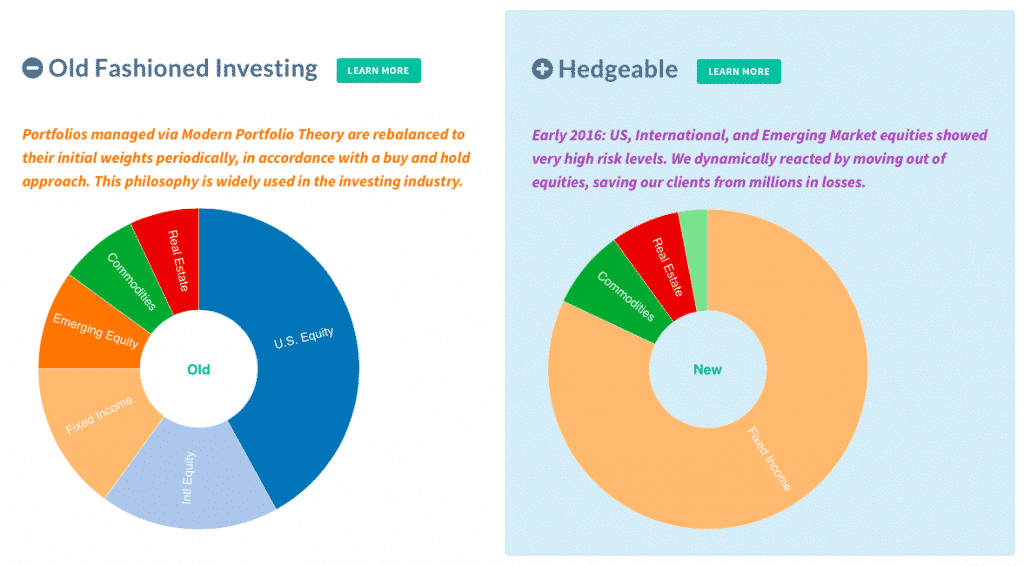
    Hedgeable attempts to track markets on the way up and protect principal on the way down by dynamically rebalancing portfolios when risk levels are high. Unlike a traditional robo-advisor that may stick with a fixed portfolio composition through up and down markets, Hedgeable will remove what it perceives to be high-risk assets from portfolios from time to time. For example, a portfolio may comprise more fixed income investments and fewer equity investments when equities are perceived to have elevated risk levels.

    Unlike most robo-advisors that adhere strictly to the investment method prescribed by Modern Portfolio Theory that seeks to invest across asset classes and optimize returns for each level of risk, Hedgeable goes beyond that and looks to track markets on the way up and protect capital on the way down.

    In what Hedgeable describes as the “old-fashioned” way of investing, a sample portfolio might comprise a combination of equities, fixed income, commodities, and real estate. But Hedgeable believes that at certain times, risk levels will increase rendering some asset classes unattractive. For example, in 2016, Hedgeable reports that US, International and Emerging Market equities displayed high risk levels and dynamically reacted by moving clients out of equities as shown below:

    hedgeable new way of investing with robo advisors

    Hedgeable employs an objective-based methodology to build portfolios, comprising three main steps:

    1. Up to 16 asset classes with unique risk and return profiles along with different correlative relationships are used to build portfolios.
    2. Every portfolio at Hedgeable has a goal associated with it. Portfolios can range from concentrated to diversified and the growth potential can vary from conservative to aggressive.
    3. After goals are set and benchmarked to indexes, Hedgeable constructs a mix of securities designed to match the benchmark’s return.

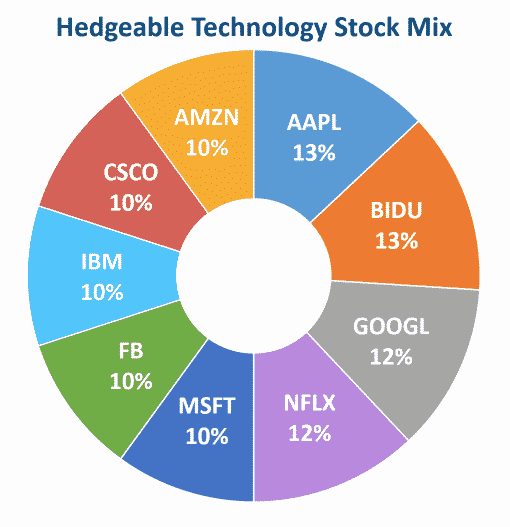
    Below is an example of one such mix constructed by Hedgeable relating to the technology sector:

    hedgeable technology stock mix

    Hedgeable Asset Classes

    Hedgeable has one of the broadest ranges of asset classes available to clients of any robo-advisor; it is edged out only by Schwab Intelligent Portfolios.

    Hedgeable provides clients a much broader range of asset classes to invest in than most robo-advisors. Clients can customize portfolios to add a layer of personalization to meet needs and goals. For example, Hedgeable, like SigFig, recognizes that some clients who already have a nest-egg may be more interested in generating income than looking for growth and constructs portfolios with high-yielding ETFs, REITs, MLPs, and dividend-paying stocks to meet these needs.

    Historically, venture capital investments have been accessible to ultra high net worth individuals but Hedgeable makes these investments accessible to clients who qualify as accredited investors.

    Bitcoin has historically been inaccessible to most investors because acquiring bitcoins requires a process called mining, and no exchange-traded funds existed to track bitcoin performance. Hedgeable has partnered with Coinbase, a leading bitcoin platform, to allow clients gain exposure to the digital currency at no additional cost.

    And for socially responsible investors keen to align their investments and values, Hedgeable facilitates allocating capital to socially responsible investments. Hedgeable claims to be the first automated platform to offer socially responsible investing. With the click of a button, a client can make their entire portfolio socially responsible, allowing exposure to categories such as Low Carbon Emissions, Alternative Energy, and LGBTQ equality.

    Hedgeable Pros and Cons

    Hedgeable offers investors an attractive alternative to the traditional model of staying fully invested through upswings and downswings in financial markets. It also offers a wide variety of alternative investment opportunities, such as bitcoin, start-ups and socially responsible investments, similar to the thematic investments available at Motif and Stash.

    Hedgeable Pros Hedgeable Cons
    Investment Method: Time will tell if Hedgeable’s investment method, which strives to track markets on the way up and protect wealth on the way down will turn out to be more successful than the approach followed by most other robo-advisors, based on Modern Portfolio Theory, to stay fully invested in a portfolio through upswings and downtrends. So far, back-tested results show good performance statistics; its Downside Risk Protection shows strong performance returns over time. Investment Method: Although Hedgeable’s investment method currently counts in its favor, it may one day count against it.
    Although back-testing has shown strong performance results through up and down market cycles, Hedgeable has not yet guided clients through a large market correction so the jury is out on whether the back-tested results will translate to real-world performance.
    Alternative Asset Classes: Hedgeable is among the first automated platforms to offer clients investing opportunities in alternative asset classes, such as:

    • Start-ups via its venture capital fund;
    • Bitcoin via its partnership with Coinbase; and
    • Impact investing that aligns investments with values, such as environmentally friendly, corporate governance and equality-related investments.
    Account Balance Minimums: No minimum threshold account balance is mandated by Hedgeable to get started.
    It’s possible to open an account, play around on the Hedgeable platform and, when comfortable, commit capital to start investing.
    Free Rebalancing & Tax-Loss Harvesting: Tax-loss harvesting and rebalancing are free services available at Hedgeable, a benefit which some other robo-advisors, such as Wealthfront, offer but isn’t available on all platforms.
    All-In-One Wrap-Fee: Hedgeable charges a wrap-fee, which includes all custodial, management, transaction, technology, administration and support fees, so clients don’t have to worry about being nickled and dimed with separate fees for separate services.

    Hedgeable Fees & Minimums

    Hedgeable gives clients breaks on fees as they invest more assets. Fees are considered wrapped, which means all fees: custodial, management, technology, administration, and support are included in one single fee charge. These fees range from 0.30% to 0.75%. The average ETF expense ratio is 0.15% and Hedgeable has no account balance minimum.

    Category Fees
    Account Management Fees 0.30% – 0.75%
    Tax-loss Harvesting YES
    ETF Expense Ratio 0.15%
    (on average)
    Account Minimum $0
    Automatic Rebalancing Free
    Annual, Transfer, Closing Fees None

    Hedgeable Accounts

    Hedgeable caters to a broad range of account types, supporting individual and joint non-retirement accounts as well as IRAs, Trusts and 401(k)s.

    Type Capability
    Individual Non-retirement YES
    Joint Non-retirement YES
    Roth IRA YES
    Traditional IRA YES
    SEP IRA YES
    Rollover IRA YES
    Trusts YES
    401(k) YES

    Hedgeable Tax Strategy

    Hedgeable believes more in preserving principal when markets fall than taking large losses and counting them against winners as part of a tax-loss harvesting strategy but it does still offer tax-loss harvesting as a service.

    Type Capability
    Tax Loss Harvesting YES
    Free Account Rebalancing YES

    Hedgeable Summary

    Hedgeable is not your average robo-advisor that keeps you fully invested during market upswings and downtrends. Hedgeable looks to track markets on the way up and protect capital on the way down by dynamically rebalancing when risk levels are elevated in asset classes.

    Beyond its investment method, Hedgeable differs from other robo-advisors in providing accredited investor clients access to investments in start-ups via its venture capital arm, provides all clients bitcoin investment opportunities at no extra cost, and caters to socially responsible investors with a single click of a button on its platform.

    With a single fee that includes management, technology, custodial and trading costs all in one charge, a broad range of standard and alternative investments, free portfolio rebalancing and tax-loss harvesting and a different take on investing methodology compared to most other robo-advisors, Hedgeable is a platform worthy of serious consideration for any investor wanting an automated portfolio management service with more than the usual bells and whistles.