Live a richer life. Independent financial guidance for smarter decisions.

Advertiser Disclosure

Search results for: “index fund”

  • What Is The Best Way To Invest $10,000?

    What Is The Best Way To Invest $10,000?

    If you have been working hard and squirreled away a nest-egg, you might be wondering now how to grow it so that your money starts working for you.

    Should you invest in stocks or bonds or real estate?

    A dizzying array of selections are available in each asset class:

    • Stocks: Dividend-paying, growth, and value
    • Bonds: Government, municipal
    • Real Estate: Residential & commercial

    But don’t be dazzled by the investment options available to you because we’ve done the hard work for you so you won’t be wondering any longer how to invest $10k!

    #1: How To Invest $10,000
    In Real Estate

    Real estate has its fair share of ups and downs when economies slow and stock markets crash, but as an asset class overall it is a solid bet if you follow some golden rules.

    The first rule is to define the term asset as something you put your money into that produces cash flow. By that definition, a house you own is not an asset unless you were to rent it out to tenants on say Airbnb.

    Investments in residential property, commercial property, and REITs can all produce the regular cash flow you seek.

    If you are not swimming in cash, the high costs of buying residential property and commercial property may make you think real estate investing is out of your reach. But these days real estate crowdfunding sites make it possible to get started for as little as $500.

    Best Way To Invest In Commercial Real Estate

    Rich Uncles is one of the best crowdfunding real estate sites. It provides exposure to the commercial real estate sector and you don’t have to be a multi-millionaire to get your toe on the property ladder.

    In fact, as long as you meet certain income criteria and have $500 available to invest, you can get exposure to top tier, triple-net lease commercial properties.

    RICH UNCLES SPOTLIGHT

    rich uncles logo approved

    InvestorMint Rating

    4.5 out of 5 stars

    • Minimum Investment: $500
    • Salary Minimum To Invest: $75,000
    • Commercial Real Estate Exposure: YES
    • Access To Non-Accredited Investors: YES

    via Rich Uncles secure site

    Best Way To Invest In REITs

    Not long ago you would have needed to qualify as an accredited investors with a 7-figure net worth or $200,000 in annual income for two consecutive years in order to get access to private market real estate investing.

    But these days, only $500 is needed when you invest with Fundrise, an online platform that pools assets from many investors. The monies are then allocated to real estate developers in need of financing.

    Unlike traditional real estate deals, which limit your investment to a single property, you can invest $10,000 in real estate through Fundrise and diversify your money to lower overall risk.

    FUNDRISE SPOTLIGHT

    fundrise logo

    InvestorMint Rating

    4.5 out of 5 stars

    • Minimum Investment: $500
    • Returns: 11.44% (net of fees)

    via Fundrise secure site

    #1 Way To Invest In Residential Property

    If you have been trying to figure out how to invest $10k in real estate, crowdfunding sites like RealtyShares is worth checking out.

    However, if you have more money and want exposure to residential property, Roofstock is a top real estate site that enables you to buy property 100% online.

    The pesky problems faced by real investors in the past are largely solved by Roofstock. For example, Roofstock will scout for properties, rate neighborhoods, create financial projections, and even connect you to property managers.

    No longer do you need to lift up your sleeves to find a tenant because Roofstock features properties that are income-producing on day one.

    ROOFSTOCK SPOTLIGHT

    roofstock logo

    InvestorMint Rating

    5 out of 5 stars

    • Buyer Fees: 0.50%
    • 30-Day Money Back Guarantee
    • 100% Online Purchase

    via Roofstock secure site

    #2: How To Invest $10,000
    In The Stock Market

    When it comes to stock market investing, an eye-watering selection of investment opportunities exist, including:

    Where on earth should you begin?

    Invest In The S&P 500

    According to one of the wealthiest investors of all time, Warren Buffett, the best way to invest 10k is to buy an index fund and hold it for the long term.

    You don’t have to be particularly smart, says Buffett, to make a lot of money over time but you do need to be patient. You must be willing to park your money in the stock market and not touch it.

    The S&P 500 (ticker symbol: SPY) represents the top 500 companies in the United States, and your investing journey begins by placing a buy order at your favorite broker, such as thinkorswim or tastyworks.

    It turns out that patiently watching your money grow over time is a challenging feat for most people, who are prone to an action bias, meaning the more they trade the better they think they will do.

    When you invest in an index fund or a very low fee total stock market fund from Vanguard, like VTSAX or VFIAX, your bet is that America will do well over time and ultimately the stock market will reflect the increase in economic prosperity.

    The hardest task will be to sit on your hands and take no action during a stock market crash or a big economic downturn, but over time the “smart money” has historically done well by staying invested.

    Stay Away From High-Fee Mutual Funds

    Mutual funds have their merits but they are not all created equal so you should be wary before investing your hard-earned $10,000 into them.

    Here are just a sampling of the mutual fund fees you need to watch out for:

    • Mutual fund load fees that can span as high as 5% of the amount invested
    • Trailing 12b-1 fees that pay financial advisors regularly
    • Fund fees that pay operational expenses and managerial fees

    Combined these fees can seriously hurt your investment returns, so instead consider an income-generating stock market investment strategy.

    Invest In Dividend-Paying Stocks

    Did you know that as much as 95% of total stock market returns over most of the 20th century stemmed from reinvested dividends, not price gains according to Jeremy Siegel of the Wharton School of the University of Pennsylvania.

    As attractive as it is to buy Amazon or Facebook or Alphabet, the reality is that none of those companies pay a dividend while so-called “boring”, dividend-paying companies like Coca Cola are the ones that have created the bulk of long-term value for patient investors.

    So, if you are going to purchase individual stocks as opposed to buy an index fund, dividend-paying stocks are the way to go.

    Generate Income From Covered Calls

    Covered calls are among the best ways to proactively generate income when you own a portfolio of stocks.

    What is a covered call? A covered call is nothing more fancy than a combination of a long stock and the sale of call options against the stock.

    For example, if the share price of a stock you own is trading at $46 per share, you could sell a call that pays you a fixed amount of money to agree to sell the shares at $50!

    That’s right, someone will actually pay you to agree to sell your shares at a higher price.

    Why would anyone do that?

    Imagine the stock rallied from $46 to $60, the “catch” is because you agreed to sell your shares at $50, you miss out on the share price gain from $50 to $60 but you do still get to keep the money you pocketed by selling the call.

    The person you paid gets to enjoy the gain in share price from $50 to $60 minus the amount paid to you.

    Top online options brokers like thinkorswim make it easy as pie to sell calls against stocks you own.

    THINKORSWIM® SPOTLIGHT

    thinkorswim®

    InvestorMint Rating

    5 out of 5 stars

    • Commissions: $0 per trade
    • Account Minimum: $0
    • Promotion: Trade free for 60 days, based on $3,000 deposit

    via thinkorswim secure site

    #3: Best Way To Invest
    $10k Short Term

    While investing in the stock market and real estate are powerful ways to grow $10,000 long term, they are not great strategies when you need to keep your money liquid.

    If you know that you have an upcoming purchase to finance, whether a wedding, a home, a car, or some other big purchase, keeping your principal safe is priority #1.

    After that, the goal is to squeeze a little juice out of the lemon to create some lemonade in the form of interest.

    And the problem with investing in the stock market is your portfolio balance may go on a rollercoaster ride short-term.

    Similarly, when you invest 10k in real estate, you often need to tie up your money for long time periods so it’s generally not a good strategy when your time horizon is short.

    So, what is the best way to invest 10k short term?

    Invest In Certificates of Deposit Or Bonds

    Certificates of deposit are similar to savings accounts, but your money is tied up for a fixed time period.

    The lock-up time can be as short as a few months or can be as long as many years.

    To maximize your rates of return while also maximizing your liquidity, consider creating a CD ladder.

    Or if you want greater liquidity and no lock-up time period, government bonds are one of the most liquid markets of all.

    To earn a slightly higher interest rate, municipal bonds are a popular choice but make sure that your local government has its financial house in order before loaning them money. Some states, like Illinois, are in a world of financial hurt and you would be wise to think twice before parting with your money.

    The bottom line is if you have a long term horizon, real estate and stock market investments may fit the bill. However, if you need short term liquidity and want to earn some interest while parking your money somewhere, bonds and certificates of deposit may be your best bet.

    What is the best way to invest 10k that you have discovered? Share your ideas below, we would love to hear from you.

    >> How To Retire Early

    >> What Are The Best Online Brokers?

    >> Find Out The Best Stocks To Buy Now!

  • Vanguard VFIAX vs VTSAX

    Vanguard VFIAX vs VTSAX

    vanguard vfiax vs vtsax

    InvestorMint provides personal finance tools and insights to better inform your financial decisions. Our research is comprehensive, independent and well researched so you can have greater confidence in your financial choices.

    In the battle between low-cost Vanguard equity funds, VFIAX vs VTSAX, which is better?

    VFIAX is the Vanguard 500 Index Fund Admiral Shares while VTSAX is the Vanguard Total Stock Market Index Fund Admiral Shares.

    For investors looking for a more diversified portfolio, VTSAX is the better choice because it holds a much larger portfolio of securities compared to VFIAX which is limited to holding S&P 500 companies only.

    Both Vanguard funds charge the same expense ratio of 0.04% and both are categorized as Large Blend, so you can’t distinguish between them on cost and focus. But what about performance, yield, risk, and returns since inception?

    VFIAX: Vanguard 500 Index Fund
    Admiral Shares

    The Vanguard 500 Index Fund Admiral Shares [VFIAX] was the industry’s first index fund for individual investors designed to provide diversified exposure to the S&P 500 market at low-cost.

    Because the fund holds shares in the 500 largest companies in the United States, it offers exposure across industries and the companies held represent about 75% of the U.S. stock market’s value.

    The primary risk when holding VFIAX is from volatility that stems from exposure to the stock market.

    The companies have large capitalizations and so VFIAX is commonly a core equity holding in a portfolio.

    VTSAX: Vanguard Total
    Stock Market Index Fund Admiral Shares

    The Vanguard Total Stock Market Index Fund [VTSAX] was created in 1992 with a view to providing investors exposure to the entire U.S. equity market, including:

    • Small-cap stocks
    • Mid-cap stocks
    • Large-cap stocks
    • Value stocks

    The fund is famous for having low costs, broad diversification, and offering the potential for tax efficiency.

    Like VFIAX, VTSAX is commonly held as a core U.S. equity holding but also exposes investors to risk of volatility from stock market swings.

    VTSAX or VFIAX:
    Portfolio Management

    A primary difference between the Vanguard Total Stock Market Index Fund [VTSAX] and the Vanguard 500 Index Fund Admiral Shares [VFIAX] is the number of stocks held by each.

    The Vanguard Total Stock Market Index Fund [VTSAX] holds over 3,000 stocks (3,624 as of Dec 2017) while the Vanguard 500 Index Fund Admiral Shares [VFIAX] holds approximately 500 stocks (508 as of Dec 2017).

    For investors seeking broader diversification, VTSAX is the better bet.

    The equity characteristics of VTSAX and VFIAX are as follows:

    Vanguard Total Stock Market Index Admiral Vanguard 500 Fund Index Fund Admiral
    Number of Stocks 3624 508
    Median Market Cap $65.4 billion $97 billion
    Price/earnings Ratio 22.7x 23.0x
    Return on Equity 15.1% 16.0%
    Earnings Growth Rate 9.6% 9.4%
    Foreign Holdings 0.1% 0.1%
    Turnover Rate 4.1% 4.1%
    Dividend Distributions Quarterly Quarterly

    *Source: Vanguard as of 11/30/2017

    While both VTSAX and VFIAX have similar price/earnings ratios, earnings growth rates, turnover rates, and foreign holdings amounts, a primary difference is that the median market capitalization of the Vanguard 500 Fund is significantly higher.

    If you like the idea of sticking with the biggest companies in the U.S. then VFIAX is the better choice but if you want exposure to small-cap or mid-cap stocks that have the potential to become goliaths one day, but commensurately may have more risk, VTSAX is the better selection.

    The equity diversification of the Vanguard Total Stock Market Index Admiral Fund is identical to the overall stock market as shown below:

    Vanguard Total Stock Market Index Admiral CRSP US Total Stock Market Index
    Basic Materials 2.70% 2.70%
    Consumer Goods 8.90% 8.90%
    Consumer Services 12.60% 12.60%
    Financials 20.60% 20.60%
    Health Care 12.80% 12.80%
    Industrials 13.30% 13.30%
    Oil & Gas 5.50% 5.50%
    Other 0.00% 0.00%
    Technology 18.60% 18.60%
    Telecommunications 1.80% 1.80%
    Utilities 3.20% 3.20%

    VTSAX vs VFIAX:
    Top 10 Largest Holdings

    The top 10 largest holdings for both VTSAX and VFIAX are listed below:

    1. Apple Inc.
    2. Microsoft Corp.
    3. Alphabet Inc.
    4. Amazon.com Inc.
    5. Facebook Inc.
    6. Berkshire Hathaway Inc.
    7. Johnson & Johnson
    8. JP Morgan Chase & Co.
    9. Exxon Mobil Corp.
    10. Bank of America Corp.

    *as of 11/30/2017

    VTSAX Fees vs VFIAX Fees

    No purchase fees, redemption fees, nor 12b-1 fees apply to either VTSAX or VFIAX fund purchases and holdings.

    However, you will be charged a $20 annual account service fee for each Vanguard Brokerage Account, and each individual Vanguard mutual fund holding with a balance of less than $10,000 in the account.

    This fee applies to non-retirement accounts, traditional IRAs, Roth IRAs, SEP IRAs, Education Savings Accounts (ESAs), and UGMA/UTMA accounts unless you signed up for account access at vanguard.com and chose electronic delivery of statements, confirmations, as well as Vanguard prospectuses and fund reports.

    VTSAX vs VFIAX:
    Which Vanguard Fund Is Best?

    Both VTSAX and VFIAX have low expense ratios but which is a better bet for your portfolio?

    Fund Overview Vanguard Total Stock Market Index Admiral Vanguard 500 Fund Index Fund Admiral
    Symbol VTSAX VFIAX
    Asset Class Stock Stock
    Category Large Blend Large Blend
    Risk Potential 4 out of 5* 4 out of 5*
    Expense Ratio 0.04% 0.04%
    Performance Since Inception
    (as of 12/31/2017)
    6.69% 6.12%
    SEC Yield 1.75% 1.86%

    *according to Vanguard

    Compared to other similar funds, the expense ratios for both VFIAX and VTSAX are significantly lower. In fact, the average expense ratio of similar funds is 0.99%.

    That means on average over a ten year period, you would pay $2,242 for each $10,000 invested at a similar rival fund compared with $95 for each of the Vanguard funds, representing a total savings of $2,147.

    VFIAX vs VTSAX: Summary

    Both the Vanguard Total Stock Market Index Fund [VTSAX] and the Vanguard 500 Index Fund Admiral Shares [VFIAX] have low expense ratios of 0.04%, quarterly dividend distributions, and hold identical stocks in their top 10 holdings.

    For risk-averse investors, the Vanguard Total Stock Market Index Fund is more diversified because it holds over 3,000 stocks compared to around 500 in the Vanguard 500 Index Fund Admiral Shares.

    The returns since inception have been similar for both funds, though the Vanguard Total Stock Market Index Fund has a slightly better performance, averaging annualized gains of 6.69% compared to 6.12% for the Vanguard 500 Index Fund Admiral Shares (as of Q4 2017).

    For investors looking for dividend income, VFIAX is the better choice because it has a slightly higher SEC yield of 1.86% compared to 1.75% for VTSAX.

    Overall, both funds provide excellent exposure to U.S. equity markets as a low-cost core holding but keep in mind that stock market volatility will affect both positions so you may want to consider these equity funds in addition to the 7 best Vanguard funds.

    Have you traded VFIAX or VTSAX? What are the best Vanguard funds that you have invested in? Share your thoughts in the comments below, we would love to hear from you.

    >> Check Out Our Vanguard Review

    >> Betterment Vs Vanguard: Which Is Better?

    >> Vanguard Personal Advisor Services Review

  • Clink App Review 2020 – Microsavings Made Easy?

    Clink App Review 2020 – Microsavings Made Easy?

    clink review

    InvestorMint provides personal finance tools and insights to better inform your financial decisions. Our research is comprehensive, independent and well researched so you can have greater confidence in your financial choices.

    If you struggle to save, Clink is designed for you. Clink makes it easy to save regularly and invest automatically without having to break out a pencil and paper and create a budget.

    The way it works is you link your bank account to your Clink mobile app. Then you simply set a savings schedule, such as $15 per week or 10% of the price of each fast food order you purchase, and you’re set to go.

    Clink will automatically transfer money from your bank account to your Clink account and invest it on your behalf, so you can be hands-off when it comes to both saving and investing.

    Like some other popular microsavings apps, Clink costs just $1 per month up to the first $5,000 managed and 0.25% of assets under management thereafter.

    Clink Spotlight

    CLINK SPOTLIGHT

    clink logo

    InvestorMint Rating

    4 out of 5 stars

    • Monthly Fee (up to first $5,000): $1
    • Annual Fee ($5,000+): 0.25%
    • Account Minimum: $0

    via Clink secure site

    Is Clink Right For You?

    If you find it hard to save or invest and you are fee-conscious, Clink is worth checking out.

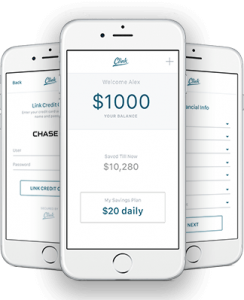
    clink screenshotsClink was designed with Millennials in mind but the reality is anyone who wants a hands-off approach to saving and investing can benefit from the microsavings app.

    If you are fee-sensitive, Clink is a perfect fit because it charges low monthly fees of $1 up to the first $5,000 managed and 0.25% thereafter, which is in line with the best money-saving apps.

    No account minimum is stipulated either, so there is no reason not to download the app to see what all the fuss is about, and you can get started investing with as little as $5.

    Clink is designed as a mobile app for those on-the-go, though you can sign up and get started in a web-based browser too.

    How Clink Works

    Download the Clink app, link to your bank account, specify your savings preferences, and Clink invests the money on your behalf. You can also link your credit card to Clink and you can save a percentage of each dining experience.

    To get started with Clink, download the app from the App Store if you have an iPhone or Google Play if you use an Android device.

    HOW TO SAVE CASH AUTOMATICALLY

    After you set up your account, you will be asked for your social security number – a legal requirement for financial companies since the Patriot Act was enacted.

    Next, link your bank account so that Clink can withdraw money to be saved.

    You will be invited to specify how much you wish to save regularly. The minimum you can choose is $1 daily if you want continuous withdrawals to your Clink account.

    HOW TO SAVE EACH TIME YOU BUY

    Or by linking your credit card to Clink, you can specify that you want to save a percentage of each dining experience. For example, each time you buy tacos, you could decide you want to save 10% of the purchase price.

    Once you have selected how you want to save, Clink does the rest so you can be hands-off – your savings will be invested automatically.

    How Does Clink Invest Savings?

    Clink relies on Modern Portfolio Theory to invest your money into a diversified portfolio of Vanguard funds.

    clink app phoneLike most traditional financial advisors and robo-advisors who invest money on behalf of clients, Clink relies on Modern Portfolio Theory as the bedrock of its investing strategy.



    Modern Portfolio Theory was developed in the 1950s when “beating the stock market” was a more popular aim than building a diversified portfolio.

    The idea behind the approach is to maximize returns for a given level of risk. So, if you are a conservative investor, your returns will generally be lower than a risk-seeking investor who is more comfortable with larger portfolio swings.

    To achieve the aim of building diversified portfolios, Clink relies on Vanguard funds with low expense ratios.

    Vanguard is renowned for creating low-cost mutual funds and exchange-traded funds (ETFs) that prioritize clients’ interests.

    By charging no monthly fees and partnering with Vanguard, Clink sends a shot across the bow to rival microsavings apps, such as Acorns and Stash, that it has a customer-centric business model, which should lead to greater loyalty.

    The six Vanguard funds used by Clink include:

    Fund Symbol Description
    VOO Vanguard S&P 500 ETF
    VWO Vanguard FTSE Emerging Markets ETF
    VCIT Vanguard Intermediate-Term Corporate Bond Index Fund ETF Shares
    VGK Vanguard FTSE Europe ETF
    VTIP Vanguard Short-term Inflation Protected Securities ETF
    BND Vanguard Total Bond Market ETF

    >> What Are The Best Vanguard Funds?

    Clink Fees

    Clink costs $1 monthly up to the first $5,000 in assets managed and 0.25% thereafter.

    Although Clink charges a comparatively low monthly amount of just $1, keep in mind that this translates to a fairly hefty annual fee on small amounts.

    Type Fees
    < $5,000 $1
    (monthly)
    $5,000+ 0.25%
    (annually)
    ACH Transfers FREE
    Returned ACH $30

    For example, if your balance was $1,000, then a $12 annual fee would translate to 1.2% of assets, which is more in line with traditional financial advisors than automated robo-advisors. By contrast, Betterment charges just 0.25% for a similar service level.

    However, once your balance reaches $5,000, the annual charge is more in line with leading low-fee robo-advisors.

    Clink Pros and Cons

    Clink automatically saves and invests your money in low expense ratio funds and charges low fees above $5,000 in deposits. However, you are not permitted to invest via retirement accounts nor will you enjoy advanced features provided by robo-advisors, such as tax-loss harvesting or automatic rebalancing.

    Clink Pros Clink Cons
    Low Monthly Cost: For just $1 monthly up to the first $5,000 or 0.25% thereafter, Clink automatically saves money for you and invests it on you behalf. Limited Account Types: If you have a retirement account, such as an IRA or Roth IRA, Clink does support it at this time.
    No Account Minimums: You don’t need to deposit a dime to open an account with Clink, however a minimum $5 is needed to get started investing. No Tax-Loss Harvesting: While many robo-advisors, such as Betterment and Wealthfront, who specialize in offering tax-loss harvesting services to boost after-tax returns, Clink does not provide this feature.
    Diversified Portfolio: Six exchange-traded funds feature in client portfolios and they include stock, bond, emerging market, european and inflation-protected funds. No Automatic Rebalancing: If a position in your portfolio drifts, Clink does not automatically rebalance your portfolio as some digital advisors sometimes do.
    Low Expense Ratio Funds: Low expense ratio funds from Vanguard are used for client portfolios.
    Automatic Savings: You can save automatically the cash you have in your existing bank account by setting a calendar date when transfers take place or by linking to your credit card and saving a percentage of each dining experience.
    Lump-Sum Investments: If you want to boost your nest-egg, you can make a lump sum deposit with a daily limit of $10,000.
    No Hidden Fees: ACH transfers are free and, other than a penalty fee for returned ACH transfers, no other fees beyond management fees apply.

    How Secure Is Clink?

    Clink uses bank level security to protect your personal information by using SSL and 256-bit encryption for mobile and web applications. Plus, any sensitive data, such as your social security number, is encrypted for maximum protection.

    Clink doesn’t store any of your banking information. Your credentials are only used to authenticate your identity and verify that you are who you say you are.

    If you link your credit card, ENVESTNET, which is a unified wealth management technology and services provider, will store its details.

    Clink Accounts

    Although Clink is an SEC Registered Investment Advisor, it only supports taxable accounts. If you have any retirement accounts that you want automatically managed, it is best to select from a list of the best robo-advisors.

    Type Capability
    Individual non-retirement YES
    Roth IRA NO
    Traditional IRA NO
    Rollover IRA NO
    Trusts NO
    Custodial Accounts NO

    Clink Tax Strategy

    Clink doesn’t support tax loss harvesting or automated account balancing strategies.

    Type Capability
    Tax Loss Harvesting NO
    Free Account Rebalancing NO

    Clink Summary

    Clink is a microsavings app designed for individuals who struggle to save or want to automate saving and investing.

    It wins brownie points for keeping fees comparatively low and in line with rivals, featuring low expense ratio Vanguard funds in diversified portfolios, and in supporting both automated cash savings from bank accounts as well as a percentage of credit card transactions on dining experiences.

    Where the app gets docked marks is by catering only to taxable accounts and charging relatively high percentage fees for low account balances – though no minimum account balance is required to get started.

  • What Are The 7 Best Robo Advisors?

    What Are The 7 Best Robo Advisors?

    7 best robo advisors

    InvestorMint provides personal finance tools and insights to better inform your financial decisions. Our research is comprehensive, independent and well researched so you can have greater confidence in your financial choices.

    Robo-advisors are a type of financial advisor who automatically manage your money by leveraging the power of technology to select investments for you that are designed to meet your financial goals, risk profile and time horizon.

    Before robo-advisors came along, you either had to pay high fees to a human financial advisor to manage your money or spend countless hours researching investments that you made on your own.

    In 2008, the first game-changing robo-advisors came on the scene and, since then, they have gathered billions of dollars in assets under management because of their low management fees and expense ratios.

    Many robo-advisors optimize after-tax returns, offer excellent mobile apps, tools and calculators, and even make social impact investing easy. So with a myriad of robo-advisor choices available, which are the best robo-advisors?

    #1 – Betterment

    Betterment wins the top prize for best overall robo-advisor with its extensive range of tools, benefits and services. Low fees, access to human advice, a clear focus on tax-efficient investing, and easy access to socially responsible investing are just a handful of the reasons why Betterment is worth exploring for any serious-minded investor with an eye on retirement.

    Betterment has two tiers of service, Digital and Premium. Betterment Digital is a purely automated investment management service while Betterment Premium includes human advice for a higher fee.

    Unlike most traditional financial advisors, who often charge north of 1% annually to manage your money, Betterment Digital is available for just 0.25% while Betterment Premium costs 0.40% and includes unlimited access to Chartered Financial Professionals.

    BETTERMENT SPOTLIGHT
    betterment

    InvestorMint Rating

    5 out of 5 stars

    • Promo: Up to 1 Year Free Management
    • Management Fee: 0.25% – 0.40%
    • Account Minimum (Betterment Digital): $0
    • Account Minimum (Betterment Premium): $100,000

    via Betterment secure site

    What you really care about at the end of the day is after-tax returns and Betterment pays close attention to tax-efficiency in two ways: tax-loss harvesting and tax-coordinated portfolios.

    Tax-loss harvesting counts losing positions against winners to lower your overall tax bill while tax-coordinated portfolios is the method by which tax-inefficient assets are placed in tax-efficient accounts, such as an IRA, while tax-efficient assets are placed in less tax-efficient accounts. Betterment claims these allocations can boost your returns over the long-term.

    >> Learn More About Betterment SRI Portfolios

    #2 – Wealthfront

    At around the same time Betterment launched in 2008, Wealthfront was founded also and the two companies have competed vigorously to win clients in the intervening years.

    Unlike Betterment, which added an overlay of human advice to its service offerings in recent years, Wealthfront has stayed true to its roots by sticking with a purely digital money management solution.

    You need to deposit just $500 to get started at Wealthfront, which will manage your money thereafter at an annual cost of 0.25% of assets under management.

    A nice bonus at Wealthfront is you get your first $10,000 managed free.

    WEALTHFRONT SPOTLIGHT
    wealthfront brokerage trading system robo advisor

    InvestorMint Rating

    4 out of 5 stars

    • Management Fee: $0 for first $10,000
    • An additional $5,000 managed free for each friend invited who signs up
    • Management Fees thereafter: 0.25%
    • Account Minimum: $500

    via Wealthfront secure site

    Where Wealthfront really shines is its focus on tax-loss harvesting. It uses a method called Direct Indexing to lower your capital gains tax liabilities by investing in a range of individual securities that mimic a diversified portfolio of index funds.

    This approach provides greater flexibility to sell losing positions against winners and replaces sold securities with similar ones to ensure portfolios remain diversified.

    >> Learn More About Wealthfront

    #3 – Schwab Intelligent Portfolios

    Betterment and Wealthfront have enjoyed so much success that big name financial companies, such as Schwab, Fidelity and Vanguard, have launched their own robo-advisors. Schwab stands out from the pack with its robo-advisor service, called Schwab Intelligent Portfolios.

    Schwab has a unique advantage compared to most of its rivals. Unlike other robo-advisors, who frequently use Vanguard funds when building client portfolios, Schwab has the luxury of constructing portfolios with its own proprietary index funds. This allows Schwab to make money from expense ratios – the fees charged for managing and operating the index funds.

    SCHWAB INTELLIGENT PORTFOLIOS
    charles schwab

    InvestorMint Rating

    4.5 out of 5 stars

    • Management Fee: 0.0%
    • Account Minimum: $5,000

    via Schwab secure site

    Because Schwab can make money from expense ratios, it can drastically lower its management fees all the way to zero!

    With no management fees and a reputation as one of the best financial firms in the industry, Schwab Intelligent Portfolios has amassed billions of dollars of assets; it even beat both Betterment and Wealthfront across the line to the first $10 billion in managed assets.

    #4 – Blooom

    Blooom is a different kind of robo-advisor service because it focuses heavily on retirement portfolios.

    If you have a 401(k), Blooom links to it and for a low monthly fee will optimize the allocation of your holdings.

    For most individuals, 401(k) portfolios are built haphazardly. You generally have a limited number of funds from which to choose and it is hard to know how much money you should put in each to align with your retirement objectives and risk profile.

    Plus, it’s difficult to know which funds are charging high fees without rolling up your sleeves and spending a lot of time comparing expense ratios. That’s where Blooom comes in to save you time and possibly money too.

    BLOOOM SPOTLIGHT
    blooom logo

    InvestorMint Rating

    4 out of 5 stars

    • Management Fee: $95 – $250
    • Account Minimum: $0

    via Blooom secure site

    If you have just a few thousand dollars in your 401(k) then Blooom may end up costing you quite a bit on a percentage basis each year, but anything more than that and the $10 monthly fee is a real bargain.

    >> View Top Robo-Advisor CEOs

    #5 – Personal Capital

    Personal Capital is the white-glove robo-advisor service. Management fees are higher than at many other robo-advisors but you also enjoy greater perks, such as a dedicated human financial advisor.

    If you can pony up the $100,000 minimum to get started with Personal Capital and are willing to pay management fees of 0.89% up to the first million dollars deposited, you will have your very own financial advisor who can look holistically at all your financial accounts. So, you get the benefits of a technology-powered automated investment management solution as well as the hand-holding of human financial experts.

    PERSONAL CAPITAL SPOTLIGHT

    personal capital logo InvestorMint Rating

    4.5 out of 5 stars

    • Management Fee: 0.49% – 0.89%
    • Account Minimum: $100,000
    • Brownie Points: Free tools to track spending; human advisors paired with clients

    via Personal Capital secure site

    Personal Capital also provides one of the best mobile apps in the industry; it enables you to track spending, income, investments, and net worth.

    Best of all, it is free to all users – not just clients. Simply link your credit card, bank and investment accounts, and Personal Capital provides a holistic view of your financial situation.

    >> Compare: Personal Capital vs Betterment

    #6 – Vanguard Personal Advisor Services

    Vanguard is perhaps best known for pioneering low cost index funds and so it’s no surprise that its robo-advisor service, Vanguard Personal Advisor Services, competes well with Betterment and Wealthfront on fee charges.

    For just 0.30% annually, Vanguard will manage your money digitally and make a team of live advisors accessible to you.

    How does Vanguard make human advice available to you at a cost so much lower than most other robo-advisors? Like Schwab, Vanguard has its own proprietary index funds, and earns revenues from fees charged when it places those funds in your portfolios.

    So, Vanguard gets to “double-dip” by making money from management fees and expense ratios.

    VANGUARD PERSONAL ADVISOR SERVICES
    vanguard investments

    InvestorMint Rating

    4.5 out of 5 stars

    • Management Fee: 0.30%
    • Account Minimum: $50,000

    via Vanguard secure site

    Vanguard imposes a $50,000 account minimum, which is a significantly higher hurdle to get off the starting blocks than you will find at Betterment and Wealthfront.

    But for those who meet the eligibility requirements, it’s hard to beat the value proposition Vanguard offers: low management fees, low expense ratios and access to human advice.

    >> Compare Betterment Vs Vanguard

    #7 – Fidelity Go

    Like other industry goliaths, Fidelity entered the robo-advisor space after seeing the enormous success enjoyed by industry pioneers: Betterment, Wealthfront and Personal Capital.

    Fidelity Go is the robo-advisor from Fidelity and it is unique in combining management fees and expense ratios in one overall fee.

    Retirement accounts incur total fees of just 0.35% annually while taxable accounts are charged 0.45% of assets each year.

    FIDELITY GO
    fidelity go

    InvestorMint Rating

    4 out of 5 stars

    • Management Fee (retirement portfolios): 0.35% (including Investment expenses)
    • Management Fee (taxable accounts): 0.40% (including Investment expenses)
    • Account Minimum: $10

    via Fidelity secure site

    Fidelity Go has a $5,000 account minimum and does not currently provide tax-loss harvesting services, so it ranks lower on the list of best robo-advisors but it is well worth exploring for fee-conscious investors.

    Some highlights at Fidelity Go include automatic portfolio rebalancing so no single holding dominates a portfolio’s allocation. And as expected from an industry bellwether, Fidelity Go caters to a wide range of account types, including traditional, Roth, SEP, and rollover IRAs.

    >> Compare FutureAdvisor Vs Betterment

    >> Is thinkorswim the Best Options Trading Platform

    >> What Are The Best Investment Apps?

  • FutureAdvisor Vs Betterment: Review 2020

    FutureAdvisor Vs Betterment: Review 2020

    InvestorMint provides personal finance tools and insights to better inform your financial decisions. Our research is comprehensive, independent and well researched so you can have greater confidence in your financial choices.

    FutureAdvisor and Betterment are like two peas in a pod when it comes to managing your money automatically.

    After reviewing your unique financial profile – age, risk tolerance, time horizon, and so on – both robo-advisors allocate your money to align with your financial goals.

    And both FutureAdvisor and Betterment view your financial circumstances holistically by taking into consideration your retirement and taxable accounts.

    Each robo-advisor has an eye on tax-efficient investing and practices tax-loss harvesting, consistent monitoring, automatic rebalancing and connect you to human experts.

    Where they diverge is on fees, minimums, and custody of assets. So in the FutureAdvisor vs Betterment battle, which robo-advisor is best?

    FutureAdvisor Vs Betterment Spotlight

    future advisor logo
    betterment

    To make an apples-to-apples comparison of FutureAdvisor vs Betterment, it is best to compare Betterment Premium with FutureAdvisor.

    Betterment Premium is the higher tier service offered by Betterment, which includes access to human advice, and costs 0.40% of assets annually.

    A purely automated money management solution is also offered, called Betterment Digital, which costs 0.25% annually.

    FutureAdvisor also has different tiers of service, called Retirement Advice and Investment Management.

    Retirement Advice is 100% free. FutureAdvisor will analyze your funds and make recommendations to improve your asset allocation and expense ratios.

    Investment management is a fee-paying service that costs 0.50% annually whereby FutureAdvisor manages your money on your behalf to help you hit your financial retirement targets.

    But management fees are just one aspect of total fees you pay a robo-advisor, so how do they compare on overall fees?

    FutureAdvisor Fees
    Vs Betterment Fees

    Betterment has a purely digital money management solution with no account minimum for hands-off investors. It imposes a $100,000 minimum for higher tier service that includes access to Chartered Financial Professionals. FutureAdvisor is more expensive for account holders with more than $100,000 available to invest but is the only choice if you want access to human advice and have less than $100,000 to invest.

    Robo-advisors compete fiercely on fees, so these days investors get a lot more for their money than used to be the case with traditional financial advisors.

    Where the average traditional financial advisor historically charged north of 1% annually to manage your money, robo-advisors typically charge a lot less.

    There are exceptions to the rule. For example, Personal Capital charges fees that are more in line with traditional financial advisory fees.

    But for the most part, fees are low and the 0.25% annual fee Betterment charges for pure robo-advice is right in line with industry norms.

    Robo-advisor $5,000 $10,000 $50,000 $100,000 Open Account
    betterment
    Betterment Digital

    REVIEW

    0.25% 0.25% 0.25% 0.25%
    betterment
    Betterment Premium

    REVIEW

    0.40%
    future advisor logo

    REVIEW

    0.50% 0.50% 0.50%

    Most robo-advisors offer a basic tier of service that features digital money management.

    Few include access to live experts as part of their basic service but SoFi and FutureAdvisor are exceptions to the rule.

    So, the Investment Management service offered by FutureAdvisor is more akin to Betterment Premium.

    For investors who are content with a hands-off approach and have no need to connect with live financial experts, Betterment Digital is the better choice.

    If you have a smaller account size and want to connect to a real person, FutureAdvisor is the best option because it imposes a $10,000 account minimum whereas Betterment requires you to pony up $100,000 for a similar type of service.

    To give you an idea of what the fees translate to in real dollars, view this comparison chart.

    Robo-advisor $5,000 $10,000 $50,000 $100,000 Open Account
    betterment
    Betterment Digital
    Management Fees
    $2.50 $25 $125 $250
    betterment
    Betterment Premium
    Management Fees
    N/A N/A N/A $400
    future advisor logo
    Management Fees
    N/A $50 $250 $500

    For larger account sizes of $100,000 or more, Betterment charges lower annual fees compared to FutureAdvisor.

    Betterment Vs FutureAdvisor: Fees & Account Minimums: If you want access to real people and have an account size under $100,000, FutureAdvisor is your only choice. If you have a larger account size or you don’t care about human advice, Betterment is cheaper.

    Betterment Vs FutureAdvisor
    Investment Method

    Both FutureAdvisor and Betterment use Modern Portfolio Theory to build investment portfolios. FutureAdvisor also takes into account your pre-existing portfolio and tax situation to build a unique, customized portfolio.

    FutureAdvisor and Betterment both follow an investment philosophy that believes the best results are achieved by building fully diversified portfolios focused on the long-term.

    They each incorporate Nobel-prize winning academic research, called Modern Portfolio Theory, which is based on the idea that risk-averse investors can build portfolios to optimize expected returns based on given levels of risk.

    FutureAdvisor incorporates the Black-Litterman model and Fama-French Five Factor model in its investing approach.

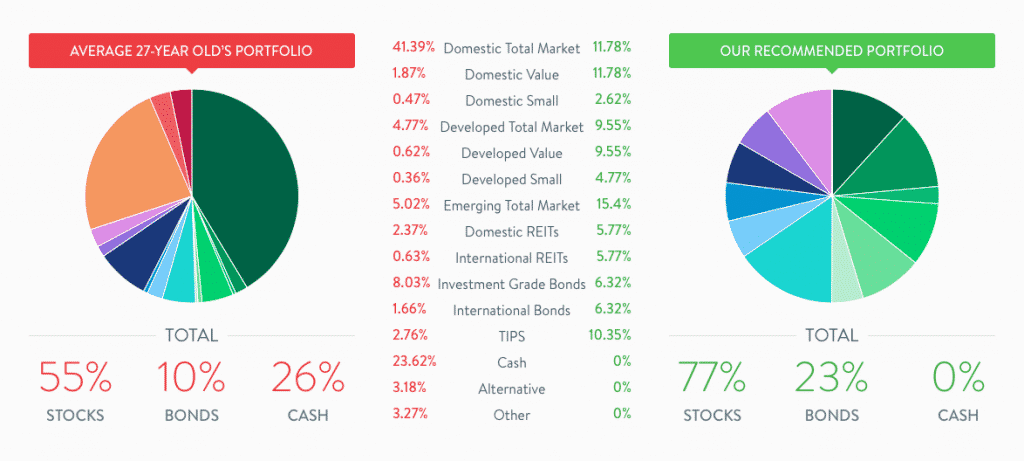
    A portfolio at FutureAdvisor may look something like this for a conservative, 27 year old investor:

    future advisor 27 year old portfolio

    Index investing is another core tenet that both companies rely upon to build low-fee portfolios.

    When Jack Bogle, who founded Vanguard, conceived and launched the first index fund, he was mocked by Wall Street aficionados, who believed stock picking was a better investment method to beat the market.

    Over time, Bogle has been proven right as it turns out few investors can beat the market long term by timing buys and sells successfully.

    So, low-cost ETFs with low expense ratios are a better choice for most investors. At FutureAdvisor, expense ratios are as low as 0.04% – which is approximately an order of magnitude or more lower than you might find in the average 401(k).

    Investing Tip: If you are not sure what fees you are paying in your 401(k), check out Blooom, which specializes in analyzing and optimizing retirement accounts.

    ETFs are selected by Betterment too because they tend to be lower cost and more tax-efficient than mutual funds.

    Research from Morningstar shows that higher-fee funds consistently underperform the market, so a digital money manager who does the research for you can pay for itself over the long term just by helping you side-step these costs.

    HOW BETTERMENT & FUTUREADVISOR DIFFER

    Where FutureAdvisor and Betterment diverge is in factoring in your prior financial circumstances.

    If you already have a portfolio of stocks and bonds, you may incur some hefty tax bills by selling stocks so FutureAdvisor adds a lot of value by considering this liability.

    FutureAdvisor stands apart by using Dynamic Fund Selection to build a customized portfolio that factors in your tax situation and pre-existing portfolio.

    A dynamic cost analysis is performed to ensure your portfolio is designed to take account of your portfolio size, number and type of accounts held, as well as the bid-ask spread on ETFs.

    FutureAdvisor will also calculate the tradeoff of mutual fund expense ratios versus ETF fees.

    Betterment Vs FutureAdvisor: Investment Strategy: You can expect to receive low-cost, diversified portfolios at both Betterment and FutureAdvisor, but FutureAdvisor alone will take into account your pre-existing portfolio and tax situation when building a unique, customized portfolio.

    Betterment Vs FutureAdvisor
    Tax Strategy

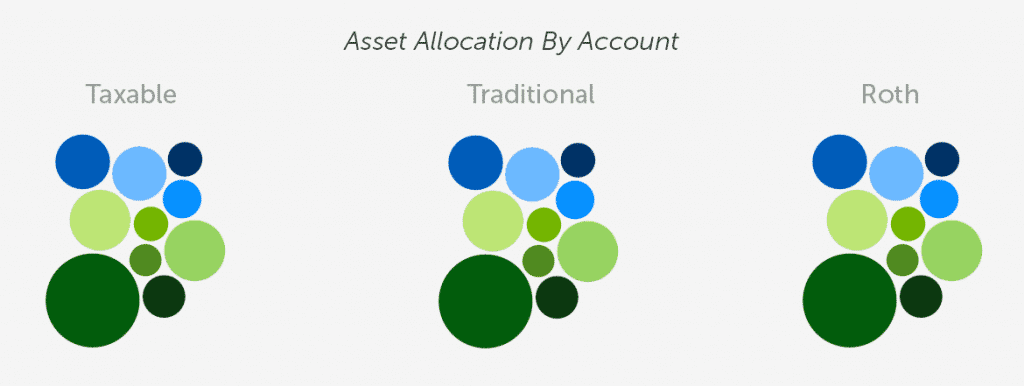
    Betterment and FutureAdvisor automate tax-loss harvesting to minimize your tax bill, but Betterment goes the extra mile by allocating assets across accounts to optimize for tax-efficiency.

    When it comes to tax-advantaged investing, Betterment is hard to beat. Not only does Betterment practice standard tax-loss harvesting techniques but it also builds tax-coordinated portfolios.

    Standard tax-loss harvesting is the practice of selling losing positions against winning positions to lower your tax bill in taxable accounts.

    Where Betterment distinguishes itself from FutureAdvisor, which also offers tax-loss harvesting, is by placing tax-efficient assets in non-tax-efficient accounts and tax-inefficient assets in tax-efficient accounts.

    For example, municipal bonds already enjoy a tax-advantaged status so there is no reason to place them in a 401(k) or IRA.

    betterment allocation by aggregate and account tcp off

    Betterment Vs FutureAdvisor: Tax-Advantaged Investing: Although both robo-advisors practice tax-loss investing, Betterment earns more brownie points for also optimizing for taxes across accounts using tax-coordinated portfolios rather than just within taxable accounts.

    FutureAdvisor Vs Betterment
    Human Advice

    Betterment and FutureAdvisor make human advice available to clients via Chartered Financial Professionals and financial experts respectively.

    If you can overcome the high account minimum hurdle at Betterment, Chartered Financial Professionals are available to you virtually on-demand.

    At Betterment, you enjoy unlimited access to human advice via phone, text, and email.

    If you have questions about your portfolio no matter how eclectic, such as queries about foreign equity investment theory, FutureAdvisor also makes licensed advisors and specialists available to you.

    The minimum at FutureAdvisor is lower to get access to human advice so if you don’t have $100,000+ to invest, FutureAdvisor is your best bet.

    Betterment Vs FutureAdvisor: Human Advice: Unlimited phone, email and text access gives Betterment the nod in this category, but for those with less than $100,000 to invest, FutureAdvisor is your only option and a good one.

    Betterment Vs FutureAdvisor
    Overall Winner

    Betterment wins on fees, tax strategy, human advice and social impact portfolios. It also takes custody of your assets, so you don’t have to worry about extra fees charged by custodians, like Fidelity, which house FutureAdvisor client assets. FutureAdvisor beats Betterment on expense ratios at the low-end, account minimums on top tier service, and investment strategy by considering pre-existing portfolios and tax circumstances of individuals.

    Betterment Wins FutureAdvisor Wins
    Portfolio Management Fees: Betterment Digital costs 0.25% annually while Betterment Premium costs 0.40% annually, both of which compare well to FutureAdvisor’s annual fee of 0.50%. Expense Ratios: Expense ratios at Betterment range from 0.09% to 0.17%, which are exceptionally low, but slightly beaten by FutureAdvisor on the low-end, which includes funds with expense ratios as low as 0.04%.
    Tax Strategy: Both Betterment and FutureAdvisor provide tax-loss harvesting services but Betterment takes a broader tax-advantaged perspective by placing tax inefficient assets in tax-efficient accounts. Account Minimums: Betterment wins for its pure robo-advisor service with no minimum account balance stipulated but for an apples-to-apples comparison that includes access to human financial experts, we give the nod to FutureAdvisor which has a $10,000 minimum versus $100,000 at Betterment.
    Human Advice: Betterment wins this category by making Chartered Financial Professionals available with unlimited access via phone, email and text. Investment Strategy: For investors with pre-existing portfolios, FutureAdvisor is the better choice because it will factor in your portfolio and tax situation before  building customized portfolios that are unique to your circumstances.
    Social Impact Portfolio: Betterment offers socially responsible investing portfolios to those who care about aligning their investment dollars with their values.

    Which Robo-Advisor Is Best For You:
    FutureAdvisor or Betterment?

    Betterment and FutureAdvisor offer digital money management that features automatic rebalancing, tax-loss harvesting, global diversification and low fee ETFs, so the choice between them is as much a matter of individual preferences and financial circumstances as it is about objectively ranked criteria.

    If you have less than $100,000 and want access to human advice as well as an automated investment management solution, FutureAdvisor is your only choice.

    On the other hand, if you don’t care so much about getting access to Chartered Financial Professionals, but do care about an optimal tax-advantaged strategy after signing up, then Betterment is the way to go.

    The caveat when it comes to tax is if you have pre-existing portfolios, FutureAdvisor will consider them as well as your tax situation before building customized portfolios.

    Betterment has some extra bells and whistles, such as socially responsible investing portfolios and retirement guides that earn it a top position among all robo-advisors, so if you are on the fence Betterment is the way to go and it doesn’t hurt that fees are slightly lower too.

  • Is Betterment The Top Robo-Advisor?

    Is Betterment The Top Robo-Advisor?

    InvestorMint provides personal finance tools and insights to better inform your financial decisions. Our research is comprehensive, independent and well researched so you can have greater confidence in your financial choices.

    The selection of robo-advisors has vastly increased since Betterment and Wealthfront launched in 2008. Robo-advisors compete on many more dimensions than simply fees, including:

    • Automated investment management
    • Human advice
    • Tax-loss harvesting services
    • Financial calculators
    • Tax-coordinated portfolios
    • Goal-based investing
    • Customer support
    • Financial tools
    • Socially responsible investing
    • Gender-focused platforms
    • Thematic investing

    With so many factors to consider, what is the best robo-advisor overall? We researched the leading robo-advisors to compare management fees, expense ratios, account selections, minimum required balances, selection of funds, human advice, customer support, social impact investing choices, tools and navigability. And after weighing up all those factors, our top robo-advisor pick is Betterment.

    Best Robo-Advisor Overall

    Betterment has low fees, makes human advice accessible, caters to goal-based financial planning, socially responsible investing, and has a friendly interface that is easy to navigate.

    Our top pick among robo-advisors is Betterment. Weighing up the factors most important to investors, Betterment comes out on top despite stiff competition from rivals such as:

    automate your finances with bettermentWhether you are a hands-off investor or prefer some extra hand-holding, Betterment caters to your needs at a cost that is hard to beat.


    A fully automated investment management solution is offered with its basic service, Betterment Digital, while human advice is accessible via its higher tier service, Betterment Premium.

    Betterment makes it easy to save for retirement by setting goal-based savings objectives. And with its launch of Socially Responsible Investing (SRI) portfolios, Betterment even lets clients align their investment allocations with their values.

    While most investors care about top line returns, after-tax income is what counts most, and Betterment has a sharp focus on tax-loss harvesting features and tax-coordinated portfolios.

    Plus, all of its features are encompassed in an easy-to-use, highly navigable interface that provides a delightful user experience.

    BETTERMENT SPOTLIGHT
    betterment

    InvestorMint Rating

    5 out of 5 stars

    • Promo: Up to 1 Year Free Management
    • Management Fee: 0.25% – 0.40%
    • Account Minimum (Betterment Digital): $0
    • Account Minimum (Betterment Premium): $100,000

    via Betterment secure site

    Betterment Fees

    Betterment has two tiers of service: Betterment Digital and Betterment Premium.

    The basic service, Betterment Digital, leverages technology to provide a fully automated investment management service.

    The higher tier service, Betterment Premium, is designed for the investor who also wants access to human financial experts.

    Service Level Fee
    Betterment Digital 0.25%
    Betterment Premium 0.40%

    Betterment Digital

    With Betterment Digital, you can get started with no account minimum and get access to a wide range of services:

    Service Feature Description
    Personalized financial advice How much should you allocate? What investments should you select? Betterment Digital answers those questions for you and makes the investments on your behalf automatically.
    Globally diversified investment portfolios A globally diversified portfolio is selected to maximize your returns based on your risk profile.
    Automatic rebalancing When the market swings up and down, portfolio weightings change so automatic rebalancing is enabled to keep your target allocation.
    Advanced tax-saving strategies The real objective is to boost your after-tax returns, and tax loss harvesting and tax coordinated portfolios that optimize asset allocation are designed to achieve this financial goal.
    Everything in one place Link to external accounts so you can view your all your finances easily.
    Top notch customer service Customer support is available every day of the week.
    Licensed financial experts Unlimited access to financial experts is available to answer your questions anytime anywhere

    Betterment Premium

    Betterment Premium includes all the same features as Betterment Digital as well as advice on how to create a plan to manage your 401(k), real estate, and individual stocks.

    The big difference between the Digital and Premium offerings is that clients in the higher tier service get unlimited access to certified financial planners. So, if you are planning to get married, have a child, or retire, CFP professionals will help you make sure your financial goals are aligned with your allocations, and any retirement withdrawals are taken with tax efficiency in mind.

    >> More: What You Need To Know About Betterment Securities

    Tax Smart Investing

    Betterment has two primary tax strategies to optimize after-tax returns: tax-loss harvesting and tax coordinated portfolios.

    What Is Tax-Loss Harvesting?

    Tax-loss harvesting is the practice of selling losing positions to “harvest” losses that can be counted against gains from winners. Capital gains taxes would be higher if tax-loss harvesting was not incorporated into your investing strategy. To optimize your asset allocation after selling a losing position, Betterment replaces the sold security with a similar one.

    Capital losses can reduce your ordinary taxable income by up to $3,000 annually, and best of all it’s done automatically for you at no extra cost.

    Betterment claims the additional returns from tax-loss harvesting can be as much as 0.77% annually, amounting to a surplus $44,692 in gains on a $50,000 portfolio that has a 70% allocation to stocks in which $750 is contributed monthly.

    What Are Tax Coordinated Portfolios?

    Tax coordinated portfolios are designed to optimize asset allocation and Betterment claims they can increase portfolio value by an estimated 15% over 30 years, based on research data that shows an annualized additional gain of approximately 0.48%.

    The idea is to place highly taxed assets into tax-efficient vehicles, such as your IRA, and to place highly tax-efficient assets into your tax-inefficient accounts.

    >> More: What Is A Betterment Tax Coordinated Portfolio?

    Socially Responsible Investing

    Socially responsible investing (SRI) is a way to align investment dollars with values. In addition to its core portfolios that are constructed on the principles of Modern Portfolio Theory, Betterment allows clients to elect SRI portfolios that cover a wide range of social impact large cap investments.

    SRI portfolios allow clients to steer clear of the issues with which they have ethical concerns, such as:

    • Environmentally pollutant companies
    • Sin stocks”, such as tobacco and alcohol producers
    • Military weapons production
    • Civilian firearms manufacturers
    • Fossil fuel producers

    Even corporate governance issues are factored into SRI portfolio considerations at Betterment. For example, Betterment views the data hack at Yahoo which led to the theft of hundreds of millions of user records as a corporative governance concern.

    >> More: What Is The Betterment Minimum?

    Financial Tools, Quizzes & Calculators

    Betterment makes available an extensive range of financial tools and calculators to clients, including:

    Betterment Calculator, Tool or Quiz Description
    Asset Location Calculator Estimate surplus after-tax returns using a Tax-Coordinated Portfolio
    Traditional 401(k) Vs Roth 401(k) Calculate which is better for you, a traditional 401(k) or a Roth 401(k)
    How Much Social Security Income? Find out how much social security income you can expect in retirement
    401(k) or IRA Calculator Should you invest in a 401(k) or IRA, or both?
    Investment Diversification Discover what a diversified portfolio really means.
    Calculate Retirement Income Spending Find out how much your current income affects your future retirement spending.
    Can You Beat A Buy-And-Hold Portfolio? Discover whether it is worth trying to beat the market.
    IRA Calculator Calculate whether a traditional IRA or Roth IRA is best for you.

    Investment Method

    The investment philosophy Betterment applies has been influenced by Nobel prize winning economists, Eugene Fama and Robert Shiller. Portfolios constructed by Betterment are diversified and align with client risk profiles. And low fee index funds are used across 12 asset classes to form a passive investing approach.

    Betterment portfolios are built with an eye on tax-efficiency too. Tax-loss harvesting is employed so that losing positions are counted against realized winners to offset capital gains tax liabilities. And tax-coordinated portfolios are used to place tax inefficient assets in tax-deferred accounts, such as IRAs, and tax-efficient assets in taxable accounts.

    The Bottom Line

    Betterment has stiff competition from rival robo-advisor firms but weighing up all the factors, it comes out on top.

    Betterment is a customer-oriented firm with rock bottom fees, provides unlimited access to real financial experts, and has exceptional customer support every day of the week.

    Plus, it focuses on the all-important after-tax returns via tax-loss harvesting and tax-coordinated portfolios.

    Navigation is easy and tools and calculators galore help you better plan for retirement.

    Want to compare Betterment vs robo-advisor rivals, check out these reviews?

    >> Compare Betterment Vs Wealthfront

    >> Compare Betterment Vs Vanguard

    >> Compare Betterment Vs Acorns

  • Want Stock Tips? Pick A Robo-Advisor

    Want Stock Tips? Pick A Robo-Advisor

    InvestorMint provides personal finance tools and insights to better inform your financial decisions. Our research is comprehensive, independent and well researched so you can have greater confidence in your financial choices.

    If you’re looking for stock tips, take a moment to think about this astonishing fact from the Wall Street Journal before hitting the Buy Order button in your brokerage account.

    Statistic: Between 1926 and 2015, one third of the cumulative wealth created by the U.S. stock market was attributable to just 30 stocks.

    The sobering reality is hot stock tips that produce Google or Amazon-like percentage gains are rare.

    If you are on the hunt for stock tips, your ultimate financial goal is to build wealth and robo-advisors may well be a better option to achieve your retirement nest-egg goals.

    What % Of Stocks Are Superstocks?

    If you were to hazard a guess at the percentage return Amazon generated since it went public in 1997, what number would you pick?

    Did Amazon share price gain 100%, 1,000%, or 10,000%? From its $1.96 IPO price (adjusted for stock splits), Amazon gained a whopping 49,000% over the subsequent two decades.

    By all measures, Amazon falls into the rare category of being labeled as a superstock.

    The holy grail as an investor is to find superstocks and hold on to them for the long term. But what is the likelihood that you will discover them before their share prices skyrocket?

    Out of 25,782 companies publicly traded between 1926 and 2015, a full one third of the cumulative wealth generated by the U.S. stock market was attributable to just 30 stocks according to Jason Zweig of the Wall Street Journal.

    When investors visit a financial advisor, they are often shown a graph of average stock market returns. But the returns of the average stock are vastly different from the average return of the market.

    Half of all the wealth generated for investors over the nine decade period was attributable to just 0.33% of companies according to Professor Hendrik Bessembinder of Arizona State University.

    If you were to pick a stock at random to buy, it turns out that there is more than a 50:50 chance the company you buy will lose money over its lifetime in the public markets.

    In fact, the 1,000 top performing stocks account for all the stock market’s gains over this period, meaning that only 4% of stocks produced 100% of the wealth.

    Strip those top performers out and the stock market wouldn’t have been worth owning at all.

    Even superstocks are hard to hold at times. Even though Amazon grew by 49,000% twenty years after its IPO, it fell by 95% during the 1999 – 2001 stock market crash.

    The reality is the likelihood of a hot stock tip turning into a superstock is so rare, it is akin to the proverbial hunt for the needle in the haystack.

    Even classic advice to diversify into a portfolio of 15 to 30 stocks risks underperformance. Professor Bessembinder found that a portfolio of 25 stocks still has a 64% chance of underperforming the market.

    Is it any wonder why one of billionaire investor Warren Buffett’s most famous investing quotes is to simply buy the S&P 500?

    What Are The Top 20 Superstocks?

    Only 20 stocks accounted for 25% of the wealth creation in the U.S. stock market between 1926 and 2015.

    The wealth creation contribution percentages (as measured by capital investment and rates of return in excess of the yield of 1-month U.S. Treasury bills) of the top 20 stocks were as follows:

    Company % Contribution to Wealth Creation in U.S. Stock Market Between 1926-2015
    Exxon 2.96
    Apple 2.13
    General Electric 1.88
    Microsoft 1.79
    IBM 1.53
    Altria Group 1.41
    General Motors 1.24
    Johnson & Johnson 1.21
    Wal Mart Stores 1.06
    Procter & Gamble 1.06
    Chevron 1.04
    Coca Cola 1.03
    AT&T 0.95
    Amazon 0.94
    du Pont 0.94
    Alphabet 0.87
    Merck 0.84
    Wells Fargo 0.79
    Intel 0.77
    Home Depot 0.71

    Source: Professor Hendrik Bessembinder, Arizona State University

    Pick A Robo-Advisor

    The astonishing percentage gains from superstocks make them alluring but they are so rare that a better approach for most investors is to buy low-fee index funds.

    If you prefer a hands-off approach to investing in low-fee index funds, consider a robo-advisor.

    BETTERMENT

    Betterment has staked its claim as one of the leading robo-advisors by offering an extensive range of services, including both purely digital advice and a premium version that provides access to human advice.

    BETTERMENT SPOTLIGHT
    betterment

    InvestorMint Rating

    5 out of 5 stars

    • Promo: Up to 1 Year Free Management
    • Management Fee: 0.25% – 0.40%
    • Account Minimum (Betterment Digital): $0
    • Account Minimum (Betterment Premium): $100,000

    via Betterment secure site

    Betterment imposes no account minimum to get started with its basic service, Betterment Digital, for which it charges 0.25% of AUM annually.

    Its higher tier service, Betterment Premium comes at a slightly higher cost of 0.40% annually but includes unlimited phone and email access to CFP professionals.

    Prospective clients concerned about how challenging it is to pick stocks that outperform can rest easy because Betterment applies Modern Portfolio Theory to build diversified stock and bond portfolios.

    For investors concerned about the social impact of how they allocate their dollars, Betterment also offers Socially Responsible Investing portfolios that align investments with values.

    >> Related: What Is A Betterment Tax-Coordinated Portfolio?

    PERSONAL CAPITAL

    Another leading robo-advisor, Personal Capital, includes access to financial advisors in its basic automated investment management service offering, albeit at slightly higher fee levels and a higher account minimum of $100,000.

    Fees range from 0.49% to 0.89% depending on the size of your account. Up to the first $1 million, fees are at the high end of the range.

    Over and above its white-glove advisory service, Personal Capital shines when it comes to its mobile app.

    The mobile app is best in class with features that let you track your cash flow, budgeting, portfolio holdings, allocation or get access research & insights.

    PERSONAL CAPITAL SPOTLIGHT

    personal capital logo InvestorMint Rating

    4.5 out of 5 stars

    • Management Fee: 0.49% – 0.89%
    • Account Minimum: $100,000
    • Brownie Points: Free tools to track spending; human advisors paired with clients

    via Personal Capital secure site

    >> Related: Compare Personal Capital Vs SoFi

    WEALTHFRONT

    Like Betterment, Wealthfront launched in 2008 and quickly became a leader in the robo-advisor industry under the leadership of Andy Rachleff.

    The account minimum at Wealthfront of $500 is a lot lower than it is at Personal Capital and the fees charged are also quite a bit lower.

    Wealthfront is laser-focused on delivering a purely automated investment management service for 0.25% annually and shines when it comes to tax-optimized portfolios.

    Wealthfront claims its tax-loss harvesting and tax-optimized services can enhance after-tax returns by up to 2% annually.

    WEALTHFRONT SPOTLIGHT
    wealthfront brokerage trading system robo advisor

    InvestorMint Rating

    4 out of 5 stars

    • Management Fee: $0 for first $10,000
    • An additional $5,000 managed free for each friend invited who signs up
    • Management Fees thereafter: 0.25%
    • Account Minimum: $500

    via Wealthfront secure site

    >> Related: Betterment Vs Wealthfront Review

    Have you traded hot stock tips? How did they work out for you? Share your trading stories and experiences in the comments below. We would love to hear from you.

    >> Compare SoFi Vs Wealthfront Robo-Advisors

    >> What You Need To Know Before Selling A Stock

    >> What Are The Best Online Stock Brokers For New Traders?

  • What Is A Betterment SRI Portfolio?

    What Is A Betterment SRI Portfolio?

    InvestorMint provides personal finance tools and insights to better inform your financial decisions. Our research is comprehensive, independent and well researched so you can have greater confidence in your financial choices.

    No doubt you have read over the years about companies who employ child labor, provide poor working conditions for employees, or destroy local habitats to make money. Investors who struggle ethically with the idea of investing in these types of companies now have a choice to allocate their money to “socially responsible” firms.

    betterment happy couple

    The idea behind socially responsible investing, or SRI, is to consider both the financial return and social good when making investments. The factors raised by asset managers who favor SRI investing include environmental, social justice and corporate governance, or ESG.

    It is not just major asset managers, such as Generation Investment Management, who are guided by socially responsible investing principles but casual investors too. With ever growing demand from ordinary investors, leading robo-advisors, such as Betterment, have expanded their automated investment management services by catering to client preferences via socially responsible investments.

    What Is Socially Responsible Investing (SRI)?

    At a high level, socially responsible investing encompasses the practices of impact investing, shareholder advocacy, and community investing. More colloquially, it can be thought of as seeking to avoid harm when investing.

    Asset managers who practice socially responsible investing often avoid the following areas:

    • Weapons manufacturers
    • Fossil fuel producers
    • Alcohol and tobacco producers
    • Casino and gambling companies
    • Fast food restaurants
    • Manufacturers of military products

    Some asset managers look to avoid negative consequences that may not be obvious at first glance. For example, some soda companies may tick a lot of boxes for value investors. But an SRI asset manager may take a pass, not because the financials aren’t compelling or the business case isn’t attractive but because of concerns over possible negative externalities – sugar consumption might lead to health consequences for consumers over the long term.

    >> More: Compare Betterment Vs Vanguard

    What Is A Betterment SRI Portfolio?

    As a leading robo-advisor, Betterment has embraced the idea of socially responsible investing and responded to customer requests to better align their investments with their values.

    Betterment looks to create portfolios that reduce exposure to companies that are seen to have a negative social impact. This may span a wide gamut from environmental destruction to poor labor standards. Equally, Betterment aims to increase exposure to companies supporting social good, such as promoting environmental sustainability.

    The big idea at Betterment is to cater to socially responsible investing consumer demands while still offering low fee, diversified portfolios that are automatically managed via technology as part of its basic service (and provide access to human advice in its higher tier service).

    BETTERMENT SPOTLIGHT
    betterment

    InvestorMint Rating

    5 out of 5 stars

    • Promo: Up to 1 Year Free Management
    • Management Fee: 0.25% – 0.40%
    • Account Minimum (Betterment Digital): $0
    • Account Minimum (Betterment Premium): $100,000

    via Betterment secure site

    >> More: What Is The Betterment Minimum?

    What Is Betterment’s
    Socially Responsible Investing Method?

    Although socially responsible investing has been around as far back as 1758 when Quakers were prohibited from participating in the slave trade, it has not been accessible to the general public until much more recently, and even then the costs have been prohibitive.

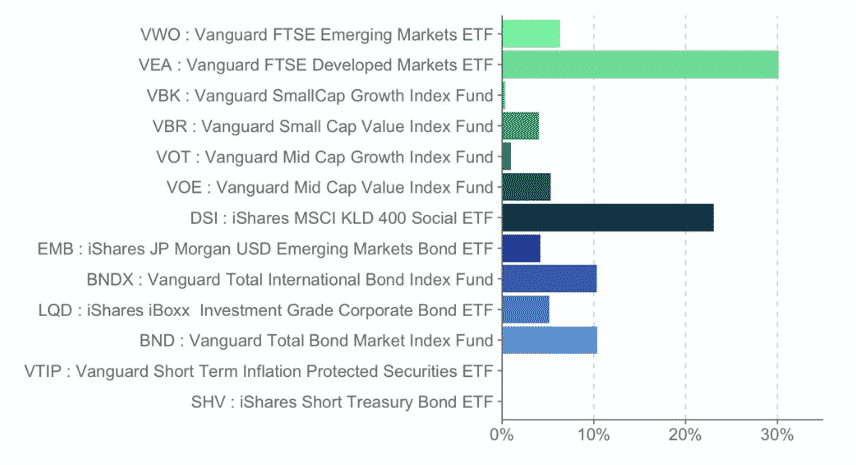
    The challenge facing Betterment has been to provide customers access to low-fee and highly liquid funds while maintaining portfolio diversity. It turns out that SRI alternatives for small cap, value stocks, international stocks and bonds do not, at this time, meet Betterment’s cost or liquidity requirements so only large cap SRI alternatives are offered.

    Due to their focus on fossil fuels companies like Exxon and Chevron may be excluded from SRI portfolios at Betterment. Other companies that may not make the cut include Walmart, Wells Fargo, Pfizer and Philip Morris.

    On the other hand, companies deemed to have strong SRI practices, such as Disney, IBM, Intel, Procter & Gamble, Alphabet, Microsoft and Cisco may comprise a larger part of an SRI portfolio.

    As a Betterment client, when you choose an SRI portfolio, you are in effect voting with your dollars for low cost, diversified, socially responsible funds – a rarity in the investing world.

    >> More: What You Need To Know About Betterment Securities

    How Betterment Defines
    Socially Responsible Investing

    Asset managers define socially responsible investing in different ways. At Betterment, the SRI approach falls into two broad definitions:

    1. Reduce exposure to companies involved in non-socially responsible activities and environmental, social, or governmental controversies.

    2. Increase investments in companies that work to address solutions for core environmental and social challenges in measurable ways.

    Environmental, Social and Governance (ESG) criteria are used to define the Betterment SRI approach.

    ESG seeks to quantify the aspects of socially responsible investing along each of the three dimensions. Betterment uses these ESG factors to score and define the extent to which a portfolio is socially responsible.

    >> More: What Is A Betterment Tax-Coordinated Portfolio?

    How Are ESG Factors Used In
    Betterment’s SRI Approach?

    Companies that sell tobacco, civilian firearms, or military weapons may be excluded. So too companies involved in controversies that relate to corporate governance standards may be excluded, such as:

    Company Controversy Example
    BP Deepwater Horizon oil spill in 2010
    Wells Fargo 3.5 million fraudulent accounts set up
    Yahoo Data breach of 500 million user accounts
    Sterling Jewelers Gender discrimination lawsuit

    Beyond controversies, Betterment looks to leverage the MSCI framework for a socially responsible investment approach:

    Pillars Themes ESG Issues
    Environment Climate Change Carbon Emissions
    Energy Efficiency
    Product Carbon Footprint
    Natural Resources Water Stress
    Biodiversity & Land Use
    Pollution & Waste Toxic Emissions & Waste
    Electronic Waste
    Packaging Material & Waste
    Environmental Opportunities Opportunities in Clean Technology
    Opportunities in Renewable Energy
    Opportunities in Green Building
    Social Human Capital Labor Management
    Human Capital Development
    Health & Safety
    Supply Chain Labor Standards
    Product Liability Product Safety & Quality
    Privacy & Data Security
    Chemical Safety
    Responsible Investment
    Financial Product Safety
    Health & Demographic Risk
    Stakeholder Opposition Controversial Sourcing
    Social Opportunities Access to Communications
    Access to Health Care
    Access to Finance
    Opportunities in Nutrition & Health
    Governance Corporate Governance Board
    Ownership
    Pay
    Accounting
    Corporate Behavior Business Ethics
    Corruption & Instability
    Anti-Competitive Practices
    Financial System Instability

    Source: MSCI

    Limitations Of
    Socially Responsible Investing

    For Betterment, the limitations to building a socially responsible investing portfolio include:

    1. Poor quality data
    2. Shortcomings in SRI products
    3. Liquidity in SRI ETFs

    The challenge in gathering ESG data is that some companies don’t disclose ESG metrics. Betterment relies on MSCI, which in turn gathers data from company disclosures and media sources.

    Product shortcomings include lack of diversification, a core philosophy upon which Betterment portfolios are built. Also, ETFs that may promote say gender diversity can fall short when it comes to environmental issues. Betterment strives to avoid these contradictory SRI issues in its portfolio holdings.

    Another limitation is cost and liquidity concerns. Expense ratios can seriously hinder client returns over the long-term, which is why Betterment aims to keep costs low. But low expense ratio ETFs often lack the liquidity needed to feature in Betterment SRI portfolios.

    >> More: Compare Betterment Vs SoFi

    Compare Betterment SRI Portfolio
    Vs Betterment Core Portfolio

    The main change between Betterment core and SRI portfolios (taxable and tax-deferred, such as traditional IRAs) is the composition of large cap holdings.

    In SRI portfolios, Betterment allocates to a U.S. ESG exchange-traded fund, DSI, which is the ticker symbol for the iShares MSCI KLD 400 Social Index Fund ETF, and secondarily to KLD for tax-loss harvesting.

    These ETFs track a benchmark that includes companies that score highly against ESG benchmarks and excludes companies involved in activities, such as:

    • Nuclear power
    • GMOs
    • Adult entertainment
    • Tobacco
    • Military weapons
    • Civilian firearms

    An example of a Betterment SRI portfolio for an IRA account is shown below:

    betterment sri portfolio for ira

    >> More: Compare Betterment Vs Wealthfront

    Do Betterment SRI Portfolios
    Score Highly?

    To evaluate how well a portfolio scores on socially responsible investment criteria, the MSCI Quality Score Scale quantifies ESG criteria:

    Scale 0-10 Score
    8-10 Very high ESG quality — underlying holdings largely rank best in class globally based on their exposure to and management of key ESG risks and opportunities
    6-8 High ESG quality — underlying holdings largely rank above average globally based on their exposure to and management of key ESG risks and opportunities
    4-6 Average ESG quality — underlying holdings rank near the global peer average, or ESG quality of underlying holdings is mixed
    2-4 Low ESG quality — underlying holdings largely rank below average globally based on their exposure to and management of key risks and opportunities
    0-2 Very low ESG quality — underlying holdings largely rank worst in class globally based on their exposure to and management of key ESG risks and opportunities

    >> More: Compare Betterment Vs Acorns

    What Are The Risks Choosing A
    Betterment SRI Portfolio?

    Betterment has conducted historical back-testing showing that SRI portfolios have tracked core portfolios with a correlation of 0.9979, so while past history cannot be used to predict future returns, the quantitative studies may provide investors some comfort.

    Factoring in expense ratios had no significant change either on total net returns of core portfolios vs SRI portfolios.

    70 percent stock allocation portfolios for 10 year period

    However, dividends may be lower by selecting a Betterment SRI portfolio vs a Betterment core portfolio. Although future dividends are random variables, past results show that income returns from Betterment SRI portfolios have been lower than core portfolios.

    betterment comparison of dividend yields

    Summary: Betterment SRI Portfolios

    Betterment SRI portfolios are a way for you to better align your social and environmental preferences, as well as your values overall with your investments.

    Although limitations with respect to liquidity and fee schedules of funds remain, you can still build a globally diversified SRI portfolio that rivals a core portfolio on costs and performance returns – with the caveat that dividends may be lower.

    The more clients who choose SRI portfolios the greater the demand for socially responsible investments and the more likely it is over time that costs will come down and liquidity concerns will fall to the wayside.

    BETTERMENT SPOTLIGHT
    betterment

    InvestorMint Rating

    5 out of 5 stars

    • Promo: Up to 1 Year Free Management
    • Management Fee: 0.25% – 0.40%
    • Account Minimum (Betterment Digital): $0
    • Account Minimum (Betterment Premium): $100,000

    via Betterment secure site

  • 7 Financial Goals To Live A Better Retirement

    7 Financial Goals To Live A Better Retirement

    InvestorMint provides personal finance tools and insights to better inform your financial decisions. Our research is comprehensive, independent and well researched so you can have greater confidence in your financial choices.

    What can a bodybuilder teach you about setting financial goals to live a better retirement?

    Not much, you might think… but hang tight a moment because famed bodybuilder, Dorian Yates, shared the secret to his success and it can be used to achieve financial goals too.

    In his prime as a bodybuilder, Dorian wrote down his goals each week and kept track of every workout session. He set goals over short time spans, even if they seemed small – for example, “add 5 pounds to my bench press this week.

    He knew that small incremental progress every week would translate into huge gains over the long term. And he was right. He sculpted his body as he envisioned, and took home one of the most prized bodybuilding crowns, the title of Mr. Olympia.

    His secret to realizing his ambitions stemmed from making the commitment to himself each week what he would do and created a plan to do it on paper. Like a captain on a ship, he didn’t leave harbor without knowing how he was going to arrive at his destination, and he had a map of how to get there.

    His approach to bodybuilding can be applied to saving for retirement:

    1. Create your financial goals
    2. Write down your goals
    3. Create a plan for how you will achieve your goals
    4. Track your financial goals every step of the way

    But what financial goals should you set?

    Financial Goal #1:
    Lower Commissions Paid To Brokers

    When you turn on a financial news network, do you notice something about how you feel after a few minutes? Are you more emotional? Do you feel like buying stock or selling stock? Are you more eager to login to your brokerage account and trade?

    At the end of each month and certainly each year, you might be surprised how much you actually pay in commissions costs. When you pay so much in commissions that your profits are eaten up by them, it’s called churning your account.

    Instead, set the financial goal to lower the commissions paid to your broker so that you don’t churn your account, or simply overpay for the price of order entry. Write down how much you spend monthly in trading commissions. What percentage of your profits went to pay commissions?

    Top brokers like TastyWorks have highly competitive commissions rates. Some like Robinhood even allow you trade stocks without paying a dime in commissions costs.

    tastytrade SPOTLIGHT
    tastytrade (previously known as tastyworks)

    Investormint Rating

    4.5 out of 5 stars

    • Commissions: Closing trades for Stocks & ETFs and Options are commission-free
    • Account Balance Minimum: $0
    • Commissions: $0 flat rate for stocks

    via tastytrade secure site

    Financial Goal #2:
    Pay Less In Fees

    Fees are nasty little critters. The problem with them is they seem innocuous. What’s 1.25% a year after all?

    betterment
    It doesn’t seem like a lot and when your financial advisor shows you historical financial stock market returns. The “paltry” fees seem to pale in comparison to the lofty returns. But those fees slowly eat away at your account each and every day, each and every week, each and every year. And they compound over time, hurting your overall wealth.

    A smart way to pay less in fees is to choose one of the top robo-advisors. Many robo-advisors have earned stellar reputations for keeping management fees low, delivering top notch customer service, and making it easy to set specific financial goals.

    At Betterment and Ellevest, for example, you can virtually “bucket” your goals so if you are saving for a new home, buying a new car, or paying college tuition, you can target your specific goals and track your progress towards them easily.

    Financial Goal #3:
    Reduce Expense Ratios

    Paying too much in management fees is fairly easy to spot because each month or quarter you receive from your financial advisor a financial statement, which reports how much you forked over in fees. Expense ratios are a whole other ballgame because they are largely hidden from view.

    When you pay a financial advisor to invest your money, they will often favor mutual funds. Mutual funds have expense ratios that are charged at the fund level, so you rarely see them unless you go hunting for them.

    Although hidden from obvious view, expense ratios when combined with management fees can add up to a hefty sum at the end of the year.

    For example, if the total cost of management fees plus expense ratios was 2% annually for you, yet just 0.5% annually for your neighbor, and both your portfolios grew at the rate of 8% annually over 30 years, did you know that your neighbor would be about $300,000 better off than you?

    Expense Ratio
    Year Annual Gain (8%) 0.50% 1.00% 1.50% 2.00%
    0 $100,000 $100,000 $100,000 $100,000 $100,000
    1 $108,000 $107,500 $107,000 $106,500 $106,000
    2 $116,640 $115,560 $114,485 $113,415 $112,350
    3 $125,971 $124,222 $122,488 $120,771 $119,070
    4 $136,049 $133,529 $131,045 $128,595 $126,180
    5 $146,933 $143,532 $140,193 $136,917 $133,702
    6 $158,687 $154,279 $149,974 $145,768 $141,660
    7 $171,382 $165,828 $160,429 $155,180 $150,078
    8 $185,093 $178,238 $171,605 $165,187 $158,980
    9 $199,900 $191,571 $183,551 $175,828 $168,395
    10 $215,892 $205,897 $196,319 $187,141 $178,350
    11 $233,164 $221,290 $209,965 $199,168 $188,875
    12 $251,817 $237,827 $224,550 $211,952 $200,002
    13 $271,962 $255,594 $240,136 $225,540 $211,763
    14 $293,719 $274,682 $256,790 $239,981 $224,193
    15 $317,217 $295,188 $274,587 $255,328 $237,329
    16 $342,594 $317,217 $293,602 $271,635 $251,209
    17 $370,002 $340,881 $313,918 $288,962 $265,873
    18 $399,602 $366,302 $335,622 $307,370 $281,363
    19 $431,570 $393,608 $358,809 $326,925 $297,725
    20 $466,096 $422,939 $383,578 $347,697 $315,004
    21 $503,383 $454,443 $410,035 $369,759 $333,251
    22 $543,654 $488,282 $438,293 $393,189 $352,516
    23 $587,146 $524,626 $468,474 $418,070 $372,853
    24 $634,118 $563,661 $500,705 $444,489 $394,320
    25 $684,848 $605,583 $535,125 $472,537 $416,976
    26 $739,635 $650,605 $571,879 $502,313 $440,883
    27 $798,806 $698,955 $611,124 $533,920 $466,108
    28 $862,711 $750,878 $653,024 $567,467 $492,718
    29 $931,727 $806,634 $697,757 $603,069 $520,786
    30 $1,006,266 $866,507 $745,511 $640,848 $550,388

    Financial Goal #4:
    Build A Diversified Portfolio

    How did Warren Buffett get so rich? It wasn’t by building a diversified portfolio but by building a concentrated portfolio of stocks that beat the market. So, if a concentrated portfolio is the way to get super rich, why build a diversified portfolio?

    The answer lies in the advice Buffett gives to non-professional investors, which is to buy an index fund that tracks the benchmark S&P 500 and leave it be for the long-term. He advocates diversifying even though he practices otherwise because he knows that few investors can beat the market over the long term.

    To beat the market requires extreme rationality, buying the troughs and selling the peaks. It is so much easier emotionally to buy the peaks and sell the dips. That’s precisely why most people don’t end up wealthy.

    Even professional investors find it hard to consistently beat the market. In fact, Buffett was so convinced hedge fund managers charging hefty fees couldn’t beat the S&P 500 over a ten year period that he placed a big wager on it with the winner’s proceeds going to charity. Ten years later, he was proven to be correct. After fees, it’s very hard to outperform the general market indices.

    If you are not sure how to build a diversified portfolio, consider advisors like Personal Capital who offer not only an automated investment approach but also human advice so you get the best of both worlds.

    PERSONAL CAPITAL SPOTLIGHT

    personal capital logo InvestorMint Rating

    4.5 out of 5 stars

    • Management Fee: 0.49% – 0.89%
    • Account Minimum: $100,000
    • Brownie Points: Free tools to track spending; human advisors paired with clients

    via Personal Capital secure site

    Financial Goal #5:
    Max Out Your Retirement Accounts

    Got a 401(k), IRA or Roth IRA, then if at all possible, look to max out your contributions. The obvious reason is that your earnings grow tax free until retirement. But you also get the dual benefit of lowering your tax bill right away.

    If you earn $100,000 annually and put the maximum contribution of $18,000 (if under the age of 50) into your 401(k), your taxable income is lowered to $82,000. So not only do you get to enjoy tax free portfolio growth until withdrawals are taken but you get to pay less to Uncle Sam right away too.

    >> Related: How To Lower Your Tax Bill

    If you are not sure how your 401(k) is performing, analyze your holdings free of charge using a company such as Blooom, which specializes in optimizing retirement account allocations.

    BLOOOM SPOTLIGHT
    blooom logo

    InvestorMint Rating

    4 out of 5 stars

    • Management Fee: $95 – $250
    • Account Minimum: $0

    via Blooom secure site

    Financial Goal #6:
    Save Every Time You Buy

    Saving more every month is a nice idea, but making it happen is not always easy. The extra $100 or $1,000 you save this month is worth a lot more than those amounts in the future because of the magic of compounding.

    If you could invest $1,000 today and let it grow at an annual rate of 8% for the next 30 years, the final sum would be 10x more, or $10,000. What if every $1 you saved turned into 10 times that amount in the future?

    All of a sudden, when you spend an extra $100 instead of investing it, think about it as spending $1,000 future dollars as opposed to “just” $100.

    When you think about things you buy in future dollars, it helps to clarify whether it’s really worth it to spend the money today.

    Still, saving regularly takes a commitment to the financial goals. And to simplify the process, Acorns lets you round up each dollar you spend and invests it automatically on your behalf. Simply connect your bank accounts or credit cards to Acorns and away you go.

    ACORNS SPOTLIGHT
    acorns investing robo advisor logo

    InvestorMint Rating

    4.5 out of 5 stars

    • Management Fee (up to first $5,000): $1 monthly
    • Management Fee (above $5,000): 0.25%
    • Acorns Deal: Free to college students for up to 4 years

    via Acorns secure site

    Financial Goal #7:
    Lower Your Interest Rate Payments

    Most Americans are saddled with some combination of student loan debt, mortgage debt, auto loan debt or credit card debt. So how do you pay off those debt faster?

    sofi logo 2019

    InvestorMint Rating

    5 out of 5 stars

    The most important factor is the interest rate you are charged. If you have a student loan, look to some of the new lenders on the scene who have grown rapidly in recent years after building loyal communities by offering highly competitive rates and community perks too, such as SoFi.

    A big killer of financial health is credit card debt because interest rates can quickly skyrocket. If you have $10,000 of credit card debt and paid 15% in annual interest rate charges that amounts to $1,500 a year of costs that gets you absolutely nothing in return – because it isn’t paying down the debt.

    A person earning $50,000 a year who can save $2,000 annually will find it hard to escape credit card debt unless the interest rate is lowered. So, the #1 priority is to transfer the balance to a new card or negotiate with your existing credit card issuer.

    Summary:
    Set Financial Goals You Can Achieve

    The most important first step in setting financial goals is to write them down and keep track of them.

    Jot down on pen and paper the 7 financial goals below along with any others which you know will help you live a better retirement, and most importantly, keep track them of them regularly.

    1. Lower commissions paid to brokers
    2. Pay less in fees
    3. Reduce expense ratios
    4. Build a diversified portfolio
    5. Max out your retirement account contributions
    6. Save every time you buy – automatically
    7. Lower your interest rate payments and pay off debt

    What financial goals have you set? How are your savings and retirement planning tracking compared to your financial goals?

    >> What Are The Best Online Brokers For Free Stock Trading?

    >> What Are The Penny Stock Brokers?

    >> What Are The Best Robo Advisors?

  • Best Online Brokers For ETF Trading

    Best Online Brokers For ETF Trading

    Believe it or not, Jack Bogle, was a lone voice advocating for the benefits of low cost, diversified index fund investing when he founded The Vanguard Group in 1975. Since then, a choir of voices have echoed his message and mission to keep fees low and diversify risk.

    Exchange-traded funds, or ETFs, are a form of index fund because both strive to produce benchmark returns at low cost. ETFs compare favorably to index funds because so many ETFs are commission-free.

    ETFs have grown in popularity as a way to inexpensively build a diversified portfolio. Whether you want exposure to the U.S. stock market, a specific sector, such as healthcare, or international markets, ETFs are available to meet your investing needs.

    How To Select An Online Broker For ETF Investing

    Trading costs, ongoing operating costs, and investment selection are among the three most important criteria to consider when selecting a broker for ETF trading.

    Unlike a mutual fund, which is actively managed, and designed to beat the market, an exchange-traded fund is passively managed so that it tracks a benchmark. The idea behind ETFs is not to beat the market but rather to match it no matter which way it swings, up or down.

    Although mutual funds and ETFs differ in their objectives, similar factors apply when selecting a broker:

    No-commissions: Competition among brokers is so fierce these days that they compete vigorously on fees, which works to your advantage.

    Over the years, online brokers have dropped commissions costs to enter and exit ETFs so low that in some cases they are free. Many top brokers for ETF trading offer an extensive lineup of commission-free ETFs.

    Expense ratios: The ongoing costs to manage and operate an ETF can vary significantly. Although ETFs are widely regarded as low-fee investment vehicles, not all funds stack up to expectations.

    ETF Lineup: Generally, you will have access to the same stocks irrespective of which broker you choose. But ETFs are another ball game because the lineup of ETFs at one broker may differ from those available at another.

    Most brokers offer ETFs by the largest issuers (Blackrock iShares, Vanguard, State Street SPDRs, Invesco and Charles Schwab) while some brokers, such as Schwab, provide a selection of proprietary ETFs too.

    Tools: A broad selection of low-cost ETFs is a good starting point but how do you build a portfolio of ETFs that align with your risk profile and financial goals?

    As it turns out, top ETF brokers provide tools to help you build a portfolio that matches your preferences.

    Overall Best Online Brokers For ETF Investing

    Vanguard and Schwab lead the pack of best online brokers for ETF traders with the best combination of low cost ETFs, tools, and investment selection.

    vanguard investments
    charles schwab

    VANGUARD

    As the pioneer of index fund investing, it is no surprise that Vanguard is among the best online brokers for ETF investors and traders.

    When Jack Bogle launched the first index fund, Wall Street labeled it “Bogle’s Folly” because tracking the market – as opposed to beating it – was considered to be a foolish bet.

    Time has proven Bogle had the foresight to realize few professional money managers can ‘beat the street’ and passive investing produces better results for most casual investors.

    Over the years, Vanguard has become famous for its rock bottom fees. So much so, that almost all the leading robo-advisors include Vanguard funds in their portfolio selections.

    Commissions: The founding philosophy at Vanguard to keep costs low and hold for the long term is reflected in its commission structure.

    Unlike most brokers who discount commissions based on volume, Vanguard charges low commissions of just $7 for the first 25 trades, and then hikes the cost to $20 for additional trades. So, Vanguard penalizes you for trading more.

    Another nice feature at Vanguard is its broad selection of no-commission ETFs on offer. Over 50+ commission-free ETFs are available to trade.

    Account Balance Minimum: Another core philosophy at Vanguard is to make it easy and inexpensive to invest. Vanguard lives up to its goals by stipulating no account balance minimums; you can open an account with zero dollars. Of course, to invest you will need to fund the account but to get started the cost is zilch.

    Expense Ratios: Expense ratios are generally low at Vanguard. At the low end is the Vanguard Total Stock Market Fund (VTI) which has an expense ratio of 0.05% and 0.17% for the Vanguard Total Stock Market Fund Investor Share Class (VTSMX).

    SCHWAB

    Like Jack Bogle, Charles Schwab has earned almost mythical status in the financial world for pioneering low cost access to financial markets for retail investors.

    In 1975, Schwab forged a path for discount sales of equities and, in the ensuing years, built Schwab to become the largest discount securities dealer in the United States.

    Commissions: Schwab offers one of the most extensive selections of commission-free ETFs – over 200 are available to customers.

    The cost to purchase other ETFs is just $4.95 per trade.

    Account Balance Minimum: The account minimum is low at Schwab, but not zero as at Vanguard. Schwab requires customers to either:

    • Fund an account with $1,000; or
    • Commit to $100 monthly automatic deposits

    Best Online Brokers For
    ETF Passive Investors

    Betterment and Schwab Intelligent Portfolios standout from the pack of top robo-advisors. Beyond low fees, Betterment offers tax-loss harvesting, financial calculators, and retirement guides while Schwab Intelligent Portfolios has extensive research and a broad range of asset classes with zero management fees.

    betterment
    charles schwab

    If the idea of picking your own ETFs seems intimidating or you don’t have the time to research exchange-traded funds that match your risk profile and financial objectives, robo-advisors are a good option.

    Robo-advisors automate investment management so you don’t need to be involved in ETF selections. After answering a few questions and depositing your funds, the robo-advisor will do the rest without you having to lift a finger.

    Among the best robo advisors are Betterment and Schwab Intelligent Portfolios.

    BETTERMENT

    Along with Wealthfront, Betterment was one of the earliest robo-advisors and remains one of the best.

    Like most other robo-advisors, Betterment builds portfolios with low-cost index funds and ETFs. Management fees range from 0.25% to 0.40% depending on whether you want a 100% automated portfolio management solution or want access to a hybrid service that includes human advice too.

    Expense ratios are low at Betterment, ranging from 0.09% to 0.17%. When you compare these costs to mutual fund expense ratios that can be as much as 5x higher and more, the value Betterment provides is compelling.

    SCHWAB INTELLIGENT PORTFOLIOS

    Schwab has a unique advantage compared to most robo-advisors. Because Schwab has its own proprietary ETFs, it competes aggressively on price with leading robo advisors, such as Personal Capital, via its own robo-advisor, Schwab Intelligent Portfolios.

    Management fees are zero because Schwab makes money from the expense ratios of its proprietary funds held in client portfolios. By offering free portfolio management, Schwab has amassed one of the largest holdings of assets under management of any robo-advisor.

    Schwab Intelligent Portfolios stands out as having the broadest range of asset classes of any robo-advisor as well as extensive research.

    Expense ratios are mostly in line with those charged by Betterment, ranging from 0.08% to 0.24%.

    >> More: Compare The Best Robo Advisors For Fees

    >> Related: Compare Wealthfront Vs Betterment

    Best Online Brokers
    For ETF Active Traders

    Interactive Brokers and Fidelity have higher account balance minimums than some rivals but offer highly capable platforms with tools, charts, real-time streaming data and watchlists for active traders.

    interactive brokers
    fidelity investments

    INTERACTIVE BROKERS

    Interactive Brokers is renowned as a leading platform for experienced and active traders. Low commissions costs, low margin rates and over 3,000 no-transaction-fee mutual funds have earned Interactive Brokers a reputation as a go-to platform for high volume, fee-conscious traders.

    Active ETF traders will find a home at Interactive Brokers, which has an extensive suite of tools, including its Volatility Lab, Strategy Scanner, and Risk Navigator, plus advanced charting and streaming live data.

    A minimum $1 commissions cost is charged and a maximum of 0.50% of the trade value, or $0.005 per share.

    The downside of Interactive Brokers is the high account balance minimum of $10,000 – though at the end of month 8, total commissions are subtracted from the $10,000 deposit to reach the required commission minimum.

    FIDELITY

    You probably know Fidelity best as an administrator of retirement plans but Fidelity has much more to offer the discerning active trader.

    If you can get past the account balance minimum of $2,500, Fidelity has a suite of tools and research to rival the best brokers in the industry.

    Active Trader Pro is a downloadable desktop and web-based platform that is easy to navigate and Wealth Lab Pro enables traders to customize strategies.

    Whether you are looking for real-time data, price alerts, watchlists or a mobile solution, Fidelity has got you covered.

    A bonus at Fidelity is if you want to allocate some of your portfolio to an automated investing solution you can do so via the Fidelity Go robo advisor.

    Best Online Brokers For
    ETF Traders Using Tools

    E-Trade and thinkorswim offer a nice stepping stone between active ETF trading and the automated, hands-off investing approach offered by robo advisors.

    thinkorswim®

    etrade

    thinkorswim

    The thinkorswim trading platform is about as close to trading nirvana as any platform when it comes to tools.

    Whether you are looking for advanced technical chart studies to view ETFs, or you want to conduct extensive back-testing or strategy scanning, thinkorswim has a robust offering that deserves its loyal following among active traders.

    thinkorswim has extensive educational resources, low commissions costs of just $6.95, and supports mobile trading too.

    For ETF investors who want to add the dimension of options trading, thinkorswim supports simple and advanced strategies, including:

    E-TRADE

    E-Trade offers a happy medium between an active ETF trading approach and an automated investing solution offered by robo advisors.

    Over 100 commission-free ETFs are available at E-Trade and you can use its tools to build portfolios that match your risk profile and financial goals.

    E-Trade’s My Virtual Advisor recommends the best way to allocate assets to ensure you don’t put all your eggs into one basket. For example, if you want to build a balanced portfolio of bond funds, equity funds, and emerging market funds, E-Trade helps you walk step-by-step through the process.

    Summary: Best Online Brokers For ETFs

    Broker Commissions Account Minimum Spotlight Promo Get Started ETF Trading
    betterment

    REVIEW

    0.25% → 0.50% of AUM $0 Automated Investing Free month with sufficient deposit
    charles schwab Intelligent Portfolios

    REVIEW

    0.0% management fee $5,000 No management fees N/A
    robin hood

    REVIEW

    $0 $0 Mobile app N/A
    vanguard investments

    REVIEW

    $2 → $20 $0 Low fees None
    charles schwab

    REVIEW

    $4.95 $1,000 200 commission free ETFs Referral bonuses
    etrade

    REVIEW

    $6.95 $500 Virtual Portfolio Advisor Tool 60 days of commission free trades when $10k deposited
    interactive brokers

    REVIEW

    $1 → 0.5% of trade value $10,000 Chart studies & volume discount None
    fidelity investments

    REVIEW

    $4.95 $2,500 Great for active traders 300 commission free trades when $50k deposited

    >> Discover The Best Online Brokers For FREE Stock Trading

    >> Find The Best Penny Stock Brokers

    >> Which Stock Brokers Are Best For New Traders?