Live a richer life. Independent financial guidance for smarter decisions.

Advertiser Disclosure

Search results for: “index fund”

  • Best Wealth Management For Women

    Best Wealth Management For Women

    best wealth management for womenWealth management, an industry that has traditionally had a “for men, by men” attitude, has not always reflected the needs of women investors – but all that is changing.

    Shifts in working behavior and drives for equal pay mean women investors are a growing market, and wealth management firms are increasingly trying to create services and offers which appeal to them.

    One of these – which we’ll look at in detail later – is Ellevest, a specialist wealth management firm led by women and designed to meet the needs of women investors.

    ELLEVEST SPOTLIGHT
    ellevest logo

    InvestorMint Rating

    4.5 out of 5 stars

    • Ellevest Essential: $1/mo
    • Ellevest Plus: $5/mo
    • Ellevest Executive: $9/mo

    via Ellevest secure site

    Why Might Women Invest Differently to Men?

    Accenture report that women are less likely to be satisfied with their advisors than men are, with just 63% saying they are satisfied and trust their advisor.

    Research is increasingly showing that the majority of women have different investing needs to men:

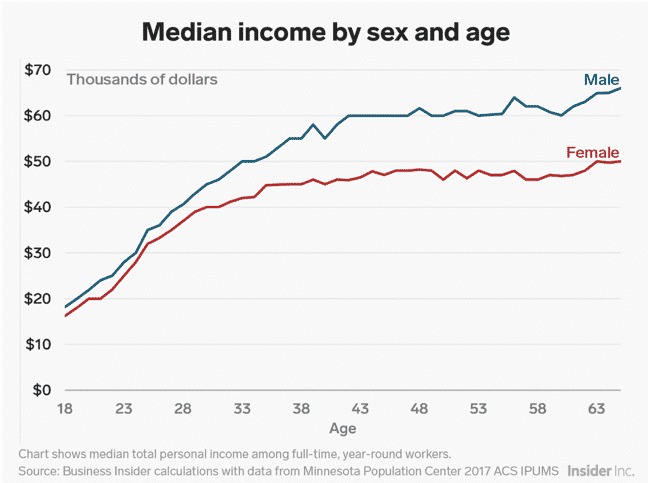
    Women’s Pay Peaks Earlier

    Despite advances in equal pay, women still earn less and peak earlier.

    Research conducted by PayScale reveals that the average woman will reach peak earnings at 44, while men won’t peak till 55. Average peak earnings are $66,700 for women and $101,200 for men.

    Women Live Longer

    In every country on earth, females outlive males – and the gap has been widening over the last century.

    gender pay gap

    *Source: https://usa.ipums.org/usa/index.shtml

    In some countries, the difference is huge – in Russia, women live more than ten years longer than men, for example. In the US, the difference is about five years. Because women live longer, they have to save differently for their future.

    Women Are More Likely To Take a Career Break

    While not true for everyone, many women are more likely to take a career break than their male counterparts because they want to have children. This means women can’t necessarily rely on investing at a steady rate throughout their career.

    Women Have Different Attitudes to Investment

    Accenture has found that women are, on average, more conservative than men.

    Often they are more interested in investing to achieve particular goals, such as buying a house or retiring, than they are in maximizing gains.

    ellevest review

    Where Can Women Find Wealth Management Tailored to Their Needs?

    Among the wealth management platforms aiming to serve women better is Ellevest, a robo-advisor service led by Sallie Krawcheck. Prior to founding Ellevest, Krawcheck had been CEO at Smith Barney and Merrill Lynch Wealth Management.

    She created Ellevest with a mission to “unleash women’s financial power and get them invested in their biggest goals“. To achieve this, Ellevest is not only marketed at women, but takes into account their income, earnings curve, and lifespan differences when constructing portfolios for their customers.

    Like other similar services, it only takes a few minutes to get started. Here’s how it works:

    • Step 1: You tell Ellevest about yourself, your current financial situation, and your long-term goals.
    • Step 2: Ellevest suggests a personalized investment portfolio to help you reach your goals
    • Step 3: You can accept Ellevest’s suggestions or edit it until it works for you. You can change the timelines, contributions, targets, and more.

    Ellevest Features

    Ellevest is a full-featured robo-advisory service. Features include:

    • No minimum account balance for Ellevest Digital ($50,000 for Ellevest Premium)
    • Account management fee 0.25% (0.50% for Ellevest Premium)
    • Investment expense 0.06% to 0.16% (core portfolio) and 0.18% to 0.25% (Impact portfolios)
    • Personalized portfolio
    • Zero penalties for withdrawal
    • Automatic deposits
    • Automatic rebalancing
    • Ellevest Tax Minimization Methodology
    • Personal accounts and IRAs (traditional, Roth, and SEP)
    • Ellevest Impact Investing Options (See below)
    • Opt-in emergency fund management (with no fee)
    • 1:1 access to Certified Financial Planner (Ellevest Premium only)
    • 1:1 access to Executive Coaches (Ellevest Premium only)

    Ellevest’s Impact Investing Portfolios allow investors to invest part of their portfolio into funds that advance women in the workplace. These funds are made up of both worthy causes (which help women), and companies led by women leaders.

    For example, one investment supports an assisted lifestyle community for seniors, and another focuses on delivering sustainable housing for women and their families who have been affected by substance abuse.

    Of course, these aren’t just for good causes – the focus is still on giving investors a good return for their investment.

    Ellevest FAQ

    Fees 0.25% – 0.50%
    Minimum Investment $0
    Tax-loss Harvesting Yes on all taxable accounts
    Best For Women
    Human Advice YES
    Portfolio Rebalancing YES
    401(k) Advice YES
    Interface Web-based
    Customer Support Phone + Email
    Automatic Deposits Monthly, Bimonthly & Quarterly

    Is Ellevest Right For You?

    Like other roboadvisors, Ellevest offers relatively low-cost investment that is easy to get started with, and of course, you don’t have to be female to take advantage of it (although it is marketed at women).

    In particular, Ellevest is best for:

    • Women Investors – Ellevest has put significant effort into research and providing the investment options that women investors want. This includes investment strategies that take into account the lower earnings, flatter earning curve, and other challenges. Of course, it also takes this into account for male investors (offering a different plan for their earnings and projected earning curve).
    • Advancing Women in Business – Ellevest’s Impact Investing Portfolios is a great way to support women in business if this is something you are passionate about.
    • Achieving Specific Financial Goals – Unlike many roboadvisors, Ellevest supports short-term goals, as well as retirement goals. This means it can set up a plan for you to buy a new car, purchase a house, or even take your dream holiday.

  • What Is UVXY?

    What Is UVXY?

    what is uvxy

    Investormint provides personal finance tools and insights to better inform your financial decisions. Our research is comprehensive, independent and well researched so you can have greater confidence in your financial choices.

    What Is UVXY? The ProShares Ultra VIX Short-Term Futures ETF [UVXY] is among the most infamous of all exchange-traded funds.

    You can buy the ETF the same way you would purchase a stock at a broker like thinkorswim or tastyworks. But don’t expect a buy-and-hold strategy will lead to portfolio returns that rival those of the Oracle from Omaha.

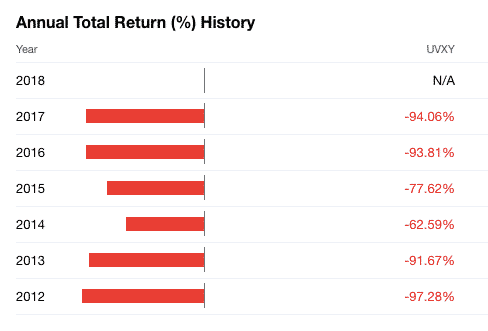
    Any daring investors who have bought and held UVXY for any lengthy timeline know its perils. In fact, we couldn’t find a single year since inception when the UVXY price was higher at the end of the year than when it began the year!

    Below we’ll cover the dangers of trading UVXY as well as the ways to make money from it, so let’s dive in!

    How Does UVXY Work?

    The ProShares Ultra VIX Short-Term Futures ETF tracks the performance of the S&P 500 VIX Short-Term Futures index for a single day.

    But it doesn’t track it on a 1:1 basis. Instead UVXY is 1.5x leveraged meaning that its results (before fees and expenses) correspond to one and one-half times the performance of the S&P 500 VIX short-term futures index.

    It is designed for investors who want to gain exposure to stock market volatility via the futures market.

    So how does UVXY work?

    In a nutshell, it measures the return from a rolling long position in the first and second month VIX futures contracts.

    Generally, this will mean that UVXY will fall over time but every once in a while expect it to skyrocket higher as volatility spikes.

    Because of its tendency to decline in price over the long-term it frequently undergoes a reverse split, meaning that the share count is reduced and the price is increased.

    UVXY reverse splits can be 1:2, 1:3, 1:4, or even 1:5, meaning that the price spikes 5X while the share count is reduced proportionately to keep the overall “market cap” the same.

    UVXY Explained

    Some traders assume that UVXY tracks the CBOE Volatility Index [VIX] but in fact that is not true.

    Instead, UVXY tracks VIX futures, which are a different animal altogether.

    Here’s why.

    If you were to bet on a spike in volatility, the VIX may rise big time. But the futures may build in a forecast that share prices will return back to median levels.

    So, when you bet on higher VIX prices, you may not see the same returns by gaining exposure to the futures market!

    With that said, historical results show that the UVXY correlates fairly closely (>90%) with the movements of the Volatility Index, or VIX.


    Getting complicated huh?!

    Trading the UVXY is not for the faint of heart.

    Before diving in you should know the risks. And most importantly, you should know why the UVXY price history shows a regular downtrend with infrequent spikes higher.

    Why Does UVXY Share Price Fall?

    A process known as contango loss negatively affects the UVXY share price.

    Contango loss is the process of VIX futures declining in value as they approach the value of the VIX.

    The declines in price on most days weigh down the underlying UVXY index and is amplified by the 1.5X leverage.

    What Is UVXY Stock Price History?

    While some stocks and exchange-traded funds are meant to be held for the long-term, UVXY is not among them.

    Companies like Facebook, Alphabet, or Amazon are plays on the long-term.

    When Facebook sells more advertising, it makes more.

    When more people click, Google enjoys rising revenues.

    And when Amazon ships more goods and sells more services, it sees its top line grow.

    By contrast, the UVXY stock price history is in perpetual decline. In fact, since UVXY was created, you can see the ROI year-over-year performance is highly negative.

    uvxy annual total return history

    NYSEARCA:UVXY Stock Quote Accuracy

    When you look up online a UVXY quote or UVXY after hours price, the number will generally match the S&P 500 Short-Term Futures Index.

    However, so-called whales will cause the price to spike from time to time when making large purchases or indeed cause it to dip when shorting a large number of shares.

    To ensure the UVXY stock quote closely matches the underlying index it tracks, market makers step in when needed to take the other side of the trades.

    Much of the order matching and market-making is done by computers however, so few human market makers are needed to ensure price stability.

    Can UVXY Fall To Zero?

    Yes. In fact, UVXY has historically been known to effectively “blow up” and wipe out buyers.

    Contango losses can cause the UVXY price to change dramatically in the blink of an eye.

    Buy-and-hold investors should look elsewhere.

    Usually, when the UVXY price is close to zero, a reverse split takes place to boost the share price back up to a higher level and the process starts all over again?

    >> 3 Ways To Trade The Most Volatile Stocks

    What Is The UVXY Expense Ratio?

    According to ProShares, the expense ratio for UVXY is 0.95%.

    With over $500 million in assets under management, this means that the managers would make over $4.75 million per year if every penny was invested.

    But UVXY usually holds a large cash position and collects interest when invested in Treasury bills and other fixed-income investments.

    Should You Buy UVXY?

    It is tempting to jump in feet first and buy the ProShares Ultra VIX Short-Term Futures ETF because the price can soar, and even double, in lightning speed.

    For risk-takers and gamblers, the appeal may be too great to resist.

    But for conservative investors looking for predictable income, it’s worth looking at more conventional dividend-paying stocks and perhaps selling covered calls on them for extra yield.

    The flipside is if UVXY has such a predictable history of declining, why not short it?

    Shorting can be highly lucrative. And if you had to choose between buying UVXY vs shorting UVXY, shorting is probably the wiser choice.

    But shorting UVXY is by no means a golden ticket. The danger of shorting it is that it can skyrocket higher in the blink of an eye, causing untold losses.

    In fact, the volatility is so high that whether you are tempted to buy or short, you will probably need to fasten your seat belt and prepare for a wild ride!

    How To Trade UVXY

    If the volatility spikes don’t scare you off, you can trade UVXY at almost every top online broker.

    Because UVXY is an exchange-traded fund that is based on the price of futures, a broker who understands derivatives, like options and futures, is going to be your best bet.

    Both the industry leader when it comes to tools and screeners, thinkorswim, as well as tastyworks, which is nipping at its heels are experts in options trading and futures trading.

    THINKORSWIM® SPOTLIGHT

    thinkorswim®

    InvestorMint Rating

    5 out of 5 stars

    • Commissions: $0 per trade
    • Account Minimum: $0
    • Promotion: Trade free for 60 days, based on $3,000 deposit

    via thinkorswim secure site

    No matter which you choose, you will find top notch customer support staff able to help you buy or short UVXY.

    Does the UVXY chart scare you or entice you to trade the exchange-traded fund? Let us know if you have bought or shorted UVXY? How did it go? We would love to hear from you.

    >> Is Twitter Stock A Buy Or A Sell?

    >> What Are The Best Online Brokers?

    >> Fix Your 401(k) Easily With Blooom!


  • Wealthfront vs Robinhood Comparison

    Wealthfront vs Robinhood Comparison

    wealthfront vs robinhoodWealthfront is a robo-advisor that relies on computer algorithms to manage client investment portfolios while Robinhood is a trading app for investors who are actively buying stocks, options and exchange-traded funds (ETFs).

    Both companies offer mobile-first platforms, but which one is right for you? In this Wealthfront vs Robinhood review we compare costs, investment minimums, tax strategy and more to help you decide.

    Robinhood vs Wealthfront Features

    wealthfront brokerage trading system robo advisor
    robinhood logo

    Why Wealthfront? Wealthfront is one of the first and most successful roboadvisors; it currently has north of $11 billion in assets under management.

    It’s a solid choice for a hands-off investor who wants to park his or her dollars away and let them grow in peace.

    Why Robinhood? Robinhood has 4 million customer accounts, and processed over $150 billion in transactions since the company was first founded in 2013.

    Robinhood’s allure is commission-free trades with no minimum investment requirement. This may make it ideal for millennials who are interested in the stock market but don’t want to spend scant cash reserves on broker fees.

    ROBINHOOD
    robinhood logo

    InvestorMint Rating

    4 out of 5 stars

    • Stock, ETF, Crypto Commissions: $0
    • Account Minimum: $0
    • Robinhood Gold: Tiered monthly fees

    Fee Comparison

    How Much Is Wealthfront?

    Wealthfront bills clients at a flat rate of 0.25% per month on all investments held with its service. There are no hidden fees or other invisible costs.

    Your average monthly balance is used to calculate the fee, and it is deducted from your account on a monthly basis.

    For account holders with under $10,000 in assets, Wealthfront waives its management fees.

    What Does Robinhood Charge?

    Robinhood charges no commissions to buy and sell stocks, but it does charge an outgoing transfer fee of $75 for each automated customer account transfer.

    The company’s monetization strategy rests with its premium Robinhood Gold service, which offers investors extended-hours trading as well as the ability to trade on margin.

    Depending on the service tier you choose, you may be charged between $6 and $200+ a month for the Gold service.

    This is based on the amount of money you deposit and the level of “Instant Deposit” to which you have access. The higher your “Instant Deposit” power and account balance, the higher the fees you will pay.

    >> Compare Robinhood Vs M1 Finance

    Investment Minimums

    Robinhood Investment Minimum

    Robinhood doesn’t impose an investment minimum on standard accounts. But for its Robinhood Gold premium margin account service, a $2,000 minimum balance is required.

    This is in keeping with the regulatory minimums required both by the New York Stock Exchange and the National Association of Securities Dealers.

    Robinhood also offers Robinhood Crypto, which is an account designed for investors who are interested in cryptocurrency trading.

    To trade bitcoin, you will need $0.10 in your account, and to trade Ethereum, you will need $0.01.

    >> Compare Stockpile Vs Robinhood

    Wealthfront Investment Minimum

    In order to open a standard Wealthfront account, you’ll need to deposit $500.

    For premium account services, such as stock-level tax-loss harvesting and Smart Beta (an advanced indexing service), the minimums are $100,000 or $500,000, respectively.

    WEALTHFRONT SPOTLIGHT
    wealthfront brokerage trading system robo advisor

    InvestorMint Rating

    4 out of 5 stars

    • Management Fee: $0 for first $10,000
    • An additional $5,000 managed free for each friend invited who signs up
    • Management Fees thereafter: 0.25%
    • Account Minimum: $500

    via Wealthfront secure site

    Account Types

    robinhood logo wealthfront brokerage trading system robo advisor
    Individual Non-retirement YES YES
    Joint Non-retirement YES YES
    Roth IRA NO YES
    Traditional IRA NO YES
    Rollover IRA NO YES
    Trusts NO YES
    Custodial Accounts NO YES
    SEP IRA NO YES
    529 Plans NO YES
    401(k) NO NO
    (will advise)

    Wealthfront Account Types

    Wealthfront handles the following types of accounts:

    • Personal investment accounts
    • Joint accounts
    • Traditional and Roth IRAs
    • Simplified Employee Pension (SEP) IRAs
    • IRA and 401(k) rollovers
    • 529 college savings plans
    • Trust accounts

    >> Compare M1 Finance Vs Wealthfront

    Robinhood Account Types

    Robinhood is strictly an investment platform for standard brokerage accounts. It offers these securities:

    Tax Strategy

    Type robinhood logo wealthfront brokerage trading system robo advisor
    Tax Loss Harvesting N/A YES
    Free Account Balancing N/A YES

    Wealthfront Tax Strategy

    Wealthfront is firmly committed to reducing its clients’ tax liability and maximizing their after-tax returns. To accomplish this, it seeks to offset capital gains by selling securities that have suffered losses.

    Another investment that’s been correlated with the portfolio’s risk and return profile will then be substituted for the security that’s been sold. This practice is known as tax-loss harvesting.

    Wealthfront also looks for ways to minimize clients’ taxes when they are transferring assets from other brokerage accounts.

    The company will wait to transfer securities that have been losing value until they have become “long-term” assets as defined by the IRS. At that point, Wealthfront will sell those securities and pass the savings along.

    For asset investitures of more than $500,000 that qualify for the Smart Beta investment feature, Wealthfront offers both ETF and individual stock tax-loss harvesting.

    Opportunities to lower tax losses can be numerous with this strategy since stocks typically demonstrate more volatility than other securities.

    >> Compare Personal Capital Vs Wealthfront

    Robinhood Tax Strategy

    Robinhood supports brokerage accounts, and the only types of accounts it offers are individual taxable accounts.

    The company does not offer retirement accounts that come with specific tax benefits.

    You will be able to access a consolidated tax 1099 document that contains the information most often found separately on 1099-DIV, 1099-MISC, 1099-INT and 1099-B forms.

    As the client, you are responsible for making sure this information is entered properly on your tax returns.

    Tools and Calculators

    What Tools Does Robinhood Offer?

    You won’t find robust research materials or sophisticated analysis software on Robinhood.

    The company’s web interface, which launched in the spring of 2018, contains more bells and whistles than the smartphone app but is still skimpy in comparison with the tools offered by some other leading online discount brokerages.

    Both the mobile app and the web interface offer the following tools:

    Earnings: Robinhood describes this as a report card. It’s a dynamic page that aggregates financial information on a specific company’s earnings and its next earnings announcement date.

    Watchlist: Allows you to customize a catalog of stocks and cryptocurrency opportunities that you want to keep an eye on.

    Candlestick Charts: Candlestick charts are a type of financial chart that describe a security’s price movements on a particular day so that you can keep an eye on variables like the opening price as well as the high, the low and the closing price.

    Additionally, the web interface aggregates analysts’ rankings so that Robinhood clients can break them down into Buy, Hold and Sell percentages.

    The web interface also offers curated collections of stocks with names like “100 Most Popular,” “U.S.” and “North America” as well as a “People Also Bought” option for any stock you’re researching.

    What Tools Does Wealthfront Offer?

    Wealthfront’s Path tool is a piece of scenario-planning software that lets you do reality testing on the assumptions you’re making about your financial future.

    The Path tool combines your risk profile and your real transaction history over the past 12 months with assumptions about inflation rates, changes in consumer spending habits and other economic criteria gleaned from the Bureau of Labor Statistics’ Consumer Expenditure Surveys.

    This allows you to see the potential impact various decisions may have on your financial future.

    Stocks, Bonds, ETFs – What Can You Trade?

    Wealthfront Asset Classes

    Wealthfront clients have access to three portfolios:

    Stocks Bonds
    Balanced Portfolio 50% 50%
    Growth Portfolio 80% 20%
    Conservative Portfolio 65% 35%

    The portfolio the robo-advisor assigns each individual client is determined by the amount of risk that the client is comfortable assuming (based on client responses to his or her initial interview questions).

    Each portfolio is balanced according to the principles of Modern Portfolio Theory with between six and eight ETFs representing stocks, bonds and assets like Treasury Inflation-Protected securities.

    >> Compare Betterment Vs Wealthfront

    Robinhood Asset Classes

    Robinhood lets clients create their own portfolios from stocks, ETFs, call and put options and cryptocurrency.

    It does not offer access to mutual funds or bonds.

    Customer Support Comparison

    Wealthfront and Robinhood both offer phone and email support for clients who are experiencing technical issues with the apps or with the web interfaces.

    You can call Wealthfront’s help line between 11 a.m. and 8 p.m. EST, Monday through Friday.

    Robinhood’s helpline is available Monday through Friday between 8 a.m. and 6 p.m. EST.

    Mobile App Comparison

    Robinhood’s user-friendly mobile app is available both for iOS and Android smartphones.

    The mobile app supports market orders, limit orders, stop limit orders and stop orders, and it also allows users to program customizable alerts.

    Users can sign up for a news feed. They can also listen in to earnings calls on their smartphones.

    Wealthfront clients can monitor their accounts throughout the day on their iPhones or Android smartphones.

    Users can generate charts and tables that will help them track their investment portfolios’ performance. Wealthfront also offers a subscription investment news feed.

    Overall Winner

    What’s the best way to grow wealth? Would you be better advised to turn financial decision-making over to an advisor or to take control of the process yourself?

    The answer to that question depends on whether you have the knowledge, the time, the inclination and – most important of all – the temperament to manage your own investments.

    If you’re lacking in any one of those areas, then you’d probably be better off working with a planner, which means you’d be better off with Wealthfront than you would be with Robinhood.

    Both Wealthfront and Robinhood considerably lower the barriers to entry into the realm of financial investments. Both also offer a robust suite of services.

    There is no clear winner here in terms of the quality of the products offered, but since Robinhood requires no investment minimum, it may be more tempting to beginning investors who are confident in their own ability to make smart investment choices on their own.

    The key word, though, is “confident.” Robinhood’s platform is very basic: The service doesn’t offer a lot of data on its site, which means you may have to track down third-party research. That can turn into a time-consuming process.

    If you are unsure about where to begin, then a robo-advisor like Wealthfront may be the better starting point. In fact, you could fund your tax-advantaged retirement account through Wealthfront and then open an account with Robinhood to learn the basics of stock trading.

    Which Robo Advisor
    Is Best For You?

    Wealthfront is the best choice if:

    • You want to work with a low-cost service that has an excellent reputation as a roboadvisor
    • You’re a hands-off investor who’s comfortable sticking with one risk strategy while saving toward a long-term goal like retirement or college education for your child
    • You’re looking for a service that will optimize your tax savings

    Robinhood is the best choice if:

    • You want to take advantage of commission-free stock, ETF and options trades.
    • You want to begin trading securities, but you don’t have a lot of money available with which to open an account
    • You’re very comfortable using a smartphone for sophisticated transactions.
    Costs Account Minimum Rating Best For Open Account
    wealthfront brokerage trading system robo advisor
    Full Review
    $0 for first $10,000
    0.25% thereafter
    $500 Hands-off Investors
    robinhood logo
    Full Review
    $0 Commissions $0 Beginner Stock Traders
  • TradeStation vs Interactive Brokers Comparison

    TradeStation vs Interactive Brokers Comparison

    tradestation vs interactive brokersInteractive Brokers and TradeStation are online brokerages that target experienced and active investors.

    Both services provide their clients with wide-ranging access to capital markets as well as research instruments, sophisticated ordering tools and relatively low costs on a per-trade basis.

    But which is better? We compare TradeStation vs Interactive Brokers to help you decide.

    TradeStation Quickview

    TradeStation has more than three decades of experience catering to brokers, hedge funds and other similar financial practices.

    It was introduced online as a serious investment platform almost exclusively for financial professionals.

    Since it began, the brand has sought to cast a wider net, and it has even cut account minimums in order to make its services more attractive to the common investor.

    TRADESTATION SPOTLIGHT

    TradeStation Logo

    Investormint Rating

    3.5 out of 5 stars

      • Promo: Save 20% on commissions up to $1,500 when you open a new account
      • Pricing: $5 per trade
      • Fast, accurate order execution, advanced trading tools and extensive research
      • Minimum Initial Account Balance: $5,000 Standard Account; $5,500 IRA


    via Tradestation secure site

    Interactive Brokers At A Glance

    Interactive Brokers is a market leader that provides clients access to more than 120 market centers.

    The company was founded 40 years ago, and its core clientele is comprised of individuals and organizations that trade professionally.

    Nevertheless, Interactive Brokers attracts non-professionals who are active or aspiring due to low barriers to entry, including account minimums and per-trade fees.

    Interactive Brokers vs
    TradeStation Features

    Both TradeStation and Interactive Brokers offer stock trading, options trading and futures trading.

    TradeStation Interactive Brokers
    Stock Trading
    Options Trading
    Futures Trading
    International Focus
    Web-based Platform
    Windows Desktop
    Mac Desktop
    iOS Mobile
    Android Mobile
    Best for Research Tools
    Best for Custom Chart Studies

    One way in which these two companies diverge significantly is that Interactive Brokers is recognized as a leader in international trading whereas TradeStation focuses exclusively on domestic capital markets.

    Interactive Brokers offers a web-based platform, desktop software for both Windows and Mac and mobile trading for both iOS and Android.

    TradeStation does not support Mac operating systems, but its other platforms are otherwise very similar.

    Interactive Brokers offers excellent research tools while TradeStation is generally regarded as lacking in this area. Both excel in regard to charting indicators.

    TradeStation distinguishes itself with custom studies. You can even create (via programming) your own indicators from square one and have those represented visually in charts.

    INTERACTIVE BROKERS SPOTLIGHT
    interactive brokers

    InvestorMint Rating

    4 out of 5 stars

    • Promo: Interactive Brokers does not typically provide promotional offers within the US, though clients under 25 are not subject to inactivity fees if monthly commissions are equal to at least US $3
    • Account Balance Minimum: $10,000 (at the end of month 8, total commissions are subtracted from the $10,000 deposit to reach the required commission minimum)
    • Stock Commissions: $1 Minimum & $0.005 per share
    • Options Commissions: $0.70 per contract with no minimums

    Fee Comparison

    Interactive Brokers doesn’t charge a flat trade fee; they charge a per-stock fee instead.

    TradeStation, on the other hand, opts for a flat fee. However, TradeStation does offer more flexibility when it comes to commissions and fees, and it allows investors to choose from a number of options beyond the default type.

    TradeStation Interactive Brokers
    Stock Trades Flat-fee or Per Share Per Share Fee
    Options Trades Flat Fee or Per Contract Per Contract
    Mutual Funds $14.95 per trade $14.95 per trade
    (min: $3,000)

    Stock Traders

    TradeStation charges a flat $5 fee for all stock trades. If direct market access is required, then there is a $0.004 per-share surcharge.

    If you prefer per-share pricing, TradeStation offers $0.01 per share for the first 500 shares and $0.006 for all subsequent shares. There is a $1 minimum per order.

    TradeStation also offers unbundled pricing.

    The base rate is dictated by the number of trades completed in the previous month. The rate starts at $0.01 per share with a $1 minimum when trading fewer than 100,000 shares in a month, and this price can fall as low as $0.002 with a $0.50 minimum at 5 million shares.

    Options Traders & Mutual Fund Investors

    If you are looking for options, TradeStation customers can choose flat-fee or per-contract pricing. The flat fee is $5 plus $0.50 per contract.

    There is an additional $0.50 per-contract fee for index options as well as an additional charge of $0.50 per contract if direct routing is required.

    With TradeStation, all mutual funds cost $14.95 per trade, and there may be other fees depending on the fund.

    Interactive Brokers charges a per-share rate without the option of a flat fee. That rate is $0.005 per share. There is a $1 minimum per share, and a maximum commission of 0.5% of trade value.

    This platform also offers a tiered structure for investors who want more control over exchange costs and rebates. At less than 300,000 shares traded per month, pricing starts at $0.0035 per share, and when trading more than 100 million shares per month, it can fall to as low as $0.0005 per share.

    Trades through Interactive Brokers use a tiered pricing structure as well.

    For investors who trade fewer than 10,000 shares per month and use the default routing system, the per-contract price is $0.70, $0.50 or $0.25 depending on the contract price. There is always a $1 minimum and never a maximum.

    With Interactive Brokers, each mutual fund trade costs $14.95, and the minimum initial purchase is $3,000.

    Platform Comparisons

    TradeStation vs Interactive Brokers

    Both Interactive Brokers and TradeStation offer virtual trading.

    Interactive Brokers offers a debit card whereas TradeStation does not. Neither one offers online banking services, such as checking, savings and credit cards.

    For mobile trading, both feature an Android app suitable for smartphones and tablets as well as an iOS app that is compatible with the iPhone and the iPad. Interactive Brokers can also be used on the Apple Watch.

    Interactive Brokers distinguishes itself with Probability Lab, which assists investors in deciphering markets and assessing risks.

    TradeStation differentiates itself not only with its analytical tools but also with back-testing software that includes a C-like language called EasyLanguage.

    Investment Securities Comparison

    In terms of the investment securities offered, TradeStation and Interactive Brokers are similar. Interactive Brokers does tend to offer more options overall when it comes to stocks, mutual funds and so on.

    Both TradeStation and Interactive Brokers offer both regular stocks and penny stocks.

    The biggest difference is that Interactive Brokers provides access to the international stock markets whereas TradeStation is limited to foreign companies that have a listing in the United States.

    Interactive Brokers and TradeStation both offer options trading. Investors interested in complex or multi-leg options strategies should note that TradeStation only supports four individual legs while Interactive Brokers supports eight individual legs.

    Clients of Interactive Brokers have access to more than 10,000 mutual funds. TradeStation offers about half that number at just under than 5,000 funds.

    In addition, Interactive Brokers offers more than 8,700 no-load mutual funds whereas TradeStation offers just more than 1,000.

    TradeStation Interactive Brokers
    Multi-leg Options Strategies Up to 4 legs Up to 8 legs
    ETFs N/A Screener
    Bonds Treasury, Municipal, Corporate Treasury, Municipal, Corporate
    Forex Trading
    (via 3rd parties)

    TradeStation does not currently offer any commission-free ETFs. Interactive Brokers currently offers 45 ETFs that trade without a commission.

    Both TradeStation and Interactive Brokers offer exchange-traded funds, or ETFs.

    ETFs are often simple, low-cost alternatives to mutual funds. Interactive Brokers does have a larger selection due to providing European ETFs, and it offers an ETF screener that TradeStation does not.

    The screener allows investors to pare down ETF options based on many criteria, including:

    • Attributes
    • Asset class
    • Structure
    • Risk metrics
    • Popular themes

    Both TradeStation and Interactive Brokers offer treasury, municipal and corporate bonds as well as other fixed-income products, such as corporate debt and government bills.

    Interactive Brokers distinguishes itself with a bond screener that lets you filter bonds based on selective criteria.

    Neither Interactive Brokers nor TradeStation offers forex trading directly. You can trade forex through the IB Trader Workstation, but this is facilitated via third parties.

    Investors seeking leveraged forex trades will need to have assets worth $10 million or more.

    Investment Minimums

    Interactive Brokers does not require any deposit or account minimum at all, but there are inactivity fees.

    TradeStation formerly enforced a $5,000 minimum but has since lowered the initial deposit to $500.

    TradeStation Interactive Brokers
    Account Minimum $500 $0
    Inactivity Fees YES YES

    For individual investors, Interactive Brokers does not require a minimum deposit.

    In order to avoid account maintenance fees, you must generate $10 in commission in a given calendar month or have greater than $100,000 in average equity associated with your account in a given calendar month.

    If you fail to meet these requirements, then the broker will charge a fee for that month, which will be $10 minus whatever commission you did generate. These requirements are waived for the first three months of your membership.

    The minimum deposit when you open a TradeStation account is $500. The minimum account for options trading and futures trading is $2,000 and $5,000, respectively.

    You must also meet a certain level of activity each month or be charged $59.95 by TradeStation. This fee can be higher depending on which additional services you activate for your account.

    The milestone required each month in order to avoid the base fee as well as some additional fees is:

    • $100,000 account balance; or
    • 5,000 shares traded; or
    • 50 options contracts traded; or
    • 10 futures options contracts traded

    Account Types

    Both TradeStation and Interactive Brokers offer a number of different account options, and you can generally adjust your account as needed after you have opened it.

    Neither offers banking accounts or services, so there is no FDIC protection. However, there is insurance for the first $500,000 through the SIPC as well as additional protections afforded through insurance from Lloyd’s of London.

    TradeStation offers five primary account types:

    • Individual
    • Joint
    • IRA
    • Entity
    • Custodial

    Interactive Brokers offers five primary account types:

    • Individual
    • Joint
    • Trust
    • IRA
    • UGMA/UTMA

    Customer Support Comparison

    Be mindful that both Interactive Brokers and TradeStation cater to advanced and active traders, so there is no hand-holding for clients.

    Support from Interactive Brokers is available 24 hours Monday through Friday, but it shifts to its overseas markets at night.

    In addition to phone support, email and chat are available. Support offerings from TradeStation are similar but run from Sunday through Friday.

    Mobile App Comparison

    The app for Interactive Brokers is generally considered one of the best in the industry. It provides a streamlined and tailored experience for smaller screens but still manages to expose most features.

    One frustrating aspect is that you cannot have the mobile and desktop versions active at the same time.

    TradeStation takes a different approach and essentially seeks to deliver its desktop experience on smartphones and tablets.

    This can make the site seem a bit cramped and difficult to navigate, but it is also quite powerful and robust for investors who are comfortable with the layout.

    Overall Winner:
    Which Broker Is Best For You?

    Interactive Brokers offers wider market access, and costs are generally lower for the average trader.

    TradeStation, however, is superior in terms of its analytical tools, and investors who employ automatic strategies will enjoy a number of different technologies that make such endeavors easier and more productive.

    Many hardcore traders consider TradeStation to be the gold standard. If you code automatic strategies, TradeStation is an excellent choice.

    Interactive Brokers is attractive in terms of cost. It is well-suited to active traders but is also a platform you can grow with. What it lacks in analytics can be compensated for with web and desktop tools.

  • When Should You Sell A Stock?

    When Should You Sell A Stock?

    InvestorMint provides personal finance tools and insights to better inform your financial decisions. Our research is comprehensive, independent and well researched so you can have greater confidence in your financial choices.

    Have you ever been tempted to sell shares and lock in gains when stocks in your portfolio rose?

    Have you ever impulsively sold stocks that were nosediving because you were afraid they would fall further and lead to bigger losses?

    If so, here’s what you need to know before selling a stock. When should you sell a stock?

    Selling A Stock Has Bigger Tax Implications Than You Might Think

    Paying taxes on gains, especially short-term capital gains taxes, can drastically lower your portfolio net worth over long time periods compared to a buy-and-hold strategy.

    When you are selling a stock that has risen in price from the time you bought it in a brokerage account, you will need to pay taxes on the gains. The impact of these taxes over time is much bigger than most investors realize.

    To understand just how much regular tax payments on gains hurt portfolio growth over time, imagine going back in time when a 30-year old Warren Buffett had a goal to build enormous wealth.

    The year is 1960 and young Warren Buffett is looking to the future imagining how to become the most successful investor of all time. He calculates how much money he will make if he can earn 15% each year for the next 60 years.

    Although we don’t quite know when Mr. Buffett made this calculation, it is clear from his investing method he ran the numbers at some point because his investing approach resulted in him becoming one of the richest investors in the world.

    Let’s imagine back in 1960 Mr. Buffett compared two portfolios growing at 15% annually. One portfolio is taxed each year by Uncle Sam at the rate of 30% on short-term gains, and the other is not taxed until 60 years later at a long term capital gains rate of 20% (we’re making these numbers up as the year is 1960!).

    Although this is a hypothetical example, it is helpful to compare the effect of taxes over time.

    You can see in the table below that holding a portfolio growing at 15% each year and not paying taxes until the final year results in $100 growing to an astounding $381,217.

    By contrast, paying taxes on gains each year results in the second portfolio growing to $61,576, meaning that the cost of paying Uncle Sam regularly is to amass a portfolio about one sixth the size it otherwise could be!

    Year Buy-and-hold Tax Liability Buy-and-sell Tax Liability
    1 100 0 100
    10 352 0 272 8.4
    20 1,423 0 804 24.8
    30 5,758 0 2,380 73.4
    40 23,292 0 7,038 217.0
    50 94,231 0 20,818 641.9
    60 381,217 0 61,576 1,898.5

    While paying taxes by selling winners regularly can hurt portfolio growth over the long term, it is generally a bad idea to hold onto a stock simply to avoid paying taxes – especially if it is fundamentally weak.

    Nevertheless, the next time you are tempted to sell a stock simply to lock in gains, take a step back and think about how the cumulative effect of paying taxes regularly on portfolio gains can severely hinder the growth of your portfolio over the long term.

    TAXES ON STOCKS IN THE RED

    Stocks in the red – those that have fallen in value and are underwater – will not be subject to taxation in a brokerage account.

    But selling losers can help you offset taxes owed on winners. You can offset capital gains on winning stocks by selling losers in a process known as tax loss harvesting.

    Many of the leading robo advisors, such as Wealthfront and Betterment, specialize in tax loss harvesting.

    Not only do these robo advisors manage your portfolio automatically but they harvest tax losses so well that in some cases the benefits can entirely offset management fees over time.

    >> Related: How To Pick The Best Robo Advisor

    TAXES ON RETIREMENT ACCOUNTS

    If you are selling a stock in a retirement account, such as a 401(k) or IRA, taxes are not something you need to worry about until you start taking withdrawals.

    You can buy and sell as often as you wish without concern for the tax impact. However, you will still pay commissions when buying and selling.

    >> More: Is A Roth IRA Better Than A Traditional IRA?

    Am I Selling A Stock Too Soon?

    Nobel prize winning research shows that it feels better to lock in gains when stocks rise in value than to risk them falling back to breakeven or worse. When you understand your own cognitive biases to make irrational investment decisions, you can consciously make better investment choices.

    SELLING A STOCK BASED ON COGNITIVE BIAS

    A Nobel prize winning theory, called Prospect Theory, states that people hate losing more than they like winning.

    So, how does Prospect Theory affect your investment decision-making?

    It turns out that by fearing losses more than we enjoy gains, we humans have a tendency to sell winning investments too soon.

    It feels good to lock in profits and bank gains by closing out positions. But what feels good short term can hurt us over the long term.

    As John Maynard Keynes once stated:

    “The market can remain irrational longer than you can remain solvent”

    Another way of saying this is that stocks can move further than you ever imagine possible.

    As stocks rise, bearish voices clamour to rationalize why further upside is limited. But the old adage “stocks climb a wall of worry” has become famous because share prices often rise in spite of the doom and gloom prognostications of skeptics.

    Selling a stock too soon is a common stock trading mistake but once you understand Prospect Theory, you become more aware of the risks of making irrational investment decisions based on a human cognitive bias.

    SELLING A STOCK BECAUSE OF VOLATILITY

    When fear grips investors, stock market volatility can spike higher and catalyze impulsive reactions. Buying and selling a stock because of share price swings is a common trading mistake, so how do you improve your chances of side-stepping these pitfalls?

    First, ask yourself if anything fundamentally has changed? Is the stock rising or falling because the overall market has started to soar or a stock market crash is in full force?

    If you buy a stock based on its share price, you may sell it based on its share price too. And if the overall market is soaring higher or crashing lower, your stocks will probably tag along for the ride.

    But just because the S&P 500, Dow Jones Industrial Average, Russell 2000 or NASDAQ is rising or falling doesn’t mean the thesis behind why you bought a stock has changed. Maybe it has, but maybe the market swings and roundabouts are just noise to be ignored.

    SELLING A STOCK BASED ON NEWS EVENTS

    A news event about a stock you own may be important enough to warrant selling a stock, but to know one way or the other with certainty you should understand how to research stocks.

    If a company missed earnings this quarter or management lowered forward guidance, nervous nelly shareholders may have a negative knee-jerk reaction and sell.

    But if you understand how to research stocks properly, you will know how to distinguish fundamental shifts from news events that only have a temporary impact on share price.

    For example, a company like Pepsi may miss earnings from time to time but if its brand value remains strong in consumers’ minds, its distribution network unaffected, its sales remain strong, and its market share resilient, the earnings miss may just be a temporary bump in the road.

    >> MORE: What Are The Best Stocks To Buy?

    Am I Selling A Stock
    To Buy A Better Stock?

    It is better to buy, at a fair price, a company whose intrinsic value is constantly increasing than to buy at a discount a decent company whose intrinsic value is not growing by much.

    When you buy a stock, you miss out on another. But what if the other stock rises more than the stock you own? That is the opportunity cost you must come to terms with when you buy a stock.

    When you see another stock rising in share price more, it doesn’t necessarily mean you should jump ship, sell your stock, and buy another.

    Forget about share price for a moment, and focus on what the company is truly worth – its intrinsic value.

    What you want to find are what Warren Buffett calls:

    “Wonderful businesses at a fair price”

    By fair price, Buffett means share prices close to intrinsic value. And by wonderful, he means that over time the intrinsic value of these companies will grow.

    Perhaps it seems obvious, but this philosophy was not the original investing framework that Buffett used.

    When he began investing, Buffett bought:

    “Fair businesses at a wonderful price”

    These were business trading below intrinsic value that had pretty good business models. By buying decent businesses at a discount to fair value, Buffett could make money when the share price rose but he learned that it’s much better to buy a business whose fair value is increasing too.

    Greater long term wealth is accumulated by buying businesses whose intrinsic value increases over time than is amassed by buying businesses temporarily “on sale” in the market.

    Should I Sell Stock Because
    My Portfolio Is Not Balanced?

    Make sure your overall portfolio is balanced and in alignment with your overall financial goals and risk profile, especially when one stock appreciates in value so much that it skews the weightings in your overall portfolio mix.

    When you start investing, you may have your money spread across a number of stocks. But as time goes by, some stocks soar. Maybe you bought Facebook or Google when they came public.

    When a company grows its intrinsic net worth fast, it generally doesn’t take too long before its share price reflects the increased value.

    But when one company in your portfolio grows much more rapidly than others, your overall portfolio can fall out of balance.

    It is tempting to hang on to a winning stock but if it becomes such a large part of your portfolio that swings in its share price significantly impact your overall portfolio, then it may be time to pare back the holding so your overall portfolio is aligned with your risk profile and financial goals.

    To avoid the tax impact of selling your stock, you could look to hedge it from time to time during downturns using married put options strategies.

    Another way to hedge somewhat and also generate income is to sell calls against your shares as part of a covered call strategy.

    >> Related: Learn How To Trade Options

    Will Selling A Stock
    Trigger A Wash Sale?

    Avoid selling a stock if you plan to repurchase it again within 30 days, otherwise it triggers a wash sale.

    As a calendar year end approaches, it becomes tempting to sell losing stocks in order to generate tax losses that can be counted against winners you have sold.

    But selling a stock and buying it again a short time later – within 30 days – triggers a wash sale, meaning your tax losses cannot be counted.

    The IRS views selling a stock in order to capture tax losses and subsequently repurchasing it within 30 days as an attempt to “game” the tax system and disallows it.

    To “get around” this tax rule, some robo advisors, such as Betterment and Wealthfront, provide advanced tax-advantaged portfolio management strategies, such as Direct Indexing, whereby losers are sold and similar (but not the same) securities are bought.

    By so doing, tax losses can be counted while reducing the risk of missing out on upside share price movement in a given sector.

    BETTERMENT SPOTLIGHT
    betterment

    InvestorMint Rating

    5 out of 5 stars

    • Promo: Up to 1 Year Free Management
    • Management Fee: 0.25% – 0.40%
    • Account Minimum (Betterment Digital): $0
    • Account Minimum (Betterment Premium): $100,000

    via Betterment secure site

    Plan On Selling A Stock
    Before You Buy

    Whether selling a stock or buying a stock, dollar cost averaging is a smart strategy.

    Timing the market well is really hard. Any day trader who has been around the block will be able to share stories of regret about buying too soon or selling too late.

    How many Twitter stock traders wish they bought or sold earlier? How many AutoZone stock traders have suffered from the swings in its share price?

    The reality is nobody can time the market perfectly, so looking back at what should’ve, could’ve or would’ve been only wears investors down psychologically.

    Rather than choose an all-or-nothing strategy, much better to build up a stock holding by dollar cost averaging in.

    When you dollar cost average, you buy shares slowly and steadily over time until your full position is owned.

    You won’t ever buy at the bottom, but equally you won’t ever buy at the peak when the risk is highest.

    Before a first purchase is made, you should have your plan to sell the stock.

    Without a strategy to sell, you are more likely to succumb to emotional trading and a knee-jerk reaction.

    A simple plan to sell is to pick a share price and dump your shares when the price is hit.

    But many traders have suffered from picking a big round number as a target only to see the share price come within a few pennies of the target yet fall short before cratering lower.

    To avoid the heartache of “almost” selling for a profit, and snatching defeat from the jaws of victory, consider dollar cost averaging when you sell too.

    Your decision to sell a stock doesn’t have to be binary whereby you sell all your shares at once.

    Instead, you can decide to sell some shares consistently over a fixed time period, say a few weeks or a few months.

    You will never sell right at the top by choosing to dollar cost average out but the chances are slim of consistently selling at the top anyway.

    >> MORE: How To Short Stock

    Are You Selling a Stock Because of Greed or Fear?

    Emotions like greed and fear have helped humans evolve into what we are today. Without them, your distant ancestor might not have hoarded the food needed to keep her family fed or she may have wandered into a field full of lurking predators.

    As animals, we need greed, fear, and other emotions.

    As investors, we need to build a wall between our feelings and our actions.

    When a stock’s price changes suddenly, you may experience strong emotions that tell you to sell a stock. Perhaps the price just skyrocketed, and you want to earn a quick return on your investment. On the other side, the stock’s price might have plummeted, and you want to sell your stake to make sure you don’t lose more money.

    Letting your emotions rule your behavior will almost always point you down the wrong path. Instead of letting greed or fear guide you, use logic and patience to get the highest returns on your investments.

    If you know that you own stock in a company with good business practices and room to grow, then you need to sit back and watch the stock’s value increase over time.

    Emotions might have worked well in the distant past, but they have no place in today’s marketplace. Do your homework, have faith in logic, and gain wealth over many years instead of responding to immediate changes in the market.

    Are You Selling a Stock Because You Got a Hot Tip?

    If you talk to enough investors, you will hear a constant stream of hot tips. “Company X is going to tank next week because its new product hasn’t met expectations!” “Company Y’s value is set to flatline tomorrow because the CEO got caught in a compromising position!”

    How often do these insider predictions come true? If the people you talk to had such great information, then they wouldn’t want everyone else to know about it.

    Ignore hot tips and focus on legitimate news sources. Your brother-in-law doesn’t know what’s going to happen to AAPL’s value. He’s probably getting his information from websites that post wild speculations.

    Rely on vetted information from professionals; follow the news; and pay attention to trends. You may not make a quick buck this week, but you will build a robust portfolio that continues to earn money throughout your life.

    Be Smart When Selling A Stock

    The long and the short of selling a stock is to be smart about the steps you take before pulling the trigger:

    • Plan when you will sell before you begin buying
    • Consider dollar cost averaging in and out
    • If you plan to sell, avoid buying within 30 days or it will trigger a wash sale
    • Know your opportunity cost when you buy or sell a stock
    • Calculate the tax impact both short-term and long-term of selling a stock
    • Verify your decision to sell is based on a fundamental reason

    What factors do you consider when selling a stock? What investing tips and trading lessons can you share? We would love to hear from you in the comments below.

    >> What Are The Best Value Stocks?

    >> What Is An Initial Coin Offering?

    >> Discover Stocks To Buy Now

  • Vanguard VTI vs VOO: Which Is Best?

    Vanguard VTI vs VOO: Which Is Best?

    vanguard vti vs vooExchange-Traded Funds (ETFs) offer an interesting alternative to mutual funds. Both allow you to buy shares in a pool of stocks, so you get automatic diversification without the pressure of selecting individual securities.

    While most mutual funds are actively managed, there are some that passively track specific indexes. On the other hand, most ETFs passively track specific indexes. Very few are actively managed.

    The biggest difference between the ETFS and mutual funds is how shares are traded.

    Mutual fund shares are bought and sold once a day, after the market closes. ETFs can be traded throughout the day, so investors who want flexibility in timing purchases and sales are better off with this type of product.

    Are ETFs Better Than Mutual Funds?

    Actively managed mutual funds and actively managed ETFs have higher fees than their passively managed counterparts.

    Morningstar notes that the average for actively managed mutual funds is 1.09 percent, the average for actively managed ETFs is 0.76 percent, the average for passively managed mutual funds is 0.79 percent, and the average for passively managed ETFs is 0.57 percent.

    If you have determined that ETFs are right for you, the big question is which one to choose. There is a long list of options from a wide variety of reputable financial service providers, and even market experts struggle with this decision.

    Vanguard has a variety of products to suit every level of experience and to meet all sorts of financial goals. Two of Vanguards most popular ETFs include the Vanguard Total Stock Market ETF (VTI) and the S&P 500 ETF (VOO). Here’s what you need to know before you invest.

    VANGUARD INVESTMENTS
    vanguard investments

    InvestorMint Rating

    4 out of 5 stars

    • Account Minimum: $0
    • Expense ratios: 0.18% (on average)
    • Commissions: As low as $2

    via Vanguard secure site

    VTI vs. VOO: The Indexes

    VTI tracks the entire stock market, while VOO focuses on the major players that make up the S&P 500.

    This is Standard & Poor’s market-cap index of the 500 largest US companies that are publicly traded. Taken as a group, this covers approximately 80 percent of the market.

    The primary difference between the two ETFs here is the level of diversification in each fund.

    VTI offers exposure to all of the companies in the S&P 500, as well as a variety of other large cap, mid cap, and small cap stocks, while VOO is limited to large cap.

    VTI vs. VOO: The Details

    While VTI holds shares in a total of 3615 different companies, VOO has just 510.

    Expense rates are the same for both at 0.03 percent.

    VTI vs. VOO: Returns

    Though past performance doesn’t predict future performance, a look at each fund’s returns compared to each other and to the benchmark offers a glimpse into how performance differs.

    VTI

    • 1-Year VTI 12.67% Benchmark 12.72%
    • 3-Year VTI 14.77% Benchmark 14.77%
    • 5-Year VTI 11.20% Benchmark 11.20%

    VOO

    • Year to Date VOO 13.65% Benchmark 13.65%
    • 1-Year VOO 9.40% Benchmark 9.50%
    • 5-Year VOO 10.86% Benchmark 10.91%

    Overall, the total stock market approach has historically been more successful.

    VTI vs. VOO: Market Sectors

    While the S&P 500, and therefore VOO, ensures representation across industry sectors, the way each sector is weighted is not identical to the total market. Here is a comparison:

    Sector VTI VOO

    • Information Technology 20.40% 21.2%
    • Healthcare 13.20% 14.6%
    • Financial Services 19.00% 12.7%
    • Consumer Discretionary 13.40% 10.2%
    • Communication Services 1.90% 10.1%
    • Industrials 13.50% 9.5%
    • Consumer Staples 7.90% 7.3%
    • Energy 5.10% 5.4%
    • Utilities 3.20% 3.3%
    • Real Estate N/A 3.1%
    • Materials 2.4% 2.6%

    If you are interested in a certain level of exposure to specific industries, it may impact which fund you choose for your portfolio.

    > Compare VFIAX vs VTSAX

    VTI vs. VOO: Top Holdings

    The top 10 stocks held in each fund can offer a better perspective on the similarities and differences between ETFs.

    VTI

    • Microsoft Corp.
    • Apple Inc.
    • Amazon.com Inc.
    • Alphabet Inc.
    • Facebook Inc.
    • Berkshire Hathaway Inc.
    • Johnson & Johnson
    • Exxon Mobil Corp.
    • JPMorgan Chase & Co.
    • Visa Inc.

    VOO

    • Microsoft Corp.
    • Apple Inc.
    • Amazon.com Inc.
    • Alphabet Inc.
    • Facebook Inc.
    • Berkshire Hathaway Inc.
    • Johnson & Johnson
    • Exxon Mobil Corp.
    • JPMorgan Chase & Co.
    • Visa Inc.

    As you can see, the top ten holdings are nearly identical between the two funds.

    VTI vs. VOO

    VTI and VOO both incur risk simply because any investment in the stock market carries risk. Vanguard publishes the following analysis:

    “Stock markets tend to move in cycles, with periods of rising stock prices and periods of falling stock prices.

    The fund’s target index may, at times, become focused in stocks of a particular sector, category, or group of companies.

    Because the fund seeks to track its target index, the fund may underperform the overall stock market.”

    VOO may also have some additional risk due to the strategy of focusing on large-cap stocks. Vanguard says this about the investment style risk:

    “Large-cap stocks tend to go through cycles of doing better–or worse–than other segments of the stock market or the stock market in general.

    These periods have, in the past, lasted for as long as several years.”

    >> 9 Top Financial Magazines To Read

  • Best Online Brokers For Free Stock Trading 2020

    Best Online Brokers For Free Stock Trading 2020

    glass multi level walkways with people

    InvestorMint provides personal finance tools and insights to better inform your financial decisions. Our research is comprehensive, independent and well researched so you can have greater confidence in your financial choices.

    The trend towards ever lower commissions costs has finally reached the holy grail level for traders: free stock trading. Some brokers also support no-commission ETF trading and mutual fund investing, so whether you are an active stock trader or a passive mutual fund or ETF investor, you can find a low cost or no-cost way to enter the stock market.

    Best Broker For Free Stock Trading & Free ETF Investing

    The Robinhood app supports free stock trading and free ETF investing. Setup is easy. Transferring funds is fast. And trading is simple due to the highly navigable interface. However, mutual fund investing, options trading, futures trading and Forex trading is not supported on the Robinhood app. Schwab also offers a low-cost way to invest by providing over 200 commission-free ETFs. Another top-rated broker, E-Trade has over 100 zero-commission exchange-traded funds available.

    robinhood logo
    charles schwab

    ROBINHOOD APP – FREE STOCK TRADING & FREE ETF TRADING

    Robinhood is one of the most popular free stock trading apps and has been for quite some time, having surpassed the billion-dollar valuation mark back in 2017. Here are some of the reasons we think it’s one of the best apps out there for those who are interested in free stock trading.

    Free With Optional Upgrade

    Unlike many apps, Robinhood doesn’t limit your ability to trade while on a free plan. You can buy and sell to your heart’s content using the Robinhood app.

    The only difference is that you can’t buy on margin unless you upgrade to Robinhood Gold. However, using margin successfully is an advanced trading concept best left to those who have been making money on investments for some time, so you don’t miss anything significant if you choose not to upgrade.

    In fact, the free app allows you to get your feet wet without spending significant money so that you can learn as you go and then upgrade if and when you’re ready.

    Easy To Set Up

    One of the perks of the Robinhood app is that it is simple to set up your account.

    You can do it in a matter of minutes simply by downloading and opening the app.

    No Account Minimums

    Many trading apps require you to have a minimum account balance, making it difficult to get started if you don’t have a lot of cash set aside for investing.

    Robinhood doesn’t have this requirement. You can open an account with any balance (or no balance at all, if you’d like to set up the account now and use it later when you’ve got the cash).

    In addition, up to $2,000 of your balance is available immediately upon set-up, allowing you to start trading right away.

    A Few Limitations

    This service is only available on mobile devices. If you have a Chromebook computer that runs Android apps, you can get around this; otherwise, there is no way to use Robinhood from a desktop.

    Robinhood only allows you to trade in taxable accounts, so if you’re interested in mutual funds, futures, or forex, this service is not for you.

    But for the beginning trader who is content to trade stocks from his or her smartphone, Robinhood provides you with everything you need at zero cost.

    SCHWAB – FREE ETF TRADING

    Founder of the Vanguard Group and business magnate, Jack Bogle, pioneered low cost index investing and Schwab has made it easy to buy these funds by providing over 200 no-commission exchange-traded funds. Historically, commissions costs were applied to investors wishing to buy and sell ETFs.

    The low cost of investing in exchange traded funds is possible because they are passively managed. Unlike mutual funds which are actively managed and have higher expense ratios, ETFs can save you a lot in fees as time goes by.

    Over time, the cost of expense ratios can make a big difference to your net worth. Pay just 0.5% more each year on a $100,000 portfolio growing at an average rate of 8% annually and thirty years later your net worth could lower by as much as $300,000!

    Schwab imposes a slightly higher account minimum of $1,000 compared to Robinhood but compared to most brokers it’s a low threshold.

    If a wide selection of commission-free ETFs is less important to you than the account minimum, E-Trade, which has a lower minimum (compared to Schwab) of $500 may be a better choice for you. Plus, they still they offer over 100 no-commission ETFs.

    Best Brokers For No-Transaction Fee Mutual Fund Investing

    Fidelity offers an extensive range of no-transaction fee mutual funds. Even if you do purchase a no-transaction fee mutual fund, expense ratios still apply so unlike free stock trading, mutual fund investing may be commission-free but a cost still applies to hold the fund (whereas no cost applies to holding a stock).

    fidelity investments


    FIDELITY – NO-TRANSACTION FEE MUTUAL FUND INVESTING

    Fidelity is best known as a retirement plan administrator that oversees over $2 Trillion in client assets. But Fidelity also offers a full-service brokerage platform that features an extensive range of no-transaction fee (NTF) mutual funds.

    Almost 4,000 NTF funds are available at Fidelity, making them one of the largest providers of NTF mutual funds in the industry.

    Best Robo-Advisors For Free Passive Investing

    WiseBanyan and Schwab Intelligent Portfolios offer truly free portfolio management to passive investors who prefer an automated investing solution that is technology-powered over a self-directed portfolio management approach.

    wisebanyan logo
     
    charles schwab


    WISEBANYAN – FREE PASSIVE INVESTING

    WiseBanyan is a truly free automated portfolio management solution for the passive investor. It claims to be the world’s first free financial advisor and delivers by charging no trading fees, no management fees, no custodial fees, no hidden fees and receiving no kickbacks from mutual funds or ETF funds.

    The robo-advisor does charge 0.25% of managed assets for clients who wish to choose its tax-loss harvesting service, which is fully optional.

    SCHWAB INTELLIGENT PORTFOLIOS – FREE PASSIVE INVESTING

    Schwab Intelligent Portfolios was the first robo-advisor to accumulate over $10 billion in client assets and its zero management fee is a big reason why it has enjoyed such popularity.

    The way Schwab Intelligent Portfolios makes money is from the expense ratios of funds used in portfolios. Schwab includes in client portfolios many of its own funds, which it earns revenues on. As a result, it can offer portfolio management at no cost, a benefit few robo-advisor can offer.

    Schwab is also highly attractive to passive investors looking for an automated portfolio management solution because it offers the most extensive range of asset classes of any robo-advisor: approximately 20 asset classes and over 50 exchange-traded funds.

    On-the-go investors who want to link in with their portfolios via mobile devices can do so easily with Schwab, which offers one of the best mobile trading apps in the industry.

    Passive investors who value a tax-optimized portfolio should consider other robo-advisors, such as Wealthfront, but should note that portfolio management is fee-based above certain threshold levels at most robo-advisors.

    >> Discover The Best Robo-Advisors For Fees

    >> View The Best Penny Stock Brokers

    >> Learn How To Lower Your Tax Bill

  • 9 Top Financial Magazines To Read

    9 Top Financial Magazines To Read

    top financial magazinesSmart investors make a point of keeping up with trends – in markets, in industry sectors, and in the world at large.

    Savvy financial reporting is a reliable way to get access to the information, insights, and analytics that will help keep you at the top of your financial game.

    But what are the top financial magazines to read to stay informed? We researched the best financial publications for you to keep you ahead of the curve.

    How to Choose a
    Great Financial Magazine

    Financial magazines aren’t all the same.

    Some can be annoyingly preachy, repeating the same old chestnuts that you’ve heard a hundred times before about asset allocation, portfolio diversification, and hanging on for the long term.

    Others can be dry and peppered with hard-to-understand jargon linked to numbers that writers make little or no effort to explain.

    The most useful financial magazines offer valuable insights and easy-to-understand analysis, whether the topic is the best mutual funds to invest in or the smartest ways to save for your retirement.

    The editorial and writing teams should be made up of names you recognize as experts on other media outlets and who you have learned to trust.

    The ideal financial magazine is authoritative, renowned in its specialized niche, and proud of its reputation as a trusted source of financial news.

    Here are our choices for the nine best financial magazines to read that belong in every investor’s library.

    >> Top 5 Warren Buffett Books to Read

    The Economist

    The Economist is an indispensable resource for any investor who wants to understand the geopolitical interconnections underlying the movement of money across global boundaries.

    This London-based weekly has been going strong for 176 years and shows no sign of slowing down, so you know it’s doing something right.

    The magazine covers an abundance of political, social, scientific, and business topics from the perspective of marginal costs and benefits – an essence of economic analysis.

    The Economist maintains news bureaus and correspondents in more than 200 countries worldwide.

    Its reporting is thoughtful, and its writers make a point of explaining complex concepts in terms that intelligent laypersons will easily to grasp. Stories are often accompanied by infographics.

    The Economist’s greatest failing may also be its greatest strength: It contains so much information that it can be very difficult to take it all in. Unread issues may begin to pile up.

    Additionally, since the magazine is published in the U.K., Briticisms and grammatical syntaxes unfamiliar to the American reader occasionally appear.

    Grab Your Copy Of The Economist Here >> 

    Investor’s Business Daily (IBD)

    Investor’s Business Daily might best be described as the day trader’s bible. This Los Angeles-based newspaper contains all the latest info on and analysis of stock market fluctuations.

    If you’re interested in the technical analysis of index securities and buy/sell signals, this is the publication for you.

    IBD offers a host of tools and apps on its website that can help simplify investing decisions.

    tastytrade SPOTLIGHT
    tastytrade (previously known as tastyworks)

    Investormint Rating

    4.5 out of 5 stars

    • Commissions: Closing trades for Stocks & ETFs and Options are commission-free
    • Account Balance Minimum: $0
    • Commissions: $0 flat rate for stocks

    via tastytrade secure site

    Every Monday, Investor’s Business Daily updates its IBD 50 Index, which is a list of market-leading growth stocks generated by the founder’s proprietary algorithm and a benchmark the entire U.S. stock market relies upon.

    IBD is well-known for the acumen of its in-house analysts. While it still updates the website available to subscribers on a daily basis, these days, IBD only publishes and distributes one paper copy per week.

    IBD’s editorial leanings are decidedly conservative, and this bias occasionally spills over into its market analysis.

    This publication assumes you already know trading concepts and does not spend time explaining them.

    Grab Your Copy Of Investor’s Business Daily Here >>

    Barron’s

    If you want to drill down deeply into the fundamentals of the industry and business trends that are shaping the world’s supply and demand curves, Barron’s is the go-to.

    Barron’s typically tackles business trends one at a time. Each issue is devoted to an in-depth exploration of a product, issue, or industry that is currently dominating the business headlines.

    This weekly publication supplements its intensive reporting with features such as:

    • Market Week,” which is a news-driven review of the previous week’s activity;
    • Barron’s Roundtable,” which features interviews with famous investors;
    • Best Online Brokers,” which rates online brokerages;
    • Top Financial Advisors,” which is a city-by-city breakdown of top financial planners; and
    • Barron’s Picks and Pans,” which is the magazine’s definitive list of the good, the bad, and the ugly in this week’s stock market.

    If you’re not a Certified Financial Planner, at first, you may have a difficult time understanding what the article you’re reading in Barron’s is all about since it’s likely to be peppered with technical terms like “alpha,” “beta,” and “yield curve.”

    Barron’s offers both a digital subscription and a digital-plus-print subscription.

    Get Your Copy Of Barron’s Now >>

    Forbes

    While Forbes may be most famous for its lists of the richest individuals in various niches, the magazine and its website are also great sources for news and commentary on social, economic, and cultural issues that affect the national and global financial outlook.

    Forbes’ writers understand the value of a good story. Though packed with useful financial info, the New Jersey-based biweekly’s profiles, statistical analyses, and other features are entertaining as well as edifying.

    The publication is known for its investigative journalism.

    In 1998, Forbes was the first to accuse journalist Stephen Glass of making up sources, and in 2010, Forbes correctly identified the runaway Prius dominating California headlines as a hoax.

    >> Will The Stock Market Crash?

    Forbes is published in 15 languages, and the magazine’s writers offer investment advice on the weekly TV show “Forbes on Fox.”

    The magazine’s subscribers can also elect to have targeted investment newsletters delivered regularly to their email boxes.

    It has a distinctly conservative bias which frequently finds its way into the magazine’s reporting.

    One thing that may irk readers is that the magazine seldom misses an opportunity to tout the luster of its brand, and this self-promotion may get tiresome for some readers.

    Every year, Forbes publishes definitive rankings of the wealthiest individuals in the U.S. and the world. It also publishes various “30 under 30” lists, recognizing Millennial influencers on several continents and in a variety of industry niches.

    Get Your Copy Of Forbes Today >>

    Bloomberg Businessweek

    If you want to understand how current events are likely to affect your portfolio, Bloomberg Business Week is the publication to read.

    Bloomberg Businessweek covers that juncture where politics and economics intersect.

    The New York-based weekly was founded in 2009, when the financial data company purchased the financial weekly Businessweek.

    The publication focuses on in-depth explorations of the way political and social events influence business trends, market opportunities, and best practices.

    In 2014, Bloomberg Businessweek won an award for excellence from the Society of American Business Editors and Writers.

    Bloomberg Businessweek is heavy on verbiage and light on the types of charts, infographics, and visuals that are increasingly becoming Americans’ favorite ways to absorb financial information.

    For a limited time, you can get either a digital or an all-access subscription to Bloomberg Businessweek for a low monthly rate.

    Grab Your Bloomberg Businessweek Copy Here >>

    Kiplinger’s

    Kiplinger’s is an excellent magazine for anyone who wants to get smart about financial planning.

    The publication especially shines when it comes to personal finance topics.

    If you’re interested in achieving the financial security that will allow you to buy a home, to send your kids to college, and to achieve the retirement you’ve always dreamed about, this weekly publication will give you the guidelines you need.

    >> Budget Smarter via the Personal Capital App

    Kiplinger’s is famous for its careful research and extensive fact-checking. In addition to the magazine, the parent company also publishes daily e-newsletters on topics like taxes, credit card management, and retirement planning.

    Kiplinger’s is a personal finance magazine, so if your interests are more in the realm of investment, this may not be a publication you’ll need to read regularly.

    Kiplinger’s website offers an introductory deal on its print, digital, and print-plus digital first-time subscriptions.

    Grab Your Copy Of Kiplinger’s Here >>

    Money

    If you’re new to the worlds of investing and personal finance, reading Money is a great way to increase your knowledge.

    Want great tips on saving for retirement or on increasing the resale value of your home through capital improvements? You’ll find them here.

    In addition to covering family finance subjects, this monthly publication offers advice on improving credit scores and avoiding financial scams.

    The magazine is also known for its annual lists of “America’s Best Places to Live” and “The Best Mutual Funds.”

    Money seems to be written for people with more-or-less conventional lifestyles. If you’re happily single, self-employed, or have no interest in owning a home in the suburbs, you may find very little of relevance when you peruse the magazine’s articles.

    Grab Your Copy of Money Magazine Now >>

    Inc.

    Anyone who owns a small business and who dreams of scaling up that business will benefit from reading Inc. Its content focuses heavily on the interests of startup and small business owners.

    The New York City-based weekly is chock-full of useful tips about how to lower your business’s operating costs, target your marketing, maintain your cash flow through tough times, and reduce your tax liability.

    >> Get A Business Loan From Lending Club

    The magazine frequently profiles the CEOs of successful companies who speak candidly about the challenges they incurred while starting and expanding their businesses.

    Every year, Inc. publishes the Inc. 500, which is a list of the 500 fastest-growing small companies in the U.S.

    Though Inc.’s business leader profiles are informative and fun to read, they don’t include a lot of hard-hitting statistics, infographics, or granular research.

    Get Your Copy of Inc Now >>

    Fortune

    Fortune is a resource for beginners and seasoned investors who are intrigued by the inner workings of the business sphere.

    These days, Fortune may be best known for its lists of the top 500 corporations, 1000 business movers and shakers, and best workplaces.

    However, the New York City-based triweekly also publishes extremely well-researched and entertainingly-written articles about practically every aspect of the business world.

    Fortune often runs theme issues such as guides to basic investment or up-close looks at a particular industry sector or niche.

    The magazine is also known for its profiles of business leaders and for looks at the ways that particular companies have grown and evolved as they’ve struggled to stay relevant to changing market trends.

    Fortune has gone through several owners in recent years, and those changes seem to have diluted the brand.

    Though the magazine publishes many good articles that are worth reading, some readers feel as though it’s no longer delivering a consistent message.

    On the magazine’s website, you can purchase a seven-issue subscription to Fortune for a low monthly and annual rate >>

    Best Financial Magazines To Read:
    The Bottom Line

    Any one of these publications can help you stay on top of changing trends so that you can have a better idea of where to invest, and you can trust them to be reliable and helpful authorities on the market.

    Consider taking advantage of their subscription discounts to sweeten the deal and get the information you need.

    >> 7 Best Accounting Books

    >> Student Loan Refinancing: Excellent Rates

  • 10 Best Financial Advisors Cincinnati OH

    10 Best Financial Advisors Cincinnati OH

    top financial advisors cincinnati ohWhat are the ten top financial advisors in Cincinnati, Ohio?

    We did the research so you can fast-track the process of finding a money manager who can best help you achieve your financial goals.

    Largest Financial Advisor:
    Fort Washington Investment Advisors Inc.

    Fort Washington Investment Advisors Inc. is a fee-based business that ranks first in this list.

    Managing more than $54 billion for high-net-worth investors, the firm requires a $500,000 deposit to open an account.

    Fort Washington Investment Advisors Inc. manages accounts for both private individuals and institutions, including pooled investment vehicles, pension plans, charities, insurance agencies, large corporations and governmental bodies.

    Meet The Fort Washington Investment Advisors Team

    The firm employs almost 100 financial advisors, including:

    • Certified Financial Planners (CFPs)
    • Certified Wealth Strategists (CWS)
    • Chartered Alternative Investment Analysts (CAIAs)
    • Chartered Financial Analysts (CFAs)

    What Fees Do You Pay?

    You pay an investment management fee based on the percentage of your invested assets.

    Commissions may also be charged when you buy insurance products.

    Is This Financial Advisor A Fiduciary?

    Yes, Fort Washington Investment Advisors Inc. is a fiduciary, so advisors are required to act in your best interests.

    History Of Fort Washington Financial Advisors

    Founded in 1990, Fort Washington Investment Advisors Inc. includes four companies, each of whom owns shares in the firm.

    The four shareholders include Western & Southern Investment Holdings, LLC., Western & Southern Financial Group, Western & Southern Mutual Holding Company and Western and Southern Life Insurance Company.

    Financial Services Offered

    The services offered to clients of Fort Washington Investment Advisors Inc., include:

    • Public Equity
    • Fixed-income
    • Insurance solutions
    • Private equity

    The company caters to a wide array of financial strategies, including derivatives management, domestic stock holdings, international stock holdings, private equity investments, options, short sales, short-term purchases and long-term purchases.

    Johnson Investment Counsel: Experienced Team

    presentation of prepared planJohnson Investment Counsel, Inc. manages more than $10 billion in assets.

    It is a fee-only advisory firm employing over fifty financial professionals in various capacities, including:

    • Chartered Financial Planners
    • Chartered Financial Analysts
    • Certified Trust and Financial Advisors (CTFAs)
    • CPA
    • Certified Investment Management Analyst (CIMA)
    • Chartered Financial Consultant (ChFC)

    What Is The Investment Minimum?

    You need to invest a minimum of $500,000 to open an account at Johnson Investment Counsel.

    Meet The Team

    In 2017, Johnson Investment Counsel, Inc. received mention on Barron’s list of top advisor firms as the 15th best firm.

    Whether you’re an industry exec or on the cusp of retirement, Johnson can help you better plan your financial future.

    History Of Johnson Investment Counsel

    Since it was established in 1965, Johnson Investment Counsel has enjoyed steady growth.

    Currently, it is ranked as the largest employee-owned, independent firm in Ohio specializing in wealth management strategies.

    Client Services

    A wide range of financial services are offered, running the gamut from retirement, business succession and charitable planning to investment management.

    The firm also provides debt management and banking services. If you want to plan your estate or make sure you have ample insurance coverage, Johnson Investment Counsel, Inc. has a strategy to fit your needs.

    At Johnson Investment Counsel, Inc., the firm’s various advisory services feature strategies for managing risk and liquidity issues.

    Is Johnson Investment Counsel Right For You?

    The firm seeks to accommodate your personal goals and financial situation.

    As an account holder, you have access to an entire team of individuals with various management techniques. So, your investment portfolio benefits from the varied opinions.

    However, if you want a tax-efficient portfolio, you may want to look elsewhere because tax management does not play a strong role at Johnson Investment Counsel, Inc.

    PCA Investment Advisory Service: Got A 401(k)?

    review retirement projectionsAs a fee-based advisor firm, PCA Investment Advisory Service Inc. manages approximately $1.5 billion in assets under management.

    The firm features nine financial advisors, including two 401(k) Administrators (QKAs), a CPA, a CFA and four CFPs.

    You’ll also have access to services provided by a Chartered Retirement Planning Counselor (CRPC) and two Qualified Plan Financial Consultants (QPFCs).

    Unlike some other firms on our list, PCA Investment Advisory Service Inc. does not cater to just high-net-worth individuals. In fact, it caters mostly to individual clients.

    How Much Does PCA Investment Advisory Service Charge?

    Investment fees at PCA are based on your assets under management. The firm charges fixed or hourly fees for financial planning services.

    Advisors can receive commissions if they convince you to buy securities. Although this practice constitutes a conflict of interest, the firm’s fiduciary obligation is to act in your best interests.

    To qualify for service, you don’t need to meet a mandatory minimum deposit level or maintain your account with a specified balance.

    PCA Investment Advisory Service History

    PCA Investment Advisory Service Inc. was established in 2001. Four shareholders own shares in the firm.

    Client Services

    Services include life insurance counseling, retirement planning, investment management, education planning, financial planning and pension consulting.

    How Does PCA Invest Your Money?

    At PCA Investment Advisory Service Inc., advisors encourage investors to invest for the long term.

    If you want to open an account at this firm, plan on holding your investments for a minimum of one year.

    However, advisors do sometimes suggest buying short-term investments depending on whether they expect the market to perform well within a short period.

    Bartlett Wealth Management:
    High Net Worth Specialist

    smiling advisor with happy coupleAs a firm serving high-net-worth individuals, Bartlett Wealth Management requires that you have at least $500,000 to open an account.

    Established in 1898, Bartlett Wealth Management is an advisory firm owned by employees.

    With Bartlett’s innovative team approach, you have access to a professional financial team to manage your investment portfolio.

    The Bartlett Wealth Management Investment Method

    Backed by in-house analysts focused on research, a team will identify, analyze and monitor your investments.

    A spokesperson has mentioned that the firm wants its financial advisors to disagree in an effort to create sound assessments about portfolios.

    Client Services

    As an account holder, you’ll have access to services including how to:

    • Manage an inheritance
    • Donate to charities
    • Retire early
    • Handle finances during divorce proceedings
    • Manage substantial stock holdings
    • Plan for the birth of a child and plan for retirement

    Is Bartlett Wealth Management Right For You?

    The philosophy of the firm is that substantial returns should take a back seat to preserving wealth.

    Building on this approach, the firm chooses stable investments focused on diversification.

    You have a say about your portfolio’s holdings because the stock picks stem from your own risk tolerance level.

    Investments include equities, bonds and alternative selections.

    You may want to take advantage of investing in the Bartlett Fund Advantage to ensure a broad range of the firm’s own mutual funds along with exchange-traded funds (ETFs).

    Bahl & Gaynor Investment Counsel: High Net Worth Clients

    Bahl & Gaynor Investment Counsel is a fee-only advisor that manages assets exclusively for high net-worth investors.

    Holding more than $11 billion, the firm manages institutional client accounts, including pension plans, profit-sharing plans, charities, state agencies, municipal bodies, investment firms and corporations.

    How Much Does Bahl & Gaynor Investment Counsel Charge?

    If you want to open an investment account at Bahl & Gaynor Investment Counsel, you must pay a fee based on your AUM. The firm’s financial advisors do not receive commissions.

    You must deposit at least $750,000 to establish an investment account with Bahl & Gaynor.

    Additionally, the firm charges a minimum annual fee of $7,000.

    Meet The Team

    Clients have access to over twenty financial advisors, including:

    • Chartered Investment Counselors
    • Chartered Wealth Managers
    • CFPs and CFAs

    Opening an account gives you several portfolio options, including an income growth portfolio, total return bond portfolio, small-cap portfolio and various mid-cap portfolios.

    You also have the option to establish a quality growth portfolio.

    Services offered at Bahl & Gaynor include:

    • Cash-flow planning
    • Tax strategies
    • Estate planning
    • Education funding
    • Debt management
    • Insurance product evaluation
    • Retirement planning
    • Investment portfolio structure
    • Trusts
    • Concentrated portfolio positions

    Truepoint: Fee-only Advisor

    Truepoint, Inc.is a fee-only advisor firm providing clients access to the expertise of Chartered Financial Planners, CPAs, Chartered Financial Analysts and a CAIA.

    Truepoint, Inc. differs from some of the other advisor firms on our list because it does not enforce an official minimum deposit amount to establish an account.

    However, the firm does offer suggestions ranging from a minimum initial investment of $3 million to receive wealth management services up to $20 million to open an account and use its family office services.

    How Truepoint Got Started

    Founded in 1990, Truepoint, Inc. is 100% owned by employees.

    The firm’s True Wealth Management services entitle you to receive comprehensive financial planning services, estate planning advice, income tax preparation services, advice on how to create a budget and assistance with developing a personal action plan.

    Truepoint Services

    • Investment management
    • Financial planning
    • Tax management
    • Estate planning
    • Risk management
    • Family office
    • Institutional investing
    • Fee-only approach

    Truepoint Investment Philosophy

    At Truepoint, Inc., financial advisors prefer that account holders are invested for the long term.

    The firm’s managers shy away from timing the stock market because they contend that this strategy can deplete an investment portfolio. Commissions and capital gains taxes can hurt gross returns.

    In lieu of an aggressive approach, managers at Truepoint, Inc. focus on discovering solid, long-term investments resonating with your needs as a valued client.

    Expect to establish a solid financial plan featuring low-cost mutual funds.

    Managers actively engage in rebalancing your portfolio to make sure your goals are met.

    Is Truepoint Right For You?

    reviewing financial plan with advisorInvestment portfolio managers at Truepoint, Inc. will work with you to discover your personal objectives and risk tolerance level.

    In addition, a financial advisor will consider your cash-flow requirements.

    After a comprehensive plan is created according to your preferences, your team designs an “intelligent portfolio.”

    Your investment portfolio is based on equities designed to tolerate the stock market’s uncertainty and volatility.

    Your portfolio also includes index mutual funds and exchange-traded funds (ETFs) with lower expense ratios.

    Your advisor may suggest including one or more individual equities and institutional funds to balance out your portfolio.

    After creating your investment portfolio, advisors continue to rebalance your investments to optimize for risk and return, including possibly adding hedge funds.

    Foster & Motley: Non-Accredited Investors Welcome

    Foster & Motley Inc. charges fees for its advisory services.

    The firm focuses on both high net-worth clients and investors who do not fall into that category.

    It provides advice about profit-sharing plans, charities and businesses.

    How Much Does Foster and Motley Have Under Management?

    The firm’s assets under management is over $1.3 billion.

    Meet The Team

    Featuring experienced financial advisors, the firm employs:

    • Chartered Financial Analysts
    • Chartered Financial Professionals
    • A Chartered Mutual Fund Counselor (CMFC)
    • CPAs

    Client Investment Minimum

    You need to pay a $2,000 fee (can be paid quarterly) upon establishing your account. The fee does not apply if you invest $1 million or more.

    If you invest less than $500,000, you must pay the $2,000 annual fee, and you also need to pay a $800 financial retainer fee after you have held your account for one year.

    Like most other advisors, the fees are based on assets managed.

    At Foster & Motley Inc., advisors do not receive commissions for insurance-related or security-related sales.

    Client Services

    Services include budget planning, estate planning, financial planning, retirement planning and in-depth tax analysis.

    The firm also provides institutional financial management services.

    Financial advisors at this firm recommend mutual funds, equities, bonds, real estate investments and alternative investments for account portfolios.

    The firms also uses a Charles Schwab Institutional Intelligent Portfolios platform.

    Wealthquest Corporation:
    Low Investment Minimum

    Wealthquest Corporation was founded in 2006 and is an employee-owned advisory firm.

    Is Wealthquest Corporation Right For You?

    The investment minimum is $50,000 to open an account.

    Wealthquest Corporation offers three separate financial paths for high-net-worth clients. Each path features a different minimum account deposit.

    The Ascend path is for investors who have less than $350,000 to invest.

    This path is advertised as the “base camp” for an investor’s financial excursion. The firm’s financial planning service is a separate option with this path.

    The Expeditions path is for clients who have a minimum of $350,000 to invest.

    Expeditions is for investors experiencing crossroads in their lives. If you seek financial guidance and have $350,000 to invest, you can receive an estate plan and financial plan designed for your transitional needs.

    The Summit path is designed for high-net-worth clients with more than $2.5 million of investable assets.

    The Summit path offers services to financially independent investors who need to incorporate sound wealth management strategies into their investment portfolios.

    Clients invested in the Summit plan have access to family legacy planning services and charitable giving strategies.

    Each financial path includes allocating the investor’s assets per the individual’s personal preferences.

    Mainly focusing on investing in mutual funds and ETFs. Wealthquest also includes stocks, bonds and option contracts in an investor’s portfolio. Plus, an investment portfolio may include Certificates of Deposit (CDs).

    Client Services

    Services at Wealthquest Corporation include retirement planning, tax preparation, tax planning, charitable planning and investment planning.

    If you open an account at Wealthquest Corporation, you have access to all financial advisors employed by the firm.

    Osborn Williams & Donohoe:
    Good For Charities

    Osborn Williams & Donohoe LLC is a fee-only advisor that manages over $800 million for both charities and high-net-worth individuals.

    Even though all of the firm’s clients are high-net-worth investors, Osborn Williams & Donohoe LLC does not enforce minimum account balances.

    The firm includes five financial advisors.

    Osborn Williams & Donohoe Fees

    If you choose to invest with Osborn Williams & Donohoe LLC, you pay a fee based on your invested assets.

    Financial advisors at this firm do not receive commissions for selling insurance policies or securities, so you can be more confident that the advisors will have your best interests in mind.

    Firm Investment Philosophy

    This advisor firm believes in five basic investment strategies: dividend growth, income equity, opportunity growth, balanced portfolio and fixed income plans.

    The dividend growth strategy emphasizes investing in companies paying high dividends.

    The income equity strategy focuses on investing in equities likely to appreciate, such as common stocks.

    The opportunity growth strategy emphasizes investments in companies likely to grow quickly.

    The balanced portfolio strategy focuses on creating an investment portfolio featuring both equities and bonds.

    The fixed income strategy focuses on creating a portfolio featuring fixed income investments.

    As you can see, Osborn Williams & Donohoe LLC gives you the opportunity to create several portfolios featuring different strategies depending on your needs.

    Simply Money Advisors

    Serving mostly individuals who do not have impressive assets, Simply Money Advisors also advises a few high-net-worth investors.

    Simply Money Advisors imposes a $100,000 minimum investment requirement.

    Meet The Team

    This advisory firm employs a team featuring ten CFPs, a ChFC and an Accredited Asset Management Specialist (AAMS).

    A handful of employees are licensed insurance agents and may suggest related products. Although Simply Money Advisors does receive income from selling insurance policies, the firm is a fiduciary.

    Firm History

    Founded in 1995, Simply Money Advisors is a registered investment advisor firm that advertises itself as a partner in planning your financial portfolio.

    Like other top financial advisors in Cincinnati Ohio, Simply Money Advisors emphasizes creating a sound financial plan.

    How Is Your Money Invested?

    Each investment portfolio is based on an investor’s budget and personal needs. A portfolio also includes investments designed to tolerate risk.

    The company issues financial plans prior to developing investment portfolios.

    The firm also has an independent investment committee and advisory board.

    Committee and board members work as a team to advise clients about market conditions and how to make the right investment choices.

    At Simply Money Advisors, investors learn about the firm’s core-satellite investment strategy that consists of two separate units.

    The core unit offers asset protection and stability to the portfolio while the satellite part offers opportunities to grow assets based on market conditions.

    Advisors believe that investment portfolios should contain ETFs in addition to other investments.

    Is Simply Money Advisors Right For You?

    If you invest with Simply Money Advisors, you have access to a large number of portfolios. You can choose among conservative, income and growth portfolios, or you can create an aggressive growth portfolio.

    How to Choose
    the Right Financial Advisor

    You need to look at a firm’s investment minimums before studying other details.

    After you find an advisory firm with investment rules matching your financial situation, pick a company mirroring your own investment needs.

    Some advisory firms on our list of best financial advisors in Cincinnati Ohio believe in conservative investment strategies while others vouch for more aggressive techniques.

    Another thing to consider is whether you want an advisor to make all the choices for you. If you want to take part in the decision-making process, choose a firm that allows this.

    Ask yourself whether you have any interest in purchasing insurance-related products. If you have no interest in buying insurance policies, pick a firm solely focused on investing.

    Keep in mind that firms which sell insurance and other products still have a fiduciary duty to all their clients.

    After you find the advisor firm matching your financial situation and viewpoint, choose a firm mirroring your investment goals.

    Are you a parent? You may want to select an advisor firm offering college planning services.

    To create a solid plan for your retirement, select a firm employing advisors specializing in retirement planning.

    If you’d like to preserve the wealth you have already managed to accumulate, choose an advisor emphasizing wealth preservation strategies.

    Decide which types of investments you prefer. Are you concerned about the environment?

    If so, you may want to select a firm offering alternative investments, such as socially responsible portfolios. If you are uncertain about which firm to choose, avoid making a decision until you arrange a face-to-face meeting with financial advisors representing several firms.

    How We Found the Top Financial Advisor Firms in Cincinnati, Ohio

    Our criteria for the top advisor firms that made this list began with a thorough search for every financial advisor firm in Cincinnati registered with the U.S. Securities and Exchange Commission (SEC).

    Firms registered with the SEC must act on their clients’ behalf because of a fiduciary duty mandated by legal regulations.

    To make sure our list did not include untrustworthy advisor firms, we only included advisors with clean records. We only included advisor firms with employed financial planners.

    To simplify the ranking process, we sorted the the advisor firms based on assets under management (AUM). The firms with the highest AUM are listed first but keep in mind larger doesn’t necessarily mean better.


  • Wealthsimple Review – $10,000 Managed Free for 1 Year!

    Wealthsimple Review – $10,000 Managed Free for 1 Year!

    wealthsimple review

    InvestorMint provides personal finance tools and insights to better inform your financial decisions. Our research is comprehensive, independent and well researched so you can have greater confidence in your financial choices.

    Wealthsimple Review: When Michael Katchen and Brett Huneycutt founded Wealthsimple, they had the goal to make it easy to invest on auto-pilot.

    Fast forward a few years and the company has succeeded marvelously by delivering a world-class robo-advisor to U.S. and Canadian clients with over $3 billion in assets under management.

    Like other robo-advisors, Wealthsimple automates the investing process, so you can be hands-off. The usual bells and whistles you might expect from a top notch robo-advisor are provided: tax-loss harvesting, tax-advantaged investing, automatic rebalancing, and even socially responsible investing options.

    Included in the annual fee of 0.50%, you can also get unlimited access to human advice. With deposits over $100,000, the fee drops to 0.40% annually as part of the higher tier service, Wealthsimple Black.

    A bonus for new Investormint customers is your first $10,000 is managed free for the first year.

    Wealthsimple Spotlight

    WEALTHSIMPLE SPOTLIGHT

    wealthsimple logo

    Investormint Rating

    4 out of 5 stars

    • Wealthsimple Basic Fee: 0.50%
    • Wealthsimple Black Fee: 0.40%
    • Minimum Account Balance: $0

    via Wealthsimple secure site

    Wealthsimple Fees

    Wealthsimple has two tiers of service, Wealthsimple Basic and Wealthsimple Black, depending on how much you deposit.

    For account balances under $100,000, investment management fees are 0.50% annually while above that threshold, fees are 0.40% annually.

    In addition to slightly lower annual fees, Wealthsimple Black clients also receive access to VIP airline lounge access.

    Anyone can schedule an appointment with a human financial expert.

    Service Description Wealthsimple Basic Wealthsimple Black
    Personalized Portfolio Low-fee, diversified portfolio aligned with your risk profile.
    Automatic Rebalancing Automatically keeps your portfolio balanced when investments drifts from target allocation.
    Dividend Reinvesting Dividends are automatically reinvested.
    Auto-depositing Automatically deposit funds according to a set schedule.
    Expert Financial Advice Email, text, or call anytime you need financial advice.
    First $10,000 Managed Free For 1 year, get your first $10,000 managed at no cost. *Investormint Special!
    Tax-efficiency Get free tax-loss harvesting.
    Financial Planning Unlimited access to human advice
    Lower Fees Annual 0.40% management fee.
    VIP Airline Lounge Access Global access to 1,000 airline lounges in 400 cities.

    Wealthsimple Investment Method

    Wealthsimple uses a mathematical investment model to minimize risks to investors when they put their hard-earned cash into the stock market. It is one of many robo-advisors to use this Nobel Prize-winning method.

    Diversification of Investments is Key

    The key to understanding the Wealthsimple method is to understand the idea of diversification of investments.

    You might think diversification simply means buying a lot of different stocks, but this isn’t quite accurate.

    Obviously, you don’t want to put all your eggs into one basket because if that one stock falls, you’ll lose a lot of money. But similarly, you don’t want to put all your eggs into similar baskets.

    Some stocks are in correlated industries – that is, industries that impact one another. For example, the automobile and energy industries are correlated.

    Vehicle performance depends on the availability of gas. So if there’s a crisis in the energy industry, such as a shortage of oil, that’ll negatively impact the auto industry.

    If you own stock in both an oil company and an automobile company when a crisis hits, BOTH stocks will go down in value.

    That is an example of putting all your eggs into similar baskets.

    Conversely, if you invest in industries that have little or nothing to do with each other, then even if one industry suffers a crisis, the other will remain stable or even grow!

    The Wealthsimple investment method encourages this type of diversification to protect you against needless losses.

    Focus on Your Portfolio

    The Wealthsimple method looks at your portfolio as a whole, not just on individual stocks.

    Any one stock you could invest in is a gamble. Stocks go up and down all the time for reasons that are sometimes hard to predict.

    But if you have a balanced portfolio, then the performance of any one stock ceases to be as important. Instead, Wealthsimple focuses on how the portfolio as a whole is doing and attempts to keep your portfolio balanced. Its interest is in making sure your total investment grows, not merely in the growth of the individual stocks in the portfolio.

    wealthsimple diversification

    A balanced portfolio, such as the one above, has exposure to a range of asset classes, including U.S. stocks, foreign stocks, emerging markets, municipal bonds, inflation-protected securities, government bonds and high-yield bonds.

    Wealthsimple Tax Strategy

    Wealthsimple offers tax-loss harvesting and tax-advantaged investing to all clients in order to boost after-tax returns.

    To lower your tax bill, Wealthsimple practices tax loss harvesting. The way it works is losing investments are sold to count against winning positions, and those losers are replaced by similar securities.

    If you were to sell a loser just for tax reasons to lower your capital gains tax rate and buy it back right away or within 30 days, the tax benefit would be disqualified by the IRS based on the wash-sale rule.

    wealthsimple details laptop

    On the other hand, you can sell an ETF that tracks U.S. stocks on the Dow Jones Industrial Average and purchase a similar one on another exchange, say the NASDAQ, without violating any rules.

    As you can imagine, tax loss harvesting can get a little tricky and it would be time consuming to make changes manually which is why the automated approach Wealthsimple provides is so valuable.

    Tax-loss harvesting doesn’t exempt you from paying taxes to Uncle Sam but it is a way to defer taxes. You can think about it as an interest-free government loan.

    When markets fall, tax loss harvesting can build up a nice tax credit that you can use in the future.

    Wealthsimple Smart Investing

    Wealthsimple reinvests dividends, automatically rebalances portfolios and allocates assets to socially responsible investments if clients wish.

    Beyond tax loss harvesting, Wealthsimple uses other investment strategies to boost your returns over time.

    REINVESTED DIVIDENDS

    Some estimates from Professor Jeremy Siegel of the Wharton School of the University of Pennsylvania are that as much as 95% of wealth over most of the 20th century is attributable to dividends.

    Reinvesting dividends may not seem like they make much of a difference in the short-term but over time they can really add up.

    The way it works is when a stock issues a dividend, you can elect to take the dividend payment in the form of more stock instead of cash.

    It’s a cheaper way to buy stock because you don’t pay the higher brokerage commissions costs to purchase more shares.

    And over time, “small” dividends compound and can ultimately produce large gains.

    PORTFOLIO REBALANCING

    When you start investing, you will typically have a target allocation that matches your financial goals and risk profile.

    If you are young, you probably have more stock exposure and if retirement is nearby you will typically have a greater composition of bonds.

    The problem with allocating your assets and sitting back to watch them grow over time is that investments grow at different rates causing your allocation to skew in favor of some securities.

    Automatic portfolio rebalancing is practiced by Wealthsimple to make sure investments that drift are modified to bring the overall asset composition back in line with your target allocation.

    SOCIALLY RESPONSIBLE INVESTMENT OPTIONS

    If you care about how your dollars are invested and want to make sure they are aligned with your values, socially responsible investing is an innovative option and rare among robo-advisors.

    The challenge historically with SRI portfolios is expense ratios run at a higher cost than standard ETFs – typically because more due diligence has to be conducted to gauge how well the securities are performing when compared using social impact metrics.

    These costs run a little higher at Wealthsimple too, though it should be noted that they are set by the funds, not by Wealthsimple.

    Six socially responsible exchange-traded funds are used at Wealthsimple:

    ETF Symbol ETF Name ETF Description
    CRBN iShares MSCI ACWI Low Carbon Target ETF Stocks with lower carbon exposure than average
    PZD PowerShares Cleantech Portfolio Cleantech innovators
    DSI iShares MSCI KLD 400 Social ETF Socially responsible U.S. companies
    SHE SPDR Gender Diversity Index ETF Greater diversity in senior leadership
    BAB PowerShares Build America Bond Portfolio Bonds issued by municipalities
    GNMA iShares GNMA Bond ETF Mortgage-backed securities issued by government agencies to promote affordable housing

    Wealthsimple Pros and Cons

    Wealthsimple is great for beginners and millennials, as well as investors who prioritize after-tax returns and don’t want to be nickeled and dimed with hidden fees.

    The annual cost is higher than some other robo-advisors charge but the personal touch and support add a good deal of value, especially to Wealthsimple Black clients, who enjoy a fee break.

    Wealthsimple takes social impact investing seriously by featuring socially responsible investing ETFs, including a Halal portfolio approved by Shariah scholars.

    Wealthsimple Pros Wealthsimple Cons
    Socially Responsible Investing: Few robo-advisors cater to socially responsible investing that tackles issues, such as gender diversity, cleantech, and environmentally friendly companies, but Wealthsimple allows investors to align investment dollars with values as part of social impact investing.

    To emphasize just how seriously Wealthsimple takes socially responsible investing, it even has a Halal portfolio of 50+ ETFs that has been approved by Shariah scholars.

    Fees: Wealthsimple fees aren’t as high some rivals, such as Personal Capital, albeit the service level for the lower fees generally tends to be lower too so it really is a case of you get what you pay for.
    Tax Strategy: Wealthsimple recognizes the importance of after-tax returns by making automatic tax-loss harvesting and tax-advantaged investing free. Tools: Unlike Betterment, which has an extensive range of tools and financial calculators, Wealthsimple keeps tools to a minimum. You will find the basics at Wealthsimple but no extra frills to help you with retirement calculations and financial goals beyond its Magazine.
    No Minimum Account Balance: No minimum account balance is required to sign up to Wealthsimple Basic, but if you want access to Wealthsimple Black, the higher tier service that includesaccess to VIP airline lounges globally, you will will need to deposit $100,000.
    No Hidden Fees: You won’t get nickeled and dimed on fees at Wealthsimple. Instead, what you see is what you get so you won’t be hit with transfer, trading, or rebalancing fees.
    Human Advice: Wealthsimple offers unlimited access to human advice. As with many rivals, dedicated financial planning sessions are available with financial experts. Anyone can schedule an appointment with a human financial expert.

    Wealthsimple Fees, Minimums, & Features

    Fees start at 0.50% annually and reduce to 0.40% for deposits over $100,000. Plus, new clients enjoy free managed service up to the first $10,000 for the first year.

    Category Fees
    Management Fees

    (balances less than $100k)

    0.50%
    Management Fees

    (balances over $100k)

    0.40%
    Investment Expense Ratio

    (weighted average)

    0.10%
    Investment Expense Ratio

    (weighted average SRI portfolio)

    0.23% → 0.26%
    Account Minimum

    (Wealthsimple Basic)

    $0


    Account Minimum

    (Wealthsimple Black)

    $100,000
    Annual, Transfer, Closing Fees 0
    Asset Classes 16

    Wealthsimple Accounts

    Alongside standard accounts, Wealthsimple supports retirement accounts, including Roth IRAs, SEP IRAs and traditional IRAs as well as Trusts.

    Type Capability
    Personal YES
    Roth IRA YES
    Traditional IRA YES
    SEP IRA YES
    Joint YES
    Trust YES
    529 Plans NO

    Wealthsimple Tax & Rebalancing Strategy

    Automatic tax loss harvesting, tax-advantaged investing, and portfolio rebalancing are included in basic service.

    Type Capability
    Tax Loss Harvesting YES
    Tax Advantaged Investing YES
    Automatic Portfolio Rebalancing YES

    Wealthsimple Review Summary

    If you want to try out Wealthsimple, the barrier is low: FREE managed service for a full year on the first $10,000 deposited for Investormint readers!

    After that, fees are 0.50% annually up to the first $100,000 and reduce to 0.40% thereafter.

    Beginners who are getting started will find Wealthsimple has enough bells and whistles to beat most traditional advisors. Where traditional advisors may charge north of 1%, Wealthsimple charges about 50% less or better. Plus, you get free tax-loss harvesting, tax-advantaged investing and portfolio rebalancing thrown in as a bonus.

    Wealthsimple supports a wide variety of accounts, including standard taxable accounts and retirement accounts, such as traditional IRAs, SEP IRAs, and Roth IRAs.

    Plus, you get access to socially responsible investing options so if you care about how your dollars are invested and want to make sure they align with your values, Wealthsimple is one of very few robo-advisors along with Betterment who support SRI portfolios.