
Live a richer life. Independent financial guidance for smarter decisions.

Advertiser Disclosure

Search results for: “index fund”

  • Ellevest Review 2020

    Ellevest Review 2020

    Founded by Sallie Krawcheck in partnership with tech entrepreneur, Charlie Kroll, Ellevest has a mission to get women invested in their financial futures and supports them in attaining their financial goals.

    Ellevest offers three levels of service:

    • Essential
    • Plus
    • Executive

    Ellevest Essential is an automated robo-advisor designed for the hands-off individual who wants Ellevest to manage her money without lifting a finger.

    On the other hand, Ellevest Plus and Executive memberships allows for retirement account management, such as Roth and SEP IRAs.

    Like most other robo-advisors, Ellevest relies on exchange-traded funds to build diversified portfolios and has substantially lower fees than most human financial advisors. On fees, it also comes up trumps when compared to many of its peers.

    Ellevest Spotlight

    ELLEVEST SPOTLIGHT
    ellevest logo

    InvestorMint Rating

    4.5 out of 5 stars

    • Ellevest Essential: $1/mo
    • Ellevest Plus: $5/mo
    • Ellevest Executive: $9/mo

    via Ellevest secure site

    Ellevest Features

    Fees $1 – $9 per month
    Minimum Investment $0
    Tax-loss Harvesting Yes on all taxable accounts
    Best For Women
    Human Advice YES
    Portfolio Rebalancing YES
    401(k) Advice YES
    Interface Web-based
    Customer Support Phone + Email
    Automatic Deposits Monthly, Bimonthly & Quarterly

    Ellevest Essential Vs Plus Vs Executive

    Ellevest offers both a purely automated investment management offering as well as a higher tier of service, Ellevest Executive, for higher net worth clients who prefer human oversight and accessibility.

    Essential

    Ellevest Essential is a technology-powered robo-advisor designed for the hands-off woman who wants to invest her money in a diversified portfolio of exchange-traded funds at less cost than a traditional financial advisor would charge.

    For a low monthly cost of just $1, Ellevest Essential constructs client portfolios using a goals-based approach. For example, you specify financial goals, such as saving for a new home or buying a new car, and Ellevest will examine your timeline, savings, target amount, and capacity for risk to build a customized investment portfolio.

    Personalized investment portfolios take into consideration other factors too, including your salary, expected salary growth, and assets in order to make portfolio recommendations.

    ellevest review

    As you get closer to the target date for your financial goals, portfolio recommendations become increasingly more conservative. This dynamic allocation adjustment over time that factors in a client’s changing capacity for risk raises the bar for all robo-advisors.

    During our discussions with the senior team, this dynamic allocation feature was described as roboadvisor 2.0, and we wholeheartedly agree that it is in the best interests of clients to modify risk exposure as time goes by to reflect changing financial circumstances.

    Where Ellevest shines also is in providing insight into how likely you are to meet your financial goals. Ellevest displays a 70% likelihood of meeting your financial goals, which compares favorably to the 50% benchmark figure used in the industry, so you enjoy a higher degree of confidence that you will achieve your goals.

    Where Ellevest Essential Shines

    The perks don’t stop at money management. Essential members have unlimited access to learning workshops, video resources, and email courses from a team of financial planners.

    You can also save more easily by electing to participate in a “rounding up” program whereby extra change is deposited into an FDIC insured account.

    Members also receive unlimited ATM fee reimbursements.

    Perhaps one of the biggest perks is the 20% discount off of one-to-one coaching sessions.

    Plus

    For members with retirement accounts, Ellevest offers a higher tier of service for a fee of $5 per month.

    When you see what you get for this fee, you will realize it is highly competitive when compared to the costs and services provided by other leading robo-advisors.

    As you might expect, Ellevest will build a diversified portfolio for you using a combination of the following securities and investment options:

    • Common stocks
    • Preferred stocks
    • Bonds
    • Municipal securities
    • Government securities
    • Mutual funds
    • ETFs
    • Unit investment trusts
    • Hedge funds
    • Alternative products

    And like other robo-advisors, Ellevest does not attempt to time the market or make bets on specific assets, sector classes, or individual securities.

    But where Ellevest Plus earns brownie points is:

    1. You receive a 30% discount for 1:1 access to Chartered Financial Professionals for personalized guidance on finances and money growth strategies; and
    2. You receive a 30% discount for 1:1 access to Executive Coaches for guidance on salary negotiations and career events.
    3. A personalized investment plan that encompasses all your retirement accounts.

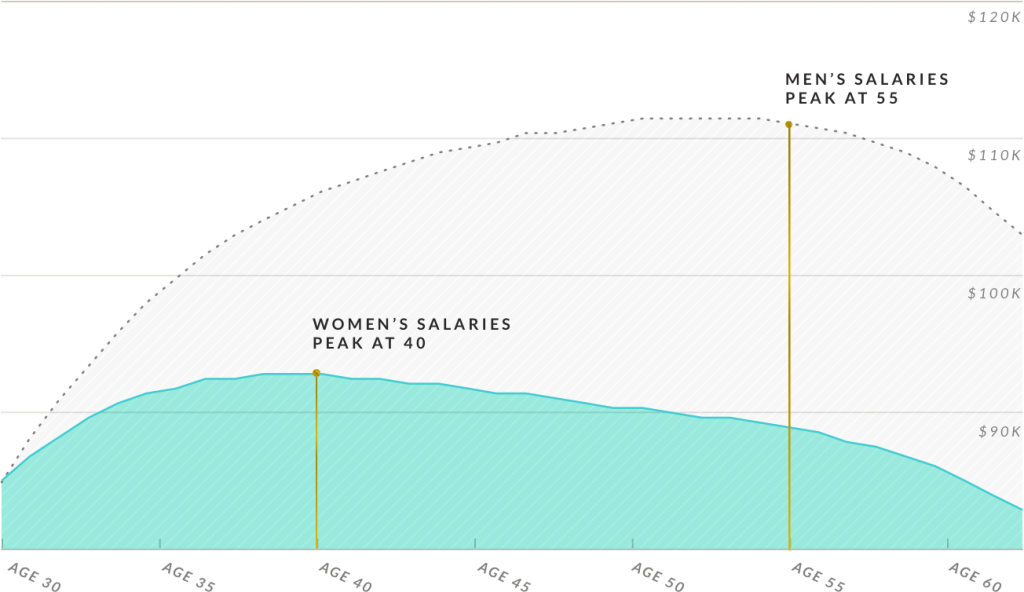
    These services distinguish Ellevest from most other robo-advisors because Ellevest emphasizes that men and women have earning trajectories that follow different arcs.

    As a company that relies on data about where women’s salaries peak in general, Ellevest can better serve women by customizing financial guidance to their specific needs.
    ellevest gender salary differences

    While some robo-advisors have a cookie-cutter investment management services that serves men and women equally without factoring differing earnings arcs, which can lead to sub-optimal portfolio allocations and money strategies for women, Ellevest optimizes for an individual’s financial circumstances.

    Both women and men can benefit from this deeper insight and more thoughtful approach to serving clients.

    Executive

    The Executive plan is all about setting goals. Research shows that setting financial goals correlates with a higher rate of achieving them versus those who do not set goals.

    The Executive level of membership features all the benefits of the Essential and Plus plans but also includes a focus on goal-based investing for up to six customized accounts.

    Ellevest Fees

    Ellevest fees are tiered based on the level of service required.

    The monthly fee for Ellevest Essential is $1 per month while $5 is charged for Plus and $9 for Executive.

    • Essential: $1 per month
    • Plus: $5 per month
    • Executive: $9 per month

    Like most robo-advisors, these management fees are exclusive of fund fees that range from 0.06% to 0.16% annually.

    Our research shows that these fund fees are highly competitive, an another reason why Ellevest deserves your serious consideration, whether you are a woman or a man.

    Ellevest Investment Method

    Ellevest uses low-fee ETFs to build diversified portfolios that are aligned with clients’ financial goals, time horizons and capacity for risk.

    Ellevest astutely realizes that risk tolerance may not be the optimal gauge to assess an investor’s risk profile because when markets are rising investors often overestimate their risk tolerances and when markets are falling they underestimate their risk tolerance levels.

    Instead, Ellevest focuses on capacity for risk as a better tool to incorporate the timeline of reaching a financial goal.

    Upon learning what your risk profile is and having a better holistic understanding of your financial goals and time horizons, Ellevest uses low-fee exchange-traded funds, including many from Vanguard, to build customized, diversified portfolios.

    Essential

    Model portfolios are used by Ellevest to manage clients’ assets. Ellevest allocates client monies to ETFs and cash equivalents on a discretionary basis using proprietary algorithms.

    For each goal you set, Ellevest invests in a portfolio of ETFs using a method influenced by your time horizon, which you can change at any time.

    Your accounts are monitored automatically, managed digitally, and rebalanced periodically according to the model strategy.

    Rebalancing does carry a tax risk – for example, if winners are sold near year-end, the capital gains taxes may be significant.

    Unlike Betterment and Wealthfront, Ellevest does not apply a broad tax-loss harvesting “brush” to all client portfolios.

    The team doesn’t believe this is necessarily the best way to optimize for after-tax returns. For more information on the tax strategies employed by its rivals, you can view this tax article.

    However, Ellevest doesn’t ignore tax considerations. Quite the contrary, it employs what it calls a Tax Minimization Methodology, which we describe below.

    Private Wealth

    A primary difference between the basic accounts and Private Wealth accounts at is human oversight. Ellevest personnel monitor client accounts and make portfolio adjustments as necessary but the minimum investment to elect the private wealth management option is $1,000,000 in investable assets.

    Think of Ellevest Private Wealth as a more tailored solution to your individual needs, risk profile and financial objectives.

    Ellevest builds a globally diversified portfolio that may include:

    • Individual debt instruments
    • Mutual funds
    • ETFs
    • Individual equities
    • Closed-end funds
    • Partnerships
    • Private and illiquid investments

    Ellevest will look to apply tax minimization methods, including deferring capital gains and realizing losses when tax benefits outweigh transaction costs.

    While investment methods are similar, perhaps the greatest benefit of Ellevest Private Wealth extends beyond your portfolio to factor in your money growth strategies for life.

    We were impressed that Ellevest doesn’t just “talk the talk” when it comes to building a financial solution for clients. Because of its insights into how income and spending patterns differ for men and women, Ellevest can help clients to better navigate career hurdles by providing Executive Coaches at no extra charge.

    And because clients get 1:1 access to Chartered Financial Professionals, Ellevest has a more holistic overview of your overall financial situation, which means a more personalized and tailored experience.

    Ellevest Tools

    Ellevest’s stand out tool is its trade-off algorithm which spotlights the cost-benefit analysis when you allocate more to one investment than another.

    Ellevest has a nice trade-off tool which gives you insights into the effects of prioritizing one goal over another.

    For example, if you are saving up for a new car but set a new goal to go on a fancy vacation abroad, Ellevest will inform you what the impact is to your car-buying goal.

    You can view your goals on Mint also if you wish. Simply eSign on the Ellevest dashboard and away you go!

    Ellevest Pros and Cons

    Ellevest charges competitive fees for both its Essential, Plus and Executive services, provides Chartered Financial Professionals and Executive Coaches, and even has a private wealth management service for higher net worth individuals. 

    Ellevest Pros Ellevest Cons
    Management Fees: Low fees that range from $1 to $9 monthly depending on membership level. Tax Loss Harvesting: Ellevest views the merits of tax-loss harvsting differently to Betterment and Wealthfront.  While Ellevest does support tax-advantaged investing, it does not provide the granular approach to tax-loss harvesting, called Direct Indexing, offered by Wealthfront.
    Emergency Fund Management Fee: No management fees are charged on monies held in emergency funds. This is highly unusual in the money management industry, which generally charges management fees even on cash held. Fewer Account Options: As a comparatively new robo-advisor on the scene, Ellevest caters to fewer account types than some other leading robo-advisors.
    Chartered Financial Professionals: Ellevest clients receive discounted 1:1 access to CFPs for personalized guidance on finances and money growth strategies.
    Executive Coaches: Ellevest clients also receive discounts to 1:1 access to executive coaches in order to help navigate salary negotiations and career events.
    Private Wealth Management: For qualified clients investing $1,000,000 or more, Ellevest provides a private wealth management service that includes value-based investing options.
    Financial Goal Setting: Ellevest provides greater specificity and clarity on financial goal-setting than you might find elsewhere.

    Instead of investing more generally for the long-term, you get to “bucket” your financial goals so you can specify for example that you are saving for a new home, buying a new car, saving up for a vacation, building an emergency funds cash cushion, preparing for college tuitions, or putting money aside for a wedding.

    Trade-off Tool: If you’re on track to meet your financial goals, but must pay for something new, what is the effect on when you will reach your financial goals? Those are the insights you may glean from Ellevest’s trade-off tool.
    Gender Focus: Data shows that women’s salaries peak earlier than they do for men. This important income difference has significant effects on investing allocations, which Ellevest recognizes and supports.

    Ellevest Minimums

    Unlike most traditional advisor who charge management fees on both invested assets and cash, Ellevest stands out by charging no management fees on money held in emergency funds. Overall fees compare well to other robo-advisors.

    Category Fees
    Account Minimums $0 for Essential, Plus and Executive

    $1M for Private Wealth Management

    Investment Expense Ratio 0.06% → 0.16%
    Annual, Transfer, Closing Fees $100 IRA Transfer Out Fee
    Personal Finance Tools Trade-off Goal Setting

    Ellevest Accounts

    As the new kid on the block, compared to the the likes of Betterment, Wealthfront and Personal Capital, who started almost a decade earlier, Ellevest is playing catch up with the selection of accounts it has on offer.

    Type Capability
    Taxable Brokerage Account YES
    Traditional IRA YES
    Roth IRA YES
    401(k) YES
    403(b) YES

    Ellevest Tax Strategy

    Some basic tax minimization strategies are included as part of Ellevest’s offering, from deferring capital gains taxes and comparing transaction costs to realizing losses for tax purposes, but Ellevest differs from Betterment and Wealthfront when it comes to providing a “one-size fits all” tax-loss harvesting solution.

    The Tax Minimization Methodology employed by Ellevest places tax-inefficient assets in tax-efficient accounts and tax-efficient assets in tax-inefficient accounts.

    For example, tax-efficient municipal bonds are placed in taxable accounts while corporate and government bonds are placed in retirement accounts.

    Plus, when your accounts need to be rebalanced, Ellevest maximizes your tax losses and minimizes your taxable gains wherever possible.

    For specific tax advice, Ellevest encourages clients to consult with tax specialists.

    Type Capability
    Tax Deferring Gains YES
    Tax Loss Benefits Vs Transaction Costs Comparison YES
    Tax Minimization Methodology YES
    Automated Tax Loss Harvesting NO

    Ellevest Review Summary

    Top robo-advisors need to look over their shoulder because the new “kid” in town has a lot to offer. Ellevest may be younger than its leading rivals, Betterment and Wealthfront, but what it lacks in age it makes up for in a world class product offering.

    Ellevest charges low monthly fees for its membership levels: Essential, Plus, and Executive. Where Ellevest has the edge is its lower account minimum and it goes the extra mile by providing Chartered Financial Professionals and Executive Coaches who help with salary negotiations and career guidance.

    Another standout feature at Ellevest is its gender focus. By recognizing that men and women experience salary peaks at different points in their respective careers, Ellevest constructs portfolios that are tailored to client needs. Plus, portfolio allocations dynamically adapt as clients get older to account for modified capacities for risk.

    Ellevest considers tax impact in its service offerings and automatically rebalances portfolios as you might expect of any leading robo-advisor.

    The bottom line is whether you are a woman or a man, you will need to go a long way before finding a robo-advisor that beats Ellevest.


  • Why Is Michael Burry Investing In Water?

    Why Is Michael Burry Investing In Water?

    Michael Burry water investments are increasingly drawing curiosity among investors. And with good reason. After all, Burry made his name during the 2008-9 crisis betting against, or shorting, the housing bubble.

    As manager of Scion Capital hedge fund, Burry applied his expertise in value investing to generate extraordinary returns for investors. In less than a decade, Scion recorded aggregate returns of 489.34% net of fees and expenses.

    When the housing bubble imploded, Burry’s contrarian bets on credit default swaps paid off so well that he was featured in The Big Short, a movie inspired by a Michael Lewis book. It featured stories of the economic crisis through the lens of a few investors who bet against the housing bubble.

    At the end of the movie, viewers got a hint of where Burry was turning his attention to next. The final line of the movie was emblazoned with his bold next investment:

    “Michael Burry is focusing all of his trading on one commodity: Water” – The Big Short

    If an investor with proven returns who, like Warren Buffett, is a student of Benjamin Graham and David Dodd’s famous book, Security Analysis, is focusing on investing in water, then maybe you should consider it too?

    Why Invest In Water

    Although investors typically think of gold and silver as precious resources before water springs to mind, the reality is water is so valuable that it has even led to serious conflicts.

    The list of conflicts relating to water include:

    • Nearly 3 million people left without access to reliable water supplies in Ukraine
    • Clashes in Darfur between farmers and herders over water access
    • Attack on Islamic State forces controlling the Tabqa dam

    And water related illnesses are responsible for approximately 80% of all illnesses and deaths in the developing world.

    In fact, over 2 billion people lack access to adequate sanitation according to the United Nations.

    cover michael burry water

    Don’t have time to read the entire guide right now?

    Let us send you the downloadable version so you can read it when it’s more convenient for you.

    Sewage and waste are causes of water pollution that leads to disease but another huge factor is limited fresh water on earth. While it’s easy to think of the earth as having a plentiful supply of water – after all 71% of the earth is covered in water – the reality is fresh water makes up only 0.76% of all water.

    “Fresh, clean water cannot be taken for granted. And it is not — water is political, and litigious” – Michael Burry

    And as any value investor worth his or her salt knows: where demand is high and supply is limited, prices rise.

    In this case, the demand comes from an ever growing population of humans on earth who demand more of the earth’s limited freshwater resources.

    How To Invest In Water

    Perhaps the simplest way to invest in water is to invest in exchange-traded funds, though stocks, farmland and water rights are other investment possibilities

    INVEST IN WATER-RELATED ETFs

    A leading water-related ETF is the Guggenheim S&P Global Water Index ETF [NYSE: CGW].

    The fund has the goal to invest in companies spanning the water sector with a view to benefiting from the development of new infrastructure that is designed to ensure efficient delivery and quality of water.

    The idea behind the fund is to also to access opportunities arising from population growth, consumption, and climate, as well as to benefit from global demand for water.

    michael burry water hero

    Like any exchange-traded fund, it does have an ongoing expense ratio, and it’s a little hefty at 0.64%, which is quite a bit higher than many of the best Vanguard funds.

    One of the reasons why the ongoing expense ratio is higher than say the expense ratio of an S&P 500 fund is that the fund invests in global companies as opposed to U.S. companies only.

    Some of the top holdings in the fund include:

    • American Water Works Co Inc.
    • Danaher Corp
    • Xylem Inc/NY
    • Pentair PLC
    • Veolia Environment SA
    • Geberit AG
    • Idex Corp
    • Suez
    • United Utilities Group PLC
    • Severn Trent PLC

    Another way to invest in water is via the S&P Global Water Index [CWW], which also tracks companies around the world that are related to the water business.

    To create diversified exposure to the global water market, the 50 companies featured are divided equally across two main groups:

    1. Water utilities & infrastructure
    2. Water equipment & materials

    Utilities and infrastructure companies include areas such as water supply, waste water treatment, sewer and pipeline construction, water purification, water utilities, water testing, and water well drilling.

    Equipment and materials companies focus on areas such as water treatment appliances, plumbing equipment, water treatment chemicals, counting devices, fluid power pumps and motors, pumps and pumping equipment.

    >> Want To Invest In Water ETFs? Select The Best Brokers For ETF Trading

    INVEST IN WATER RIGHTS

    Investors purchase water rights, which give them the right to use water from a source such as a river or lake.

    As an investor, you can rent out the water right to farmers, municipalities, or even corporations.

    The problem with water rights is much like the problem with a non-dividend paying asset, such as gold. And that is, the way to make money is for someone else to pay more than the investor.

    However, some investors believe so much in the idea of water-related investments that they exclusively focus on water rights. Aqua Capital Management, for example, is a water rights and investment management company that accumulates water rights in water-scarce regions across the globe.

    aqua capital management water scarcity

    As water scarcity and droughts increasingly become challenges for arid regions like California and Nevada, some local governments have come up with innovative solutions to recycle water. For example, Las Vegas recycles close to 100% of its indoor water.

    INVEST IN FARMLAND

    As appealing as water rights may be to some investors, they don’t attract Michael Burry as much as farmland.

    A PBS segment ran a piece about how Michael Burry is investing in farmland. Now, this type of investment isn’t for everyone but seeing how Burry is allocating his money is instructive in understanding how value investors think about making money over the long-term.

    When Burry was interviewed by New York magazine about his water investment thesis, he stated that:

    “Transporting water is impractical for both political and physical reasons, so buying up water rights did not make a lot of sense to me. What became clear to me is that food is the way to invest in water” – Michael Burry

    According to the segment, Burry is investing in almond farms. Why on earth is he investing in almond farms you might ask?

    Well, it turns out that growing almonds requires lots of water and when water shortages take place farmers will sometimes walk away which results in even less supply of almond growers, and therefore almonds.

    The almond growers who remain in business can increase their prices and profit as a result.

    Another popular yet water-intensive good is wine. Studies show that 872 gallons of water is needed to produce 1 pound of wine.

    The water footprint for popularly consumed items, includes:

    Item Gallons Of Water Needed
    To Produce 1 Pound
    Chocolate 2,061
    Cinnamon 1,860
    Beef 1,847
    Olive oil 1,729
    Hazelnuts 1,260
    Sheep 1,248
    Walnuts 1,112
    Coffee 1,056
    Wine 872
    Pork 718
    Lentils 704
    Ginger 199
    Peppermint 35

    Source: Huffington Post

    When hedge funds start buying almond and walnut farms because of the high margins, you know they believe in the long-term supply-demand imbalance investment thesis.

    INVEST IN STOCKS

    Another way to invest directly in water-related projects is to bet on individual stocks. Historically, when industries are fragmented they are ripe for disruption and the opportunity for a roll-up play that aggregates many players becomes lucrative.

    For example, American Water Works Company (NYSE: AWK) is a holding company that provides water and waste services to public utilities in 16 states.

    Aqua America (NYSE: WTR) is another company that has consolidated its grip on wastewater services by acquiring over 300 companies between 1993 and 2013.

    No shortage of competitors exist in the water space, such as York Water (NYSE: YORW) which impounds and purifies water to meet or exceed safe drinking water standards.

    A slightly larger company is American States Water (NYSE: AWR) which is the parent company of a handful of utility operators that engage in the purchase, production, distribution, and sale of water.

    If the prospect of researching water companies in an online brokerage, such as thinkorswim or tastyworks, seems daunting then the Guggenheim ETF may be a better bet. However, the cost of buying the stocks will be limited to trading commissions costs whereas the ETF will incur an ongoing annual expense ratio.

    Michael Burry Water Investments

    A key takeaway from Bloomberg’s interview with Michael Burry is that investing in water or farmland is smart in special situations. Not every piece of farmland or every water rights venture will pay off or even pay dividends, but where limited supply meets increasing demand, prices will likely rise over time.

    For the hands-off investor not sure where to begin, the best place is generally via an exchange-traded fund that has a lower risk yet lower reward payoff because it is diversified compared to buying shares in a specific company that may have higher upside potential and higher downside risk.

    Riskier than stocks are water-rich farmland and water rights opportunities, which may have the greatest upside but equally are the least liquid investment opportunities, so they are probably best for the most sophisticated and experienced of investors – which is why Michael Burry is investing in farmland directly – though shunning water rights!

    >> Check Out The Best Online Brokers For ETF Trading

    >> Why You Should Not Put All Your Eggs In One Basket

    >> What Are The Best Value Stocks?

  • How Karen the Supertrader Blew Up

    How Karen the Supertrader Blew Up

    How Karen The Supertrader Blew Up? Karen Bruton, better known as Karen the Supertrader, earned a reputation for making enormous amounts of money by trading options.

    Bruton has a master’s degree in business administration from Wake Forest University, which could help explain why how she conceived of such innovative options strategies.

    Her success led to featured spots on popular options shows where she explained in detail how she grew portfolios so fast.

    But according to the United States Securities and Exchange Commission (SEC), she accumulated her wealth through more nefarious means.

    Above all, the rise and fall of Karen the Supertrader is a lesson to all traders in risk management. Here’s the skinny on how Karen the Supertrader blew.

    Karen the Supertrader Strategy

    In an interview with Tom Sosnoff at tastytrade, Karen claimed that she started trading options seriously back in 2007, around the same time that she retired from an executive position with a limestone company. She says that her strategies earned $50,000 in her first year of trading.

    Understandably, everyone wanted to know how she managed to make so much money so quickly. Tastytrade interviewed her several times to learn more about her trading strategies.

    The interviews revealed the Karen the Supertrader strategy as follows:

    • Using Bollinger Bands to see graphical representations of standard deviations.
    • Initiating trades outside of two standard deviations to a stock’s current value.
    • Selling wide Index strangles in NDX, RUT, and SPX.
    • Letting her front month positions expire during low-volatility months.
    • Trading, selling, and collecting premiums constantly during high-volatility times.
    • Selling calls and puts 95% out of the money.
    • Selling contracts at 56 days to expiration while sometimes selling after a few weeks or just a few days.

    By following the above options trading strategies, Karen claims she did not have a single losing month in 2013.

    Her wealth accumulation also attracted clients that wanted her to manage their portfolios. At its height, her company, Hope Advisors, managed more than $175 million for Bruton’s clients.

    Unfortunately, her startling success would draw attention that eventually led to her downfall.

    rise and fall of karen the supertrader

    How Risky Are Karen’s Options Strategies?

    Some people would find Karen’s options strategies a bit too risky because she often committed 50% or more of her capital to trades.

    When you have as much capital under management as Karen reported, a little risk is not necessarily a bad thing. A lot of risk can become a problem, however. She used several strategies to lower the risk of her options strategies.

    Karen described how she takes a pessimistic look at the market. She always assumes that the market (S&P 500) will fall by at least 100 points. Then, she subtracts an additional 12% from her assumption.

    Karen the Supertrader also focuses on selling puts. She does sell calls, but most of her effort goes toward selling puts. Typically, she would sell calls on up moves. She would sell puts on down moves.

    Karen aimed to minimize risk by preventing her trades from going in the money. If she had a position that moved close to 30% in the money, she would adjust the position.

    These strategies show that Karen didn’t have a lot of faith in the market’s ability to grow quickly. She always assumed that the market would shrink. Taking this perspective helped her manage risk.

    When she did lose, she didn’t tend to lose much money. When she won, she tended to profit a lot by underestimating growth.

    Karen the Supertrader Vs. The SEC

    In 2016, the SEC filed a complaint against Karen Bruton. The complaint cited deceptive trade practices and other offenses.

    What did Bruton and Hope Advisors do wrong?

    Karen The Supertrader Lost Millions

    According to the SEC, the company hid losses by pushing them forward without recognizing them. During this time, Karen failed to acknowledge these losses. She only talked about the success of her company’s portfolio management.

    Some say that her misleading practices look similar to those of Bernie Madoff, a popular hedge fund manager that promised incredible profits that he could not deliver. To hide losses, he attracted more investors and used their money to pay long-term investors. In other words, he hid losses by setting up a type of pyramid scheme that paid forward new investments.

    Karen’s offenses didn’t come close to matching the magnitude of Madoff’s. When Madoff went to prison after pleading guilty, he had to pay billions in restitution to more than 4,800 clients.

    The SEC also accused Bruton of using her charity, Just Hope, to funnel money back into Hope Advisors’ main fund. While the charity gave money to help struggling people around the world, it also sent money to Hope Advisors to hide the company’s losses.

    Latest News On Karen the Supertrader

    Karen the Supertrader has tried to keep a low profile over the last several years. Hope Advisors settled with the SEC for $1.5 million to avoid the fraud charges. Regulators also blocked Bruton and her colleague Dawn Roberts from accessing $7 million in Hope Advisors’ account.

    As part of the judgment, Bruton is temporarily forbidden from working as an accountant or giving advice to investors.

    Bruton turned 70 in 2019, so she may not mind the forced retirement. She had to pay a considerable amount of money to the SEC, but she may well have plenty of cash to enjoy the next couple of decades.

    Karen the Supertrader had a wild ride that likely earned her millions of dollars and made her a superstar for a certain time period.

    But like so many people who try to fly too close to the sun, she got burned. You can learn from her mistakes, but probably best to stay gun shy when it comes to risking the farm on any options strategy.

    Want to Trade Like Karen Bruton?

    If you want to trade like Karen Bruton, it’s best to sift the good from the bad. While Bruton took risks that would make many experienced options traders nervous, her strategy is a well-known one among proficient traders and has a good deal of merit.

    It boils down to a bet that options will expire worthless and produce profits regularly as long as the stock market doesn’t crash below short put strike prices or rise too far above short call strike prices.

    If you want to start trading more exotic strategies like Karen, including condors, calendars, iron butterflies, ratio backspreads, it is best to choose a broker who understands the risks of trading complex options strategies.

    Two of the best options trading platforms in the business are thinkorswim and tastyworks. Both are run by teams that have a deep understanding of the payoffs and risks associated with more exotic options trades.

    thinkorswim®

    tastytrade (previously known as tastyworks)
    • Standout Feature
      Closing trades for Stocks & ETFs and Options are commission-free
    • Commissions
      $0 flat rate for stocks
    • Account Balance Minimum
      $0

  • How To Buy Subway Stock

    How To Buy Subway Stock

    It’s understandable why you might be wondering how to buy Subway stock. After all, Subway has over 26,000 restaurants in the United States and over 44,000 locations in more than 100 countries, making it the largest fast-food company in the world based on the number of locations.

    The Subway brand is well recognized domestically and internationally, which can make it a quality company for investors to buy stock in except for one thing.

    Subway is owned by a private company called Doctor’s Associates. So, you can’t actually buy stock in Subway itself, but you can invest in other large restaurant companies.

    Below we take a look at some alternative investment opportunities within the fast-food sector that may be a good fit for your portfolio.

    Subway Fast-Food Chain Competitors

    McDonald’s Stock

    Most people are familiar with the famous golden arches that comprise the McDonald’s logo.

    The brand has 36,888 locations throughout the world, which makes it the largest burger chain on the planet.

    It was founded in 1955 in California and initially focused on providing a quality hamburger.

    Today, it offers hash browns, pancakes, and other foods, including the famous Big Mac and Quarter Pounder with cheese…. or a Royale with cheese depending on where you are in the world… cue Pulp Fiction clip!

    McDonald’s drink lineup includes coffee, soda, and smoothies.

    In 2017, McDonald’s announced its Velocity Growth Plan, which highlights the use of technology to offer better food and better service.

    The fast-food chain also plans to use its scale to create more sustainable company long term.

    >> Screen For Stocks with Finviz

    Wendy’s Stock

    Wendy’s has 5,739 locations in the United States. Although it has locations in 30 countries around the world, it primarily operates in North America.

    Despite its limited geographical positions, the brand is the third-largest hamburger chain in the world.

    The vast majority of Wendy’s locations were owned by franchisees as of January 2017.

    In Canada, Wendy’s partnered with Restaurant Brands International Inc. to operate a series of Tim Horton’s/Wendy’s locations.

    According to the Restaurant Brands Inc. website, roughly 80 percent of all cups of coffee poured in Canada are consumed at a Tim Horton’s.For bullish investors this could make Wendy’s an attractive investment. It also makes Restaurant Brands stock an even more compelling play, particularly for those who want some portfolio diversification.

    >> 3 Ways To Trade The Most Volatile Stocks

    Restaurant Brands International Stock

    Restaurant Brands International owns a variety of fast-food chains in the United States and around the world.

    It is the owner of Tim Horton’s locations in Canada as well as Burger King locations in the United States and throughout the world.

    RBI expects Burger King to lead its international growth efforts, which could make the combined entity attractive to investors.

    Altogether, the company has 23,000 locations among its portfolio of branded entities.

    It is also the owner of Popeye’s, which specializes in spicy chicken and other foods that are found largely in New Orleans.

    >> Find The Best Stocks To Buy

    However, the company does also offer food options that are geared toward anyone looking for a quick and healthy meal at breakfast, lunch, and dinner.

    Depending on the particular restaurant, available items range from muffins and bagels in the morning to wraps, soups, and chicken tenders for lunch or dinner.

    The companies that are held under the Restaurant Brands umbrella have been in existence for over 150 years combined. And it’s that track record of success in all economic climates that makes it an attractive fast food investment alternative to buying subway stock.

    They also have a record of giving back to the communities that they serve. For example, the Tim Horton’s Children’s Foundation has provided resources to tens of thousands of youth who are in need throughout Canada.

    If you’re looking to buy Wendy’s stock or indeed invest in McDonald’s stock, tastyworks is a top tier broker that charges $0 commissions on closing stock and options trades.

    tastytrade SPOTLIGHT
    tastytrade (previously known as tastyworks)

    Investormint Rating

    4.5 out of 5 stars

    • Commissions: Closing trades for Stocks & ETFs and Options are commission-free
    • Account Balance Minimum: $0
    • Commissions: $0 flat rate for stocks

    via tastytrade secure site

    Domino’s Pizza Stock

    Domino’s Pizza is one of the largest pizza chains in the world with 14,434 locations globally. The total includes 5,491 restaurants in the United States.

    The company claims to sell about 1.5 million pizzas each day, and it also states its commitment to being a local company while also being a global brand.

    Like many other fast food companies, Domino’s operates a franchise business model.

    In foreign countries, franchisees are generally granted the rights to operate in a given area.

    Within those territorial rights, master franchisees will then grant rights for others to operate specific locations.

    Dunkin Brands Group Stock

    Dunkin Brands Group is the owner of both Baskin-Robbins and Dunkin’ Donuts.

    Combined, the two companies have 11,336 locations in the United States and more than 20,000 locations throughout the world.

    Founded in 1950, Dunkin’ Donuts is one of the most recognized brands in donut and pastry sales. However, it is also known for its variety of hot and iced coffee products.

    Baskin-Robbins was founded in 1967 and is known for its array of ice cream flavors.

    Check out Dunkin’ Brands valuation estimate based on a discounted cash flow here.

    The chain also features frozen ice cream pizza and frozen beverages.

    Employees from all of the Dunkin Brands Group companies volunteer their time and money each year to various nonprofit organizations.

    It is part of the corporate social responsibility (CSR) program that can be a unique selling point for its brand as well as for investors looking for a reason to invest in it.

    >> Should You Invest In Stocks Or Options?

    Yum! Brands Stock

    Yum! Brands owns Kentucky Fried Chicken, Pizza Hut, and Taco Bell.

    Altogether, there are over 44,000 locations operated by companies under the Yum! Brands umbrella.

    Each day, this restaurant group opens seven or eight restaurants, according to its corporate page.

    This means that it is an actively growing company with the potential to increase earnings and to provide maximum value for shareholders.

    Pizza Hut is the largest takeout pizza chain in the world, and KFC and Taco Bell are major players in the chicken and Mexican food niches.

    Yum! Brands has been recognized as a quality corporate citizen and is part of the Bloomberg Gender-Equality Index.

    Yum! Brands was part of PepsiCo until it was spun off from that company in 1997.

    Best Fast-Food Chains to Buy Stock: Dividend Play

    A dividend is a cash payment to shareholders that is usually made on a quarterly basis.

    Shareholders can choose to either put the money in their bank accounts or use the funds to buy more shares in the company that just paid them out.

    To determine a dividend yield, you take the share price and divide it by the amount of the dividend itself.

    The yield is what you use to determine your return on investment on a yearly basis, excluding share price fluctuations.

    Generally speaking, a yield of 2 percent to 3 percent is normal among mature companies with stable finances.

    McDonald’s Dividend

    McDonald’s pays a dividend of ballpark $4 per share per year, which translates to a dividend yield of 2.8%.

    The company makes dividend payments on a quarterly basis, and the amount paid to shareholders has increased since the shares were first offered in 1976.

    Wendy’s Dividend

    Wendy’s pays a dividend of 34 cents per share per year, and dividend payments have gone up every 12 to 18 months since 2012.

    The current dividend per share results in a yield of 1.9%.

    >> Discover Hidden Value Stocks

    Restaurant Brands International Dividend

    Restaurant Brands International pays a dividend of $1.80 per share on an annualized basis.

    This translates to 45 cents a share paid quarterly, which means that investors currently see a 3.97% dividend yield. The company has raised its dividend regularly since 2016.

    Domino’s Pizza Stock Dividend

    Domino’s Pizza offers an annualized dividend payout of $2.20 per year, which provides a yield of 0.8%.

    Shareholders receive a dividend payment four times per year, and the dividend amount has grown consistently since 2014.

    >> What Are The Best Value Stocks?

    Dunkin Stock Dividend

    Dunkin Brands Group has a dividend equal to $1.39 on an annualized basis.

    Dividends are paid quarterly, and the amount of the dividend paid to investors has gone up each year since 2013. Currently, the dividend yield is 1.86%.

    Yum! Brands Dividend

    At last glance, Yum! Brands offered a dividend of $1.44 cents per share annually.

    Payments are made to shareholders quarterly. The dividend yield is currently at 1.56%.

    Related: Get Paid A Dividend From Real Estate Investing

    Financial Metrics To Watch

    Trailing price-to-earnings (P/E) numbers are calculated by dividing a company’s stock price by its earnings per share (EPS) over the prior 12 months.

    This figure can be of use to investors who need a way to determine the overall health of a company without looking only at its recent stock performance.

    Of the companies that investors may consider as Subway alternates, Wendy’s among the lowest trailing Price-earnings ratios.

    Dunkin Brands Group had the second-lowest number on the list with a trailing P/E of 16.66.

    Yum! Brands was third on the list with a trailing P/E figure of 18.78.

    A company’s forward price-to-earnings (P/E) ratio takes into account that the ratio is based on predicted future performance.

    Generally speaking, projected earnings for the next four quarters or 12 months are deemed to be the most relevant.

    This figure is generally more useful for investors who are looking for stocks with more potential for growth.

    Of the fast-food companies that may be worth investing in, McDonald’s has among the the lowest forward P/E ratio of around 22x.

    Yum! Brands has the second-lowest forward P/E ratio at 24.2, and Dunkin Brands has the third-lowest at 25.01.

    McDonald’s and Domino’s Offer Room for International Expansion

    While you can’t buy Subway stock, there are other enticing options if you want exposure to the fast-food sector.

    If you are specifically focused on emerging markets, it may be best to put your money in either McDonald’s stock or Domino’s Pizza stock based on the current investment data.

    These two companies already have brand recognition around the world, and a number of international markets have yet to be saturated.

    These stocks may be able to grow both in the short term and the long term.

    Of course, you should always review your investment goals and criteria before deciding whether a particular stock or sector is worth putting your money into.

    No matter how you allocate your money, it is smart to choose a broker that offers competitive commissions, fast order execution, and top notch trading platforms. thinkorswim and tastyworks check all those boxes.

    THINKORSWIM® SPOTLIGHT

    thinkorswim®

    InvestorMint Rating

    5 out of 5 stars

    • Commissions: $0 per trade
    • Account Minimum: $0
    • Promotion: Trade free for 60 days, based on $3,000 deposit

    via thinkorswim secure site

  • 6 Stock Investing Tips

    6 Stock Investing Tips

    fish market

    InvestorMint provides personal finance tools and insights to better inform your financial decisions. Our research is comprehensive, independent and well researched so you can have greater confidence in your financial choices.

    Investing in the stock market is easy in theory: simply buy-and-hold for the long term and bet on the US economy. So says Warren Buffett.

    In practice, it’s so much harder. The fastest decline in stock market history was recorded in the first quarter of 2020 following the outbreak of COVID-19.

    For investors to stay the course while watching portfolios crash ever deeper into the red is no mean feat. Here are stock investing tips to help you prepare for stormy days and prosper long-term.

    Stock Investing Tip #1: Prepare For Stormy Days

    As stock markets hit higher highs, you can feel like the winner at Casino Royale cashing in your chips. And at market lows, the stock market can make you feel like you got duped in game of three card monte.

    The challenge is to ride out the storms and anticipate them when the sun is shining. Not everyone can generate market-beating returns for half a century like Warren Buffett did, but at the very least you should be able to earn returns in line with the stock market – a feat most investors fall short in achieving.

    So, how can you succeed where most investor fail?

    Begin by preparing for those stormy days that inevitably lie ahead. That means creating a disciplined investing plan that you stick to no matter where share prices move.

    The tried and trusted method of investing is to dollar cost average into the an index like the S&P 500 over time. 

    Rather than time the stock market highs or lows, invest a steady amount each and every month year after year. That has proven to be the the best investing tip to create wealth over the long term.

    You won’t buy the bottom or sell the top using this method, but equally you won’t miss out on huge gains by attempting to time the market.

    Stock Investing Tip #2: Avoid Panic Selling

    Human minds are a powerful thing, but they sure do have a habit of sabotaging us from time to time thanks to cognitive biases.

    Prospect Theory is a Nobel prize-winning theory that explains how we humans hate to lose more than we enjoy winning.

    When stocks fall, it hurts us more to lose money than it gives us pleasure when they rise and we make money. As stocks fall further, the pain of loss grows and it is easy to hit the panic button and sell – because it eliminates the pain of further losses.

    It is especially easy to panic and submit a sell order with your broker when the money you are trading is money you need to live on or expect to use to pay bills in the near future. But what if you didn’t need that money? Would it be easier to ride out a stock market storm until sunny days returned?

    But What If The Stock Market Crashes?

    Successful investors have seen the ups and downs of the stock market, so even a stock market crash tends not to phase them a whole lot.

    In fact, they often pounce on stock market declines as opportunities to buy value stocks. They have the luxury of knowing they don’t need to sell stocks to pay the bills. So how do you avoid the pitfall of panic selling like rich investors?

    Define clearly what money is needed to cover your expenses, including an emergency fund, and provide a cushion room for day-to-day living costs in case you lose your primary income stream.

    Label your money and bucket it into categories. Once you know how much you need to pay for current and future bills, add a cash savings buffer which will give you peace of mind knowing you can dip into it if you lose a job, and then ask yourself whether any of that money is invested in the stock market.

    >> More: 21 Legendary Investing Quotes

    Any money that is assigned to cover bills, tuition expenses, day-to-day costs and other living expenses should probably not be invested in a concentrated portfolio of equities.

    If you are retired and enjoying dividends or yield from bond investments that’s another story. But if you have money you need soon tied up in a portfolio of risky investments, then take a step back and think realistically instead of optimistically.

    Optimistically you might believe you have the intestinal fortitude to handle a stock market crash, but Prospect Theory predicts you might hurt more than you think, which means you might get trigger happy and sell the dips precisely when stocks are on sale.

    bear catching fish in streamRich investors are like predatory bears upstream just waiting for you to swim by and eat you for lunch, or at least your assets. They will be happy to take your money from you by buying the shares you may be selling at bargain basement prices.



    By bucketing your money into different categories, you will avoid the temptation to over-commit to investments. Instead, allocate only what you can afford to lose to your brokerage account.

    At the very least, sum up your total liquid assets to get a handle on the size of your pie and then consider how much you need to allocate to:

    • Mortgage or rent costs
    • Grocery and food costs
    • Entertainment and vacations
    • Utilities and cable costs
    • Emergency fund
    • Auto and fuel costs
    • Insurance costs
    • Investments

    The last item on the list is investments because it is imperative that you cover the necessities first: food, housing, auto, and insurance.

    Stock Investing Tip #3: Buy Intrinsic Value

    Are you a professional investor or a speculator? Do you really know what your buying? The answer to those questions is at the heart of understanding intrinsic value.

    Share prices are quoted so widely that investors often use them to make buy and sell decisions. But what information do share prices really convey?

    Prices are quoted on financial news networks daily and spotlighted when earnings soar or plunge so it’s easy to be distracted by them.

    When you log in to your brokerage account, share prices are listed in your stock watchlist. And when takeovers occur, it is often the skyrocketing share price of the acquired company that grabs headlines.

    A share price doesn’t convey the true value of a company. Nor does it offer you any insight into where the company is headed. From a share price you can’t discern whether competitors are sneaking up on the company and about to steal its market share.

    >> Related: How To Research Stocks

    Technical analysts and chartists may find value in analyzing share prices by comparing price levels to support and resistance, moving averages, and overlaying chart studies, such as MACD and RSI indicators. But if you are not an avid trader tied to your desk daily watching every tick what should you do?

    Focus On Intrinsic Value

    Where share prices are highly visible, intrinsic values are virtually invisible to most casual investors. Hedge funds, institutional investors, and Wall Street analysts pay a lot of attention to intrinsic values because they convey much more information about where a stock price may be headed than do share prices themselves.

    Think of share price as the moth and intrinsic value as the flame. In the darkness, the moth may fly up and down, circle around and back, weave left and right but when it sees the flame it naturally is attracted to it.

    Similarly, share prices may undulate from one moment to the next and from one week to another with a seemingly random pattern, but a force attracts them, called intrinsic value.

    When you examine share prices over time, it may seem to defy logic why some companies stay still while others march higher.

    But the mystery can be solved easily.

    Companies with increasing intrinsic values generally enjoy rising share prices over time. Risk of corporate governance issues or other outlier events is always a risk but for the most part, share prices track intrinsic value over the long term.

    Intrinsic value is also known as fair value, and it can be calculated using a discounted cash flow forecast. Here is the fair value for Alphabet Inc. or Google as it used to be known.

    So, the key stock investing tip when you are making buy and sell decisions is to focus on intrinsic value much more so than share price. By doing so, you can make more informed decisions.

    After all, if you know a company has an intrinsic value much higher than what its share price reflects then you will be less likely to view it in a negative light and offload it when it may be on sale.

    Plus, you will be more likely to make a rational decision about where it is headed over the long term.

    Stock Investing Tip #4: Track Your Financial Goals

    Can a sports athlete help you think about investing better? Perhaps…

    Over a 5 year period, mixed-martial arts fighter, Conor McGregor, went from paying his bills from social welfare income to making hundreds of millions of dollars.

    But how did he do it?

    Talent is only part of the answer. McGregor says the reason he became so successful is his greater work ethic compared to that of fellow combatants.

    He explained how his philosophy of hard work extended beyond physical sessions in the gym. After each sparring session and each wrestling or jiu-jitsu clinic, he took copious notes about what he did right and wrong, and how he could improve.

    From his reflections, he learned to improve so that he could move closer to his goals.

    conor-mcgregor

    Successful stock market investing requires this level of introspection too in order to prosper and meet your financial goals.

    What investments made money and which trades lost? Did you buy too much all at once because you got greedy?

    If so, what rule can you put in place to lower your initial risk? Perhaps you can buy via dollar cost averaging instead of all at once.

    Did you panic and sell when prices dipped only to see them recover to higher highs? Determine the reason behind each purchase and sale order.

    Maybe you had too much on the line, and couldn’t stand the pain of losing more. Should you consider hedging your stock portfolio with married puts to limit risk? Would that give you more peace of mind?

    If you have a regular stock brokerage account and don’t understand options trading, maybe the investing lesson to learn is how to trade options. Perhaps you could consider opening a demo account on an options trading platform, such as thinkorswim, so you can begin practicing.

    THINKORSWIM® SPOTLIGHT

    thinkorswim®

    InvestorMint Rating

    5 out of 5 stars

    • Commissions: $0 per trade
    • Account Minimum: $0
    • Promotion: Trade free for 60 days, based on $3,000 deposit

    via thinkorswim secure site

    By tracking your performance, measuring the results, reporting your gains and losses monthly and documenting the investing lessons learned, you will be on the path to iteratively improving so you can better achieve your financial goals.

    Stock Investing Tip #5: Focus On Financial Metrics

    Sometimes the 10,000 foot view of how you spend your time can be eye-opening when it comes to building wealth.

    For example, consider how many hours you worked to build up your nest-egg.

    Now think about how many hours you dedicate to choosing investments for your hard-earned dollars.

    If you’re like most people, the time you spent building your savings can be counted in years and decades while the time taken to allocate your money can be counted in minutes or hours.

    But common sense says you should be diligent about researching how you invest your money.

    To understand what you are investing in, start with the financial metrics. You don’t need to open up a spreadsheet and get too crazy, but at the very least take a look at some important numbers.

    In the stock chart below, you get to see the historical revenues for Amazon.com. Revenues are helpful in giving you the 10,000 foot view of where a stock has been, but it doesn’t offer any insight as to where it may be headed.

    To know where a stock could be headed next, future earnings growth expectations can be used to place a stake in the ground. When earnings are growing rapidly, share prices generally move higher over time.

    A quick glance at the balance sheet will tell you whether your company, like Amazon, is debt free or has a high debt to capital ratio. Companies with high debt levels may suffer more during high interest rate environments.

    After viewing some of the basic financial metrics on the balance sheet and income statements, glance at share price history to see how volatile it has been historically.

    Even a solid company may not be appropriate for your risk profile if it has a history of wild swings up and down.

    Above all, what you want to glean from your research is the fair value of the company.

    Share price tells you what price you will buy or sell, but fair value is much more insightful – it can offer insight into where a stock may be headed next.

    Stock Investing Tip #6: Manage Risk

    It is with good reason that Warren Buffett has described the first rule of investing as not losing money and the second rule is to not forget the first rule.

    Lose just 10% of your portfolio and you need to make an 11% gain to get back to breakeven. Lose 50% of your portfolio and you need to generate a 100% return to get back on an even keel.

    The percentage you need to gain after losing money is always larger than the percentage you lose to get back to where you began because, after a loss, you have less money to play with.

    This focus on risk is contrary to our human nature. Our tendency is to keep our eyes on the prize. But earnings handsome returns come at the cost of ever higher risks.

    When an investor gleefully claims to have generated a 100% return, the real question is how much risk was taken to achieve the high return?

    Professionals focus on risk-adjusted returns with good reason. Generating high returns is not the biggest challenge to overcome but generating high risk-adjusted returns, that’s a whole other ballgame.

    At an extreme, you can think about a lottery win. The return is enormous if you win, but what is the risk?

    The probability of failure is nearly 100%, so while the reward is alluring it is highly improbable.

    In the stock market, focus on your risk-adjusted return more so than your absolute return, and you will be one step ahead of much of your competition.

    What stock investing tips have you learned? Share your investing stories with us in the comments below. We would love to hear from you.

    >> Is Facebook Stock A Buy Or A Sell?

    >> What Are The Best Stocks To Buy Now?

    >> What Are The Best Penny Stock Brokers?

  • 10 Best Financial Advisors Cleveland OH

    10 Best Financial Advisors Cleveland OH

    top financial advisors cleveland oh

    Cleveland has the most robust economy of any city in Ohio. In recent years, Cleveland’s economy surged by nearly 3 percent to a Gross Metropolitan Product (GMP) of around $140 billion. That makes Cleveland the 28th most prosperous city in the U.S.

    Prosperous cities like Cleveland attract talented professionals who want to make sure they’re making the right decisions when it comes to building wealth.

    A great financial advisor is one who’s ethical, who possesses professional credentials, and who will take the time to focus on your concerns.

    Whether he or she is making decisions about money on your behalf or is advising you about what moves to make on your own, you have to be able to trust that your financial advisor’s strategy is one that reflects your own risk tolerance and wealth growth objectives.

    There are many financial advisors in Cleveland. How do you go about finding the one that’s right for you?

    We’ve put together this curated list of the ten best financial advisors working out of Cleveland and the surrounding areas to help you simplify the selection process.

    The 10 Best Financial Advisors in Cleveland, Ohio

    The firms below are the standouts among Cleveland’s financial advisors. You’ll find a more thorough description of each firm’s services, wealth-generating philosophy, and specific strengths below.

    1. Fairport Asset Management
    2. Wellspring Financial Advisors
    3. MAI Capital Management, LLC
    4. Pension Advisors (AdviseMe National Advisors)
    5. First Fiduciary Investment Counsel, Inc.
    6. Gries Financial LLC
    7. Clearstead Advisors
    8. Vantage Financial Group, Inc.
    9. Winfield Associates
    10. Beacon Financial Advisory, LLC

    #1 Fairport Asset Management

    Fairport Asset Management is a boutique firm that caters to the needs of very high-net-worth clients.

    To work with this firm, you’ll need to be willing to invest at least $1 million, and you’ll need to have a net worth of at least $2 million.

    The firm takes a very hands-on approach to asset management, so it’s a good fit for clients who are looking to delegate the heavy lifting when it comes to making financial decisions.

    Fairport Asset Management Process

    At your initial interview, you may be asked questions about your background, your relationships, your interests, your career, and your goals that are somewhat more sensitive than the typical inquiries into risk tolerance that most financial advisors content themselves with.

    Once the financial advisor who’s working with you has a chance to review your information, he or she will draft a customized proposal that focuses not merely on asset management but also on success metrics like tax planning, insurance and risk management, education planning, stock compensation planning, charitable giving, and estate planning.

    The firm will analyze the ways in which your current portfolio isn’t supporting your individual objectives and present you with strategies designed to help remove you from concentrated stock positions and to aid you in creating an income stream.

    Get To Know Fairport Asset Management

    Fairport is a small firm with an investment committee of five nationally recognized advisors.

    Other staff members include CPAs, CFPs, CFAs, CAIA, CRPCs, Registered Paraplanners (RPs), Chartered Financial Counselor (ChFC), and Accredited Estate Planners (AEPs).

    Is Fairport Asset Management Right For You?

    The firm takes a special interest in women in transition.

    Fairport recognizes that transitional events like a career change, divorce, the death of a spouse, or an inheritance can be especially challenging for women who while well-educated may not be particularly well-versed in financial strategizing.

    Fairport is committed to providing financial education as well as financial advice and management services.

    The firm sponsors an acclaimed Solutions for Women™ program that addresses a wide range of topics that may be of particular interest to women.

    These topics include charitable giving strategies, asset allocation and investment strategies, and raising financially literate children.

    #2 Wellspring Financial Advisors

    Although Wellspring Financial Advisors sidesteps the issue of a minimum account requirement, they do note on their website that clients with at least $10 million to invest are the best fit for their bespoke set of services.

    Unsurprisingly, the firm’s clients include high-net-worth individuals and their families as well as the trusts, estates, and charitable foundations to which those clients lend their names.

    Wellspring Financial Advisors Investment Process

    Wellspring offers a holistic suite of services that begins with a series of discussions during which the firm ascertains details about each client’s objectives and preferences as well as his or her risk tolerance and the time frame over which that client sees wealth growing.

    From there, the firm creates an investment strategy that’s informed by diversification, the quality of prospective portfolio assets, the client’s own need for liquidity, and the client’s desire for transparency.

    Wellspring generally prefers to build portfolios using mutual funds and ETFs rather than individual securities.

    What Sets Wellspring Financial Advisors Apart

    Wellspring offers several innovative services to clients such as family education, which seeks to prepare younger family members about the responsibilities that the inheritance of great wealth entails.

    Wellspring also has a risk management offering that in addition to providing periodic reviews of insurance coverage helps protect personal information about clients from falling into the wrong hands.

    Wellspring manages more than $1.2 billion in assets. The firm’s team includes CPAs, CFAs, CFPs, AEPs, and CAIA.

    #3 MAI Capital Management, LLC

    MAI Capital Management is one of Cleveland’s largest financial advisory firms with 32 advisors on staff and over $4 billion in assets under management.

    The firm’s minimum investment requirement is $500,000, and clients are either high-net-worth individuals and their families or entrepreneurs and professionals who aspire to high net worth.

    MAI Capital Management Team

    Staff members hold impressive credentials: The firm employs:

    • Certified Public Accountants (CPAs),
    • Certified Financial Planners (CFPs),
    • Chartered Financial Analysts (CFAs),
    • Chartered Retirement Planning Counselors (CRPCs)
    • Certified Private Wealth Advisors (CPWAs)
    • Chartered Life Underwriter (CLU)
    • Chartered Market Technician (CMT).

    In addition to its headquarters in Cleveland, MAI maintains offices in Nashua, New Hampshire; Ponte Vedra Beach, Florida; and Irvine, California.

    How MAI Capital Management Got Started

    The firm got its start in 1973 when Arnold Palmer accepted founder Mark McCormack’s offer to handle the golf legend’s business affairs so that Palmer could concentrate on what he did best, which was to play golf.

    Today, the firm’s client rostrum has expanded to include corporate executives and wealthy families, but its focus remains upon individual clients with complex financial lives rather than upon institutional investors.

    How MAI Capital Management Invests Your Money

    As part of its comprehensive wealth management, MAI offers planning in a number of different areas.

    The firm understands that delegation is often key when it comes to managing a multifaceted financial profile: MAI’s own investment professionals will develop and implement a personalized asset allocation model to meet each client’s individualized needs, but the firm will often recruit an outside manager with expertise in equities, fixed income, and alternative asset classes to oversee portfolios on a daily basis.

    MAI monitors these outside managers closely in keeping with its high fiduciary standards.

    Portfolios typically fall into one of nine categories: MAI managed volatility portfolios, dividend-yielding portfolios, diversified core portfolios, diversified dividend portfolios, core portfolios, exchange-traded fund portfolios, MAI energy infrastructure portfolios, fixed-income/tax-exempt portfolios, and fixed-income/taxable strategy portfolios.

    MAI Capital Management Minimum Investment Amount

    Minimum asset requirements for these portfolios range from $10 million for the MAI managed volatility portfolio to $250,000 for the fixed-income portfolios.

    MAI also coordinates estate planning; tax planning and tax compliance; insurance protection, including property and casualty coverage, life insurance, appropriate personal and commercial liability coverage, and specialized coverage for luxury vehicles like airplanes.

    This advisor can also help you if you wish to pursue philanthropic goals, including the setup of charitable lead annuity trusts (CLATs), charitable remainder unitrusts (CRUTs), net income with makeup charitable remainder unitrusts (NIMCRUTS), and charitable gift annuities (CGAs).

    #4 Pension Advisors (AdviseMe National Advisors)

    So, one of the perks of your great job in Cleveland is a generous 401(k) contribution benefit. Where do you go from there?

    What’s the proper formula for diversifying your portfolio and rebalancing it regularly so that you maintain optimal asset allocation and take advantage of periodic market upswings? This is Pension Advisors’ particular area of expertise.

    Is Pension Advisors Right For You?

    On the corporate end, Pension Advisors (AdviseMe National Advisors) primarily works with employers who offer retirement savings plans to their employees.

    The firm counsels these plan sponsors on matters such as choosing a retirement plan, administering a retirement plan, finding the right retirement plan vendor, and deciding upon the types of investments that will be offered through that pension plan.

    Employers may not fully understand the implications of the fiduciary responsibilities they assume when they take on the sponsorship of a retirement plan, and it’s Pension Advisors’ task to get them up to speed.

    How Pension Advisors Helps Employers

    The firm helps employers write the necessary policies that will allow them to comply with federal and state regulations.

    Since June 2018, when the Fiduciary Rule was overturned by a Fifth Circuit decision, an increasing number of states have also begun to act to enforce their own fiduciary rules.

    These Investment Statement Policies are reviewed at least annually or whenever significant regulatory changes are made.

    Get To Know Pension Advisors

    Founded in 1999, Pension Advisors maintains satellite offices in Milwaukee, Chicago, and San Juan, Puerto Rico.

    The firm has no minimum investment requirement.

    Though the company has more than $1.5 billion under management, none of its individual clients are high-net-worth individuals.

    Of the eight full-time advisors on board, one is a Retirement Plan Associate (RPA), and one is a Certified Employee Benefits Specialist (CEBS).

    The firm typically bills individual clients either through a one-time consultation rate or an hourly fee; institutional clients who manage funds through Pension Advisors may be charged a percentage fee of the assets they have under management.

    #5 First Fiduciary Investment Counsel, Inc.

    First Fiduciary Investment Counsel is an employee-owned investment advisory firm.

    As one might expect from a company that uses the word “fiduciary” as part of its name, this firm’s compliance standards are higher than many of its cohorts: Its reporting guidelines are aligned with the rigorous Global Investment Performance Standards (GIPS).

    The firm uses an independent third-party custodian who confirms each transaction and provides monthly statements to add an extra layer of security for its clients.

    First Fiduciary Investment Counsel Minimum

    First Fiduciary’s minimum investment requirement is $1 million.

    The firm’s individual clients are high-net-worth individuals.

    First Fiduciary’s institutional clients include charitable foundations, charitable remainder trusts, state and municipal governments, corporations, and pension and profit-sharing plans.

    First Fiduciary has over $500 million in assets under management.

    First Fiduciary Investment Counsel Process

    First Fiduciary’s investment strategy focuses on minimizing risk to the extent possible in a volatile market environment.

    To that end, the firm prefers to invest in companies with strong balance sheets that demonstrate a commitment to shareholders by offering dividends.

    Such companies most often tend to be large capitalization entities whose cash reserves grant them immunity to market volatility.

    First Fiduciary offers individual and institutional investors two investment approaches: the flagship large-cap value equity strategy described above and a balanced account management strategy that blends a large-cap equity strategy with a conservative bond program.

    Meet The First Fiduciary Team

    First Fiduciary has been in business since 1975.

    The firm has three advisors on staff, two of whom are CFAs.

    Though some of the services it provides to clients are billed at a flat rate, the firm earns most of its compensation through fees calculated as a percentage of the assets it manages for clients.

    #6 Gries Financial LLC

    Gries Financial has been offering financial planning and investment advisory services for individuals, charitable foundations, and pension and profit-sharing plans for more than 40 years.

    The firm has 11 advisors on staff, including six CFPs and one CFA. Most of its individual clients are high-net-worth individuals, and it has a $1 million minimum investment requirement.

    The firm has more than $870 million under management.

    Is Gries Financial Right For You?

    The firm is keen on intergenerational planning at both the individual and institutional level.

    It works with endowments and foundations to develop customized plans that will help ensure the survival of philanthropic and cultural legacies, and it partners with individuals who see themselves as stewards of family wealth.

    Among the planning services offered by Gries Financial are retirement planning, estate planning, tax planning, education funding, charitable giving strategies, and family giving strategies.

    What Makes Gries Financial Different

    Gries Financial sees itself as one part of a team that’s providing support for clients and is open to collaborating with other trusted advisors like accountants, attorneys, and insurance agents on the financial plans it devises for clients.

    Fees for these financial planning services are assessed on an hourly basis.

    When the firm undertakes investment management on behalf of its clients, it customizes investment portfolios so that they align with client directives regarding risks and returns.

    Such portfolios often include a broad spectrum of asset classes that may have prohibitive minimums in instances where existing relationships aren’t in place. Investment advisory fees are based on percentages of assets under management.

    #7 Clearstead Advisors

    In 2018, the financial advisory services firm Hartland & Co. decided to rebrand itself as Clearstead Advisors.

    When Tom Hartland started the Cleveland-based company in 1989, he named it after himself. Nearly 30 years later, however, the firm’s principals selected a name that more keenly reflected the core values of the business: transparency, clarity, and steadfast guidance through all aspects of client relationships.

    Clearstead Advisors Investment Process

    To reduce portfolio volatility, Clearstead’s investment strategy focuses upon mutual funds and exchange-traded funds (ETFs) rather than upon individual securities.

    The firm believes that these asset classes offer the best opportunity for optimal risk-adjusted returns.

    The firm relies heavily upon the mathematical Black-Litterman model for portfolio development but augments this quantitative approach with a qualitative evaluation of economic and market conditions.

    Is Clearstead Advisors Right For You?

    Clearstead Advisors offers private wealth management, institutional investment consulting, 401(k) and retirement fund management, and responsible investment opportunities.

    The firm has more than $3.2 billion under management.

    The firm’s 700-plus individual investors are primarily individuals with a net worth of at least $1.5 million and investable assets of at least $750,000.

    Its Outsourced Chief Investment Officer (OCIO) system is called Clearstead Prism OCIO; increasingly, OCIO is the service that’s providing the firm with traction as it extends its reach outside Northeastern Ohio.

    Clearstead has expanded its workforce by 30%+ over the past three years. Currently, it employs over 30 advisors, several of whom hold certifications in more than one specialty.

    Staff members include CPAs, CFPs, CFAs, three Chartered Alternative Investment Analysts (CAIAs), Accredited Investment Fiduciaries (AIFs), Certified Investment Management Analysts (CIMAs), and an Accredited Tax Preparer (ATP).

    #8 Vantage Financial Group, Inc.

    Vantage Financial Group prides itself on offering services to hardworking people who are looking to secure their financial futures.

    Some of these people may be high-net-worth individuals, but the vast majority are not.

    The company also manages investments for corporations, charitable foundations, and pension and profit-sharing plans.

    Meet The Vanguard Financial Group Team

    Vanguard has a large staff of 24 advisors that include CFPs, ChFCs, AIFs, CLUs, CRPCs, and a CEBS.

    Though headquartered in Cleveland, the firm maintains regional offices in Bethlehem, Pennsylvania; Pickney, Michigan; and Sylvania, Ohio.

    The company manages over $500 million for its clients.

    How Vanguard Financial Group Investment Process Works

    Vanguard describes itself as a “single-source financial services company,” by which it means that it offers the equivalent of one-stop shopping to clients who are looking for services that will enhance their material security.

    At the beginning of each client relationship, the firm assigns that client a Vantage Financial Advisor who continues to be his or her point of contact throughout that client’s subsequent relationship with the firm. This advisor will be instrumental in mobilizing any additional services the client may be interested in.

    For individual clients, those services might include investment management, financial planning services, insurance planning, estate planning, and litigation settlement support.

    For institutions, services may be investment management, retirement plan services, and specialized third-party administrative services.

    Litigation settlement support is a unique service that few if any other financial advisors offer.

    Professionals hit by litigation involving medical malpractice, product liability, wrongful death, and other complex torts can take advantage of Vanguard’s expertise in mediation and structured settlement evaluation and implementation.

    Vanguard Financial Group Investment Minimum

    Vanguard imposes no minimum account size requirement. Financial planning fees are billed at an hourly rate while portfolio management fees are calculated as a percentage of assets under management.

    Advisors are also free to sell financial products on which they earn commissions, but it’s understood that advisors must act in the best fiduciary interests of clients at all times.

    #9 Winfield Associates

    Though Winfield Associates is headquartered in Cleveland, it maintains a satellite office in San Diego, California, and the firm’s clients include private individuals, business professionals, retirees, and a select handful of charitable foundations and endowments from across the nation.

    The firm’s main service is investment portfolio management, but it also does some customized financial planning that focuses upon identifying wealth-building opportunities. In order to work with Winfield, clients must be willing to invest $500,000.

    The firm has over $200 million in assets under management.

    How Winfield Associates Invests Your Money

    Winfield uses an asset allocation model that’s derived from modern portfolio theory to customize, manage, and balance its clients’ investments.

    The firm favors investment vehicles like equities, fixed income, convertibles, publicly traded partnerships, ETFs, and mutual funds.

    For retirees, portfolios are more weighted toward investment vehicles that facilitate the option of drawing income. In the work the firm does with endowments and charitable foundations, Winfield relies upon index and factor-based ETFs in order to avoid concentrated risk.

    Winfield Associates Investment Process

    Winfield provides quarterly investment analyses to all clients. Staff members meet with clients on a regular basis to review portfolio performances and to discuss recommended reallocations.

    The firm has a number of advisors, four of whom are CFAs. Winfield charges a fixed fee for its wealth-building advisory services, but its investment advisory services, which make up the bulk of the work the firm does for clients, are assessed as a percentage of assets under management.

    #10 Beacon Financial Advisory, LLC

    Though Beacon Financial Advisory’s client base consists primarily of individuals who are interested in building or preserving wealth, the firm also works with companies to develop and implement qualified and non-qualified retirement plans.

    While the firm imposes no minimum account requirement, but with more than $300 million under management, Beacon’s individual clients are definitely on the affluent side.

    Beacon partners with the independent Pennsylvania-based broker Lincoln Investment Planning, LLC: Beacon provides the financial planning and wealth management strategies while Lincoln provides the robust investment platform.

    Among Beacon’s advisors are CPAs, CFPs, a CFA, a CLU, and two ChFCs.

    Beacon Financial Concierge Service

    Beacon offers clients concierge service: Every client is assigned a Client Services Manager when he or she begins working with the firm, and every investment decision a client makes is made in consultation with one of the firm’s advisory principals.

    The firm’s services include financial planning, advanced wealth strategies, investment advisory services, and corporate retirement strategies.

    Beacon Financial Investment Process

    Modern portfolio theory is the linchpin of Beacon’s investment strategy.

    The firm conducts interviews with clients when clients begin their relationships with the company to determine their risk tolerance, the specifics of their financial situations, and their long-range goals.

    Using these factors, Beacon advisors construct a plan that allocates assets into different investment vehicles across different markets and geographic regions.

    These investment vehicles may include individual stocks, bonds, mutual funds, ETFs, money market accounts, treasury securities, and fixed and variable annuities.

    This allocation is evaluated and rebalanced at frequent intervals in accordance with each client’s individual risk tolerance.

    Transactional strategies include long-term trading, short-term trading, short sales, margin transactions, and options.

    Beacon bills financial planning services at either a fixed rate or on an hourly fee basis, but portfolio management fees are assessed as a percentage of assets under management.

    Advisors are free to accept commissions on financial products they sell to clients, but it is understood that advisors will always act in the best financial interests of their clients.

    How We Ranked the Top Financial Advisor Firms in Cleveland, Ohio

    In compiling this list of Cleveland-based financial advisors, we looked at:

    Assets under management: Assets under management (AUM) is a number that represents the market value of funds under an investment advisor’s discretionary management. It’s a metric that reassures prospective investors that since other investors have trusted this advisor with their money, the advisor must be sound.

    Qualifications: We gave preference to firms that are registered with the U.S. Securities and Exchange Commission (SEC) because SEC registration guarantees that the firm holds to a fiduciary standard, meaning that they act in their clients’ best interests.

    Credentials: Credentials, awards, and positive news mentions showcase an advisor’s essential trustworthiness.

  • SoFi Invest Review 2020 – Free Portfolio Management

    SoFi Invest Review 2020 – Free Portfolio Management

    sofi brokerage trading system investing
    SoFi burst onto the wealth management scene with an offering that competes aggressively with other top robo-advisors and a service level that rivals what is offered by dedicated financial advisors.

    Although the company is best known as a student lender targeting Ivy leaguers and prime borrowers, SoFi now offers Personal Loans, Mortgage Loans, Life Insurance and wealth management.

    One reason SoFi has grown so fast is its refreshing transparency when it comes to fees.

    As you’ll see in this SoFi Invest review, the same customer-first commitment applies to its investment management products as its lending products.

    No management fees and a super low investment minimum are just a few of the perks you can expect.

    SoFi Wealth Spotlight

    SOFI SPOTLIGHT
    sofi logo 2019

    InvestorMint Rating

    5 out of 5 stars

    • Management Fees: 0.0% of assets invested
    • Account Balance Minimum: $100

    Is SoFi Right For You?

    The SoFi Invest service is designed for hands-off investors who want the personal touch offered by traditional financial advisors and the low fees charged by robo-advisors.

    When it comes to fees, SoFi beats competitors, such as Betterment, Personal Capital and Wealthfront. That’s because SoFi charges no management fees whatsoever!

    No Management Fees

    Its no-fee investment management service is just the appetizer of what you can expect at SoFi Wealth.

    While rival Wealthfront steadfastly sticks with a robo-advisor solution only, SoFi goes a step further and provides access to live financial advisors, so if you’ve got questions a human can answer them for you.

    Live advisors are not commission-based so they are not incentivized to sell you on other products, phew!

    But wait, there’s more! (We couldn’t resist saying that!)

    Exclusive Rate Discounts On SoFi Loans

    Chances are you found out about SoFi Invest because you began as a borrower. And SoFi borrowers enjoy extra perks, including a 0.125% rate discount on loans.

    Career & Salary Guidance

    With its combination of no management fees and high service, SoFi takes direct aim at established robo-advisor competitors.

    For example, Personal Capital has higher fees for a similar level of service.

    And Betterment, which introduced its premium service connecting clients to live advisors, also charges higher fees than SoFi.

    But the perks don’t stop there for SoFi Wealth clients, who also enjoy salary guidance and career guidance free of charge. SoFi values that promo bonus at $795.

    Free Access to SoFi Events

    One of the best parts of SoFi is its community. The company has fostered one of the most active Facebook groups of any financial company. It’s engaging, vibrant, and helpful.

    Its online community extends offline too. You qualify to attend any one of 200+ events that are available to SoFi members.

    SoFi is best for:

    • Existing SoFi borrowers
    • Hands-off investors
    • Fee-conscious investors
    • Investors who want access to human advisors

    SoFi Management Fees

    SoFi fees has among the most competitive fee schedules of all technology powered advisors; 0.00% of assets invested.

    • Management Fees: 0.00% of assets under management

    SoFi imposes a $100 account balance minimum.

    How Does SoFi Wealth Invest Client Money?

    SoFi has an experienced investment committee, including Chief Economist, Michael Dooley, and former CEO of KKR Financial, Nino Fanlo.

    SoFi uses Modern Portfolio Theory to spread investments over many asset classes, business sectors, industries, and countries to statistically optimize the mix of stocks, and bonds, as well as real estate and precious metals, such as gold.

    Uses Low-Cost Exchange Traded Funds

    SoFi offers a wide range of low-cost exchange-traded funds to investors.

    It tracks more than 20 indexes and offers a number of different types of investment vehicles in order to keep portfolios balanced.

    Investments are Diversified

    Not only are investments low-cost, but they are also diversified.

    SoFi offers a mix of investment vehicles including both US and international stocks, real estate, and high-yield and Treasury bonds.

    SoFi also offers exposure to specific countries and regions for investors who have an interest in putting their money to work in a specific part of the world.

    Portfolios Are Automatically Rebalanced

    SoFi offers automatic portfolio rebalancing.

    Whenever there is a change in your account (e.g. you make a deposit or withdrawal), SoFi checks your balance against your target allocation and rebalances accordingly.

    It also monitors your portfolio daily and rebalances as needed to get you within 5 percentage points of your target allocation.

    SoFi Human Advisors

    In addition to these automatic features, SoFi offers human advisors that you can speak to from 10:30 AM to 11 PM EST on weekdays about your portfolio and your investment goals.

    Unlike many companies, SoFi offers portfolio management completely for free, and investors who contribute more than $20/month are entitled to member bonuses such as free career coaching.

    Lacks Tax Loss Harvesting

    SoFi is planning on adding tax loss harvesting later in 2019, but for now this is not a feature it offers. This means you could lose extra money at tax time, and if you invest withSoFi you should realize this is one area where it currently comes up short.

    Note: SoFi avoids conflict of interest by not receiving compensation for selecting certain funds or families of funds, meaning that funds are selected based on merits alone.

    >> Compare SoFi Vs Betterment

    SoFi Wealth Tools

    SoFi applies a goal-based approach to wealth management.

    Based on age, income and investable assets, SoFi recommends an investment portfolio to achieve investment goals that it maps out.

    Clients can adjust their own level of risk tolerance to update selections.

    A risk simulator in SoFi’s goal planner helps assess risk and probability of reaching set retirement goals.

    Savings adjustments that increase timeline to retirement and amounts deposited will reflect on the probability of reaching retirement goals.

    SoFi Wealth Pros and Cons

    SoFi offers a wealth management solution with a highly competitive fee structure, combining a personal touch with technology powered investment methods.  

    Plus, it has perhaps the best customer experience of any financial institution having fostered a true community feel, regular offline social meet-ups, educational events and much more.

    SoFi Pros SoFi Cons
    No Management Fees: 0.0% of assets under management. Most other robo-advisors charge at least 0.25% of managed assets. Tax Optimization: Unlike other top robo-advisors, SoFi doesn’t offer tax-loss harvesting.
    Live Advisors: For investors who don’t want the option to connect with humans from time to time, SoFi is a better choice than pure robo-advisors, like Wealthfront, that do not offer human advice. 529: Like Betterment and Personal Capital, SoFi does not offer 529 Plans yet. For those wishing to get a head start saving on college tuition expenses for beneficiaries, Wealthfront might be a better option.
    Customer Experience: Offline and online meet-ups, career and salary guidance, and exclusive loan discount rates are a few of the perks customers enjoy when signing up to SoFi Wealth.
    Live Chat: In our customer support evaluations, we found SoFi to be highly responsive; it took less than 2 minutes to reply comprehensively to Live Chat queries and email responses were received within a day.
    Tools: SoFi offers a retirement tool to assess the likelihood that a client will be able to retire and maintain their lifestyle objectives.
    Low Investment Minimum: $100 is required to open a SoFi Wealth account.

    SoFi Wealth Fees & Minimums

    SoFi has the lowest fees we found among both robo-advisor firms and traditional personal financial advisors.

    Category Fees
    Account Management Fees 0.0% of assets managed
    Investment Expense Ratio Low
    (only ETFs)
    Account Minimum $100
    Annual, Transfer, Closing Fees None

    SoFi Wealth Accounts

    SoFi supports individual accounts, Roth IRA, Traditional IRA and SEP IRA accounts.

    Type Capability
    Individual Non-retirement YES
    Roth IRA YES
    Traditional IRA YES
    SEP IRA YES
    Rollover IRA NO
    529 Plans NO

    SoFi Invest Review Summary

    Among leading robo-advisors, SoFi stands out from the crowd.

    While some robo-advisors offer technology-based investment management run by computer algorithms alone, SoFi connects clients to live advisors if they want human advice too.

    Where SoFi Wealth shines brightest is its lack of management fees. Zero is hard to beat, and rivals who have seen SoFi build a hugely popular lending services in years gone by will likely be worried that customers will flock to the “new kid on the robo-advisor block”.

    It’s not just fee-savvy investors who will be attracted to SoFi but any borrowers who enjoy exclusive rate discounts.

    So too will clients who are job-hunting find the salary and career guidance valuable. If you’re looking to network with like-minded individuals the offline SoFi meet-ups are available too.

    Or if you lack the time to hit the events locally, SoFi’s invite-only online Facebook group goes way beyond what most companies offer in terms of support and responsiveness.

    The bottom line is SoFi Wealth is much more than an investment management service at a great price. It’s a portal that connects clients to the exclusive SoFi community which has perks galore.

    SoFi FAQ

    Is SoFi legit?

    SoFi began by serving prime borrowers from Ivy League and top tier colleges like Stanford, Harvard, and University of Pennsylvania.

    The company aims to serve “HENRYs”, which are defined as High Earners Not Rich Yet.

    With its wealth management solution, SoFi manages money for customers who often begin as borrowers and now have progressed in their careers to build sufficient assets to invest.

    By doing so, SoFi partners with its clients throughout their entire financial life-cycle, from students in debt to equity-rich executives.

  • Tulsi Gabbard Net Worth – $500,000

    Tulsi Gabbard Net Worth – $500,000

    tulsi gabbard net worth

    Tulsi Gabbard entered politics in her early 20s and has made a career of public service, first in her home state of Hawaii, then in the armed forces, and finally in the U.S. House of Representatives.

    Her bid for the 2020 presidential election has brought her under more public scrutiny than ever before as voters focus on each candidate.

    Forbes lists Gabbard’s net worth as $500,000. This raises the question of how a woman still in her 30s earned her financial stability.

    It also may raise doubts about whether she is wealthy enough to compete in a race where most other candidates are worth millions.

    Additionally, Gabbard’s fundraising totals fall short of most other candidates’ intake. She collected only about $3 million for her campaign in the third quarter of 2019 whereas others raised as much as $24 million.

    Tulsi Gabbard Rise to Fame

    Tulsi Gabbard became the youngest individual to be elected to the Hawaii state government in 2002. She was just 21 years old.

    Two years later, she joined the Army National Guard and went to Iraq as a medic assistant.

    After serving a second tour of duty, Gabbard returned to politics, successfully running for a spot on the Honolulu city council.

    In 2012, she entered the House of Representatives in Washington, D.C., filling Hawaii’s second congressional seat. In 2019, Gabbard is vying for the 2020 Democratic Party nomination for president of the United States.

    Gabbard boasts several firsts to her name. Not only was she the youngest person to serve in Hawaii’s state legislature, but she also became the first combat vet to run for president. She was the first practicing Hindu to serve in the House and the first representative of Samoan-American heritage in Congress.

    Where Was Tulsi Gabbard Born?

    Born in 1981 on the American-Samoan island of Tutuila, Gabbard was just 2 years old when she moved with her family to Hawaii.

    Prior to becoming a Hawaiian lawmaker, Gabbard taught martial arts.

    After her first tour in Iraq, she worked for Senator Daniel Akaka in Washington, D.C. During this same time period, she attended the Alabama Military Academy where she graduated from the Officer Candidate program in 2007.

    Gabbard has served four terms in her own right as a U.S. congresswoman from 2012 to date.

    She has announced she will not seek reelection, preferring to devote her energy and funding to her presidential bid.

    >> Is Tom Sosnoff’s Net Worth $100 Million?

    Tulsi Gabbard Salary and Earnings

    As a U.S. congresswoman, Gabbard earns a base salary of $174,000 per annum.

    She also earns a monthly salary from the Army National Guard, with which she currently holds the rank of major. A major typically earns more than $50,000 per year while on duty.

    Her current earnings certainly contribute to her net worth of $500,000.

    As a U.S. representative, Gabbard can potentially earn a sizeable honorarium for speaking engagements. However, during a presidential campaign, most candidates do fewer paid speeches than they normally would.

    >> Saturday Night Live Made Lorne Michaels Crazy Rich

    Does Tulsi Gabbard Own Property?

    A significant portion of Gabbard’s net worth of $500,000 is the fruit of some savvy real estate investments. Property transactions in Oklahoma and Washington, D.C., proved to be lucrative for her.

    The residential property she purchased for $39,000 in Oklahoma turned out to be a smart real estate investment. She sold it a few years later for $110,000.

    Gabbard owns a Washington, D.C., rental that has also panned out as a moneymaker.

    She has earned about $300,000 in equity in that property over just two years. In addition, her rental income from this property brings in around $20,000 per year, according to her financial disclosures.

    >> How Rich Is Kelsey Grammer?

    Is Tulsi Gabbard in Debt?

    Not all of Gabbard’s investments appear to have been profitable. She reports that in 2017, she spent up to $30,000 on cryptocurrency.

    As far as reporters can tell, she seems to have lost it all due to the subsequent crash of that market in 2018. However, her net worth remains in the black.

    >> What Is Rachael Ray’s Net Worth?

    How Much Could Tulsi Gabbard Earn?

    After serving three terms in Congress, Tulsi has earned a pension worth $200,000. As president of the United States, she could earn far more than the $400,000 annual salary.

    For starters, the president gets $150,000 for expenses and travel, including 24/7 access to Air Force One. There is a $19,000 annual allowance for entertainment.

    Health care coverage is also a given. A staff of 100 handles all of the daily household chores that keep the White House humming. Having these customary expenses covered is akin to a financial gain for a sitting president.

    A president receives continuous Secret Service protection during White House tenure as well as afterward through retirement. This security extends to members of the presidential family, too. The American people pay for this ongoing protection.

    After leaving office, a president typically receives an annual pension in excess of $200,000. Upon request, Congress can allocate additional funds to cover a former president’s office space and staff expenses.

    Funding for a six-month transition period between administrations is available to outgoing presidents as well. For example, during the Obama transition period, covered expenses totaled more than $9 million.

    When a former president dies, the federal government pays for funeral expenses. This can be a significant amount because such a funeral may last up to seven days and comes with complete military honors.

    After serving as president, individuals can earn a significant amount of money making speeches. Former President Obama earns up to $400,000 per engagement. Serving on various boards also can be a lucrative source of income.

    >> How Much Does Neil deGrasse Tyson Make?

    Tulsi Gabbard Political Beliefs

    Gabbard gives priority to foreign policy in her political platform. Her military background and overseas deployments are likely responsible for this focus of her worldview.

    She has spoken in support of reforms in campaign financing. She believes super PAC political contributions exert unfair influence on American voters.

    Another issue Gabbard is vocal about is the country’s broken criminal justice system. She believes in widespread sentencing reform. She also supports legalizing the use of marijuana nationwide.

    Gabbard believes that a community college education should be tuition-free. In her opinion, the cost of a four-year degree should be waived for families earning less than $125,000 per year.

    The Sierra Club has endorsed Gabbard for her environmental platform. She supports a widespread transition to renewable energy in the U.S. Her plan calls for the country to run solely on renewable energy by 2035. She has also come out in favor of the Green New Deal introduced by fellow Representative Alexandria Ocasio-Cortez.

    Tulsi Gabbard Gun Control LGBT Rights

    Gabbard advocates sensible gun control. The NRA has given Gabbard an “F” grade for her voting record on gun legislation. In contrast, the Brady Campaign to Prevent Violence gives her a score of 100%.

    Like several of her colleagues in the presidential race, Gabbard supports health care for all. She co-sponsored the Affordable and Safe Prescription Drug Importation Act of 2019, and she has been outspoken in her criticism of the Trump administration’s efforts to revise the Affordable Care Act.

    Gabbard is an advocate of LGBT rights. As a member of the House of Representatives, she serves on the LGBT Equality Caucus.

    She supports women’s reproductive rights as well as abortion funding. She believes that the U.S. government should not determine whether a woman has the right to make her own reproductive decisions. She has a consistent voting record in support of Planned Parenthood and its mission.

    Gabbard believes that financial reform is essential to the nation’s economic health. The actions she supports include breaking up big banks, protecting Americans from predatory lending, and changing the culture of Wall Street.

    The candidate does not support President Trump’s immigration policies. In fact, Gabbard has stated that the problems that are causing so many people to seek a better life in the U.S. are at the root of the refugee problem. She has proposed addressing U.S. influence on counterproductive regime changes in specific regions.

    >> What Is Jeff Goldblum’s Net Worth?

    Tulsi Gabbard Military Service

    Gabbard enlisted in the Army National Guard as a young adult in 2003. She deployed to Iraq as part of a medical battalion, serving a 12-month tour of duty.

    After attending and graduating from Officer Candidate School in 2007, she served in Kuwait as a second lieutenant as part of the 29th Brigade Special Troops Battalion. Her tour spanned 2008-2009.

    In 2015, Gabbard received a promotion to major. She continues to serve the country as an officer in the Hawaiian National Guard.

    Tulsi Gabbard Awards

    As a member of the National Guard, Gabbard received the Combat Medical Badge and the prestigious Meritorious Service Medal. In 2013, she was honored with the John F. Kennedy New Frontier Award from Harvard’s Institute of Politics.

    Elle magazine honored Gabbard in 2014 with inclusion on its yearly “Women in Washington Power List.

    The following year, she received the designation “Friend of the National Parks” from the National Parks Conservation group.

    Tulsi Gabbard Religious Beliefs

    Gabbard became a Hindu during her teenage years and continues to practice that religion to the present day.

    Her first name, Tulsi, means “holy basil” in Sanskrit. Basil is a sacred plant in the Hindu religion.

    She follows the practices of Gaudiya Vaishnavism, which dates to the 17th century.

    Tulsi Gabbard Husband

    tulsi gabbard podiumIn 2015, Gabbard married her second husband, Abraham Williams.


    He is a cinematographer and a freelance editor who has worked on her campaign and who has produced political ads.

    The couple enjoys surfing and water sports. In fact, Williams proposed while the two were out on the water.

    Tulsi Gabbard has accomplished more in her life so far than many people twice her age.

    As a presidential candidate, she has decades ahead of her should she need to run again.

    Despite being the youngest candidate in the current field, she has financial stability, an impressive list of awards, honorable military service, and a strong political platform in her corner.

    >> How Much Is Hugh Laurie Worth?

  • Alexandria Ocasio-Cortez Net Worth – $166,000

    Alexandria Ocasio-Cortez Net Worth – $166,000

    aoc net worth

    Alexandria Ocasio-Cortez – often known just as AOC – is a rising figure in the Democratic Party who earned her seat in the U.S House of Representatives by defeating a 20-year incumbent in Joe Crowley in 2018.

    This was a major upset that shook up the political landscape. Prior to this, she was a bartender—a Boston University-educated bartender—but a bartender, nonetheless. Joe Crowley, on the other hand, was an entrenched politician who served as the House chairman of the Democratic Caucus.

    U.S. politicians on both sides of the aisle are often wealthy and elite. This was not the case with rising star. Indeed the Alexandria Ocasion-Cortez net worth figure is estimated at $166,000, but how can that be?

    What Did AOC Do Before Politics?

    Alexandria Ocasio-Cortez majored in economics and international relations at Boston University.

    She graduated cum laude in 2011. In 2016, she became an organizer for Bernie Sanders and supported his presidential campaign by traveling via automobile to places across the U.S., including Flint, Michigan.

    In 2018, she was still tending bar when she began her own campaign. It was the first time Crowley had been challenged since 2004, but Ocasio-Cortez received significant New York-based endorsements. Governor Andrew Cuomo, Mayor Bill de Blasio and Senators Kirsten Gillibrand and Chuck Schumer all backed the fledgling politician.

    On June 26, Ocasio-Cortez earned more than 57% of the vote during the primary election. Time magazine called it the “biggest upset of the 2018 elections.”

    Once elected in November after winning the general election against Republican Anthony Pappas, Ocasio-Cortez would gain national attention for her progressive policies, her active role on social media and clashes with established Democrats.

    Now that she’s made it to Congress, how much does AOC earn?

    >> How Rich Is Dr Phil?

    Alexandria Ocasio-Cortez Salary and Earnings

    As a bartender, Ocasio-Cortez earned a salary of about $27,000, which is just under the nationwide average for bartenders.

    Once elected to Congress, her salary increased to $174,000, which is the standard annual salary for most senators and representatives.

    This salary is the largest contributor to her net worth, but she does not have many assets yet, which is why AOC’s net worth is estimated at $166,000.

    Indeed a big reason her net worth is so low can be seen by comparing her assets to her liabilities. More on that in a moment…

    >> What Is Mariah Carey’s Net Worth?

    Does Alexandria Ocasio-Cortez Own Property?

    Alexandria Ocasio-Cortez House: As of this writing, Alexandria Ocasio-Cortez does not own property. She was involved in a multiyear probate battle with Westchester County concerning her father’s home after he died of lung cancer.

    The family almost lost their home during this period but eventually won the battle and sold their home for more than $300,000 in 2016.

    Some portion of the profits from that sale went to Alexandria, and this inheritance from her father is among the largest influencers of her net worth thus far.

    After the sale, she rented an apartment in the Bronx with her partner. Once elected, she moved to Washington, D.C., and rented an apartment there. She expressed concern over affording the area’s high rents, which suggested she had little in terms of capital reserves.

    >> How Much Does Carrie Underwood Earn?

    Is Alexandria Ocasio-Cortez in Debt?

    Yes. Alexandria Ocasio-Cortez is in debt, which is student debt from attending Boston University.

    She has cited her personal experiences with being a student and incurring debt as motivation to cancel all student debt and establish a system for free tuition to a public college or trade school.

    Her student debt could be considered another factor contributing to her net worth of close to $166,000.

    As someone running for public office, Ocasio-Cortez was required to file a federal disclosure regarding her finances. This disclosure is public record.

    She listed between $15,000 and $50,000 owed to the U.S. Department of Education for her enrollment from 2007 to 2011. During a 2019 House committee meeting, she stated that her student loan was down to $19,000.

    She listed no credit card debt, and when you consider that the average tuition at Boston University is more than $50,000 a year, she has done well with her finances.

    Perhaps even more impressive is that her income as a bartender was about $27,000 in 2017 and just $3,600 in 2018.

    Ocasio-Cortez did sell her parents’ home in 2016, but her personal savings were “well below $7,000” according to a spokesperson due to the toll the campaign had taken. However, her disclosure form also listed at least $17,000 combined in her checking, investment and retirement accounts.

    >> Best Investment App For Women

    How Much Could Alexandria Ocasio-Cortez Earn?

    Nothing has contributed more directly to Ocasio-Cortez’s net worth – or at least potential net worth – than being elected to Congress.

    U.S. representatives serve two-year terms and are up for election every even year. As of this writing, Ocasio-Cortez is only guaranteed a seat in 2019 and 2020.

    The annual salary for a U.S. representative is $174,000. The Government Ethics Reform Act of 1989 allows U.S. senators and representatives an annual cost of living adjustment (COLA).

    However, Congress can and often has blocked the COLA from taking effect. There was a push in mid-2019 to allow the COLA for 2020, but the momentum was short-lived, and the adjustment seems unlikely at this point.

    That means that Ocasio-Cortez will earn $174,000 in 2019 and most likely earn $174,000 in 2020. Presuming a 20% tax obligation, she would take home a total of $278,400 over that two-year period. If she opts to clear her student debt, she would take home approximately $259,400.

    It is possible to estimate her living expenses based on the monthly medians for Washington, D.C.: $2,700 for her lease, $1,000 for food and drinks and $500 for transportation and entertainment.

    At those reasonable spending levels, Ocasio-Cortez would be able to save about $6,608 every month.

    Over the course of two years, that amounts to $158,592. A 5% return is all but guaranteed even targeting just safe investments. That would give her a net worth of about $166,521.

    Of course, Alexandria Ocasio-Cortez is a very popular politician in her home state of New York and has gained notoriety nationwide as part of the “Squad”—a group of four congresswomen who advocate progressive policies to the point that they have even clashed with the old guard of their own party.

    Ocasio-Cortez is, therefore, a rising star in U.S. politics. She seems likely to be reelected at this point, and it would take her only about three terms in Congress to become a millionaire—and that assumes a reasonable lifestyle, no pay increases and only low-risk investments.

    Per her financial disclosure form, it is also known that Ocasio-Cortez has a Charles Schwab checking account worth between $1,000 and $50,000. She also has a Charles Schwab investment account worth between $1,000 and $15,000 and a National Hispanic Institute 401(k) plan worth between $1,000 and $15,000.

    Ocasio-Cortez is expected to have a long and prolific political career and may eventually vie for the presidency. However, even if her political career is shorter than expected, it would still provide her earning opportunities after leaving office, and she has her Boston University degree to fall back on as well.

    >> Who Is The Richest Woman In The World?

    Alexandria Ocasio-Cortez Political Beliefs

    Alexandria Ocasio-Cortez is a member of the Democratic Socialists of America.

    The DSA is the main socialist organization in the U.S., and Ocasio-Cortez sees it as an integral aspect of her political identity. She is one of the two DSA members in Congress. The other is Rashida Talib of Michigan.

    Ocasio-Cortez sponsors progressive policies. Examples include canceling outstanding student debt, tuition-free public college, a federal job guarantee and single-payer health care. She wants to enact stronger gun laws, abolish ICE, end prison privatization and guarantee family leave.

    She is not, however, in favor of state socialism and has rejected such politics and economics on many occasions.

    Ocasio-Cortez has said she favors policies similar to those enacted in Sweden and the United Kingdom.

    The congresswoman has called for more hardliners in Congress when it comes to combating climate change, and she has proposed high tax rates for the wealthiest Americans.

    >> What Is Gwen Stefani’s Net Worth?

    AOC Green New Deal

    The Green New Deal is the first legislation Alexandria Ocasio-Cortez submitted to Congress. This legislation was a joint effort with Senator Ed Markey and entered on February 7, 2019.

    The document outlines a 10-year plan through which the U.S. infrastructure can evolve in order to reduce the consumption of fossil fuels. It includes aspects that were present in the plan by the Obama administration and contains strategies to create jobs and bolster the economy in the process.

    Ocasio-Cortez and Markey asserted that the Green New Deal would allow the U.S. to achieve net-zero greenhouse gases in a decade. The plan gained some notable support within Congress, including backing from presidential hopefuls Bernie Sanders of Vermont and Elizabeth Warren of Massachusetts.

    Republican opposition was expected, but the legislation garnered in-party challenges as well.

    House Speaker Nancy Pelosi disparaged it as the “green dream.” The bill was defeated 57-0 in the Senate on March 26, 2019, but the U.K. Labour Party developed a similar plan and cited Ocasio-Cortez’s ideas as inspiration.

    >> What Is Rachel Ray’s Salary?

    Alexandria Ocasio-Cortez Tax Views

    Alexandria Ocasio-Cortez is a proponent of marginal tax rates, which are tax rates that are set higher for taxpayers in higher brackets. In fact, she is in favor of a marginal tax rate as high as 70% for incomes greater than $10 million and has cited this rate as a means of funding the Green New Deal.

    She has opposed PAYGO, which stands for pay as you go. The PAYGO rules require that any proposed legislation be budget-neutral.

    Balancing expenses with spending cuts and tax increases is popular among many Democrats, but Ocasio-Cortez argues that it restricts progress, and she supports that position with the Modern Monetary Theory (MMT).

    MMT favors whatever budget deficit is necessary to realize full employment.

    Ocasio-Cortez successfully opposed a new Amazon headquarters in her district. New York had attracted Amazon by offering $3 billion in state and city tax breaks and subsidies. She wanted that money spent directly, but her critics asserted that New York did not have $3 billion in liquid assets to spend.

    >> How Much Does Jessica Simpson Earn?

    Alexandria Ocasio-Cortez Boyfriend

    aoc

    Alexandria Ocasio-Cortez was born in 1989 in the Bronx to Sergio Ocasio and Blanca nee Cortez.

    She has remained rather private about her personal life beyond her parents. She has not married and does not have any children. A notable partner is Riley Roberts, with whom she has had a long-term relationship.

    Much of what is known about Roberts was revealed in the Netflix documentary “Knock Down the House.” He was born in Arizona and attended Boston University where he majored in sociology and finance. Roberts and Ocasio-Cortez were college sweethearts but broke up prior to graduation.

    They got back together and had been together four years when Ocasio-Cortez was elected.

    The documentary shows Roberts and Ocasio-Cortez together in their then Bronx apartment. He covets his privacy, but people in her inner circle call them a team and him a “grounding force” for Ocasio-Cortez.

    >> What Is Sam Harris Worth?

  • Tim Ferriss Net Worth $100,000,000 Really?

    Tim Ferriss Net Worth $100,000,000 Really?

    tim ferriss net worth

    Tim Ferriss Net Worth: Fresh out of college, author, investor, public speaker, and philanthropist Timothy Ferriss founded his first company on his road to wealth. It was called BrainQUICKEN, an online health supplement vendor, which he sold to a private equity group in 2010.

    Ferriss is also a best-selling author. His books include “The 4-Hour Work Week” and “The 4-Hour Chef,” both of which are best-sellers and catapulted him to national fame as a motivational speaker.

    Ferriss made some smart investments in startups like Uber, Twitter, and Facebook, and he became an angel investor to help other entrepreneurs fund their ventures.

    He also holds a world record as a tango dancer with the most spins in one minute. For someone who spreads himself so thin, how can this 40-something self-made man be worth an estimated $100 million?

    Tim Ferriss Net Worth

    Why Is Tim Ferriss Famous? Writer, Podcast Host, Investor
    How Old Is Tim Ferriss? July 20, 1977
    Gender Male
    Is Tim Ferriss Rich? $100,000,000
    Education Princeton University
    Nationality American
    Famous Book The 4-Hour Workweek
    Last Updated 2019

    Tim Ferriss Books:
    “The 4-Hour Workweek”

    Ferriss published his first nonfiction work in 2007. Since that time, he has written four more books. All of them focus on self-improvement strategies.

    The 4-Hour Workweek: Escape 9-5, Live Anywhere, and Join the New Rich” is the first book Tim Ferriss wrote. It is available in 35 languages, and well over a million copies have been sold worldwide. Ferriss’ writing debut was listed on the New York Times’ best-seller list for four years, with some of that time at No. 1.

    The book describes an alternative to the 9-to-5 mentality. Born out of Ferriss’ own frustration with being chained to his job when he was running BrainQUICKEN, “The 4-Hour Workweek” describes the easy-to-initiate changes that can reduce the typical 40-hour week tenfold.

    Tim Ferriss Books:
    “Tools of Titans”

    Published in 2016, “Tools of Titans: The Tactics, Routines, and Habits of Billionaires, Icons, and World-Class Performers” is the fourth of Ferriss’ self-help books.

    Like “The 4-Hour Workweek,” it reached the top spot on the New York Times’ best-seller list. In it, the author pulls together tips and strategies from more than 200 celebrities who have joined him on his podcast, “The Tim Ferriss Show,” over the two years prior to publication. The book includes an introduction written by Arnold Schwarzenegger.

    According to the author, the big difference between “Tools of Titans” and other self-help books in similar genres is that his book is packed with actionable details that readers can readily apply to their own lives.

    From the supplements they take to their exercise routines, the book provides insider information about the daily habits of cultural icons, the ultra-wealthy, and other top performers that Ferriss believes can fuel anybody’s success.

    No doubt these habits have also helped to increase the Tim Ferriss’ net worth too.

    Tim Ferriss Books:
    “The 4-Hour Body”

    In his 2010 book “The 4-Hour Body: An Uncommon Guide to Rapid Fat-Loss, Incredible Sex, and Becoming Super-Human,” Tim Ferriss shares the wisdom he has gleaned from world-class athletes, physicians, and his own personal experimentation to help readers achieve their physical pinnacles.

    Ferriss has collected the tips and tricks from such varied sources as Olympic training tables and underground laboratories.

    The book’s most radical departures from traditional medical advice include the suggestions that you can:

    • Sleep just two hours per day and still feel completely rested
    • Heal so-called permanent injuries
    • Avoid gaining weight during holiday bingeing

    Results from research studies involving more than 200 test subjects demonstrate some of Ferriss’ most outrageous claims.

    This New York Times’ best-seller promises peak physical and mental results with minimal effort.

    Tim Ferriss Books:
    “Tribe of Mentors”

    Ferriss was inspired to write his book “Tribe of Mentors: Short Life Advice from the Best in the World” after the deaths of several friends made him take a closer look at his own life.

    He started asking himself questions about how he could make the most of life and how he could stop wasting time.

    With this focus, Ferriss sought out answers from more than 130 of the smartest, most successful achievers across a number of age groups and disciplines to get the tactical pointers he needed.

    The result is a collection of solutions that are universal in their utility, such as:

    • How to balance work and private life
    • How to prioritize effectively
    • How to be kinder to yourself
    • How to thrive

    Although reviews of this book have been positive, reviewers do point out that quotes from the successful go only so far because mentorship, by nature, is more effective one-on-one.

    Tim Ferriss Books:
    “The 4-Hour Chef”

    Released in 2012, “The 4-Hour Chef: The Simple Path to Cooking Like a Pro, Learning Anything, and Living the Good Life” is a book that offers culinary guidelines that translate equally well into other areas of life.

    Learning to cook, as presented in “The 4-Hour Chef,” is a meta-learning, step-by-step undertaking that you can apply to sports, business, and whatever else you have been itching to try.

    A primer for how to learn effectively, how to use that knowledge to master the culinary arts, how to become self-sufficient, how to rediscover creativity, and how to be the master of your professional life are all rolled up, sushi-like, into this installment of Tim Ferriss’ 4-Hour series.

    One critic called this distillation of kitchen knowledge “wildly inventive” and engaging.

    Tim Ferriss TV Show

    Fear(Less) with Tim Ferriss” is a television interview show that debuted in 2017. It appears on the AT&T AUDIENCE network.

    On the show, Ferriss engages well-known guests from a variety of career fields in intense, one-on-one conversations.

    Some of the luminaries featured on “Fear(Less) with Tim Ferriss” have included:

    • Bill Burr
    • Michael Gervais
    • Yael Aflalo
    • Tom Morello
    • Stewart Copeland

    Throughout the series, Ferriss reprises some of the themes he has explored in his books. You can find out how people you may admire have overcome their fears and how they have made some tough decisions in their own lives.

    You can also get some ideas about how to overcome anxiety paralysis and how to take actions that will improve your future personal and professional outlooks.

    Fear(Less) with Tim Ferriss” showcases what the author does best: interviewing celebrities to get their practical insights on success.

    Tim Ferriss Podcast:
    “The Tim Ferriss Show”

    The Tim Ferriss Show” is a podcast that boasts more than 300 million downloads, according to Ferriss’ blog.

    It frequently rates as a top podcast, and it has repeatedly been named among Apple’s best online shows.

    Some of the people Ferriss has interviewed on the show include:

    • Arnold Schwarzenegger
    • Edward Norton
    • Amanda Palmer
    • Jamie Foxx
    • Rick Rubin
    • Vince Vaughn

    Topics of focus on the podcast range from favorite books to tips for time management.

    You can find out how to say no from Seth Godin, how to think clearly about investments from Howard Marks, and how to change the world from James and Suzy Cameron.

    One reviewer for the Observer once described Ferriss as the “Oprah of Audio.”

    Tim Ferriss Investments

    Tim Ferriss has done well in securities, both as an investor and as an advisor for such startups as StumbleUpon, Shopify, Reputation.com, Trippy, TaskRabbit, Daily Burn, and Evernote.

    Many of these startups have grown into leading online companies.

    Ferriss developed a step-by-step strategy as a hands-on investor that he translates into general terms and shares with listeners in his podcast.

    He advises that you do the following before you spend your money:

    1. Perform research via Ferriss’ recommended reading list for nascent investors. The list includes works written by the likes of Warren Buffett, Sebastian Mallaby, and Jim Paul.
    2. Get more information and better insights than the average investor to give yourself advantages.
    3. Evaluate your risk tolerance, and invest accordingly to minimize stress.
    4. Invest to make a difference, helping others or putting money into companies with values that mesh with your own.
    5. Develop a set of criteria for when to buy and when to sell.
    6. Decide upon a timeline, and stick to it whenever possible.
    7. Test your investment strategy with a practice run, trading on paper before actually spending.
    8. Adjust your strategy to reflect your test results.

    As an angel investor who helps fund other people’s startups, Ferriss has not only provided operating capital for entrepreneurs who might have trouble getting traditional funding but has also seen his seed money blossom and return to him at a profit.

    Uber, Lyft, and StumbleUpon are probably the most recognizable brands that Ferriss has helped launch, but he has also bankrolled many less flashy enterprises.

    In 2013, he formed the AngelList, a syndicate of investors who have joined him in making collective investments in Facebook, Wealthfront, Twitter, Nextdoor, Shyp, Digg, CreativeLive, and other online companies.

    The syndicate multiplies the investing power of individuals while providing inexperienced members with the support and the wisdom of successful investors.

    Tim Ferriss Net Worth, Awards & Recognition

    The New York Times has included Tim Ferriss on its list of notable angel investors. CNN has called him one of the leading technology angel investors in the world.

    Although Ferriss took a sabbatical from new investments in 2015 due to the high level of stress involved, he has amassed a substantial fortune from his investment career alone.

    In addition to investments, book proceeds, and advertising income from his TV show and podcast, Ferriss sends a weekly email to his list of more than a million subscribers.

    People trust him as an authority on how to achieve success and how to improve daily life. The email not only supports the trustworthy Ferriss brand, but it also provides his recommendations in terms of products, and those endorsements often generate significant income in collaboration with Amazon.

    Some call it the Tim Ferriss Effect: the fact that virtually anything the author endorses sells out within a few hours.

    Newsweek once ranked Tim Ferriss No. 7 in its Digital Power Index 100. Fortune magazine has listed him on its “40 Under 40” list, and Fast Company has named him among the “Most Innovative Business People” of 2007.

    His “4-Hour Workweek” and “4-Hour Body” were among Kindle’s “10 Most-Highlighted Books of All Time.”

    Given everything we discovered about his career, it is really no surprise that a leading influencer who is as trusted, prolific, intentional, and popular as Tim Ferriss is worth more than $100 million.

    Build Wealth Like Tim Ferriss

    One of his successful investments so far is Wealthfront. And while you may not have the opportunity to invest in this top robo-advisor, you can still put your own money to work for retirement by letting a robo-advisor manage your money.

    Betterment and SoFi are among the best robo-advisors if you are starting out, want a hands-off investing experience, and still have access to financial experts when you want them.

    Another top robo-advisor, Ellevest, has figured out how career trajectories differ for men and women in terms of peak earning potential. Ellevest creates different investing methods for men and women as a result.

    You may not build the enormous net worth of Tim Ferriss that way but you’ll be ahead of the ordinary American if you squirrel away savings regularly and let the power of compounding build your wealth for retirement.

    Follow news on the Tim Ferriss Twitter account and updates on his Tim Ferriss Instagram account.