
Live a richer life. Independent financial guidance for smarter decisions.

Advertiser Disclosure

Search results for: “index fund”

  • Betterment vs DIY Comparison

    Betterment vs DIY Comparison

    betterment vs diy

    Investormint provides personal finance tools and insights to better inform your financial decisions. Our research is comprehensive, independent and well researched so you can have greater confidence in your financial choices.

    If you are wondering “should I invest in Betterment?”, this review should clear the fog to help you decide between Betterment vs DIY portfolio investments.

    For an apples-to-apples comparison, we use Vanguard’s VTI exchange-traded fund as our proxy for a do-it-yourself portfolio.

    Both Betterment portfolios and the Vanguard VTI fund represent diversified portfolios of stocks.

    Ok, so let’s see who comes out on top!

    Diversification

    The Vanguard Total Index Market Fund [VTI] is about as good as it gets for any stock market beginner.

    The average expense ratio of similar funds is 0.95% but the VTI expense ratio is just 0.04%.

    VTI tracks the performance of the CRSP US Total Market Index, which combines large-cap, mid-cap, and small-cap stocks traded on the NYSE and NASDAQ.

    Both value and growth stocks are included in the index so it’s about as broad as it gets.

    Betterment portfolios are highly diversified too because they abide by Modern Portfolio Theory, which aims to maximize rewards for each level of risk.

    To ensure portfolios remain diversified, Betterment applies portfolio rebalancing free to all accounts.

    No matter which tier of Betterment service (Digital or Premium) you choose, you can be confident your taxable and retirement portfolios will remain diversified.

    So you know Betterment portfolios and DIY portfolios (where VTI is used as a proxy) are both diversified to spread risk but what about performance returns?

    Performance Returns

    Each Betterment portfolio is built to align with client risk and reward preferences, so returns vary.

    Betterment claims that, on average, annual returns can increase by an extra 2.66% because of its tax optimization methods that we will talk about more below.

    The Vanguard Total Index Market Fund returns mirror overall stock market returns. As the stock market soars, so too does VTI and vice versa when it falls.

    Below are recent VTI returns:

    Year Performance Returns
    2017 21.16%
    2016 12.68%
    2015 0.40%
    2014 12.56%
    2013 33.51%
    2012 16.41%
    2011 1.06%
    2010 17.26%
    2009 28.82%
    2008 -36.97%

    But gross performance returns can be misleading. What you care most about is not the headline percentage gain each year as much as how much you take home after paying Uncle Sam his share of taxes.

    So who comes out on top after factoring in taxes, Betterment or DIY?

    Tax Strategy

    Betterment Tax Strategy

    To maximize how much you take home, Betterment offers two powerful tax strategies: tax-loss harvesting and tax-coordinated portfolios.

    Daily tax-loss harvesting is provided free to all portfolios. It involves selling losing positions to offset capital gains taxes, and replacing those losers with similar securities to maintain a diversified portfolio.

    But tax-loss harvesting only applies to taxable accounts. How do you ensure your tax strategy is optimized across retirement accounts too?

    The answer Betterment has come up with is tax coordinated portfolios, which places tax inefficient assets in tax-advantaged accounts and tax efficient assets in taxable accounts.

    DIY Taxes

    The taxes you pay on VTI shares will depend largely on when you sell.

    VTI dividends are paid each quarter and dividends are taxed when you sell shares.

    If you choose to sell shares before you’ve held them for a year, they will be taxed at ordinary income tax rates.

    Fee Comparison

    Betterment Fees

    When you invest with Betterment, you pay two types of fees: management fees and expense ratios.

    Management fees range between 0.25% → 0.40% depending on the tier of service you choose.

    Betterment Digital, which is a pure robo-advisor solution, costs 0.25% annually while Betterment Premium costs 0.40% and provides unlimited access to human advice for the additional cost.

    The average expense ratio charged on Betterment funds is 0.13%.

    VTI Fees

    It’s virtually impossible to beat VTI on fees. The VTI expense ratio is 0.04% so you end up paying, on average, a minimum of 0.34% extra per year in fees using Betterment.

    However, if Betterment can offset those fees each year by boosting returns as much as 2.66% on average as it claims then the comparison is not so black and white. Arguably, Betterment could come out ahead over time.

    Investment Minimums

    Betterment Investment Minimum

    No investment minimum is required to get started with Betterment Digital.

    To qualify for Betterment Premium, you will need to come up with $100,000, the minimum investment amount.

    VTI Minimum Investment

    Unlike some other Vanguard funds (VTSAX or VFIAX), VTI has no minimum investment amount.

    Account Types

    Betterment Account Selection

    Betterment offers a wide variety of account types:

    • Individual accounts
    • Joint non-retirement accounts
    • Roth IRA accounts
    • SEP IRA accounts
    • Traditional IRA accounts
    • Rollover IRA accounts
    • Trusts

    Employer sponsored plans like 401(k)s are not supported – check out blooom if you have a 401(k) and want it managed automatically.

    As one of the best Vanguard funds, VTI can be placed in most account types.

    Investment Strategy

    When it comes to asset classes, Betterment and VTI or DIY portfolios are virtually identical in terms of exposure.

    Neither features much in the way of bonds while both have broad exposure to stocks.

    Asset Class Type Betterment DIY
    US stocks YES YES
    Foreign stocks YES YES
    Dividend stocks NO YES
    US bonds YES NO
    Corporate bonds YES NO
    Municipal bonds YES NO
    Emerging market bonds YES NO
    Real estate NO YES
    Natural resources NO YES
    Emerging markets YES YES
    TIPS YES NO

    Overall Winner

    DIY Wins Betterment Wins
    Fees: VTI charges 0.04% annually, which is so close to zero that few funds rival it. Returns: Depending on whether Betterment can live up to its claims to boost after-tax returns, Betterment returns may eclipse VTI returns.
    Investment Minimum: No account minimum is required to invest in VTI, however Betterment Premium has a $100,000 minimum. Tax Strategy: Betterment has a clear focus on after-tax returns as opposed to a short-sighted focus on gross performance returns only.
    Dividends: The Vanguard VTI fund pays a modest dividend each quarter. Hands-Off Investors: Betterment caters to investors who don’t want to manage their own accounts
    Active Investors: If you prefer to have control over how your funds are invested, a DIY portfolio invested in VTI may be preferable. Account Types: A wide variety of accounts are available from taxable to retirement and even trust accounts.

    Comparison Do-It-Yourself
    vs Betterment Portfolios

    Investors who are focused on gross performance returns net of fees will find VTI a better bet.

    A do-it-yourself portfolio invested in VTI is also a good fit for investors who like to control how their portfolios are allocated.

    Betterment is an ideal fit for individuals and joint account holders who want a hands-off investing experience.

    By focusing on after-tax returns as opposed to gross returns, it is possible that Betterment could outperform a do-it-yourself portfolio over time.

    For investors who speculate or trade actively, the odds heavily favor Betterment portfolios because few investors beat the market over the long term.

    The bottom line is if you want to go solo entirely, VTI is a very solid investment but if you want a little hand-holding, an optimized tax strategy, retirement calculators, and lots of other bells and whistles, Betterment is a 5-star investment management service.


  • Personal Capital vs Wealthfront Comparison

    Personal Capital vs Wealthfront Comparison

    wealthfront vs personal capital

    Investormint provides personal finance tools and insights to better inform your financial decisions. Our research is comprehensive, independent and well researched so you can have greater confidence in your financial choices.

    Robo-advisors rely on algorithms to manage investment portfolios and are significantly more cost-effective than most human advisors. By managing portfolios as effectively as traditional advisors but at lower cost, robo-advisors have soared in popularity.

    But which robo-advisor is best for you? We compare Personal Capital vs Wealthfront in this review on key factors, like fees, investment minimums, tax strategy, investment methods, human advice, tools, and even mobile apps.

    Wealthfront vs Personal Capital Features

    wealthfront brokerage trading system robo advisor
    personal capital logo

    What Is Personal Capital?

    Personal Capital is a hybrid robo-advisor that combines a robo-advisor algorithm with human oversight.

    As the “white-glove” robo-advisor in the industry, it gives preference to high-balance portfolios. Accounts with balances of over $200,000 come with access to two dedicated human advisors as well as the digital robo-advisor.

    Clients with balances below this mark have access to the robo-advisor and a team of human advisors.

    What Is Wealthfront?

    Wealthfront offers a robo-advisor service only and appeals to those who prefer a hands-off approach to investing.

    Where Wealthfront shines brightest is threefold:

    1. Risk Parity which aims to increase risk-adjusted returns via enhanced asset allocation strategies.
    2. Smart Beta which is designed to increase returns by weighting securities in the U.S. stock index more intelligently.
    3. Tax-Loss harvesting which monitors client portfolios daily to lower tax bills without compromising portfolio balance.

    Personal Capital Fees vs Wealthfront Fees

    Personal Capital Management Fees

    Personal Capital has a lower fee structure than most human financial advisors. But compared to robo-advisor rivals, its fees are on the high end.

    Clients with assets under $200,000 will pay 0.89% for services.

    Considering that industry leaders like Betterment charge 0.25%, the Personal Capital management fee is high for the industry.

    Personal Capital justifies these high fees as part of the overall service that they provide, including the many free financial tools that customers can access.

    Management Fee Features
    0.89% Up to $1,000,000
    0.79% First $3,00,000
    0.59% Next $5,000,000
    0.49% Over $10,000,000

    Wealthfront Fees

    Wealthfront has very low fees in comparison to Personal Capital. The robo-advisor-only service charges 0.25% of the total assets managed.

    Pro Tip: The company runs promotions from time to time that allow for portions of the assets to be managed at a further discounted price or for free for limited periods of time.

    Wealthfront allows for a much smaller opening balance to use its services. It can be used with accounts starting as low as $500.

    Investormint Verdict:  Wealthfront has lower fees than Personal Capital.

    Investment Method

    Personal Capital Investment Method

    Personal Capital segments clients into two buckets. Investors with portfolios valued at over $200,000 receive customized investing strategies via Smart Indexingwhich aims to reduce overall risk while maximizing returns.

    Clients with balances under the $200,000 mark have assets invested in exchange-traded funds (ETFs).

    Wealthfront Investment Method

    Wealthfront requires all investors to complete an 11-question intake form regarding risk preferences for their investments. Based on their answers, Wealthfront will then invest client portfolios in up to eleven different asset classes to achieve desired returns.

    Wealthfront portfolios are invested in ETFs covering all sectors of industry, as well as government, municipal and corporate bonds.

    In taxable accounts, Wealthfront will not include real estate investments with a view to decreasing client tax burdens. A typical portfolio will include about eight different asset classes to ensure a balanced portfolio.

    Both companies feature holdings that align with client values; a strategy Betterment labels socially responsible portfolios.

    These investments include industries that are environmentally friendly, those that produce or use sustainable goods, or industries that will align with their clients’ beliefs.

    Investment Minimums

    Personal Capital Account Minimum

    Service Type Account Minimum
    Robo advisor + team of human advisors $100,000
    Robo-advisor + dedicated human advisors $200,000

    Personal Capital has geared its service more toward high-dollar investors or those who have already been in the market for a while and are now seeking an advisor.

    The investment minimum is $100,000 to open an account.

    Pro Tip: Don’t hold your breath for Personal Capital promotions – only clients with over $1 million in assets enjoy fee discounts.

    Wealthfront Account Minimum

    Wealthfront opens its doors to investors who have as little as $500.

    Investors are encouraged to continue to contribute to build wealth.

    Investormint Verdict: Wealthfront wins with a much lower investment minimum.

    Wealthfront vs Personal Capital
    Tax Strategy

    Wealthfront Tax Strategy

    Wealthfront shines brightest compared to other top robo-advisors with its multifaceted tax strategy.

    All taxable accounts undergo daily tax harvesting.

    When balances rise to $100,000 and above, stock-level (versus fund level) tax-loss harvesting services are performed.

    And accounts of $500,000 or higher enjoy smart beta testing for the most effective tax savings.

    Personal Capital Tax Strategy

    Personal Capital applies a tax-loss harvesting algorithm to all taxable accounts.

    With human oversight, client portfolios are also optimized across tax-advantaged retirement accounts and standard taxable accounts.

    Investormint Verdict: Wealthfront has one of the most advanced tax-optimization algorithms and wins this category.

    Personal Capital vs Wealthfront
    Account Types

    Wealthfront Account Types

    Wealthfront manages:

    • Individual and joint non-retirement accounts
    • Roth IRAs, Rollover IRAs, Traditional IRAs and SEP accounts
    • Trust accounts
    • 529 college savings plans

    Personal Capital Account Types

    Personal Capital manages:

    • Individual and joint non-retirement accounts
    • Roth IRAs, Rollover IRAs, Traditional IRAs and SEP accounts
    • Trust accounts

    Personal Capital advises upon but does not directly manage:

    • 529 plans
    • 401(k) investments
    Account Types Personal Capital Wealthfront Invest
    Individual
    Joint non-retirement
    Traditional IRA
    SEP IRA
    Roth IRA
    Rollover IRA
    529 Plans Advises
    Trust
    401(k) Advises
    Investormint Verdict: Personal Capital wins the account selection battle, just marginally, by advising on 401(k)s which Wealthfront avoids.

    Personal Capital vs Wealthfront
    Overall Winner

    Between the two robo-advisor companies, Wealthfront is a better match for most investors. It’s more cost-effective, has lower investment minimums, and features and industry-leading tax strategy. However, higher net worth individuals with more complex financial situations who need human advice will fare better at Personal Capital.

    Wealthfront Wins Personal Capital Wins
    Management Fees: Charging just 0.25%, Wealthfront easily beats Personal Capital’s 0.89% fee. Human Advice: Investors seeking more than a digital advisor will be best suited to Personal Capital
    Investment Minimum: To open an account at Wealthfront requires just $500 compared to $100,000 at Personal Capital. Complex Financial Situations: If your financial situation is complicated with lots of account types, Personal Capital will be a better fit.
    Tax Strategy: Wealthfront has long held the mantle of industry leader with its advanced tax optimization strategies. White-Glove Service: For investors who want more hand-holding, Personal Capital comes out on top.
    Hands-off Investors: Investors who don’t feel the need to connect with human advisors should stick with Wealthfront. Mobile App: Personal Capital not only offers an investment management service but also has a world class budgeting tool.

    Which Robo-Advisor Is Best For You:
    Wealthfront or Personal Capital?

    When it comes down to selecting the right robo-advisor for your personal investments, you have to consider the following questions:

    • How much money do you have to start investing with right now?
    • How comfortable do you feel working with a digital advisor instead of a human?
    • Do you feel that you need to interact with a human advisor to make your final investment decisions?
    • What type of investment accounts do you wish to invest in at this time?

    Answering these questions will help guide you to the right type of investment advisor.

    For example, if you have over $100,000 to invest right now and you like the human interaction of working with an advisor, you will benefit from using the services offered by Personal Capital.

    On the other hand, if you are just eager to begin investing and only have $500 to start, Wealthfront is the obvious choice. This service allows you to start small and has very low fees, and lots of personal finance tools as well as education to help you make the right investment choices.

    Both programs offer superior tax strategies for their clients, and both handle the most common types of investments that individuals make. Wealthfront also offers 529 college savings plans, a great choice for parents who are worried about paying for college.

    The best way to select your investment advisor is to be honest about your needs and your future plans. Once you have established your goals, you can select a service that will help you reach those goals effectively.


    FAQ

    Is Personal Capital Safe?

    Compared to human advisors, Personal Capital enjoys the advantage of using both computer algorithms and human advisors to provide investors. The extra safeguard of human oversight may comfort investors who are hesitant to rely purely on a digital solution.

    Are Robo-Advisors Better Than Human Advisors?

    The accuracy and benefits of using one type of advisor over another boils down to personal choice.

    Some people prefer the interaction of a human advisor and feel more comfortable acting on their advice than advice given by an algorithm. For hands-off investors, the convenience of a digital advisor fits in with their busy lifestyles and that the accuracy of the decisions made by these algorithms stays within their personal goals for wealth accumulation.

    If you prefer human interaction as well as digital algorithms to help manage your wealth, Personal Capital will be the right option for managing your assets. If you feel comfortable allowing only algorithms to help you make your investment selections, Wealthfront is the logical choice.

  • Betterment vs S&P 500 Comparison

    Betterment vs S&P 500 Comparison

    betterment vs s&p 500

    Investormint provides personal finance tools and insights to better inform your financial decisions. Our research is comprehensive, independent and well researched so you can have greater confidence in your financial choices.

    Before placing any money with a financial advisor, it is important to know what they offer beyond the S&P 500, Dow Jones Industrial Average, or NASDAQ.

    If you’re looking to compare the S&P 500 vs Betterment, a leader in the robo-advisor industry, a big question is do Betterment returns beat total stock market returns?

    In this review we’ll use VTI to represent the stock market and compare it to Betterment so you can make the best choice.

    Diversification
    Betterment vs S&P 500

    What makes investing tricky from time to time is that different types of stocks perform better at different times. Sometimes large-cap stocks outperform and other times small cap stocks do best.

    Investors who look in the rear-view mirror and chase stocks that have had good runs often buy too late and then sell for losses.

    Where the the Vanguard Total Index Market Fund [VTI] shines is that it doesn’t cherry-pick one class of stocks over another. The entire gamut of stocks falls under its umbrella, including large-cap, mid-cap, and small-cap stocks.

    It also wins high marks for charging among the lowest fees in the industry. The Vanguard Total Index Market Fund expense ratio is just 0.04%.

    To highlight how low that is, most similar funds charge 0.95%. If you were to build a similar portfolio in a standard brokerage account at tastyworks you’d probably pay more in commissions than Vanguard charges for the same exposure.

    And you’d be stuck with the responsibility of selling positions that are removed from the S&P 500 or other indexes and buying new positions. Quickly, you can imagine how it would swallow up your money and time.

    Much simpler instead to stick with Vanguard’s VTI fund that mimics the returns of  the CRSP US Total Market Index.

    Not only are different size companies included but also both value and growth stocks are included too so you can be confident that it is a diversified basket of stocks.

    The portfolio mix Betterment uses is spread across up to 12 asset classes. Client portfolios are highly diversified because Betterment aims to maximize returns for each level of risk by applying Nobel-prize winning Modern Portfolio Theory.

    All Betterment portfolios are rebalanced regularly to ensure they remain diversified but how do S&P 500 returns or, better yet, total stock market returns compare?

    Performance Returns
    Betterment vs S&P 500

    Betterment performance returns vary by client because each one has a different risk profile and financial goals leading to different allocations.

    On average, Betterment claims returns can be increased by 2.66% using various tax strategies mentioned below according to the robo-advisor.

    The total stock market performance returns in recent years are listed below using the Vanguard Total Index Market Fund as the benchmark.

    Year Performance Returns
    2017 21.16%
    2016 12.68%
    2015 0.40%
    2014 12.56%
    2013 33.51%
    2012 16.41%
    2011 1.06%
    2010 17.26%
    2009 28.82%
    2008 -36.97%

    Focusing on performance returns alone can be a red herring because returns net of taxes is what you actually put in your pocket.

    So let’s see when considering tax implications, who wins the race: Betterment or the Vanguard Total Index Market Fund?

    Tax Strategy
    Stocks vs Betterment

    Betterment Tax Strategy

    To limit Uncle Sam’s take of your gains, Betterment provides tax strategies, called:

    • Tax-loss harvesting
    • Tax coordinated portfolios

    Tax-loss harvesting is an automated service that monitors client portfolios daily to check whether tax savings are possible. Losers are sold and counted against winners to lower capital gains taxes. The sold positions are then replaced with new, similar holdings to keep the portfolio diversified.

    Daily tax-loss harvesting only applies to taxable accounts. To optimize for tax implications across both taxable and retirement accounts, Betterment tax coordinated portfolios are used.

    The portfolios are built so that tax inefficient assets are placed in tax-advantaged accounts and tax efficient funds are placed in taxable accounts.

    Stock Market Taxes

    Vanguard Total Index Market Fund buyers are taxed only when selling shares for a gain.

    The timing of sales is important. When you sell for a gain within a year of purchasing VTI, you pay taxes at ordinary income rates.

    By holding longer than a year, you enjoy the current capital gains tax rate.

    Fee Comparison
    S&P 500 vs Betterment

    Betterment Fees

    Management fees and investment expenses are the two costs clients pay.

    The basic service, Betterment Digital, costs 0.25% of managed assets yearly.

    Betterment Premium, which includes unlimited access to financial consultants, costs 0.40% annually.

    Investment expenses are the fees charged by the funds placed in your portfolio and average 0.13%.

    Vanguard Total Index Market Fund Fees

    The investment expenses charged by VTI are the lowest of any similar fund, just 0.04%.

    On cost, VIT cannot be beaten. However Betterment might have an edge on returns net of taxes if its claims are correct that performance can increase by as much as 2.66% on average using advanced tax strategies.

    S&P 500 vs Betterment
    Investment Minimums

    Betterment Investment Minimum

    Betterment Digital has no investment minimum but Betterment Premiums requires clients to invest $100,000 to qualify for an account opening.

    Vanguard Total Index Market Fund Minimum Investment

    The Vanguard Total Index Market Fund has no minimum investment amount.

    Betterment vs S&P 500
    Account Types

    Betterment Account Selection

    Individual, joint, retirement and trust accounts are all available.

    • Individual accounts
    • Joint non-retirement accounts
    • Roth IRA accounts
    • SEP IRA accounts
    • Traditional IRA accounts
    • Rollover IRA accounts
    • Trusts

    The Vanguard Total Index Market Fund can be purchased in almost all account types too.

    >> Need help with your 401(k), check out blooom?

    Betterment Vs S&P 500
    Investment Strategy

    Betterment and the Vanguard Total Index Market Fund are both weighted towards stocks over bonds.

    Asset Class Type Betterment S&P 500
    US stocks YES YES
    Foreign stocks YES YES
    Dividend stocks NO YES
    US bonds YES NO
    Corporate bonds YES NO
    Municipal bonds YES NO
    Emerging market bonds YES NO
    Real estate NO YES
    Natural resources NO YES
    Emerging markets YES YES
    TIPS YES NO

    Overall Winner

    VTI Wins Betterment Wins
    Low Fees: It’s near impossible to beat an investment expense of just 0.04% – Vanguard’s total stock market fund wins on fees. Returns: If Betterment can deliver on its claims to increase after-tax returns, it may ultimately beat VTI.
    Investment Minimum: You don’t need to meet any threshold to invest in Vanguard’s VTI fund. Tax Strategy: Tax-loss harvesting and tax coordinated portfolio strategies give Betterment the clear victory on tax implications.
    Dividends: Investors looking for passive income stream are paid quarterly. Hands-Off Investors: Betterment is ideal for investors who want to give control to a financial advisor.
    Active Investors: Want more control over your portfolio holdings and composition? Vanguard is best. Account Types: A wide variety of accounts are available from taxable to retirement and even trust accounts.

    Comparison S&P 500
    vs Betterment Portfolios

    Investors who care about all-important after-tax returns and want to hand over investment control to a financial advisor will find Betterment an ideal match.

    While Vanguard offers many enticements, including low investment expenses and no minimums, it requires investors to take a more active role in managing their portfolios.

    Clients need to decide how much to buy, when to buy and when to sell. Betterment allows investors to be hands-off.

    It’s also got a lot of bells and whistles, like socially responsible portfolios, automated charitable giving, an advanced retirement calculators, and behavioral finance methods to influence goal-setting.

  • Personal Capital Vs Betterment Comparison

    Personal Capital Vs Betterment Comparison

    personal capital vs betterment

    InvestorMint provides personal finance tools and insights to better inform your financial decisions. Our research is comprehensive, independent and well researched so you can have greater confidence in your financial choices.

    Betterment and Personal Capital are pioneers since the early days of the robo-advisor industry but the similarities end quickly because they contrast starkly across key factors, like fees, tools, and human advice.

    Betterment began life as a pure robo-advisor. If you wanted a technology-powered algorithm to manage your money at low cost, Betterment was the place to go.

    Over time, Betterment expanded from offering digital advice only to include human advice. It improved its service by adding tax-loss harvesting, tax-coordinated portfolios, and socially responsible investing portfolios.

    Personal Capital took a different approach from the outset by pairing investors with dedicated human advisors. You got all the benefits of a robo-advisor along with human oversight, but at a higher annual cost.

    Personal Capital also developed a world class mobile investment app, so you can view your day-to-day spending as well as your investments all in one place, and manage your budget while on-the-go.

    Each offers enormous value to clients but when comparing Personal Capital vs Betterment, which is the best robo-advisor?

    Personal Capital vs Betterment

    personal capital logo
    betterment

    QUICK PERSONAL CAPITAL REVIEW

    Over 1.8 million people use Personal Capital to track over $550 billion using its mobile app, which is world class.

    The mobile app is available to all users, so you don’t have to be a Personal Capital investment client to track your spending, manage your budget, view your assets and liabilities, and monitor your investment accounts. It’s free to all users.

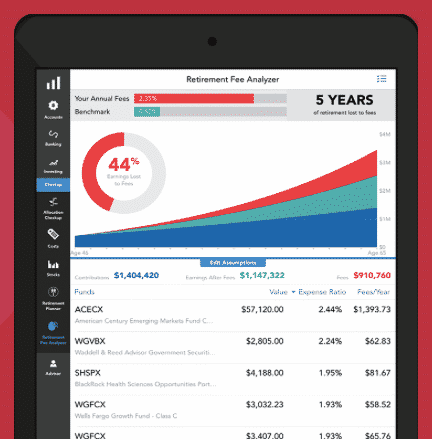
    personal capital fee analyzer identify hidden fees

    The “catch” when using the Personal Capital mobile app is the company gets to see your entire financial life and will invite you to consult with a dedicated financial advisor if you meet the minimum account levels to invest.

    In our experience, the “up-sell” is not intrusive and feels more like an invitation that you can politely decline or accept.

    Once you start using the mobile app, you will find that it is very well designed and may hook you. Don’t be surprised if you find yourself logging in daily to view your net worth, track your spending and keep tabs on loan balances.

    If you choose to invest at Personal Capital, you will experience a white-glove service. You can think of Personal Capital as the luxury robo-advisor that holds your hand every step of the way by pairing you with a dedicated financial advisor as opposed to a team of live advisors or financial experts.

    The fees you pay will be steeper than those charged by many top robo-advisors – you pay for the higher level of personal service.

    Personal Capital charges 0.89% annually on assets managed. Still, you pay a good bit lower than what the average financial advisor charges and you get a whole lot more bang for your buck.

    QUICK BETTERMENT REVIEW

    Betterment began as the low-cost robo-advisor but has continually improved its offering over time to cater not only to customers who want pure digital advice but also to those who seek access to Chartered Financial Professionals.

    As an early robo-advisor pioneer, Betterment has taken full advantage of its head-start over new up-and-comers by developing ever more tools and services to add value to customers. You can even donate to charity automatically via the Betterment platform.

    Want to avoid so-called “sin stocks” that produce tobacco and alcohol? Or side-step companies with questionable track records of protecting customer data? Maybe you want to steer clear of companies that have polluted the oceans following oil spills?

    Check. Check. Check. Betterment has you covered on all fronts with socially responsible investing portfolios, known as SRI portfolios.

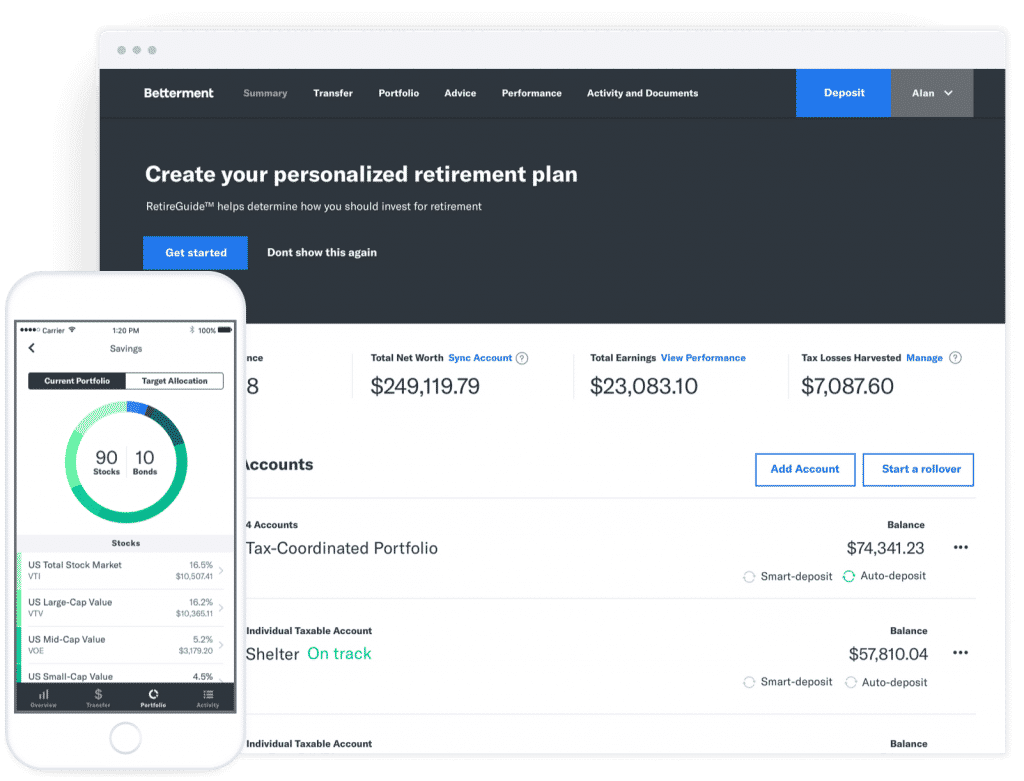
    betterment web summary mobile portfolio

    Are you fee-savvy and tax-aware? Betterment charges some of the lowest fees among all robo-advisors and has one of the most comprehensive tax-advantaged setups in the industry, featuring not only tax-loss harvesting service but also tax-coordinated portfolios.

    If you have an eye on retirement, Betterment delivers calculators, guides and tools to help you assess where you sit and what you need to do to reach your financial goals.

    Fee Comparison: Betterment Vs Personal Capital

    Personal Capital fees range from 0.49% to 0.89% but for most investors with less than $1 million, the higher fee will apply. Betterment fees start at 0.25% for its pure robo-advisor service and increase to 0.40% for a hybrid service that includes human advice.

    Betterment imposes no account minimum to get started, so if you want to try out its service the hurdle is low.

    When you deposit money, you will be charged 0.25% for Betterment Digital, its pure digital advice service.

    Fees remain at 0.25% of assets managed as you deposit more money, so you know you are getting rock bottom pricing no matter how much or little you invest.

    If you want access to human advice, Betterment does make available Chartered Financial Professionals to customers of its higher tier service, Betterment Premium. However, you will pay a bit more for this service – it costs 0.40% annually.

    Robo-Advisor $5,000 $10,000 $50,000 $100,000 Open Account
    bettermentREVIEW

    0.25% 0.25% 0.25% 0.25%
    personal capitalREVIEW

    NA NA NA 0.89%

    Personal Capital is more expensive from the get-go. It costs 0.89% up to the first million dollars deposited.

    To qualify for a Personal Capital account, you need to deposit at least $100,000 so if you have less, Betterment is your only option.

    Take note however that Betterment also imposes a $100,000 minimum for its higher tier service, Betterment Premium, but anyone can get started with Betterment Digital, which provides digital advice only.

    The fees at Personal Capital decline on a sliding scale all the way down to 0.49% but you will need to pony up a hefty $10 million to qualify for its lowest rate.

    The sliding scale of fees at Personal Capital is:

    Amount Management Fees
    Up to $1,000,000 0.89%
    First $3 million 0.79%
    Next $2 million 0.69%
    Next $5 million 0.59%
    Over $10 million 0.49%

    So what do these percentage charges mean in terms of how many dollars come out of your pocket?

    Robo-advisor $10,000 $100,000 $1,000,000 $3,000,000 Open Account
    bettermentBetterment Digital
    Management Fees
    $25 $250 $2,500 $7,500
    bettermentBetterment Premium
    Management Fees
    N/A $400 $4,000 $12,000
    personal capitalManagement Fees N/A $890 $8,900 $23,700

    Betterment Fees or Personal Capital Fees: Which Robo-Advisor Wins? Betterment is about half the cost of Personal Capital for equivalent service. For a pure robo-advisor service, Betterment is the only choice and charges fees in line with industry norms.

    Personal Capital vs Betterment
    Human Advice

    Clients at Personal Capital are paired with a dedicated financial advisor and if they deposit over $200,000 they have access to two dedicated financial advisors. Betterment clients can connect with a team of Chartered Financial Professionals.

    Both Betterment and Personal Capital provide human advice in addition to algorithmic, computer-powered money management services.

    Where they differ is that Personal Capital pairs you with a dedicated financial advisor while Betterment connects you to a team of Chartered Financial Professionals.

    Personal Capital also goes a step further by examining your complete financial picture. Leveraging its mobile app, Personal Capital can view much more than your investment accounts to get a holistic view of your financial circumstances.

    By examining your day-to-day spending habits, savings rates, assets and liabilities, Personal Capital can construct a tailored portfolio.

    Personal Capital Vs Betterment: Which is Better for Human Financial Advisors? If you don’t need or want the extra hand-holding and feel comfortable simply knowing a financial expert is accessible when you need one then Betterment can save you money but if your financial situation is more complex, or a more personalized approach suits you better, Personal Capital is the way to go.

    Personal Capital vs Betterment
    Investment Method

    Betterment and Personal Capital use ETFs in portfolios that are built on the foundations of Modern Portfolio Theory. Above $200,000 in assets, clients have access to individual stocks at Personal Capital.

    Like most robo-advisors, Betterment and Personal Capital rely on Nobel-prize winning research, called Modern Portfolio Theory, to build diversified portfolios for clients.

    Low-cost exchange-traded funds, or ETFs, are used by both robo-advisors, though Personal Capital will use individual stocks also for clients with portfolios over $200,000.

    This process is called Smart Indexing and allows Personal Capital portfolios to mimic an ETF by grouping a collection of individual securities that can then be sold or replaced to lower taxes.

    Betterment exclusively uses exchange-traded funds with expense ratios that range from 0.09% to 0.17% and include up to 12 asset classes.

    Retirement Planning & Financial Goals: Should You Choose Personal Capital Or Betterment? It’s a virtual tie between Personal Capital and Betterment on investment strategy because both rely on the same Nobel-prize winning research to build diversified portfolios that match client risk profiles and financial goals but Personal Capital squeezes out a narrow victory thanks to its Smart Indexing (also known as Smart Beta) approach.

    Betterment vs Personal Capital
    Tax Efficient Harvesting

    As top robo-advisors, both support tax-loss harvesting and look to allocate assets optimally across taxable and tax-advantaged accounts.

    Betterment has a keen eye on tax-efficient investing. Beyond tax-loss harvesting, which looks to lower capital gains taxes by offsetting losing positions against winning positions, tax-coordinated portfolios are used by Betterment.

    A tax-coordinated portfolio is designed to place tax-efficient assets in tax inefficient accounts and tax inefficient assets in tax efficient accounts. For example, municipal bonds are already tax-advantaged so there is no reason to place them in a tax-efficient account, such as an IRA or 401(k).

    Personal Capital also strives to place assets in taxable and tax-advantaged accounts based on their taxable impact.

    Personal Capital vs Betterment: Tax Loss Harvesting? Betterment and Personal Capital tie on tax strategy because both optimize for taxes within taxable accounts using tax-loss harvesting as well as across accounts based on the tax impact and tax efficiency of assets and underlying accounts.

    Betterment vs Personal Capital
    Account Types

    Both robo-advisors support a wide range of accounts, including taxable and tax-advantaged accounts.

    Personal Capital Betterment
    Individual non-retirement Individual non-retirement
    Joint non-retirement Joint non-retirement
    Traditional IRA Traditional IRA
    Roth IRA Roth IRA
    Rollover IRA Rollover IRA
    SEP IRA SEP IRA
    Trusts Trusts

    Personal Capital will also advise on 529 Plans and 401(k) plans, though it won’t manage either.

    Betterment vs Personal Capital
    Overall Winner

    Betterment wins on fees, a lower account minimum, range of services, and retirement tools while Personal Capital wins for its mobile app, dedicated financial advisors and tax strategy.

    Personal Capital Wins Betterment Wins
    Human Advice: Personal Capital clients are paired with dedicated financial advisors, and clients with assets over $200,000 are assigned to two dedicated financial advisors. Portfolio Management Fees: Betterment wins with low fees of 0.25% for Betterment Digital and 0.40% for Betterment Premium, a hybrid service that includes human advice via Chartered Financial Professionals.
    Tax Strategy: Both robo-advisors do an excellent job on tax strategy, though if we had to pick one, Personal Capital would get the nod simply because it employs Smart Beta or Smart Indexing using individual securities as opposed to ETFs alone. Account Minimum: Although both Personal Capital and Betterment have high minimums of $100,000 for clients who want access to human advice, Betterment is the clear winner for solely digital advice because it imposes no minimum to get started.
    Mobile App: Clients and non-clients alike can take advantage of Personal Capital’s world class mobile app, which will track your budget, spending, savings, investments, assets and liabilities in an easy-to-use interface. Goal Setting: Betterment relies on behavioral investing to help clients set financial goals and stick to them – plus you get the option to sweep unused cash into accounts that are dedicated to certain financial targets, such as saving for a new home or a car.
    Tools: Clients enjoy a 401(k) fee analyzer as well as a budget tracker to monitor expenditures at no extra cost. Retirement Planning: RetireGuide is a tool at Betterment that links to outside accounts and tracks how savings and financial objectives match to make sure you are on target with your financial aspirations.
    Account Types: Personal Capital will advise on 529 Plans and 401(k) plans as well as manage taxable and retirement accounts, including rollover, traditional, Roth and SEP IRAs. Expense Ratios: Betterment expense ratios range from 0.09% to 0.17%
    Fractional Shares: No cash is left idle at Betterment thanks to its fractional shares feature, so you can be confident that your money if fully invested.

    Which Robo-Advisor Is Best For You: Personal Capital or Betterment?

    Betterment has long been regarded as one of the top robo-advisors but Personal Capital offers stiff competition.

    For investors with less than $100,000 to invest, the only option is Betterment because Personal Capital imposes that as a minimum. If you can meet that hurdle, you will pay higher fees at Personal Capital than at Betterment but you will also enjoy a higher level of service when paired with a dedicated financial advisor.

    If your circumstances are more complex and access to human advisors is important, Personal Capital may be the better fit, and you will also get the bonus of a robo-advisor who has a clear focus on optimizing the all-important after-tax returns.

    Betterment has a wide range of tools and calculators to help you stay on track to meet your financial goals while Personal Capital has an excellent mobile app to track budgeting, spending, and investments.

    So, which is better when comparing Personal Capital vs Betterment? It’s a close call, but Betterment gets the nod overall because of its lower fees and account minimums.

  • Betterment vs Online Savings Account Comparison

    Betterment vs Online Savings Account Comparison

    betterment vs online savings account

    Investormint provides personal finance tools and insights to better inform your financial decisions. Our research is comprehensive, independent and well researched so you can have greater confidence in your financial choices.

    More than money, time is your best friend when investing for a better tomorrow.

    The earlier you start investing, the more the magical power of compounding works in your favor.

    But should you invest in the stock market or a bank savings account?

    We compare a leading robo-advisor which invests clients’ money in the stock market, Betterment vs online savings accounts to help you decide which is right for you.

    What Is Your Investing Timeline?

    Savings rates have been dismal for many years. Since 2009, it’s been so bad in fact that for every $100 you deposited in an online savings account, you’d have been lucky to get back $1 by the end of the year.

    Unlike investors in the 1980s who earned $15 or more for every $100 bill invested in a savings account, savers over the past decade earn peanuts in interest by comparison.

    But just because savings rates have been poor doesn’t mean an online savings account is a bad idea.

    The most important factor to consider when comparing an online savings account vs Betterment or some other investment management option is timeline. Specifically, when will you need the money you have invested?

    Even the best short term savings options these days don’t pay much interest. On the flipside, they are usually very liquid, meaning you can withdraw your cash easily.

    Long term savings options are often much less liquid, so if you expect you will need the money to pay for an upcoming large purchase or an Alaskan whale-watching cruise, it’s best to stick with short term investments.

    Best Places To Invest
    Your Savings Short-Term

    Short term savings options fall into a few main buckets:

    Savings Vehicles Possible Investments Returns
    Online Savings Account 1%
    Certificate of Deposit 1% → 2%
    Short-term Bonds 1% → 2%

    An online savings account or money-market fund isn’t just a good option when you need cash in a hurry, it’s also a good match if you are risk-averse and want to avoid the slings and arrows of stock market volatility.

    Even if your investing time horizon is long and you have no qualms about riding the ups and downs of the stock market, an online savings account can be used as an emergency fund.

    But what about an online savings account vs Betterment?

    Where To Put Savings?

    Money you need now or in the near future should not be invested in the stock market but once your investing time horizon stretches to 5 → 10 years or more, investing savings is a smart strategy.

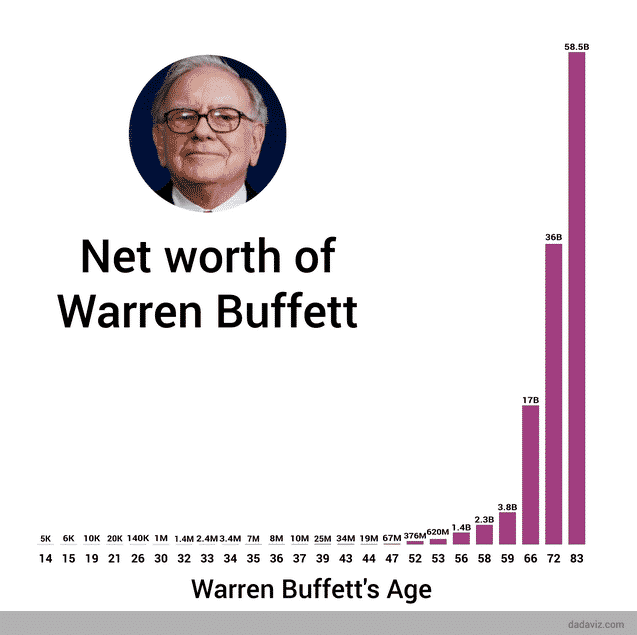
    The secret to growing wealth is hidden in the magical power of compounding. And perhaps the best way to understand it is to visualize the wealth of the world’s most success investor, Warren Buffett.

    By age 30, he was worth $1,000,000. Almost a decade later his wealth had grown to $34 million. That’s a pretty impressive gain!

    But more recently his net worth increased by $22 billion over an 11 year period from age 72 to 83. That’s $22 Billion with a B!

    buffet net worth business insider

    Source: Business Insider

    By investing in the stock market and letting his investments grow over the long term, the power of compounding has amassed a fortune.

    The takeaway is clear: a smart long term savings plan should include stock market investing.

    Not every year will be a good one in the stock market but if you brace yourself for rocky periods and trust in the long-term tendency of stock markets to rise, you might be surprised at just how much money you can accumulate.

    But where should you put savings and what are the best long-term investment options?

    Where To Invest Money Long Term?

    When you read Warren Buffett books, you’re left in no doubt that the stock market is the best way to invest money long term.

    But should you pick stocks like Netflix or Amazon or invest in Vanguard funds?

    The lesson that comes through loud and clear from the Oracle of Omaha is that beating the stock market is notoriously difficult for most non-professional investors and even most professional investors!

    Rather than picking stocks that are grabbing headlines today, a broad stock market index featuring a diversified portfolio of exchange-traded funds is a smarter choice over the long term.

    Most investors fail to beat the major stock market indexes over long time horizons so it makes sense to stick with the proven strategy of buy-and-hold.

    One of the best ways to do so is to choose a robo-advisor and the clear leader among digital financial advisors is Betterment.

    What Is Betterment?

    Betterment is a robo-advisor that manages your money automatically. It features two tiers of service, Digital and Premium.

    Betterment Digital is aimed at hands-off investors who want a pure robo-advisor to manage their money while Betterment Premium also includes unlimited access to human advice.

    Regardless of which service tier you choose, Betterment computer algorithms spread your money across up to 12 asset classes using low cost ETFs.

    By keeping your portfolio diversified, Betterment returns more closely match average stock market returns. That means you don’t fall into the trap of stock pickers who cherry-pick hot stocks in the hopes of big windfalls only to underperform long-term on average.

    Fee Comparison

    Online savings accounts don’t pay much in the way of interest but they don’t cost much either.

    On the other hand, Betterment does charge management fees:

    Betterment Service Annual Management Fees
    Digital 0.25%
    Premium 0.40%

    The management fees you pay are much lower than the fees paid to traditional financial advisors, and arguably they go a lot further too.

    Every Betterment portfolio enjoys free automatic rebalancing and tax-loss harvesting to make sure your portfolios stay diversified and the tax impact of gains is lessened.

    Another way tax implications are lessened is through tax coordinated portfolios which are designed to place tax inefficient assets in tax-advantaged accounts and tax-efficient assets in taxable accounts.

    Betterment tax strategies, according to the company, can boost average returns by as much as 2.66% annually – more than many online savings accounts pay in annual interest!

    Betterment Management Fees

    Service $2,000 $5,000 $100,000 $1,000,000 Get Started
    Betterment Digital $5 $12.5 $250 $2,500
    Betterment Premium N/A N/A $400 $4,000

    Like other top robo-advisors, Betterment passes on the cost of expense ratios to clients but does an excellent job keeping those fees in check.

    The average expense ratio at Betterment is just 0.13%.

    Investment Minimums

    Betterment Account Minimum

    Service Type Account Minimum
    Betterment Digital $0
    Betterment Premium $100,000

    No investment minimum is required to open a Betterment Digital account but investors will need $100,000 to gain access to Betterment Premium.

    Online Savings Account Account Minimum

    Online savings accounts usually have no minimums.

    Betterment vs Online Savings Account
    Overall Winner

    Online Savings Account Wins Betterment Wins
    Emergency Fund: It’s wise to keep some money in an online savings account to pay the bills when rainy days come. Performance Returns: If history is a reliable indicator, the performance returns of the stock market will far outpace savings rates over any long term period.
    Liquidity: If you need money soon to pay for a large purchase, an online savings account is best so your money is not tied up when you need it most. Beat Inflation: The purchasing power of cash held in savings accounts can dwindle over time whereas stock market investments keep pace and usually beat inflation rates.
    Stable Returns: Online savings accounts don’t pay much but the returns are predictable over time. Tax Strategy: Betterment offers tax strategies on all accounts to keep more in your pocket versus Uncle Sam’s.
    Short-term Timeline: If your time horizon to needing money is short, a savings account is best. Human Advice: Betterment features in-app messaging access to financial consultants to help guide your investing decisions.

    Online Savings Account vs Betterment Summary

    Not sure whether to put your money in an online savings account or invest it with Betterment?

    Savings accounts will provide predictable and stable returns which are ideal when you think you’ll need money soon. However, interest rates are so low that the purchasing power of your cash may diminish after factoring in inflation.

    Betterment offers the potential for much greater returns on your money long term, access to financial consultants, and an advanced tax strategy to minimize Uncle Sam’s share of your profits. But remember the downside risk is higher too.

    Provided your time horizon is long and you’ve already got cash savings to provide for a rainy day, Betterment is among the very best long term investment options.

  • Annuity vs IRA Pros and Cons

    Annuity vs IRA Pros and Cons

    annuity vs ira pros and cons

    Investormint provides personal finance tools and insights to better inform your financial decisions. Our research is comprehensive, independent and well researched so you can have greater confidence in your financial choices.

    The financial industry is laden with jargon that’s hard to understand for people who work in other areas. Annuities and IRAs fall squarely into that category of being difficult to compare when it comes to fees, expenses, returns, pros and cons.

    What’s the difference between a traditional IRA vs Roth IRA vs 401(k)? How do you choose between an annuity vs IRA account?

    It’s all quite complicated at first glance, which is why we broke it down and made it easy so you can quickly gauge annuity vs IRA differences in order to give yourself the best chance at a more comfortable retirement.

    What Is An Annuity Account
    And How Do Annuities Work?

    An annuity is a financial product issued by an insurance company that pays a guaranteed fixed income amount on a regular basis, typically each month or quarter.

    The way annuities work is:

    Step 1: You fork over a lump sum all at once or you make regular contributions over time.

    Step 2: The insurance company then invests those premiums and gambles that it can earn more money from its investments than it commits to pay you.

    Annuities come in various shapes and sizes. You could choose to be paid a fixed income stream for the rest of your life, a set time period, or a fixed number of years.

    Below we’ll compare fixed annuities vs variable annuities vs equity-indexed annuities.

    What Is An IRA?

    An IRA or Individual Retirement Account is nothing more than a type of account set up at a brokerage firm or some other financial company.

    Different types of IRA accounts exist, including traditional IRA, Roth IRA, and SEP IRA accounts.

    The main attraction of an IRA is that contributions grow tax-deferred. That means if you invest in stocks, bonds, mutual funds, or other asset classes, your gains are not subject to taxes while the money remains in the accounts.

    It is not until you withdraw money from a traditional IRA that you pay taxes however you never have to pay taxes on gains from a Roth IRA.

    You might be wondering then why not put all your money into a Roth IRA if gains are never taxed?

    The catch is your contributions to a Roth IRA are made with after-tax money while your contributions to a traditional IRA are made with pre-tax money.

    >> Learn more about traditional IRA vs Roth IRA accounts

    Even if you wanted to put all your money into a particular IRA account, contribution limits are in place so you can’t deposit more than a certain amount.

    And the withdrawal rules for IRAs and Roth IRAs may vary too, so it’s worth checking them before picking one retirement account over the other.

    >> What Are The Rules For Roth IRA Withdrawals?

    IRA Rules: Snapshot View

    Types of IRA Contributions Max Contribution Withdrawals
    Traditional IRA Pre-tax Dollars $5,500
    (or $6,500 if over 50)
    Taxed
    Roth IRA After-tax Dollars $5,500
    (or $6,500 if over 50)
    Not Taxed

    Keep in mind that any traditional IRA withdrawals you make before the age of 59.5 years old will be penalized and you must take mandatory withdrawals by age 70.5 if you haven’t already done so.

    For Roth IRA accounts, you must take minimum withdrawals by the age of 70.5.

    Annuity vs IRA: 3 Major Considerations

    Depending on three primary factors, you will probably find yourself naturally leaning more towards either an annuity or IRA account.

    Control, fees, and certainty are the biggest considerations when choosing between an IRA and an annuity.

    Control & Certainty: How Your Funds Are Managed

    If you are a self-directed investor who actively manages a portfolio in a brokerage account, an IRA will probably be a better fit for you.

    In an IRA, you have control over how to invest your money. Want to bet it all on Amazon, Facebook, Google, or Netflix? You can and nobody will stop you – however, it may not be the wisest way to allocate your retirement money!

    For retirement-focused individuals who want to offload the responsibility of managing money, an annuity may be more attractive because the responsibility of the insurance company is to invest your contributions.

    What makes fixed annuities attractive is the insurance company guarantees you a fixed payout irrespective of how your investments perform.

    So, if the stock market crashes, you still receive your fixed income payment.

    Equally, if the stock market soars, you don’t receive more than the specific amount the insurance company agreed to pay you when you selected your annuity.

    The bet the insurer makes is that they will earn more on the investments than they commit to paying out to you.

    Fees: Annuities vs IRAs

    The certainty of a fixed income stream for a defined time period promised by insurance companies when you select an annuity comes at a cost.

    Annuities are famous for their lack of fee transparency, so it is always best to ask an insurance company for a full breakdown of all fees associated with the annuity.

    If you have a financial advisor, ask them how much they get paid. You might be surprised to discover financial advisors often get paid a hefty fee for referring customers who purchase annuities to insurance companies.

    A 5% fee paid to a financial advisor may not seem like a massive amount until you figure that could be $50,000 on a $1,000,000 annuity sale!

    >> 17 Questions To Ask Your Financial Advisor

    Are Annuities A Good Investment?

    Although annuity fees can be hefty, the peace of mind they bring may be worth the upfront cost to many retirees.

    Annuity Pros

    If you are worried about outliving your nest-egg or running out of money, an annuity can bring certainty that you will always receive a fixed income.

    Annuities come in all sorts of shapes and sizes too. You could pick one that pays you until you die or both you and your spouse die.

    And you can choose from different types of annuities to ensure that your kids or other beneficiaries receive payments from any unpaid funds via a death benefit.

    Annuity Cons

    Beyond fees, the biggest reason to think twice about annuities is the hidden factor of inflation.

    Today it might seem like a good idea to purchase an annuity that pays $5,000 per month for the rest of your life.

    But in 30 years the same $5,000 may not go nearly as far as it does today because inflation erodes the purchasing power of money over time.

    Evaluate how much money you will really need to pay your bills not just this year and next year but perhaps in 20 or 30 years time too.

    Annuities often include terms and conditions that you should research before signing. For example, surrender charges may apply if you were to close your policy early.

    And in many (though not all) annuities you won’t benefit from investments that soar in value.

    Types Of Annuity: Payouts & Fees

    By now you know an annuity is a type of insurance policy that pays out fixed premiums, but which annuity option is best?

    The basic types of annuities include:

    Fixed Annuity
    • Fixed annuities pay a guaranteed amount
    • Earnings grow on a tax-deferred basis
    • Taxes are paid when withdrawals are made
    Variable Annuity
    • A variable annuity gives you more control over how your money is invested, whether stocks, bonds, or mutual funds
    • The payout you receive depends on the performance of the investments
    • Like fixed annuities, gains accumulate on a tax-deferred basis
    Equity-indexed Annuity
    • An equity-index annuity is usually tied to the performance of the S&P 500
    • It guarantees a minimum interest rate usually and minimum payment amounts

    Annuities are famously hard to decipher when it comes to total fees charged.

    Clients usually receive thick booklets full of financial jargon and it can be challenging to find out precisely what you are paying in annuity fees and expenses.

    While your financial advisor should have your best interests at heart, it’s probably wise to compare the best annuity rates in order to create a shortlist of the best annuities for retirement before meeting with your advisor.

    >> 7 Financial Goals To Live A Better Retirement

    Annuity vs IRA Pros and Cons

    When comparing annuities vs IRAs, you have lots of factors to consider but perhaps the most important of all is peace of mind.

    For seniors especially, the idea of running out of money later on in life can weigh heavily as a concern.

    While an annuity may be costly when it comes to fees and expenses, it can provide a certainty that is virtually unparalleled: a guaranteed payment for life.

    For younger individuals or those who can tolerate more risk and want greater control over how their retirement money is invested, IRA accounts offer tremendous flexibility.

    You are not restricted to investing in different types of stocks or bonds. Real estate and other asset classes are options too.

    Companies like Fundrise, Roofstock, and Rich Uncles all offer ways to gain exposure to real estate without getting your hands muddy with day-to-day management.

    FUNDRISE SPOTLIGHT

    fundrise logo

    InvestorMint Rating

    4.5 out of 5 stars

    • Minimum Investment: $500
    • Returns: 11.44% (net of fees)

    via Fundrise secure site

    >> How To Rollover a 401(k) To An IRA Account

    >> The Best Retirement Plans For Independent Contractors

    >> Retirement For Dummies

  • What Is SVXY?

    What Is SVXY?

    what is svxy

    Investormint provides personal finance tools and insights to better inform your financial decisions. Our research is comprehensive, independent and well researched so you can have greater confidence in your financial choices.

    What Is SVXY? The ProShares Short VIX Short-Term Futures ETF [SVXY] is a bet against volatility.

    It’s as easy to purchase the exchange-traded fund as it is to buy shares of Amazon in a brokerage account.

    But buying the ProShares Short VIX Short-term Futures ETF is in no way similar to buying a dividend-paying stock as part of a buy-and-hold strategy.

    Adventurous traders who have purchased SVXY in the past know it can be a highly lucrative trading vehicle but it is also fraught with risk.

    Before you put your hard-earned money into the SVXY ETF, you need to know the pros and cons which we cover below.

    How Does SVXY Work?

    The ProShares Short VIX Short-Term Futures ETF looks to replicate the performance of one-half the inverse of the performance of the S&P 500 VIX Short-Term Futures Index for a single day.

    For emphasis we highlight that it doesn’t track on a 1:1 basis as it originally did when it first launched, but instead the results (before fees and expenses) correspond to -0.5x the inverse performance of the S&P 500 short-term futures.

    That’s a complicated way of saying when volatility declines, the SVXY is generally expected to rise and when volatility spikes ticker symbol SVXY usually falls.

    The security is designed for traders who want to bet against volatility spikes.

    So how does SVXY work?

    In order to track the inverse of market volatility through publicly traded futures markets, the ETF is set up to measure the returns from rolling long positions in the first and second month VIX futures contracts.

    As a result, buyers of the SVXY should expect that it will typically rise over time but when volatility spikes higher, the ETF will fall sharply.

    The tendency of the exchange-traded fund to rise in price over time means it will most likely undergo regular stock splits.

    SVXY Splits History

    According to SplitHistory, SVXY has undergone numerous splits in the past.

    In 2012, a 2:1 SVXY stock split took place, meaning that if you owned 100 shares before the split you would have owned 200 after the split, albeit at half the price.

    A couple of years later in 2014, another 2-for-1 stock split took place and finally a third stock split took place in 2017, which was again a 2-for-1 split.

    When these stock splits take place, no increase or decrease in market capitalization occurs. The value you own before the split is identical post-split but the share price diminishes to make it more affordable for new investors to buy.

    How SVXY Relates To VIX

    For traders who are new to volatility products, it’s reasonable to assume the SVXY tracks the CBOE Volatility Index [VIX] but it would be an error to do so.

    The SVXY mirrors the performance of the VIX futures, which behave very differently.

    When volatility spikes, the Volatility Index, or VIX, may rise significantly. However, the VIX futures may build in an expectation that prices will return to lower levels.

    Similarly, when you bet on volatility declining and it does indeed fall, you may not see a commensurate increase in the value of SVXY because the futures build in some expectation of future spikes in volatility.

    Nevertheless, history shows that the Volatility Index inversely correlates with the SVXY fairly closely.

    If you need to scratch your head after all that jargon, don’t worry because you’re not alone. In fact, it’s probably fair to say the SVXY can be so volatile that it is not really intended for first time traders.

    Before placing any real capital at risk, you should know how the SVXY price history changes over time and why it tends to rise slowly most of the time but fall fast some of the time.

    Why Does SVXY Share Price Rise?

    Over time, SVXY has a history of rising due to a process that few traders understand, called contango.

    Contango can be simply understood by visualizing futures prices rising over time. So, month 2 is more costly than month 1, and month 3 is more costly than month 2.

    As uncertainty rises over time, futures prices increase with time. But that is not always the case.

    Every once in a while a market crisis occurs and the short-term outlook is more uncertain than the long-term outlook, which causes backwardation, or a downward sloping futures curve.

    The slope of this curve is intimately connected to the way SVXY trades so it’s important to understand.

    With that said if contango and backwardation are giving you a headache, you can use this rule of thumb:

    When the short-term market outlook is calm, SVXY will usually rise slowly but when volatility spikes, SVXY will usually fall fast.

    SVXY vs VXX

    SVXY is essentially the inverse of VXX, the iPath S&P 500 VIX Short-Term Futures ETN, albeit with different leverage.

    Traders who are worried the stock market will crash often purchase the VXX as a hedge against portfolio losses.

    If you owned stocks like Netflix, Facebook, Amazon, and Alphabet in your portfolio, and the market subsequently crashed then those stocks would probably fall too.

    But by owning shares of VXX, which can be purchased much like any stock in a brokerage account, such as at thinkorswim or tastyworks, the chances are VXX will rise in price while other positions decline in price.

    The problem with purchasing VXX is that over time it has a history of falling in price. And therein lies the opportunity for SVXY buyers.

    Because SVXY trades inverse to VXX, the long-term trend for SVXY has been to rise in price.

    If you think it’s “easy money” after buying SVXY however, think again! Before taking the plunge, you need to view the SVXY price history and know what to expect when markets are rattled by bad news.

    What Is SVXY Stock Price History?

    It’s true that SVXY can be held over the long term and has generally shown a history of rising prices. But it’s known to cause its fair share of heart-stopping moments along the way too.

    In early 2018, investors lost a fortune as SVXY plunged in price by over 80% in the virtual blink of an eye.

    In fact, losses were so fast and severe that trading was halted in SVXY.

    The takeaway is that betting against volatility is not for the faint of heart.


    AMEX:SVXY Stock Quote Accuracy

    Because of the extreme volatility in SVXY in early 2018, ProShares modified the investing goal from tracking the inverse of VXX on a one-to-one basis to only half that amount.

    That means price history before March, 2018 reflects a more volatile security than thereafter.

    Also when you search for an SVXY quote or SVXY after hours price, the number will closely match the inverse of the S&P 500 Short-Term Futures Index but may not be precisely accurate.

    This is due to the influence of deep-pocketed buyers and sellers, who may place large orders, which from time to time can causes prices to spike or dip away from market levels.

    When SVXY stock price deviations like this take place, market makers generally step in to match orders and keep prices stable.

    Can SVXY Go To Zero?

    Yes, it is theoretically possible that SVXY can go to zero. But believe it or not this is not the worst outcome for traders betting against volatility.

    While the worst outcome for SVXY buyers it to lose all their money, traders who short VXX as an alternative way to bet against volatility stand to lose even more money because theoretically there is no limit to how high VXX can rise when volatility rises.

    If you are tempted to bet against volatility, the downside is limited when buying SVXY but is theoretically unlimited when shorting VXX.

    >> How To Trade The Most Volatile Stocks

    What Is The SVXY Expense Ratio?

    According to ProShares, the expense ratio for SVXY is 0.95%.

    Approximately $500 million is held in assets under management, so managers make close to $5,000,000 per year.

    SVXY may hold large cash positions due to the nature of the fund, which holds positions daily. So, it’s possible interest is collected on Treasury bills too.

    Should You Buy SVXY?

    Who doesn’t love an investment that is almost certainly guaranteed to rise most of the time?

    What makes the ProShares Short VIX Short-Term Futures ETF [SVXY] so alluring is its price history of slowly and steadily rising since inception.

    But be under no illusions, this instrument can cause heartache in the blink of an eye.

    In the past it has crashed by 80%+, effectively wiping out SVXY buyers.

    If you can stomach such gut-wrenching volatility every once in a while knowing that, more often than not, the ETF will march higher then it might be for you.

    For nervous nellys who shudder at the thought of waking up to losses so large, other investments will be a better fit.

    How To Trade SVXY

    Risk-seeking investors who can tolerate lots of volatility could consider SVXY as a way to bet against volatility.

    If economic clouds loom on the horizon or you believe markets are about to fall off a cliff, this is an exchange-traded fund to stay away from until blue skies appear again.

    And while SVXY is an ETF that can be traded much like a stock, remember it is based on futures prices. So, ideally it is best to trade it with a broker who understands futures and options well.

    Consider a leading broker like thinkorswim or tastyworks as opposed to a broker specializing in stocks or cryptocurrencies like Robinhood.

    tastytrade SPOTLIGHT
    tastytrade (previously known as tastyworks)

    Investormint Rating

    4.5 out of 5 stars

    • Commissions: Closing trades for Stocks & ETFs and Options are commission-free
    • Account Balance Minimum: $0
    • Commissions: $0 flat rate for stocks

    via tastytrade secure site

    Have you traded SVXY in the past? Share your tips in the comments below about how best to trade the ETF so other readers can sidestep the pitfalls.

    >> What Is UVXY?

    >> Best Brokers For ETF Trading

    >> Prefer To Automate Your Investments? Check Out Betterment

  • Saving vs Investing Money: How Do You Decide?

    Saving vs Investing Money: How Do You Decide?

    saving vs investing

    Investormint provides personal finance tools and insights to better inform your financial decisions. Our research is comprehensive, independent and well researched so you can have greater confidence in your financial choices.If you have built up a nest-egg, you might be deciding whether saving vs investing is better for your future wealth.

    At first glance, it may not seem like there is a big difference between squirreling away money as part of a savings plan compared to investing in the stock market, real estate, or some other asset class.

    But over time, a stark difference emerges in how much wealth you can accumulate, especially when interest rates are low.

    What makes the biggest difference to how much money you can have in the future has been described by Albert Einstein as the most powerful force in the Universe and by Warren Buffett as the least understood concept by most stock market traders.

    What is it? Let’s take a look as we compare investing vs saving.

    Saving vs Investing:
    A Historical Perspective

    To really understand the difference between saving and investing, we need to take a trip back in time to the 1980s when interest rates were high.

    For simplicity, let’s pretend you could deposit your money in a bank savings account and earn an interest rate of 15% per year – which is close to the Federal Funds rate in 1980.

    Or you could have invested your money in the stock market and bet on higher share prices over the coming years.

    Should you have saved your money or invested it?

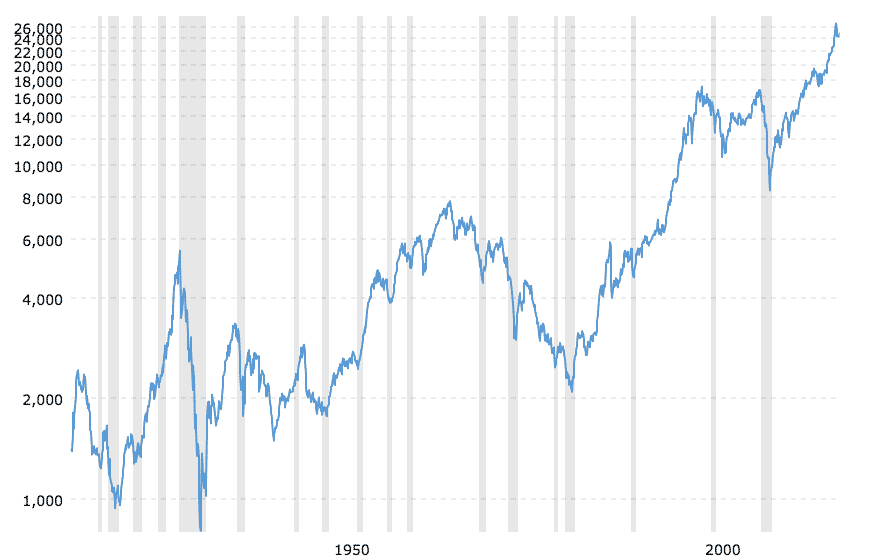
    To help guide the decision, we can look back at history and figure out, on average, how much the stock market increases per year.

    With average annual stock market returns of approximately 8% historically, the smarter choice would have been to lock in the savings rate of 15%.

    We’ll see why in a few moments.

    dow jones 100 year historical chart

    Source: Macrotrends

    The problem with a bank savings account is, when interest rates decline, the amount you earn on your savings declines too.

    So, when interest rates are paying yields greater than the average annual stock market return, you should consider locking in the high yield by purchasing long term government bonds.

    When Is It Better To
    Save Than To Invest?

    When interest rates are already high and you don’t think they’ll go much higher, parking your money in a 30-year government bond is a pretty smart bet.

    Just imagine the astute investor who chose to put money into a 30-year bond in the 1980s would still have been earning that 15%+ yield per year in 2010 when interest rates were near zero!

    And by locking in a fixed yield they would have avoided the rollercoaster ride of the tech bubble of 2000 and subsequent stock market crash as well as the real estate bubble in 2007 and the Great Recession that followed.

    The bottom line is when interest rates are very high, the best yield on your money for the risk you assume is likely to be earned by parking your money in a bank savings deposit account. Or consider a long-term government bond if you are willing to take a bit more risk and want to lock in a high rate of return.

    >> Chime Bank: Low Fees 100% Online

    When Is It Better To
    Invest Than To Save?

    Now let’s switch gears and imagine a time when interest rates are low when compared to the 1980s.

    When interest rates on savings accounts pay say 3% or less, you need to park your money for 5 years or more to earn the same rate of return as a saver a few decades earlier when interest rates were at 15%.

    The numbers are even worse if you save your money in a checking account and earn peanuts.

    In the recent past when interest rates were just 0.25%, you would have had to wait 60 years to earn the same rate of return as the 1980s saver did in one year!

    And the likelihood is any gains would be offset by inflation, which erodes your purchasing power over time.

    >> Best Bank Comparison: Chase Vs Bank Of America

    How Inflation Affects
    Your Savings Nest-Egg

    While inflation doesn’t rear its ugly head from one day to the next or even one year to the next, its effect is significant over the long term.

    Just look back to your childhood and think about how much a can of soda or a chocolate bar cost back then versus now.

    The price increases over time for the same amount of product reflects the power of inflation taking effect.

    And while on any given year it’s hardly noticeable if a can of soda goes up by a penny or two, you can’t help but notice after a couple of decades when prices are 50-100% higher that your money doesn’t go as far as it did in the past.

    The Investing vs Saving Cycle

    So, if inflation continues to eat away at your purchasing power and savings accounts don’t pay more than peanuts, what are you supposed to do in a low interest rate environment?

    The short answer: invest.

    All you need to do is compare the historical returns of the stock market again to the current savings rate to see the value of investing vs saving.

    If the average annual stock market return is 8% and the savings rate is 3% then it makes sense to invest.

    Just as you make that calculation so too do many others. In fact, so many other astute individuals make the same comparison that a herd instinct kicks in and ever more money flows into the stock market.

    As share prices continue to rise, still more people invest, which in turn pushes the stock market even higher.

    Eventually, share prices rise so high that the Federal Reserve takes action to put the brakes on the economic juggernaut by hiking rates.

    How Borrowing Costs Affect
    Saving vs Investing

    As interest rates rise, the cost of borrowing increases so businesses are less inclined to take on new loans to invest.

    That means fewer projects get off the ground and fewer people are employed and eventually the economy cools down.

    So you can think about saving vs investing much like a pendulum swinging back and forth.

    When interest rates are low, investments increase, share prices rise, and the economy powers ahead at full speed.

    And when it overheats, the Federal Reserve hikes rates causing the economy to slow to the point where eventually it becomes more attractive to save than to invest.

    Where Should You
    Invest Your Money?

    While it’s fairly obvious what to do with your money when interest rates are high – deposit them in a savings account or buy long-term government bonds – it’s not so clear where your money should be allocated during low interest rate environments.

    Should you invest in the stock market, real estate, art, gold, or even cryptocurrencies?

    Before picking an asset class, you first need to really understand what the term ‘investing’ means.

    You can buy Coca Cola in your brokerage account as easily as you can buy gold but according to Buffett, only one of those purchases is an investment while the other is a speculative bet.

    The easy way to know the difference is to create two buckets. One bucket is for investing and the other is for speculation.

    Anything that pays you a dividend is defined as an investment while anything that makes you money only when prices rise is speculative.

    Investing vs Speculation

    Not everyone agrees with Buffett’s definition of investing vs speculation.

    Some of the richest investors in the world buy gold and art, and other assets that only make money when they rise in price.

    And so they would probably disagree with Buffett. But the “Oracle from Omaha” is more successful than most when it comes to earning a return on invested capital so we’ll stick with his investing perspective for now.

    Plus, it’s backed up by some quantitative evidence from Jeremy Siegel of the Wharton School of the University of Pennsylvania.

    In his book, Stocks For the Long Run, Siegel calculated that over 95% of total stock market returns last century came from reinvested dividends, not price gains.

    Sure, you can buy a piece of art or gold or even cryptocurrencies and hope they will rise in price but know that your bets are speculative because someone must buy those assets from you at higher prices in order for you to profit.

    By contrast, an investment in Coca Cola will pay you a steady stream of dividends long into the future even if the share price doesn’t rise a penny.

    Should You Buy Gold,
    Art Or Cryptocurrencies?

    Assuming you want to invest your money not speculate with it, the process of eliminating asset classes that we followed leaves stock market investing and real estate investing as two primary investing avenues.

    Gold, art, cryptocurrencies and other assets that don’t pay regular dividends are all lumped into the speculative category for simplicity.

    rental apartments florida beach property for rentNow when you compare the stock market vs real estate market, you have a difficult choice to make.
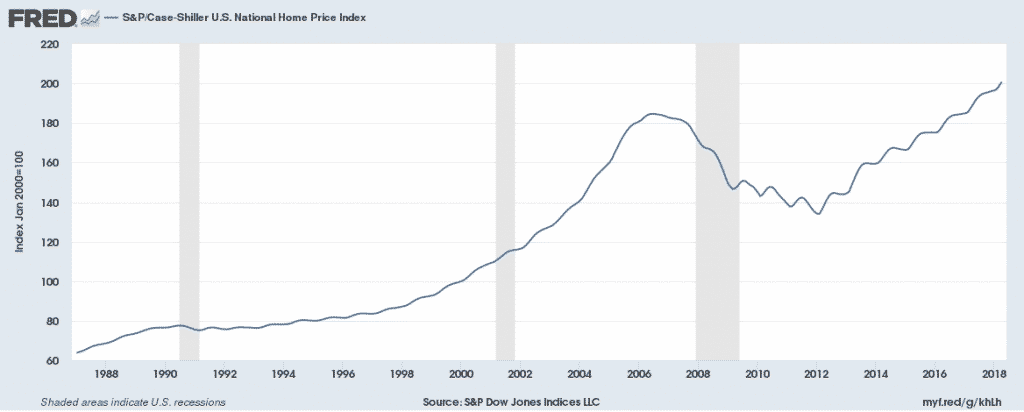

    Depending on what time frame you select to compare the two asset classes, you will find one performs better than the other.

    In the past, people compared total stock market returns to real estate price increases nationally and concluded the stock market was the better investment.

    But real estate returns vary by location. And not all studies factor in total real estate returns including cash flow from tenant income and tax breaks.

    For investors who don’t want to get into the nitty gritty of real estate, the stock market used to be the best answer. But these days, investors have many more choices to invest in real-estate without getting their hands dirty.

    S&P/Case-Shiller U.S. National Home Price Index

    Source: FRED

    No longer do you need to find a property and tenants, apply for a bank loan, and manage leaky sinks and toilets.

    Instead you can choose from a wide variety of online real estate companies that make it easy to gain exposure to the asset class with a few clicks on your computer.

    >> How To Invest In The Stock Market For Beginners

    How To Invest In Real Estate Easily

    Rich Uncles

    For investors who want exposure to commercial real estate, triple-net lease properties, and renowned business tenants, Rich Uncles is a compelling choice.

    The online experience is as good as any crowdfunding real estate company that we have reviewed.

    And within a few minutes you can diversify into real estate without having had to do any of the legwork.

    RICH UNCLES SPOTLIGHT

    rich uncles logo approved

    InvestorMint Rating

    4.5 out of 5 stars

    • Minimum Investment: $500
    • Salary Minimum To Invest: $75,000
    • Commercial Real Estate Exposure: YES
    • Access To Non-Accredited Investors: YES

    via Rich Uncles secure site

    Roofstock

    For investors who prefer to own residential property but don’t want the hassle of managing it, Roofstock is a good bet.

    You can literally buy a home the same way you would buy goods on Amazon.

    Roofstock has simplified the process of investing in real estate by sourcing properties that are usually already rented, so a cash flow stream pays you from day one.

    And you get connected by Roofstock to local property managers who take care of the nuts and bolts of day-to-day issues.

    ROOFSTOCK SPOTLIGHT

    roofstock logo

    InvestorMint Rating

    5 out of 5 stars

    • Buyer Fees: 0.50%
    • 30-Day Money Back Guarantee
    • 100% Online Purchase

    via Roofstock secure site

    Fundrise

    Another popular marketplace to invest in property online is also one of the best real estate crowdfunding sites: Fundrise.

    At Fundrise, you can invest in an eREIT, which is much like a regular real estate investment trust.

    But unlike a regular REIT traded in the stock market, Fundrise provides you a portal where you can log in 24/7 to view your property portfolio, track performance, and get a better view of where your money is invested.

    FUNDRISE SPOTLIGHT

    fundrise logo

    InvestorMint Rating

    4.5 out of 5 stars

    • Minimum Investment: $500
    • Returns: 11.44% (net of fees)

    via Fundrise secure site

    Investing vs Saving: Summary

    The rule of thumb when comparing the benefits of saving vs investing is to park your money in a bank savings account or long-term government bond when interest rates are high, like during the 1980s.

    During low interest rate environments, investing is usually the better bet and you can choose between stock market investing or real estate investing.

    Whereas in the past it was easier to gain exposure to the stock market, companies like Roofstock, Rich Uncles, and Fundrise have leveled the playing field, making it easy to gain exposure to real estate.

    Of course, this rule of thumb is just a rule of thumb. When it comes to earning the greatest return on your money, the goalposts are constantly shifting based on the political winds of change, economic stability, international trade and global money flows among other factors.

    What remains constant is the force that Albert Einstein called the most powerful in the world: compounding.

    On any given year the returns you earn may not seem earth-shattering but, over time, compounded gains can produce eye-watering returns.

    Bonus: The Power Of Compounding Revealed In A Story

    If you’re not yet aware of the power of compounding this anecdote may clear the fog.

    Imagine a pond of water that is partially covered by a plant that doubles in size every day as the sun shines on it.

    On day 1, the plant covers some small portion of the pond and on day two it covers twice that amount.

    Every day the plant doubles in size and, by day 32, the pond is fully covered by the plant.

    The question for you is what percentage of the pond is covered on day 31?

    If you are like most people, you may assume that if the pond is fully covered by day 32 then on day 31 it must be almost entirely covered. After all, there is only one more day to go.

    But remember each day the plant doubles in size, so by day 31, only half the pond is covered.

    By increasing its size at the same rate, the plant covers the same amount of the pond on the last day as it did in the first 31 days combined.

    Think about that for a moment.

    Similarly, when you invest money in year 1 or 2 or even 3, you may not experience startling returns.

    But hang on 2 or 3 decades and the power of compounding is likely to produce returns in a single year that rival or even dwarf the returns earned during the first few years.

    Of course, we’re taking some penmanship liberties here assuming a rising stock market. In practice, the stock market rises some years and falls on others. Regardless, compounding has a greater effect far out in time than near term.

    If you are not convinced, think back to the plant. Between day 1 and day 2, the plant increased in size by just a small amount, not nearly enough to cover a big portion of the pond.

    But between day 31 and day 32 a full 50% of the pond was covered thanks to the power of compounding.

    So, the effects of compounding really took hold further out in time versus near term.

    Do you have a better idea now of when to save vs invest your money? Let us know if you have any other rules of thumb about how to compare investing vs saving. We would love to hear from you.

    >> What Are The Different Types Of Stocks?

    >> Why Do Accredited Investors Choose Origin Investments?

    >> Best Stock Market Books For Beginners

  • What Are The 7 Best Personal Finance Books?

    What Are The 7 Best Personal Finance Books?

    best personal finance books

    Investormint provides personal finance tools and insights to better inform your financial decisions. Our research is comprehensive, independent and well researched so you can have greater confidence in your financial choices.

    Whether you are a twenty something, a beginner, a young adult, in college, or an experienced budgeting pro, you can always improve your financial IQ.

    The average Joe or Jane citizen claims to read one book each year while the average CEO is reported to read sixty books annually. Why is reading more important to improving your financial well-being?

    To build a richer life, make more money, and live more comfortably, new habits and knowledge are needed. And it’s for that reason we compiled a list of the best personal finance books to read.

    1 – Best Finance Book
    For Entrepreneurs: The 10X Rule

    The 10X Rule: The Only Difference Between Success and Failure by Grant Cardone is a book designed for the go-getter who aspires for greater professional and personal wealth.

    Cardone explores the habits that lead to mediocrity and the actions needed to create phenomenal success.

    If you want to achieve extraordinary results professionally, personally, or physically, you will need to radically alter how you spend your time each day, according to Cardone.

    A routine 9-to-5 job won’t translate into enormous riches. To reach phenomenal heights of success, you need to stop underestimating the effort needed and operate by what the author describes as the fourth degree of action: Massive Action.

    The 10X Rule is provocative and will prod you to reflect on whether you could be doing more to realize a life of abundance versus an ordinary life which simply meets your needs.

    The title of the book offers a hint of what lies within the pages of this bestselling book. You will be asked to think not about how you can increase your salary by 5-10% but how you can find ways to boost your income by 10X.

    By aiming ten times higher, your mind is forced to seriously evaluate what it will take to transform your life from its current state to one of significantly more abundance.

    In The 10X Rule, Cardone claims you will learn how to:

    • Set goals and guarantee they are realized
    • Achieve goals you previously imagined were unattainable
    • Create happiness professionally, personally, and physically
    • Never settle for what you have and understand why that is important
    • Be motivated by fear and use it to fuel massive action
    • Eliminate procrastination and follow a step-by-step guide to success

    2 – Top Finance Book For
    Adults – Principles: Life and Work

    Ray Dalio may not be a household name to the general public but he is an icon in the investment management industry.

    As a young, ambitious go-getter, he started a company in his two-bedroom apartment in 1975 and grew it to become one of the most successful private companies in the United States.

    That company is called Bridgewater Associates and it made more money for its clients than any other hedge fund in history.

    In Principles: Life and Work, Dalio shares a philosophy that he believes can be applied by anyone to create greater wealth and success in life, both professionally and personally.

    As an ordinary kid from a middle class neighborhood in Long Island, Dalio claims that what led to his enormous success and that of Bridgewater Associates was a ruleset that anyone can follow.

    Dalio believes economics, investing, and life itself can be systemized into rules and understood much like machines.

    In this video, for example, he describes how the economy acts like a machine:

    The basis of Dalio’s philosophy stems from the importance of what he calls “radical transparency” and “radical truth.”

    He applies this philosophy at his firm, where employees receive “baseball cards” that highlight both their strengths and weaknesses. This approach he believes leads to more meaningful relationships and work.

    Within the pages of Principles: Life and Work, Dalio shares hundreds of practical lessons to help individuals and companies become more effective and create richer outcomes.

    3 – Best Book For
    Getting Out Of Debt:
    The Total Money Makeover

    The Total Money Makeover: A Proven Plan For Financial Fitness by Dave Ramsey is a must-read for debt-laden consumers who overspend.

    If you are saddled with debt from student loans, auto loans, personal loans, or a mortgage, and trying to figure out how to improve your financial health, this is the book for you.

    In The Total Money Makeover, Ramsey attacks head-on the idea of “keeping up with the Joneses.” Just because your neighbor bought a new car doesn’t mean you should too in order to keep up appearances.

    Instead, Ramsey advocates getting out of debt and shows you how to lower your debt levels through a 4-step process that includes:

    1. List your debts from smallest to largest
    2. Make minimum payments on all your debts except the smallest one
    3. Pay as much of your smallest debt off as you can afford
    4. Repeat the process until all of your debts have been paid off

    If you want an automated way to help you achieve this method, called the Debt Snowball Method, check out this Tiller Money spreadsheet.

    While some critics argue that it is better to pay off your highest interest debt first, Ramsey claims that research shows eliminating an entire bucket of debt feels better and helps people build momentum to pay down debt at a faster rate.

    So, if you have credit card debt, a car loan, and a personal loan, the goal would be to pay off your personal loan or car loan entirely because it will make you more likely to get out of debt sooner – even if your credit card debt is costing you more each month because of higher interest rate charges.

    If the idea of being more disciplined with how you spend money resonates with you, The Total Money Makeover is one of the top personal finance books to buy.

    4 – Personal Finance Book
    For Beginners: MONEY Master The Game

    Tony Robbins is best known as a speaker, life coach, and consultant to some of the best known celebrities, sports stars, and dignitaries from Princess Diana to Andre Agassi.

    Usually his work concentrates on how to break bad habits, control your mind, rebuild broken relationships, be more confident, and discipline yourself.

    So it may seem unusual for him to write a book purely about money, but following the stock market crash of 2008-09, Robbins believed people needed to learn about money in a simple, powerful way that wasn’t cluttered with financial jargon.

    His book, MONEY Master The Game: 7 Simple Steps To Financial Freedom is a blueprint for how to improve your financial wellness.

    Where most other personal finance books for adults, twenty somethings, or college kids are written from the perspective of the author, MONEY Master The Game is based on extensive research and interviews with 50 of the world’s richest people, including Warren Buffett, Ray Dalio, and Steve Forbes.

    Robbins dispels financial myths that can steal away your financial future and shows you step-by-step how to become financially free by creating an income plan.

    In the book, you will be guided through a 7-step plan designed to create financial freedom for you and your family. Not only does Robbins make complex financial concepts easy to understand but he provides an actionable plan to use from day one.

    5 – Best Finance Books of All Time:
    Rich Dad Poor Dad

    Rich Dad Poor Dad by Robert Kiyosaki is a timeless classic and a must-read for anyone who is working a 9-5 job yet aspiring for more wealth.

    Kiyosaki shares the story of his real father who he describes as poor and his “Rich Dad” who taught him the skills of the ultra wealthy.

    His actual father was by no means a professional slouch. He had succeeded in his career when it came to a lofty professional title but financially he was poor.

    In Rich Dad Poor Dad, Kiyosaki explores the professional journeys of both his real father and his so-called “Rich Dad”, who had fewer academic credentials but had attained much greater wealth.

    If you earn a regular salary, Kiyosaki will contrast your income potential with the earning possibilities of investors and business owners.

    You will also learn about smart passive income streams so you can make money even when you are sleeping.

    In Rich Dad Poor Dad, Kiyosaki shares his own story from unsuccessful Xerox salesman to multi-millionaire real estate mogul, successful author, and investor.

    For readers who want to open their minds to new ways to make money and enjoy a page-turner in the process, few personal finance books are as compelling as Rich Dad Poor Dad: What The Rich Teach Their Kids About Money That The Poor and Middle Class Do Not!

    6 – Best Selling Finance Book:
    The Richest Man In Babylon

    The Richest Man In Babylon has long been regarded as one of the best books on finances.

    What began as a collection of leaflets provided to consumers in the 1920s culminated in a book of timeless financial principles, priceless suggestions, and financial tools designed to help you become more financially successful.

    You will learn how to control your expenditures, guard your nest-egg from loss, insure a future income, and enhance your capacity to earn.

    The more you read the more you will discover pearls of wisdom, such as the Five Laws of Gold and how Work is the Key To Golden Shekels.

    If you are looking for a book that reads as easily as a novel but is jam-packed with valuable financial lessons, The Richest Man In Babylon is a timeless classic.

    7 – The Automatic Millionaire

    Hailed as one of the greatest books on getting rich, The Automatic Millionaire by David Bach shares the story of a low-level manager and a beautician who earned no more than $55,000 per year collectively.

    What makes their story extraordinary is how they retired with over $1 million, owned two homes debt-free and put their kids through college.

    The natural conclusion is they must have adhered to a strict budget but in The Automatic Millionaire you will see how they achieved their financial goals without:

    • Budgeting
    • Earning a lot of money
    • Summoning a lot of willpower
    • Having an interest in money

    In fact, this New York Times Bestselling book, which has sold over 1.5 million copies, claims to be a simple one-step plan that can be designed in one hour and it lives up to its promise.

    If you are worried about securing your financial future and want a simple plan to achieve your financial aims, The Automatic Millionaire won’t disappoint.

    What finance books have you read that you would recommend? Let us know what the top personal finance books are in your opinion, we would love to hear from you.

    >> Best Stock Market Books For Beginners

    >> Top 5 Warren Buffett Books

    >> Best Books On Technical Analysis

  • 7 Financial Lessons From Shark Tank’s Mr. Wonderful

    7 Financial Lessons From Shark Tank’s Mr. Wonderful

    Kevin O’Leary, aka Mr. Wonderful, isn’t just the star of the hit show Shark Tank, he’s also a massively successful businessman with a net worth estimated to be over $400 million.

    The bulk of his wealth was created when he built and sold SoftKey to Mattel for $3.65 billion.

    Since then, he has gone on to create his very own exchange-traded funds, called O’Leary Funds, and imparted financial advice galore to those who listen closely.

    So, what are the top financial lessons that Mr. Wonderful has shared which anyone can use to make money or save more?

    1 – Best Way To Save For Retirement

    Even if your salary is modest, Mr. Wonderful suggests that you take 10% of your after-tax earnings and invest it for the long-term.

    According to O’Leary, the stock market has produced returns of approximately 7% annually.

    If equivalent returns were to continue into the future, a 20-something year-old, he says, could hypothetically amass a nest-egg of about $1.2 million by retirement based on an average salary of $52,000 per year.

    In typical Mr. Wonderful style, he bluntly states “stop buying all that crap you don’t need!”, meaning expensive lattes and stuff in storage you never use.

    Instead, put the 10% aside in an investing account at a broker like tastyworks or thinkorswim and you will be in better financial shape.

    Even if it seems scary to invest, he encourages you to take the plunge because a more scary reality is having no savings nest-egg when you reach retirement.

    Finally, he emphasizes that you can’t rely on government or someone else to take care of you during your retirement years – you must look out for yourself.

    2 – Top Stock Picks For First Time Investors

    Mr. Wonderful likes really big companies that are safe. Ideally they have big balance sheet, pay dividends and are in different sectors so you get the benefits of diversification.

    Diversification is the only free lunch in investing”, he says, but if he had to pick three top stocks, which ones would make the shortlist?

    His top stock picks for first time investors include:

    Johnson & Johnson is a healthcare company that owns dozens of well known brands, including Tylenol, Listerine, Band-Aid, and Benadryl. It was founded in 1885 and continues to go strong over a century later.

    Home Depot is one of the best knowns brands in the Services sector and sells everything from building materials to lawn and garden products.

    Home Depot has over 2,200 stores throughout the United States, Canada, and Mexico. And like Johnson & Johnson, it pays a healthy dividend.

    Exxon has long held the distinguished title as the largest energy company in the United States but its operations span the entire globe, including Africa, Europe, Asia, and Australia.

    It sells crude oil, natural, gas and petroleum products, and from an investor perspective, pays a generous dividend.

    3 – Invest In ETFs Not Active Managers

    When Mr. Wonderful sold his business for a fortune, he set up trusts that would provide for him and his family for generations to come.

    But he worried about investing his money with fund managers, even the great ones.

    The risk of investing money with active managers is what he calls “style drift.” Even great managers are tempted to migrate to a different investing style over time.

    By contrast, exchange-traded funds are rule-based and must invest money based on a rigid, fixed style always.

    When you invest in ETFs, fund managers are not tempted to change investing methods over time because it’s prohibited.

    The bottom line is if you have a choice between investing your money with active fund managers or exchange-traded funds, pick the latter.

    4 – Credit Card Tips: The Rule Of Two

    When your information is online these days, it is at risk.

    Even top companies like Facebook and Uber have suffered from massive data breaches. So how do you increase the security of your personal information?

    Mr. Wonderful recommends that you always have two credit cards.

    When you make purchases online, use a credit card with a low limit. For other purchases, use a credit card with a higher limit.

    If your online information is one day compromised by a hacker, the financial damage is contained to the smaller amount.

    In both cases, he recommends you pay off the full balances on each card each month. Otherwise, interest charges as high as 20% or more can be applied to your balances, making it very hard to pay off credit card debt.

    By paying off your balances each month, you also get to build up your credit history and improve your credit score, which in turn can lead to better lending rates when taking out home loans, student loans, or personal loans.

    5 – Mom’s Investing Tip:
    Split Your Investments Evenly

    In an interview with Forbes, Mr. Wonderful described his mother’s investing style, whereby she split her investments evenly between stocks and bonds.

    But not just any old stocks or bonds. She selected large-cap dividend paying stocks and corporate credit.

    Over a 50 year period, his Mom took 30% of her paychecks and invested half into dividend-paying stocks and half into corporate bonds.

    When she passed away, her investments had grown to become a small fortune.

    Moreover, Mr. Wonderful states that you can’t find any better combination of asset classes that beats the returns earned by his Mom’s portfolio.

    The bottom line: split your investments evenly between corporate bonds and dividend-paying stocks.

    6 – Ignore New, Flashy Stocks

    When Mr. Wonderful was researching how best to invest his fortune, he says he stumbled upon an extraordinary statistic.

    Over a 40 year period, 70% of the stock market’s returns came from dividends not capital appreciation.

    His golden rule after learning that investing lesson is to only own dividend-paying stocks.

    In his book, Stocks For The Long Run, Professor Jeremy Siegel from the Wharton School of the University of Pennsylvania notes that over an even longer stretch of time, an even higher percentage of gains stem from dividends.

    The lesson according to Mr. Wonderful: avoid new, flashy stocks that just went public as well as non-dividend paying stocks.

    Until companies have proven themselves over the long haul and pay dividends, they are best avoided. Otherwise, the only way to make money is when someone else buys your stock at a higher price.

    7 – No Stock or Bond Should Be
    More Than 5% Of A Portfolio

    The first generation of exchange-traded funds were market-cap weighted, meaning when one company does really well and grows its valuation significantly it becomes an inordinately large piece of the ETF.

    But Mr. Wonderful has a philosophy that no position should be more than 5% of his portfolio.

    As a result, most ETFs are a poor fit for his investing style. Instead, he says an equal weighted index is a better bet to reduce overall portfolio volatility and potentially risk.

    Rather than one egg dominating the basket, your investments will be split more evenly across many holdings.

    What financial lessons have you learned from Mr. Wonderful? Share your financial tips, we would love to hear from you.

    >> TradingView: Social Network & Charts For Traders

    >> Screen For Top Stocks With Finviz

    >> Find Out How To Earn More From A Lazy Portfolio