
Live a richer life. Independent financial guidance for smarter decisions.

Advertiser Disclosure

Search results for: “index fund”

  • What Are The Best Options Trading Books?

    What Are The Best Options Trading Books?

    best options trading books

    Investormint provides personal finance tools and insights to better inform your financial decisions. Our research is comprehensive, independent and well researched so you can have greater confidence in your financial choices.

    When you invest in stocks, you can make money when they rise or pay dividends. But how do you protect your nest-egg when stocks fall?

    How do you earn income regularly even when share prices don’t increase over time and companies don’t pay dividends?

    Options are popular among investors and traders looking to limit downside risk, generate income regularly on existing portfolio holdings, and speculate on price moves.

    Experienced options traders can significantly lower risk on portfolio holdings during stock market crashes and can regularly earn income by trading various options strategies.

    However, options can be risky when applied incorrectly. So, we compiled a list of the best options trading books to help you get up to speed quickly.

    1 – Options As A Strategic Investment

    Larry McMillan is widely regarded as an options guru. He has been featured on CNBC and Bloomberg TV, traded professionally, and been awarded the prestigious Sullivan award by the Options Industry Council for his contributions to the U.S. options markets.

    He is also the author of one of the seminal works in options trading: Options As A Strategic Investment.

    McMillan’s book is a long-time bestseller and must-read for any student of options trading strategies.

    It is so comprehensive that it may be the only options book you ever need.

    Indeed it earned McMillan so much respect that he has been sought after for quotes by Barron’s, Futures Magazine, and TheStreet.com among others.

    It’s no surprise McMillan became an options expert. He is highly quantitative, having earned a B.S. Degree in Mathematics and an M.S. in Applied Mathematics and Computer Science.

    But he is not just a numbers guy. He also communicates and teaches in a clear, matter-of-fact way that makes it easy for readers to follow along and pick up the options techniques he describes in Options As A Strategic Investment.

    > Related: Best Options Trading Brokers

    What You Will Learn

    Stock Options Basics
    • Exercise and assignment
    • Options symbology
    • Order entry
    • Profit graphs
    Covered Call Writing
    • The importance of covered call writing
    • The total return concept of covered writing
    • Computing return on investment
    • Execution of the covered write order
    • Selecting a covered writing position
    • Protection in a covered write
    Call Buying
    • Risk and reward for the call buyer
    • Which option is a buy?
    • Advanced selection criteria
    Other Call Buying Strategies
    • Synthetic put / Protected short sale
    • Simulated straddle / Reverse hedge
    • Ratio of long calls to short stocks
    Naked Call Writing
    • Uncovered (naked) call options
    • Philosophy of selling naked calls
    • Risk and reward
    Ratio Call Writing
    • The ratio write
    • Selection criteria
    • Variable ratio write
    Bull Spreads
    Bear Spreads
    • Ranking bear spreads
    • Uses of bear spreads
    Calendar Spreads
    • Neutral calendar spread
    • Bullish calendar spread
    • Three expiration series
    Butterfly Spreads
    • Selecting the spread
    • What is a butterfly spread?
    Ratio Call Spreads
    • What is a ratio call spread?
    • Selecting the ratio call spread
    Combining Calendar & Ratio Spreads
    • Ratio calendar spread
    • Choosing the spread trade strategy
    • Delta neutral calendar spreads
    Reverse Spreads
    • Reverse calendar spread
    • Reverse ratio spread
    • Reverse ratio backspread
    Diagonalizing a Spread
    • Diagonal bull spread
    • Owning a call for “free”
    • Diagonal backspreads
    Put Option Basics
    • Put strategies
    • Pricing put options
    • Effect of dividends on put premiums
    • Exercise and assignment
    Put Option Buying
    • Put buying vs short sale
    • Selecting which put to buy
    • Ranking prospective put purchases
    • Loss limiting actions
    Stocks & Puts
    • Which put to buy?
    • Tax considerations
    • Put buying as protection for the covered call writer
    • No cost collars
    Buying Puts Alongside Calls
    • Straddle buying
    • Selecting a straddle buy
    • Buying a strangle
    The Sale of a Put
    • Uncovered put sale
    • Naked put write
    • Buying stock below market price
    • Covered put sale
    • Ratio put writing
    The Sale of a Straddle
    • Covered straddle write
    • Uncovered straddle write
    • Selecting a straddle write
    • Strangle (combination) writing
    Synthetic Stock Positions
    • Synthetic long stock
    • Synthetic short sale
    • Splitting the strikes
    Basic Put Spreads
    • Bear spread
    • Bull spread
    • Calendar spread
    Spreads Combining Calls & Puts
    • Butterfly spread
    • Combining an options purchase and a spread
    • Complex options strategies
    Ratio Put Spreads
    • Ratio put spread
    • Deltas
    • Ratio put calendar
    • Ratio calendar combination
    LEAPS
    • LEAPS basics
    • Pricing LEAPS
    • LEAPS vs short-term options
    • LEAPS strategies
    • Speculative option buying with LEAPS
    • Spreads using LEAPS
    Options & Treasury Bills
    • How the Treasury bill/options strategy works
    Arbitrage
    • Put and call arbitrage
    • Dividend arbitrage
    • Conversions and reversals
    • Carrying costs
    • Risks in conversions and reversals
    • Interest plays
    • Box spreads
    • Variations on equivalence arbitrage
    • Effects of arbitrage
    • Risk arbitrage using options
    • Pairs trading
    • Block positioning
    Mathematical Applications
    • Black-Scholes Model
    • Expected return
    • Applying calculations to strategy decisions
    • Institutional block positioning
    Index Options & Futures
    • Cash-based options
    • Options strategies using index options
    • Put-call Ratio (PCR)
    Stock Index Hedging Strategies
    • Market baskets
    • Program trading
    • Index arbitrage
    • Market basket risk
    • Impact on the stock market
    • Simulating an index
    • Trading the tracking error
    Index Spreading
    • Inter-index spreading
    Structured Products
    • Riskless ownership of a stock or index
    • Structure of a structured product
    • Cash value
    • Price behavior prior to maturity
    • PERCS
    • Price behavior
    • PERCS strategies
    Futures & Futures Options
    • Futures contracts
    • Options on futures
    • Futures options trading strategies
    • Commonplace mispricing strategies
    Futures Options Strategies for Futures Spreads
    • Futures spreads
    • Futures options in futures spreads
    Basics of Volatility Trading
    • Moving averages
    • Implied volatility
    • Volatility of volatility
    • Volatility trading
    How Volatility Affects Options Strategies
    • Vega
    • Implied volatility and delta
    • Effects on neutrality
    • Position vega
    • Outright options purchases and sales
    • Time value premium misnomer
    • Volatility and the put option
    • Buying and selling straddles/strangles
    • Call bull spreads
    • Vertical put spreads
    • Put bear spreads
    • Calendar spreads
    • Ratio spreads and backspreads
    Distribution of Stock Prices
    • Volatility buyer’s rule
    • Distribution of stock prices
    • Misconceptions about volatility
    • Pricing of options
    • Probability of stock price movement
    • Expected return
    Volatility Trading Techniques
    • Two ways volatility predictions can be wrong
    • Trading the volatility prediction
    • Trading volatility skew
    Advanced Options Concepts
    • Neutrality
    • The Greeks
    • Advanced mathematical concepts
    Taxes
    • Basic tax treatment of options
    • Exercise and assignment
    • Special tax problems
    • Tax planning strategies for equity options
    Best Options Strategy
    • Mathematical ranking

    2 – Trading Options For Dummies

    Trading options has its pros and cons. You can buy protection, similar to insurance in order to limit downside risk on stocks you own, but it will cost you money out of pocket to do so. And you can generate income with covered calls but limit upside gains.

    So how do you weigh the costs and benefits of trading options?

    Trading Options For Dummies is written to help you make those cost-benefit assessments, build strategies to win no matter what the market conditions, and broaden your portfolio with equity, index, and ETF options.

    It is not as exhaustive in its coverage as McMillan’s Options As A Strategic Investment but it will get you up to speed on key options trading strategies that enable you to:

    • Buy equities at lower prices
    • Increase your income on existing and new portfolio holdings
    • Protect your investments from share price declines
    • Benefit from share price movements, up and down, without outright owning or selling equities

    What You Will Learn

    Options Trading Basics
    • Understanding options
    • Differentiating between options styles
    • Using options in challenging markets
    • Option contracts
    • Valuing options
    • Options mechanics
    Options Exchanges
    • U.S. options exchanges
    • Option costs and benefits
    • Option pricing factors
    Option Risks and Rewards
    • Option trading risks
    • Risk graphs
    • Risk and reward profile
    Market Swings
    • Macro factors
    • Stock market bias
    • Call and put activity
    • Volatility as a proxy measure for fear
    • Breadth and sentiment tools
    Technical and Fundamental Analysis
    • Stock chart technicals
    • Identifying strong sectors
    • Sector volatility tools
    • Projecting prices for trading
    Practice Trading
    • Monitoring options greek changes
    • Paper trading as a strategy
    • Using trading systems
    • Shifting from knowledge to mastery
    Designing A Trading Plan
    • Developing a reliable plan
    • Managing your costs
    • Optimizing order execution
    Types of Options
    • Index options
    • Style risk
    • Exercising American options
    • Exercising European options
    • Option obligations
    • American-style index options
    Protecting Your Portfolio with Options
    • Long stock protection
    • Limiting short stock risk with calls
    • Hedging your bets with options
    • Avoiding adjusted options risk
    Increasing Profit Potential, Decreasing Risk
    • Leveraging assets to reduce risk
    • Combining options to reduce risk
    Combination Strategies & Spreads
    • Combining options with stocks
    • Vertical spreads
    ETFs and Options
    • Exchange-traded Funds
    • Reducing portfolio volatility with ETFs
    • Sector ETFs
    Making Money In Any Market
    • Limiting directional risk
    • Neutral view vs neutral position
    • Trading with delta
    • Trade adjustments
    Volatility Trading Opportunities
    • Implied volatility levels
    • Understanding ratio spreads
    • Using ratio backspreads
    Trading Profitably In Sideways Markets
    • Winning positions in sideways markets
    • Butterfly positions
    • Condor positions
    Ten Top Options Strategies
    • Married Put
    • Collar
    • Long put Trader
    • LEAPS Call Investor
    • Diagonal Spread
    • Bear Call Credit Spread
    • Straddle
    • Call Ratio Backspread
    • Put Ratio Backspread
    • Long Put Butterfly
    Ten Do’s & Don’ts Of Options Trading
    • Do focus on managing risk
    • Don’t avoid losses
    • Do trade with discipline
    • Don’t expect to remove your emotions
    • Do have a plan
    • Do be patient
    • Don’t suffer from analysis paralysis
    • Do take responsibility for your results
    • Don’t stop learning
    • Do love the game

    3 – Understanding Options

    If you are new to options trading and want a clear guide that is jam-packed with charts and strategies, Understanding Options 2E by Michael Sincere is a bestseller with good reason.

    Sincere looks to help readers understand options trading basics, overcome anxiety associated with the obligations of options, and get comfortable with the Greeks – factors which affect options prices.

    The basic strategies and more advanced options strategies are covered, plus the book is filled with helpful options tips.

    So, whether you are learning for the first time about married puts, collar trades, and covered calls, or credit and debit spreads, straddles and strangles, Sincere walks you step-by-step through applying options with an eye on risk and reward.

    What You Will Learn

    What You Need To Know First
    • How to open an options account
    • Characteristics of options
    Selling Covered Calls
    • Writing covered calls
    • How to choose the right covered call
    • Step-by-step selling covered calls
    • Managing your covered call position
    • Assignment: your obligation to sell
    How To Buy Calls
    • Introduction to call strategies
    • How to choose the right call option
    • Volatility and options pricing
    • Step-by-step: buying calls
    • Managing your call position
    • Exercise: your right to buy
    How To Buy Puts
    • How to choose the right put option
    • Managing your put position
    • Protective and married puts
    • The collar trade
    Intermediate and Advanced Strategies
    • Credit and debit spreads
    • Buying straddles and strangles
    • Selling cash-secured and naked puts
    • Delta and other Greeks
    • Trading options with ETFs, Indexes, Weeklys, and Mini-options
    • Advanced strategies

    4 – Options Trading: The Bible

    Options trading can be lucrative if you know what you’re doing. But how do you know what to do or how to get started trading so that you don’t lose money instead of making it?

    Samuel Rees’ Options Trading: The BIBLE is a helpful resource that you can use to understand the stock market better and proceed with confidence as you make your first trades.

    The author is regarded as an expert trader who has been where you are now. But before he became successful, he struggled financially for many years before beginning to study the stock market in depth with the aid of a mentor.

    Once he mastered the stock market, he claims to have earned significant money from his investments and now passes his knowledge on to other investors who may be struggling financially.

    Focus of This Book

    The book focuses mostly on stock market basics. Investors who don’t know a lot about the stock market will find the crash course offered here helpful.

    It also helps investors avoid making serious mistakes that can lose them money – many investors who have read it have commented that they wish they’d picked it up before they began investing.

    Who This Book Is Right For?

    This book is geared towards the beginning investor. Readers who are unfamiliar with the stock market and want to begin trading will find it valuable.

    It’s also helpful for anyone who wants to learn more about stocks and options trading, regardless of how much experience you’ve had with the stock market already.

    What You Will Learn

    Some of what you’ll learn in this book includes:

    • Common lingo that traders use. You’ll learn vocabulary that is familiar to most expert traders and understand what common words mean in terms of whether or not to invest in a particular stock.
    • Mistakes to avoid. You’ll get an insider’s explanation of common mistakes traders make that cost them money and how to avoid them, as well as the faulty reasoning behind these mistakes.
    • Strategies for success. This book goes in depth about common trading strategies, explaining why these strategies work. There is also a step-by-step guide for making your first successful trades.
    • Understanding risks. The book goes into the risks you take when you get involved in options trading and how to understand, evaluate, and mitigate these risks.

    What options trading books have you read that you would recommend? Let us know what the best options trading books are in your opinion, we would love to hear from you.

    >> Best Online Options Trading Brokers
    >> Options Vs Stocks: Which Should You Choose?

    >> Charts For Traders Plus A Social Network

  • Wealthfront Vs Acorns Comparison

    Wealthfront Vs Acorns Comparison

    wealthfront vs acorns

    Wealthfront and Acorns are online robo-advisor investment services that can create and manage investment portfolios based on your individual financial goals.

    Acorns offers a limited menu of exchange-traded funds, which it funds automatically with change from the day-to-day purchases you make through your linked financial accounts, such as credit cards.

    It caters especially well to cash-strapped college students.

    Wealthfront is aimed at the hands-off investor who already has a nest-egg but doesn’t want the hassle of managing a portfolio nor the cost of paying a human financial advisor.

    Below we compare Wealthfront vs Acorns to see which comes out on top!

    Acorns vs Wealthfront Features

    Acorns combines automated investing with automatic investment capital collection based upon the amount of your daily purchases.

    Free to verified college students, Acorns provides an easy introduction to investing if you are already juggling a job, classes and your social life.

    The Acorns app includes a regular account as well as Acorns Later, which helps you to prepare for retirement.

    Wealthfront offers automated portfolio creation and management for a wider range of investors.

    It regularly rebalances portfolios to optimize for investment returns based on your appetite for risk.

    Wealthfront’s tax-loss harvesting tool is designed to minimize the taxes you pay on your proceeds.

    Based on a risk-tolerance questionnaire you complete when you establish an account, this robo-advisor assembles your investment package from ETFs in nearly a dozen asset classes.

    >> Compare Wealthfront Vs M1 Finance

    Fee Comparison

    Wealthfront Fees

    Wealthfront charges 0.25% of your account balance for its services. For example, you would pay just over $2 per month if your account balance is $10,000.

    The average expense ratio, which is the fee you pay for investment fund maintenance, is 0.08%.

    Wealthfront does not assess any account fees, transfer fees or annual fees.

    You must maintain a minimum of $500 in your Wealthfront account to remain active.

    WEALTHFRONT SPOTLIGHT
    wealthfront brokerage trading system robo advisor

    InvestorMint Rating

    4 out of 5 stars

    • Management Fee: $0 for first $10,000
    • An additional $5,000 managed free for each friend invited who signs up
    • Management Fees thereafter: 0.25%
    • Account Minimum: $500

    via Wealthfront secure site

    >> Find Best Robo Advisors For Fees

    Acorns Fees

    You can use Acorns free for up to four years while you are in college.

    Otherwise, you pay $1 a month for a taxable investment account and $2 per month for an IRA with a balance up to $1 million.

    The expense ratio for your ETF portfolio averages 0.10%.

    Opening an account is free, and the minimum balance is just $5.

    You pay no annual, transfer or closing fees.

    >> Compare Acorns Vs Stash

    Wealthfront Vs Acorns: Minimums

    You may be uncomfortable with a high investment minimum that ties up your liquid assets. Because both Acorns and Wealthfront aim to attract all kinds of investors, they keep their minimums as low as possible.

    Acorns Investment Minimum

    Acorns is designed to appeal to cash-strapped college students. Its investment minimum is just $5.

    If you sign up for automatic purchase roundups, what you buy determines what you invest above that minimum.

    You have other options, though, such as investing a lump sum or setting up a predetermined amount to invest regularly.

    ACORNS SPOTLIGHT
    acorns investing robo advisor logo

    InvestorMint Rating

    4.5 out of 5 stars

    • Management Fee (up to first $5,000): $1 monthly
    • Management Fee (above $5,000): 0.25%
    • Acorns Deal: Free to college students for up to 4 years

    via Acorns secure site

    Wealthfront Investment Minimum

    Wealthfront investment minimums start at $500.

    If you have at least $100,000 in your taxable Wealthfront account, you qualify for stock-level tax-loss harvesting, which enables the system to pinpoint more tax-savings opportunities.

    Should your taxable account exceed a balance of $500,000, you get even more for your money with a service designed to maximize your profitability with an intelligent weighting of securities.

    >> Compare Wealthfront Vs Wealthsimple

    Account Types

    One of the top reasons investors choose robo-advisors such as Wealthfront and Acorns is the automation.

    You don’t need to research, compare or select where to invest because the software does it for you based on the best data available.

    Wealthfront Account Types

    The basic Wealthfront account is the free PassivePlus package, which offers three different levels of investment tools.

    The base-level package comes with automatic portfolio creation and maintenance based on factors specific to your profile. You also benefit from daily tax-loss harvesting.

    The next level up, for those maintaining an account totaling $100,000 or more, includes a more refined tax-loss harvesting tool that not only evaluates your funds but also each stock within those funds for increased tax savings.

    At this level, you also receive risk parity, a robo tool that helps balance out your investment risk across a variety of asset classes.

    Finally, if you have $500,000 or more with Wealthfront, the free Smart Beta tool is provided. It weighs the stocks within client portfolios based on an advanced selection of factors, including:

    • Market capitalization
    • Value
    • Dividend yield
    • Momentum
    • Volatility

    Smart Beta aims to not only increase your investment yields but also maximize the tax efficiency of client portfolios.

    >> Compare Betterment Vs Wealthfront

    Acorns Account Types

    The Acorns Core account offers the basics.

    Once you sign up and link your funding sources, the robo component selects an ETF that best suits your situation and financial goals.

    It automatically funds your portfolio with the difference between your everyday purchases and the next highest dollar amounts.

    Acorns Later includes the core account plus a tax-deferred retirement account.

    The combination account, which includes Core, Later and Spend, adds rewards checking to the equation.

    Tax Strategy

    Both online investment services offer tools to cut down on tax obligations.

    Wealthfront Tax Strategy

    Wealthfront employs a multilevel tax strategy.

    First, it offers various accounts to park the proceeds of investments and defer the taxes on that income until a later date.

    You can choose from the following types of accounts:

    • Traditional IRA
    • Roth IRA
    • SEP IRA
    • 401(k) Rollover IRA
    • 529 college savings plan
    • Trust

    Wealthfront’s basic PassivePlus account includes automatic daily tax-loss harvesting.

    One strategy this tax-loss harvesting service uses is selling ETFs that go down in value so that you can claim a loss to offset your gains.

    The robo-advisor replaces that ETF with another that is performing better, which helps to maintain investment income at a similar or a higher level.

    If you have $100,000 or more invested, Wealthfront upgrades its tax-loss harvesting service free of charge to stock-level tax-loss harvesting.

    This tool searches for tax savings not only at the overall funds level but also at each stock within those funds to fine-tune for tax efficiency.

    Acorns Tax Strategy

    Acorns does not offer an automated tax-minimization tool with its investment accounts.

    It does give you the standard retirement account options.

    Human Advice vs Digital Advice

    Some people are comfortable trusting the software to adequately manage their investment capital. Others like to have the option of human backup for occasional troubleshooting and advice.

    If you are in the latter category, you should investigate SoFi Wealth or Betterment.

    Acorns offers customer support by phone during regular business hours. And it has an online help center containing articles, FAQs and tutorials for using the site.

    You can also fill out a contact form with a specific question, and you will receive an email response within a couple of days.

    Wealthfront offers a phone help line to registered users as well as a contact form for specific email inquiries.

    Similar to Acorns, its help center includes FAQs and articles on various relevant topics such as tax-loss harvesting basics and account funding.

    Are financial advisors available?

    Neither robo service makes financial advisors available because they deliver a fully automated investment experience.

    They make all your investment decisions for you based on your particular information, eliminating the need for expert advice.

    If you do have a complicated financial situation, the leader when it comes to dedicated personal advice plus automated money management is Personal Capital.

    Tools and Calculators

    Even though you need not lift a finger in selecting your investments or initiating trades, you can still benefit from tools that help you get the most for your money.

    Acorns Tools

    Acorns offers Found Money, a purchase discount tool that puts cash into your linked Acorns account when you make purchases from about 100 different partners.

    The robo-advisor also publishes Grow magazine online which features a variety of investment-related and personal finance articles.

    Wealthfront Tools

    One of the premium tools Wealthfront provides to users is the Path app.

    It crunches your data to help you get a handle on retirement, a home purchase or your child’s college fund.

    The Time Off for Travel app helps you to decide on how much time away from work you can afford to take, how much you can spend on your vacation and how all this will affect your long-term financial goals.

    The site also provides a simple calculator that shows you your monthly fee according to your account balance.

    Asset Classes

    Ideally, a robust portfolio includes a balance of securities from different asset classes. Any good robo-generated portfolio should contain a diverse selection of investments.

    Wealthfront draws from 11 asset classes to build your custom portfolio whereas Acorns offers a smaller selection.

    Wealthfront Acorns
    U.S. stocks
    Foreign stocks
    Emerging market stocks
    Dividend stocks
    Real estate
    Inflation-indexed bonds
    Municipal bonds
    Corporate bonds
    U.S. government bonds
    Emerging market bonds
    Natural resources

    >> Invest Like A Woman with Ellevest

    Mobile App Comparison

    The mobile Acorns app is well-designed and very easy to use.

    It offers the same full range of functions, from banking to monitoring, as the desktop version. It comes in both Apple and Android formats.

    This is also true of Wealthfront’s mobile app. Additionally, Wealthfront’s Path and Time Off for Travel apps offer services not available with Acorns.

    Which Robo-Advisor
    Is Best For You?

    Wealthfront is the clear winner in terms of tools, diversity and scalability.

    Its daily tax-loss harvesting function offers you a distinct advantage when tax time rolls around.

    If you are in college and want to get a head start on your financial future, Acorns represents a simple, low-cost pathway into the investment environment that is fee-free for up to four years.

    If you are not a student and have some capital to invest but want to bypass the learning curve and get straight to the rewards, Wealthfront may be a better choice for you.


  • Stockpile Review 2020 – The Low Cost Trading Platform

    Stockpile Review 2020 – The Low Cost Trading Platform

    stockpile review

    InvestorMint provides personal finance tools and insights to better inform your financial decisions. Our research is comprehensive, independent and well researched so you can have greater confidence in your financial choices.

    What is Stockpile? Stockpile is a discount brokerage firm that charges just $0.99 per trade. More than a standard trading platform that allows you to buy and sell shares for your own account, Stockpile also makes it possible to give gifts of stock.

    In this Stockpile review, you will discover that it’s as easy to give stock gifts as it is to buy Starbucks gift cards – but gifts of stock will probably last longer!

    Just as you would buy a gift card that can be redeemed for coffee at Starbucks, so too can gift card recipients redeem Stockpile gift cards for shares of publicly traded company like Facebook and Amazon.

    Stockpile stock gift cards are available for purchase online as well as offline in retailers like Safeway and Target.

    Stockpile Reviews Spotlight

    STOCKPILE SPOTLIGHT

    stockpile logo

    InvestorMint Rating

    3.5 out of 5 stars

    • Transaction Costs: $0.99 (to buy and sell stock)
    • Cost To Give e-Gift: $2.99 first stock plus 3% credit card/debit card + $0.99 for each additional stock
    • Cost To Give Physical Card: $4.95 → $7.95

    via Stockpile secure site

    Stockpile Fees & Facts

    Online Stock Gifts Fast checkout online
    No Minimum $0
    Low Commissions $0.99 per trade
    Discount Stock Broker Stocks & ETFs
    Giftcards Offline Available Safeway, Target etc.
    User Experience Easy to navigate site
    Mobile App iOS + Android
    Account Types Taxable, Custodial

    How Does Stockpile Work?

    Stockpile is essentially two businesses under one umbrella: a regular brokerage business and a stock gifting service. In this Stockpile review we’ll concentrate mostly on how gifting stocks works.

    How To Buy Stockpile Gift Cards

    First, pick a stock you would like to give as a gift. The range of Stockpile stocks is as broad as you might expect on any other brokerage platform so you will be spoiled for choice.

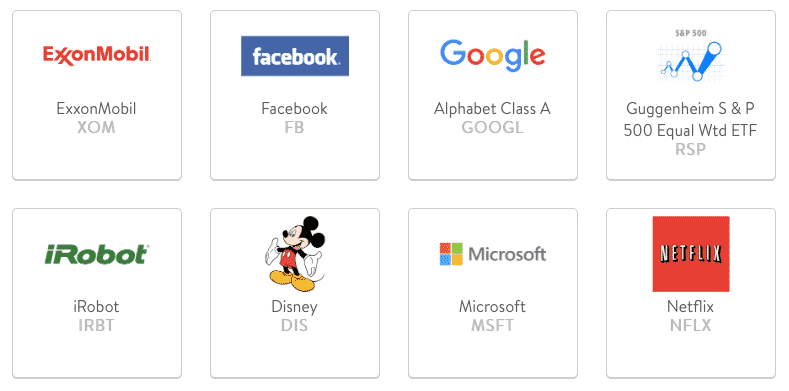
    Big name companies like Amazon, Google, and Facebook all feature on the platform, as well as thousands of less well known companies.

    Exchange-traded funds that mirror the performance of an index, like the S&P 500, can also be given as gifts.

    stockpile individual stocks companies

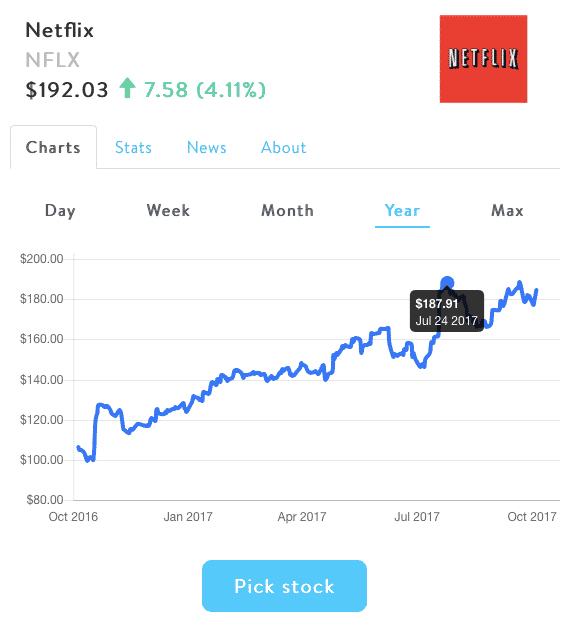
    After you select a company on the online dashboard, a price chart of your stock will pop up.

    Next, click the “Pick Stock” button.

    We use Netflix stock to highlight how it works below.

    stockpile pick netflix

    You will then be invited to choose the gift amount, ranging from $25 to $100 – or you can enter another amount.

    stockpile netflix choose amount

    You are not restricted to giving a single stock gift. After selecting one stock, you can pick many others too.

    Once you’ve made your picks, simply enter the recipient’s email address as well as your own.

    Finally, checkout with your credit card, debit card, or Paypal account and “voila”, you just gave someone the gift of stock!

    How To Redeem Stockpile Gift Cards

    Recipients can redeem stock gifts as easily as they might redeem a gift card at a retail store.

    Each Stockpile stock gift comes with a unique code.

    By clicking the “Redeem” button from the Stockpile.com home page, the recipient can simply follow a few steps to set up a brokerage account where their stock gifts are waiting for them.

    stockpile redeem code payment

    Stockpile FAQ: Who pays for the gift card?

    In order for recipients to receive the full value of stock gifts, buyers pay the fees regardless of whether an electronic gift card or physical gift card is bought.

    How Much Are Stockpile Fees?

    Stockpile fees vary depending on whether you are buying stock as a gift for someone else or for yourself.

    The cheapest way to buy stock is for yourself in a brokerage account.

    If you purchase an e-gift card for someone else, it will cost a bit more. The most expensive gift card to purchase for someone is a physical gift card.

    Stockpile Commission Costs

    To buy or sell stock in your own Stockpile brokerage account, a transaction fee of $0.99 is charged regardless of whether you buy whole shares or fractional shares.

    A $0.99 fee applies when selling stock also.

    Fractional shares are a good option when you don’t have enough money to buy a single share of stock but you also don’t want your cash sitting idle in your account earning no money.

    Some stocks like Google and Amazon trade north of $1,000 per share so Stockpile makes them more affordable by allowing traders to purchase fractions of a share.

    Fractional Shares Example

    Share Price: $1,000

    Amount Available To Invest: $50

    Because it costs $100 to buy a single share but only $50 is available to trade, a fractional share can be purchased.

    The fee to purchase the fractional share is $0.99 so the total cost would be $50.99

    How Much Does It Cost To Buy Using A Credit Card?

    Stocks can be bought using credit cards too but the costs will factor in credit card processing fees of 3% in addition to the usual $0.99 charge.

    So, if you want to buy $50 worth of stock, it will cost you $50 + $0.99 + $1.50 for a total of $52.49.

    Transaction Type Fees
    Buying Stock with Cash $0.99
    Buying Stock with Credit Card $0.99 + 3%
    Selling Stock $0.99

    How Much Do Physical Gift Cards Cost?

    As you might expect, it is more expensive for Stockpile to print out gift cards than to sell online gift cards, so physical gift cards bought in retail stores cost more.

    Cost to buy a physical gift card: $2.99 plus a 3% credit or debit card fee.

    For every additional stock bought, the cost drops to just $0.99 per stock but credit and/or debit card fees still apply.

    How Much Does Stockpile Charge?

    To calculate how much Stockpile charges, we’ll use a “real-life” example.

    Imagine your nephew loves athletic gear so you decide to buy him the gift of $100 of Nike stock that will probably hold its value much longer than buying him a $100 pair of Nike sneakers.

    How much will it cost to buy Nike stock gift card?

    $100 + $2.99 + $3 (credit card/debit card fee) = $105.99

    Now, imagine you also give him the gift of $25 worth of Under Armor stock, the cost will be:

    $25 + $0.99 + $0.75 (credit card / debit card fee) = $26.74

    But what happens if your nephew has a sister, and you want to buy stock for her too?

    No problem.

    When you add more recipients to the same order, each stock you give them incurs a cost of $0.99 plus 3%.

    So, if you give your niece $100 worth of Facebook stock, you would pay:

    $100 + $0.99 + $3.00 = $103.99

    Cost To Buy Stockpile Gift Cards At Retail Stores

    If you want to give a physical gift card, it will cost you a bit more than an e-gift will set you back.

    Physical Gift Card Cost: $4.95 to $7.95

    These charges cover the costs of credit card and debit card fees, trading commissions, and the cost to make the physical gift card.

    As the buyer, you pay these costs so that the recipient can redeem the full value of their stock gift.

    Gift Card Value Cost To Purchase
    $25 $29.95
    $50 $56.95
    $100 $107.95

    Stockpile Gift Card Review: Pros and Cons

    Stockpile has low transaction costs to buy and sell stock for an individual account, no minimum balance requirements nor ongoing maintenance fees, and caters to physical and electronic gift cards of stock. However, the cost to give a physical gift card is steep and, unlike other brokerage firms, a limited range of securities and account types is supported.

    Stockpile Pros Stockpile Cons
    Low Commissions: It costs just $0.99 to buy or sell stock – unless you wish to purchase stock via credit or debit card in which case a 3% surcharge is added. Physical Gift Card Cost: For smaller gifts, the fees are steep. A $50 gift card would set you back $6.95 which is a hefty price to pay.
    No Minimum Balance: No minimum cash balance requirement is in place. You don’t even need to click on the Stockpile login button, you can check out as a guest when gifting stock. Limited Securities: Stocks and ETFs can be purchased but options, futures, forex, and bonds are not available.
    Give The Gift Of Stock: Prior to Stockpile, gifting stock would have required setting up a brokerage account for someone which in turn meant you needed to know their social security number. Stockpile makes it easy to bypass the hassle and still give a valuable gift for the long-term. Limited Account Selection: Taxable and custodial accounts are supported, but trust, partnership, joint, retirement or other accounts are not supported.
    e-Gifts and Physical Gifts: Both types of stock gifts are supported. U.S. Residents: You must be a U.S. resident to be eligible to receive Stockpile gift cards.
    Fractional Shares: You don’t need to buy whole shares for gift recipients. Instead, you can simply buy fractions of a share in $25, $50, $100 increments, or other denominations that you choose.
    No Ongoing Fees: Recipients are not charged maintenance fees that would erode the value of the gift as time goes by.
    Stockpile App: Stockpile is available on your mobile phone whether iPhone or Android.
    Is Stockpile Safe?: Stockpile.com uses industry-level security protocols to protect your data and personal information.

    Stockpile Securities & Account Types

    Stockpile makes it easy to buy stocks and exchange-traded funds, but you should look elsewhere, such as thinkorswim or tastyworks, to buy options, futures, or forex.

    Stockpile is a brokerage firm without bells and whistles. If you want to open a standard, taxable brokerage account to buy stocks and ETFs, Stockpile can do that for you. You can also set up a custodial account for a child.

    However, buying more complex securities, such as options and futures, or doing so in an IRA, Trust, or Partnership account is not possible.

    Although the platform options are limited to buy more exotic securities, Stockpile is a specialist in gift cards for stocks, and while it may not earn top marks as a brokerage firm overall, it wins 5-stars for its specialty area.

    Stockpile Platform Features

    Type Capability
    Web-based YES
    Mobile YES
    (iOS & Android)
    Securities Stocks & ETFs
    Account Minimum $0
    Account Types Taxable & Custodial
    Customer Support Phone & Email

    Stockpile Review Summary

    Stockpile is unique among stock trading platforms in that it offers stock gifts cards. This service allows you to purchase gift cards worth $25 or more so that your recipient can buy stocks.

    There’s also a ton of educational information on Stockpile’s site to help gift card recipients understand the fundamentals of investing before they redeem their gift cards.

    Stockpile Makes It Easy To Give The Gift of Stock

    Stockpile was founded in order to make it easier for people to buy stocks as gifts. Instead of having to buy actual shares of stock, you just buy a gift card and your recipient can use it to buy the stocks of their choice!

    This is easier for you and easier for them, as you don’t have to buy the stocks yourself or transfer them to your intended recipient and they don’t have to worry about whether they approve of the company you’ve chosen to invest in on their behalf.

    Great Gift For Kids

    Stockpile’s founder came up with the idea when he was thinking about a way to give kids the gift of stock. The Stockpile gift cards program makes it easy to do this.

    All you have to do is buy the gift card and give it to the child. Just make sure your recipient’s parents are on board first, as they will have to open a custodial brokerage account in order to redeem the gift card.

    E-Gifts and Printed Gift Cards Both Available

    E-gifts are convenient. You just have to put in the recipient’s email address and then he or she can sign up online at Stockpile to redeem the card.

    But if your recipient doesn’t have an email account or doesn’t trust online services, you can also purchase a printed gift card.

    Stockpile charges a printing fee if you opt to get a physical card, making e-cards slightly less expensive.

    Low Cost

    Stockpile is one of the lowest-cost trading platforms around.

    When you purchase a gift card, you pay a fee of $2.99 for the first stock and .99 for each additional stock, and your recipient will pay only .99 each time he or she sells a stock at Stockpile.

    There are no annual fees for opening or maintaining a brokerage account at Stockpile and trading fees are super low, making it easy to trade using this platform.

    The Bottom Line

    As a broker, Stockpile is meant for investors who are content to buy stocks and exchange-traded funds.

    For hardcore traders who want feature-rich chart studies, research, tools, simulators, virtual trading platforms, options, futures, and forex, it is best to look elsewhere such as tastyworks or thinkorswim.

    Behind The Scenes: The Stockpile Story

    When Stockpile founder Avi Lele had the idea to give his nieces and nephews the gift of stock over the holiday season, he found the prices of two stocks he wanted to give, Apple and Google, were too pricey – a single share cost hundreds of dollars.

    Plus, it was such a hassle to figure out how to buy stocks for kids because you needed to set up a brokerage account for them and you needed to know their social security numbers.

    Avi simply gave up and bought toys for his nieces and nephews.

    But he never gave up on the idea that buying stocks for loved ones should be easy, whether grandparents buying stock for grandchildren or parents giving kids the gift of stock as stocking stuffers to learn the value of investing for the long-term.

  • Best Robo Advisors For Fees 2020

    Best Robo Advisors For Fees 2020

    best robo advisors

    InvestorMint provides personal finance tools and insights to better inform your financial decisions. Our research is comprehensive, independent and well researched so you can have greater confidence in your financial choices.Robo-advisors have become popular in recent years by offering a compelling value proposition when compared to traditional financial advisors.

    Most traditional financial advisors charge advisory fees of over 1% for managing assets. But what most clients don’t realize is those advisory fees are just one of the many fees they pay.

    Mutual funds and exchange-traded funds, which feature in many client portfolios, also charge fees. Plus, many advisors pass on brokerage fees to clients when transactions are made to buy and sell.

    When clients add up management fees, mutual fund expense ratios, brokerage fees and any other fees, such as hourly consulting fees, the total frequently exceeds 1.5% of assets managed each year.

    Over time, this high fee hinders account growth. And that’s where robo-advisors can add value, by delivering a similar service at much lower cost.

    Which Robo-Advisors Have Low Fees?

    In addition to having low-fee services, Wealthfront offers automated tax-loss harvesting which it claims can boost annual returns by as much as 2%. Betterment rivals Wealthfront as an industry leader, and has a low-fee service plus offers access to human advice – Wealthfront does not.

    wealthfront brokerage trading system robo advisor
    betterment

    Betterment

    In addition to low fees, Betterment stands out from other robo-advisors with an overall roboadvisor platform that is hard to match because it includes:

    1. Tax loss harvesting
    2. Access to human advice
    3. Tax-coordinated portfolios
    4. Retirement calculators
    5. Socially responsible portfolios

    Wealthfront

    Wealthfront offers free account management up to $10,000 and charges a management fee of 0.25% thereafter.
    It has a slightly low account balance minimum of just $500 though Betterment eclipses it by allowing clients sign up without imposing an account minimum.
    Wealthfront shines brightest when it comes to tax-loss harvesting.

    This free service automatically seeks to create more tax-efficient portfolios, which enhance returns by as much as 2% annually according to Wealthfront.

    Wealthfront creates tax-optimized portfolios using a method called Direct Indexing on accounts over $100,000 by purchasing up to 1,001 individual securities and taking advantage of individual tax-loss harvesting opportunities.

    Which Robo-Advisors
    Charge No Fees?

    Schwab Intelligent Portfolios and WiseBanyan have pioneered a no-management fee model. Schwab provides account management free but primarily selects its own proprietary Schwab funds for client portfolios and makes money from their expense ratios. WiseBanyan is truly free with no account management, custodial, trading or hidden fees but add-on optional services, such as tax-loss harvesting, are premium services which do incur charges.

    charles schwab
    wisebanyan logo

    SoFi

    SoFi is best known as a student lender but you may not know that it also has a free wealth management division.

    If you’ve paid down most of your student or graduate loans and already saved with SoFi, investing in your future via its free robo-advisor is the next obvious step.

    Schwab Intelligent Portfolios

    For cost-conscious investors looking for a low-cost automated portfolio management solution, Schwab Intelligent Portfolios and WiseBanyan stand out among robo-advisor firms.

    Schwab is the runaway leader among robo-advisors when it comes to assets under management; they were the first robo-advisor to manage over $10 billion.

    Users flocked to Schwab because it figured out how to offer portfolio management without charging account management fees.

    Instead, Schwab selects its own proprietary Schwab funds for client portfolios and makes money from their expense ratios, which range from 0.08% to 0.24%.

    WiseBanyan

    WiseBanyan claims to be “the world’s first free financial advisor” and delivers on its claim by charging no management fees, no custodial fees, no trading fees and no hidden fees for its basic, automated portfolio management service.

    Clients are billed up to 0.25% of assets under management, capped at $20 monthly, for optional products and services, such as tax-loss harvesting.

    Best Robo-Advisors For Fee Transparency

    Management fees are just one of the fees incurred by clients of portfolio management companies. The funds which make up your portfolio also have fees which are called investment expenses. These fees need to be added to management fees to arrive at the total fees charged, assuming custodial and brokerage or transaction fees are negligible.

    fidelity go
    vanguard investments

    FidelityGo

    Fidelity Go offers a more attractive fee schedule than meets the eye at first glance.

    While most casual observers will compare Fidelity Go’s fee of 0.35% for retirement accounts and 0.45% for taxable accounts with what appears to be lower fees at other robo-advisors, the eagle-eyed observer will spot that Fidelity Go includes investment expenses in its overall % figure.

    So while other robo-advisors may quote a management fee of 0.25%, the total fees clients pay may be quite a bit higher when investment expenses are included, making Fidelity Go better value overall.

    Vanguard Personal Advisor Services

    Vanguard Personal Advisor Services is almost as hard to beat on overall fees as Fidelity Go. Vanguard charges just 0.30% but only investors with at least $50,000 can sign up to Vanguard’s robo-advisory service.

    What makes Vanguard even more attractive is that it connects clients with more than $500,000 to live financial advisors too.

    Robo-Advisors With Add-On Fees

    Some robo-advisors have added fees in addition to the service fees charged for portfolio management.

    future advisor logo
    rebalance ira logo

    Future Advisor

    A few robo-advisors charge additional service fees in addition to portfolio management fees. Among robo-advisors, FutureAdvisor has one of the higher fee schedules of 0.50% annually.

    In addition to those fees, FutureAdvisor passes on transaction fees of between $7.95 – $24 per trade to clients. Most funds used in its portfolios are commission-free but those that aren’t are pricey to enter and exit.

    Rebalance IRA

    Rebalance IRA has perhaps the highest account balance hurdle of all robo-advisors. To open an account requires a minimum $100,000.

    Once or twice a year Rebalance IRA rebalances client portfolios and trade fees, which can range from $50 to $70, to enter and exit positions are passed on to clients.

    Robo-Advisors Fee Comparison By Account Balance

    Robo-Advisor $5,000 $10,000 $50,000 $100,000 Open Account
    charles schwabREVIEW

    0.0% 0.0% 0.0% 0.0%
    wisebanyan logoREVIEW

    0.0% 0.0% 0.0% 0.0%
    wealthfront brokerage trading system robo advisorREVIEW

    0.0% 0.0% 0.25% 0.25%
    sofi brokerage trading system investingREVIEW

    0.25% 0.25% 0.25% 0.25%
    acorns investing robo advisor logoREVIEW

    0.25% 0.25% 0.25% 0.25%
    fidelity goREVIEW

    0.35% 0.35% 0.35% 0.35%
    bettermentREVIEW

    0.25% 0.25% 0.25% 0.25%
    vanguard investmentsREVIEW

    NA NA 0.30% 0.30%
    future advisor logoREVIEW

    NA 0.50% 0.50% 0.50%
    rebalance ira logoREVIEW

    NA NA NA 0.50%
    personal capitalREVIEW

    NA NA NA 0.89%

  • Wealthfront vs M1 Finance Comparison

    Wealthfront vs M1 Finance Comparison

    wealthfront vs m1 financeAs the robo-advisor market matures, digital advisors stand out in different ways to attract investors who have yet to seek out automated money management solutions.

    Wealthfront, which was founded in 2008, is practically a template for the types of passive portfolio services that robo-advisors represent.

    The template features index exchange-traded fund (ETF), algorithmic wealth management and sophisticated techniques for optimizing after-tax returns.

    M1 Finance, which was founded in 2015, provides digital wealth management too, but it also offers portfolio customization and other services that are more typically associated with full-service online brokerages, such as tastyworks or thinkorswim.

    M1 Finance’s CEO Brian Barnes calls this approach “engaged investing” to differentiate it from the passive investing approach epitomized by robo-advisors like Wealthfront.

    M1 Finance vs Wealthfront Features

    How do Wealthfront and M1 Finance features compare?

    Wealthfront M1 Finance
    Fees 0.25%
    (first $10,000 free)
    $0
    Investment Minimum $500 $100
    (taxable account)

    $500
    (IRA)

    Tax Strategy Tax-loss Harvesting &
    Smart Beta
    Tax Minimization
    Account Selection Extensive Extensive
    Tools Extensive Limited
    Human Advice No No
    Discretion Over Portfolio Selection Low High

    Wealthfront Fees

    Wealthfront bills clients monthly for account management services.

    This fee amounts to 0.25% of all assets held under Wealthfront management and is computed using the average monthly account balance.

    If you have under $10,000, Wealthfront won’t charge you a penny in management fees.

    For clients with more than $10,000 under management, Wealthfront also passes along the embedded fees associated with the ETFs in their accounts.

    >> Compare Wealthfront Vs Wealthsimple

    M1 Finance Fees

    M1 Finance doesn’t charge any broker fees, commission fees or annual management fees.

    You will have to pay the expense ratios associated with any of the ETFs in your account.

    Account Types

    Wealthfront M1 Finance
    Personal investment accounts Individual brokerage accounts
    Trust accounts Joint brokerage accounts
    Joint accounts Trust accounts
    529 college savings plans Traditional and Roth IRAs
    Traditional and Roth IRAs Simplified Employee Pension (SEP) IRAs
    Simplified Employee Pension (SEP) IRAs IRA and 401(k) rollovers
    IRA and 401(k) rollovers

    >> Compare Betterment Vs M1 Finance

    Wealthfront vs M1 Finance
    Tax Strategy

    Wealthfront Tax Strategy

    Wealthfront’s shines brightest when it comes to tax strategy.

    It practices tax-loss harvesting, which is a process whereby securities that have been losing money are sold to capture a capital loss.

    That loss is used to offset taxable capital gains of up to $3,000 of ordinary taxable income every year.

    Wealthfront then rebalances the client’s portfolio by replacing the sold asset with one that is similar in terms of the portfolio’s overall risk-and-return profile.

    Only taxable accounts are eligible for tax-loss harvesting, which is conducted daily.

    For accounts with assets under management totaling $100,000 or more, Wealthfront offers tax-loss harvesting at the more granular stock level.

    WEALTHFRONT SPOTLIGHT
    wealthfront brokerage trading system robo advisor

    InvestorMint Rating

    4 out of 5 stars

    • Management Fee: $0 for first $10,000
    • An additional $5,000 managed free for each friend invited who signs up
    • Management Fees thereafter: 0.25%
    • Account Minimum: $500

    via Wealthfront secure site

    Accounts with assets under management of $500,000 or more benefit from Wealthfront’s Smart Beta function, which integrates aggressive tax-loss harvesting with intelligent weighting by considering factors like fund value, momentum and volatility.

    Clients can even benefit from Wealthfront’s tax strategies while they’re still in the process of transferring their accounts from another brokerage.

    Wealthfront’s Tax-Minimized Brokerage Account service deliberately delays the transfer of money-losing securities until those securities can qualify as “long-term” investments as defined by the IRS.

    Once the securities mature, Wealthfront transfers them and immediately sells them.

    M1 Finance Tax Strategy

    M1 Finance provides a simplified form of tax-loss harvesting known as Tax Minimization.

    This allocation strategy is designed to help automatically reduce the amount clients will owe in taxes when securities are sold as part of the automated rebalancing process.

    Securities are sold in the following order to maximize tax efficiency:

    1. Positions that result in no capital gains
    2. Positions that will result in long-term capital gains
    3. Positions that will result in short-term capital gains

    M1 FINANCE SPOTLIGHT

    m1 finance circle logo

    InvestorMint Rating

    4 out of 5 stars

    • FREE: No Broker Fees or Commissions
    • Expert Pies: Ready-made Portfolios
    • Investment Minimum: $100 (taxable accounts)

    via M1 Finance secure site

    Human Advice vs Digital Advice

    Neither Wealthfront nor M1 Finance gives clients access to human advisory services.

    However, M1 Finance will allow you to book a no-cost consultation with a product specialist after you fund your account.

    You will be given a brief tour of the online platform and any technical questions you may have will be answered.


    Tools and Calculators

    M1 Finance Tools

    While M1 Finance doesn’t have calculators, widgets or other bells and whistles per se, the highly graphic nature of the user interface makes it very easy to grasp how your investment styles are reflected in the investment options you’ve selected.

    m1 pie exampleM1 Finance’s visual metaphor is the “pie,” which the service uses to represent the basic building block of its client portfolios.


    When you’re putting together a portfolio, you have the option of selecting among professionally assembled M1 Finance pies, which represent various types of investment strategies, including hedge fund strategies and responsible investment strategies.

    Other pies represent individual industries or industry sectors.

    Clients can also customize their own pies using any combination of stocks and ETFs listed on the New York Stock Exchange or NASDAQ.

    To customize a pie, just input criteria like:

    • Company name
    • Total assets
    • Dividend yield
    • Expense ratio
    • P/E ratio

    Keep in mind, however, that you cannot hold more than 500 individual positions in your pies.

    Although you have to have an account with M1 Finance before you can use the pie feature, you can create and customize your M1 Finance pies without funding that account.

    >> Compare M1 Finance Vs Robinhood

    Wealthfront Tools

    Wealthfront clients have free access to a tool called Path.

    Path is a future-scenario planning algorithm that combines information from the financial accounts you’ve linked to your Wealthfront account with economic criteria from the Bureau of Labor Statistics’ Consumer Expenditure Surveys.

    Path uses this data to create a series of alternate outcomes that are influenced by changes you implement in your portfolio allocations.

    Wealthfront designed Path to help clients model investment forecasts and see how much they will need to save by a specific date if they want to achieve their financial goals.

    M1 Finance vs Wealthfront
    Asset Classes

    Wealthfront Asset Classes

    When you sign up for Wealthfront, the robo-advisor compiles your portfolio for you.

    The criteria the algorithm uses reflect your risk tolerance, your expectation of return and your financial goals, which will be apparent from the interview questions you were asked to answer as part of your application process.

    All clients are assigned to one of three separate portfolio classes:

    Stocks Bonds
    Balanced Portfolio 50% 50%
    Growth Portfolio 80% 20%
    Conservative Portfolio 65% 35%

    Wealthfront’s robo-advisor algorithm uses an economic framework called Modern Portfolio Theory to create client portfolios and to maintain the balance within those portfolios over time.

    Each individual portfolio contains between six and eight ETFs, which represent bonds, inflation-protected securities and stocks.

    M1 Finance Asset Classes

    If you can buy a stock on the New York Stock Exchange, you can use it to create a portfolio with M1 Finance.

    The service also gives you access to more than 1,900 ETFs.

    However, if you’re not interested in customizing a portfolio, you can use one of M1 Finance’s preset portfolios called “expert pies.”

    It is also easy to substitute your own choices for some of the stocks and ETFs in an M1 Finance template.

    The robo-advisor component of the company’s services goes into play when it comes to ongoing investing.

    You can designate a time frame for bank-account funding contributions, and M1 Finance will withdraw those funds automatically and invest them in accordance with the template you’ve created.

    M1 Finance also allows you to buy fractional shares when you don’t have the funds to buy a whole share.

    Plus, M1 Finance’s algorithm rebalances your portfolio if your investments begin to fluctuate in market value.

    When selling securities to rebalance a portfolio, M1 Finance uses a tax-minimization strategy.

    Additionally, M1 Finance allows clients to buy stocks on margin through a feature called M1 Borrow.

    If you were wondering how does M1 Finance make money, this is in fact how the company generates revenues from its services.

    M1 Finance charges 4% interest on the total amount borrowed. The borrowed amount can never exceed 35% of the total account balance, though.

    M1 Finance is only available to account holders with $10,000 or more under management.


    Customer Support Comparison

    For customers experiencing technical issues, M1 Finance offers phone support Monday through Friday from 9 a.m. to 5 p.m. CST.

    Wealthfront also offers a customer hotline that is available Monday through Friday from 11 a.m. to 8 p.m. EST.

    >> Compare Wealthfront Vs Personal Capital

    Mobile App Comparison

    M1 Finance is available as a mobile app for both iOS and Android devices.

    The user-friendly phone app has the same functionality as the PC platform.

    Wealthfront iOS and Android apps also allow clients to do everything possible on a laptop or desktop computer.

    Wealthfront vs M1 Finance
    Winner

    M1 Finance excels when it comes to customizing investment selections.

    And it shines brightest on price, you can’t beat free!

    However, the tax strategies the service offers clients can’t rival the tax strategies Wealthfront offers.

    M1 Finance also lacks a robust financial planning tool.

    Still, if price and portfolio customization is what’s most important to you, M1 Finance is the obvious winner.

    Of course, you might argue that asset allocation is actually one of the services you’re looking for with any type of advisory account whether your advisor is a human being or an algorithm.

    With M1 Finance, you won’t be able to live out your day-trading fantasies because the service only does batch trades once a day.

    To use M1 effectively, you’ll have to educate yourself on financial matters and discipline yourself in terms of what you buy.

    >> Compare Betterment Vs Wealthfront

    Which Robo-Advisor
    Is Best For You?

    M1 Finance is the best choice if you want to:

    • Trade stocks and ETFs without paying commission fees or annual management fees.
    • Be able to buy fractional stock shares.
    • Customize the stocks and ETFs in your investment portfolio.

    Wealthfront is the best choice if you want to:

    • Protect your investments against tax liabilities.
    • Save efficiently for your son or daughter’s college education.
    • Invest passively and don’t wish to exercise a lot of control over your specific investment choices.


  • Affirm Review 2020 – Mini Personal Loans At Checkout

    Affirm Review 2020 – Mini Personal Loans At Checkout

    affirm review

    InvestorMint provides personal finance tools and insights to better inform your financial decisions. Our research is comprehensive, independent and well researched so you can have greater confidence in your financial choices.

    If you are not as familiar with Affirm as you are with Visa, MasterCard, American Express or Paypal you may soon be.

    Here’s why…

    Imagine you are at an online checkout about to buy furniture or airfares and realize you don’t have the cash available to pay the full amount right away. What do you do? If you are like most people, you close the browser window or visit another website.

    Even if you do have the money but you know you’ve got an upcoming bill due and want to keep enough cash on-hand to pay it, you probably don’t checkout.

    But what if there were a way to pay for the things you wanted without resorting to a credit card or visiting a bank to get a loan?

    The answer is an increasingly popular payment option called Affirm which lets you purchase your goods via fixed monthly payments.

    Within 3 to 12 months, your fixed payments end and you get to own your goods free and clear without having to drain your cash reserves at the time of purchase.

    Affirm Review: Spotlight

    AFFIRM SPOTLIGHT

    affirm logo

    InvestorMint Rating

    4.5 out of 5 stars

    • Instant Loan Approval: On retailer’s checkout page
    • Flexible Financing: 3 → 12 months
    • APR Rates: 10% → 30%

    via Affirm secure site

    Why Choose Affirm Personal Loans?

    If you can’t afford to pay for an item at checkout and don’t have a credit card or have poor credit, Affirm lets you pay in monthly installments for the item over 3, 6 or 12 months.

    To understand how Affirm is different, consider the traditional payment options available to consumers who want to purchase higher priced goods.

    If you want to pay for a vacation deal you spotted online or buy a new piece of furniture but don’t want to drain your cash reserves, a credit card would be the obvious choice.

    Another possibility would be to approach a bank or credit union to apply for a loan.

    But what if you have little credit history and can’t get a credit card or you don’t want to go through the hassle of filling out lots of forms with a traditional lender?

    Affirm helps you in these situations because it acts as a mini-lender bridging the divide between credit card companies and larger loan issuers.

    You don’t have to jump through the same hoops required by traditional lenders, and if you don’t have a credit card or have poor credit, you can still purchase the goods you want at the point of sale.

    Plus, Affirm never conducts a hard credit check so, unlike a credit card company or traditional lender, your credit score won’t be hit when you pay with Affirm.

    Affirm Personal Loan Amounts
    Loan Amount Range $100 → $10,000
    APR Range 10% → 30%
    Other Fees 0
    Funding Timeline Immediate

    Perhaps the best aspect of Affirm is that approval is immediate at the point of sale. You don’t have to wait for even a single business day for loan approval.

    Affirm uses its own technological wizardry to instantly provide approvals when you provide them with some basic personal details.

    How Affirm Works

    For the 40% of young adults who say they have no interest in using a credit card, according to MillennialDisruptionIndex, Affirm offers a way to purchase goods over time by relying on proprietary algorithms to calculate the creditworthiness of users.

    To pay with Affirm, simply choose the Affirm payment option when you are checking out online.

    A large network of online stores integrate Affirm as a payment choice now across many categories, including:

    Apparel Electronics Jewelry Music Home & Garden
    TheRealReal Motorola ice.com Reverb Wayfair
    Tradesy eero Agape diamonds The Music Zoo iRobot
    Good American gazelle Diamond Nexus Wildwood Guitars Joss & Main
    Bluefly ting Catbird Chuck Levin’s Birch Lane
    Rebecca Minkoff owlet True Facet Chicago Music Exchange All Modern

    Once you get to the checkout page, you will have a choice to pay by credit or debit card, or Affirm.

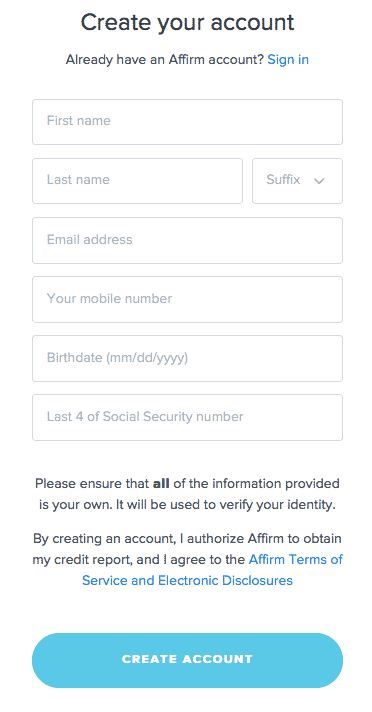
    When you choose to pay over time with Affirm, you will be invited to enter some personal details: name, email, mobile phone number, birthdate, and the last four digits of your social security number.

    affirm create your account

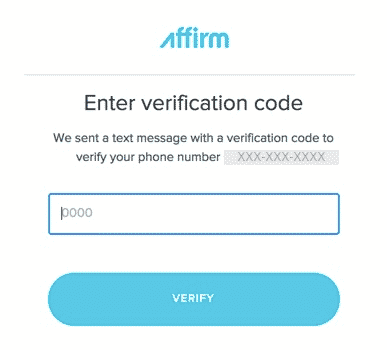
    Once you have created an account, Affirm will send you a text notification to ask you to verify your account by entering a confirmation code.

    affirm verification code

    Once confirmed, you are all set to go shopping at one of the many stores that has integrated Affirm into its checkout page.

    affirm featured stores


    Affirm Interest Rates & Fees

    Affirm loans span 3, 6, and 12 month durations with interest rates ranging from 10% → 30%, though a few select merchants will offer 0% financing. You will not be charged any late, prepayment, or other hidden fees.

    Affirm loans start at $50 and are designed to help you pay for higher priced goods that may otherwise be out of reach.

    The loan terms vary depending on how much you need:

    Amount Term (months)
    $50 → $99.99 3 or 6
    $100 → $10,000 3, 6 or 12

    Interest rates on loans vary from 10% to 30% APR simple interest.

    No other fees are charged, so you won’t be hit with late fees, service fees, prepayment penalty fees, or any other hidden fees.

    Loan Amount
    Typical APR
    (with autopay)
    10% → 30%
    Hidden Fees 0
    Prepayment Fees 0
    Late Fees 0

    How Much Does An
    Affirm Loan Cost?

    Shorter term loans will cost you more in monthly payments but cost you the least in interest charges. It is best to consider your monthly budget as well as interest charges when you select your loan term.

    affirm hughes chair

    Imagine you find that dream furniture piece you’ve always wanted and discover it costs $1,000 – more than you wanted to spend today.

    You decide to pay with Affirm and discover that the APR rate is 20%. How much would the $1,000 item cost you over the duration of a loan term?

    $1,000 Loan 3 Month 6 Months 12 Months
    Monthly Payment $344.51 $176.52 $92.63
    Total Payment $1,033.52 $1,059.12 $1,111.56
    Interest Charge $33.52 $59.12 $111.56

    As you can see, the longer the duration you choose, the more you will pay in interest but the lower your monthly payment.

    If you can afford to pay off the loan over a shorter time period, it is best to choose that option to save on interest but a longer duration may be better suited to your overall budget. You will need to make the best choice based on your own financial circumstances.

    Affirm Review: Pros and Cons

    Affirm instantly approves loans starting at $50 at the point of sale without hurting your credit score and can be paid back in monthly installments over a period of up to 12 months but APR rates are quite high so make sure to calculate your total interest charges and financial budget before checking out.

    Affirm Pros Affirm Cons
    Immediate Approval: You don’t have to wait for days or weeks to get approval as with traditional lenders but instead can be approved immediately at the point of sale when checking out online. High APR Rates: APR rates range from 10% → 30%, which at the low end are competitive but at the high end rival credit card rates.
    No Hidden Fees: You won’t be charged any late fees, prepayment penalty fees, or other hidden fees. Competitors: Rival firms such as SoFi have lower rates but they tend to have more stringent and longer application processes.
    Short Term Mini Loans: Loans can be issued for as little as $50 and as much as $10,000 for periods of 3, 6 and 12 months.
    Credit History: If you have little or no credit history, you may still be eligible to pay with Affirm, which relies on its own algorithms to verify user creditworthiness.
    Soft Credit Check: Your credit score won’t be hurt with a hard credit check as is the case with most traditional lenders and credit card applications because Affirm performs only a soft credit check.
    Secure Payment: Affirm doesn’t use standard credit card numbers to process transactions so it adds an additional layer of security to your personal financial details.
    Low Application Hurdle: No minimum credit score, minimum gross income, nor minimum credit history is required and and no maximum debt-to-income is stipulated to be eligible for a loan.

    Affirm Founding Team

    Affirm was founded by the co-founder of Paypal, Max Levchin, and the co-founder of Palantir Technologies, Nathan Gettings, as well as Jeffrey Kaditz, formerly of Microsoft.

    Most everybody knows about Paypal these days but Palantir is a less well-known company that most recently was valued at $20 billion.

    Together, the founding team has raised $520 million since starting their Fintech company in 2012.

    Some of the best known and successful venture capitalists have invested, including:

    • Khosla Ventures
    • Andreesen Horowitz
    • Spark Capital
    • Founders Fund
    • Lightspeed Venture Partners

    Affirm Summary

    Affirm solves a problem for both consumers and businesses when checking out online.

    For consumers, Affirm offers a way to pay for items in monthly installments for anywhere from 3 to 12 months.

    And for businesses, who regularly lose sales when customers decide to walk away from a purchase because the purchase price of goods are not immediately affordable, Affirm increases sales conversions.

    Critics argue that Affirm makes it easy for consumers with little or no credit to buy goods that would otherwise be unaffordable. However, consumers who really want or need to purchase items and lack the cash may find it is the only simple solution to finance a purchase.

    Taking out a loan from a bank or credit union, or relying on a credit card may be even more expensive or take a lot more time whereas Affirm enables users to get financing during the checkout process.

    We believe Affirm offers an alternative means of paying for goods that may otherwise cause consumers to resort to much more expensive options, such as payday lenders, and so it provides a valuable service.

    However, if you choose to use Affirm, look to shorter time periods where possible in order to lower interest costs.

  • Ethereum Price Prediction 2020

    Ethereum Price Prediction 2020

    ethereum price prediction

    InvestorMint provides personal finance tools and insights to better inform your financial decisions. Our research is comprehensive, independent and well researched so you can have greater confidence in your financial choices.

    Although it is foolhardy to make an Ethereum price prediction with confidence, it may be possible to forecast future prices using various analytic methods.

    Whether conventional technical analysis, Monte Carlo simulations, or market capitalization comparisons, we explore what the future holds for the price of Ethereum.

    But in order to make price forecasts for Ethereum, we first need to see how and why it is different to the original cryptocurrency, Bitcoin.

    How Does Ethereum
    Compare To Bitcoin?

    Bitcoin may have sparked the cryptocurrency revolution but Ethereum may have greater longevity, which in turn could bode well for forecasters brave enough to make an Ethereum price prediction.

    While Bitcoin gained popularity as a cryptocurrency that could supplant conventional currencies, like U.S. dollars, euros, and yen, Ethereum has received attention because it has the possibility for broader use beyond payments.

    The best way to think of Ethereum is as a general purpose platform upon which other applications can be built. Similar to how Apple and Microsoft built operating systems that supported a wide range of software from spreadsheets to budgeting tools, so too can Ethereum support a range of applications related to blockchain technology.

    The big difference between Bitcoin and Ethereum is that developers are permitted to build applications on top of Ethereum’s blockchain technology but they are restricted from doing so on top Bitcoin’s technology.

    By catering to developers, Ethereum is responsible for the majority of initial coin offerings and its currency has earned a reputation for being robust in the face of cyber attacks.

    But with hundreds of cryptocurrencies in existence, what does the future hold for Ethereum and what Ethereum price prediction can be forecast?

    Ethereum vs Bitcoin vs Litecoin

    Most cryptocurrencies impose a limit on the number of coins issued over a specific time period.

    Bitcoin has a limited supply of 21 million coins, which are due to be mined by the year 2040, while Litecoin has a total supply of 84 million coins.

    Unlike Bitcoin and Litecoin, Ethereum does not have a fixed supply of coins.

    The supply of ethers, the name given to Ethereum’s currency, is not limited but the issuance is capped at 18 million ether per year, which represents approximately one quarter of the initial supply.

    By issuing a fixed number of ethers annually, relative inflation declines each year.

    BITCOIN VS ETHEREUM

    Ethereum borrows significantly from Bitcoin’s protocol and blockchain design but is significantly different because it supports applications beyond money.

    Like Bitcoin, Ethereum has a blockchain structure that has a record of transaction history.

    But unlike Bitcoin, Ethereum uses accounts much like bank accounts whereby ether tokens are stored in digital wallets and can be transferred to other accounts.

    By contrast, Bitcoin figures out how much of the digital currency someone has by tracking unspent transactions.

    Where Ethereum shines compared to Bitcoin is the flexibility it provides to programmers, who can create programs whereby blockchain transactions automate and control various outcomes.

    So, if Ethereum has more flexibility compared to Bitcoin and is more resilient to cyberattacks, what Ethereum price predictions can be forecast?

    Ethereum Price Prediction:
    Monte Carlo Analysis

    John Young, founder of Spreadsheet.io, analyzed Ethereum using Monte Carlo analysis.

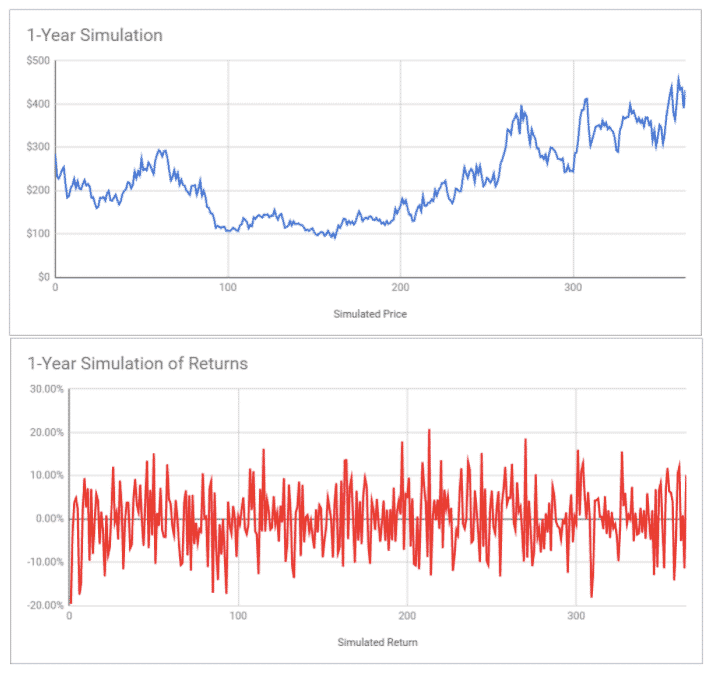
    The idea behind Monte Carlo analysis is to use randomness to solve problems that may be deterministic. Monte Carlo experiments rely on repeated random sampling to obtain results, which is why the graphs below look a little chaotic!

    In order to make an Ethereum price prediction, he used historical prices for Ethereum, calculated daily returns and daily range, and simulated outcomes over single year and multi-year durations.

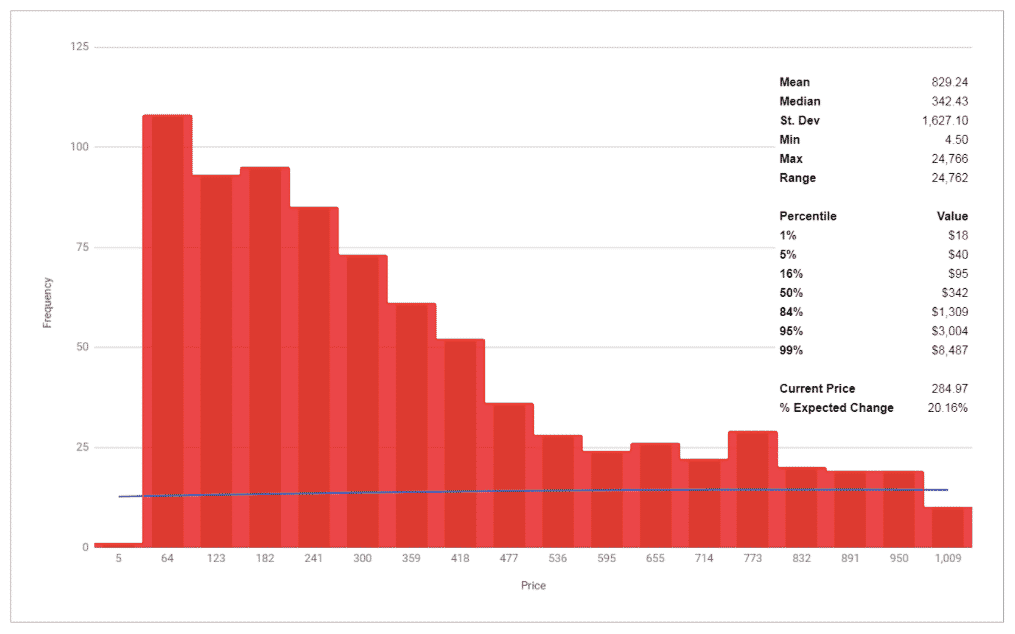
    A geometric Brownian motion model was used to make Ethereum price predictions that led to a minimum price forecast of $40 and a maximum price forecast of $3,004 with a mean of $829 with 95% confidence.

    ethereum one year simulation

    ethereum 1000x one year simulation

    If you stretch that to 99%, the maximum value could rise as high as $8,487 but eagle-eyed statisticians may find this analysis troublesome.

    The premise beyond the analysis is that the underlying process is stationary and well behaved but the real world tends to produce long tails that break sophisticated models!

    Just ask the team who founded the infamous hedge fund, Long Term Capital Management. The team of Nobel prize winners believed they had a foolproof model to make money but neglected to factor in extremely rare price movements that subsequently occurred and ultimately blew up their hedge fund and nearly took down the world economy too.

    So even though it is common to model the progression of asset prices as a stochastic process with drift and a random Brownian term, and changes are assumed to be normally or lognormally distributed, the reality is cryptocurrency price movements are characterized by spikes and plunges.

    The broad price range from a minimum of $40 to a maximum of $3,004 is due to the fact the model is calibrated to past data. And it wouldn’t be an outlandish argument to suggest that a price range so wide is not especially helpful anyway in narrowing down an Ethereum price prediction.

    Still, few good tools exist to make good cryptocurrency price predictions due to the significant price volatility from one day to the next, so Monte Carlo simulations may prove to be one of the best.

    But are there other ways to make Ethereum price predictions?

    Ethereum Price Chart:
    Technical Analysis

    Another way to forecast the future price of Ethereum is to use classical technical analysis.

    Technical analysis is a tool used to forecast future price movements by analyzing data from trading activity, such as price and volume.

    By viewing an Ethereum price chart, a prediction can be made by extending an uptrending mean price line.

    When applying this method at the time of writing, the 1-year forecast for Ethereum would place the price at $1,872 U.S. dollars and the 5-year price forecast would result in a price of $4,721.

    As with any technical analysis price chart forecast, no guarantees exist that past price movement will be indicative of future price movement.

    Ethereum Price Prediction:
    Market Capitalization Analysis

    Another way to make price forecasts is to compare Ethereum with Apple and Microsoft.

    If Ethereum is the “operating system” upon which future blockchain applications are built, it could be compared to Apple and Microsoft, which built the two primary computer operating systems used worldwide.

    The combined market capitalizations of Apple and Microsoft are approximately $1.5 trillion at the time of writing whereas Ethereum had a market capitalization just north of $100 billion.

    If Ethereum were to realize its potential as the platform upon which all future blockchain technologies were built perhaps its price rise has a significant runway ahead of it yet.

    But Apple and Microsoft produce real products and have real customers that pay them year after year so it is difficult to make a like-for-like comparison.

    And it would be a bold claim to infer that Ethereum could grow to a market capitalization as large as $1.5 trillion.

    The expectation of capturing future value is largely what has catapulted the price of Ethereum and other cryptocurrencies higher.

    Whether they will sustain their valuations and continue to grow will depend on how closely expectations match reality.

    Ethereum Price Forecast:
    What Experts Predict

    John McAfee became famous as the founder of McAfee anti-virus software but more recently he has jumped on the cryptocurrency bandwagon with gusto.

    As one of the leading cryptocurrency miners in the United States, he has predicted a rise in Bitcoin to $1,000,000 per coin by 2020.

    If Ethereum were to rise in price by the same amount, it would translate to a 50x increase, which would seem to defy reason because that would equate to a market capitalization of $5.7 trillion!

    While that may seem outlandish, McAfee does make the case for blockchain technology and cryptocurrencies in the video below.

    On the other side of the argument is Warren Buffett, who encouraged investors to “stay away” from Bitcoin in 2014 before its meteoric rise.

    Buffett may end up being right in the end when he stated that Bitcoin is a “mirage” but so far the cryptocurrency market is leaving him with egg on his face.

    His argument is based on the fact that you “can’t value Bitcoin because it’s not a value-producing asset” which means it doesn’t produce a dividend.

    Without a dividend, financial analysts cannot apply standard financial models to make price forecasts.

    Critics of Buffett would argue that he doesn’t have a great record betting on technology companies and historically has shunned them so he may not be the best qualified observer of the cryptocurrency market.

    Still, he didn’t amass billions of dollars without having a good idea of what assets in the world are worth investing in and which are undervalued, so it may be best to keep an open mind even if you are upbeat about the prospect for digital currencies.

    Ethereum Price Prediction:
    Summary

    The price volatility of cryptocurrencies has historically been so high that making accurate price predictions is a near impossible game.

    Expert miners like John McAfee predict Bitcoin will rise to a value of $1 million per coin while one of the richest investors in the world, Warren Buffett, made a bleak assessment of digital currencies because they don’t pay dividends making them virtually impossible to value.

    If you were to apply conventional technical analysis to Ethereum, it has a 1 year upside price potential of $1,872 at the time of writing while Monte Carlo simulations show a price range from $40 to $3,004.

    Some advocates for cryptocurrencies believe they will take market share away from conventional currencies but even then it is hard to gauge precisely what percentage is likely.

    The bottom line is making an Ethereum price prediction with high confidence is virtually impossible so if you do decide to take the plunge into the world of digital currencies, it is well worth sitting down with a Chartered Financial Professional or financial advisor before risking your hard-earned savings.

    Have you traded cryptocurrencies? What is your Ethereum price prediction for the next year?

    >> Coinbase Vs Kraken: What Is The Best Cryptocurrency Exchange?

    >> Coinbase Vs Gemini Review

    >> Litecoin Vs Ethereum: Which Cryptocurrency Is Best?

  • Jim Cramer Net Worth – Is It Really $100 Million?

    Jim Cramer Net Worth – Is It Really $100 Million?

    jim cramer net worth

    Jim Cramer Net Worth: Clearly, investing whiz Jim Cramer is doing something right because his net worth is estimated to be somewhere in the neighborhood of $100 million.

    The “Mad Money” TV host and former hedge fund manager was born in 1955 and grew up just outside Philadelphia.

    He graduated magna cum laude from Harvard University in 1977, and began his career as a newspaper reporter.

    Reporters don’t typically make very much money, though and during one nine-month period Cramer was so broke that he lived out of his dilapidated Ford Fairmont.

    jim cramerThough he loved journalism, it was an experience he didn’t want to repeat.

    It’s difficult to gauge if the over 110,000 viewers who watch “Mad Money” every week are tuning into the show for its value as financial education or because Cramer himself is just such a blast.

    Cramer hectors and cajoles. He dresses up in a chef’s toque and sautés tiny plastic bulls and bears with onions and garlic while ranting at the stock ticker that crawls along the bottoms of his viewers’ TV screens.

    But don’t let the theatrics fool you! Jim Cramer is a man who’s serious about making money, and he’s made a fortune. How is Jim Cramer’s net worth estimated at $100 million? We reveal all below.

    Jim Cramer Hedge Fund Career

    In 1981, disheartened by the meagerness of the financial returns provided by his career as a newspaperman, Cramer enrolled at Harvard Law School.

    It was during this time that he first began taking the stock market seriously.

    Harvard gave Cramer access to the Financial News Network (FNN), which was an early precursor to CNBC.

    He became so fascinated at this peek into the world of high finance that he began using his academic loans and the money he made as Alan Dershowitz’s researcher to buy stocks.

    The gamble paid off, and Cramer began to grow rich.

    Success fueled Cramer’s obsession with the stock market even further to the point where he started leaving stock tips on his personal answering machine.

    Martin Peretz, the editor of The New Republic, began calling Cramer’s answering machine regularly just so he could benefit from Cramer’s tips.

    Finally, Peretz approached Cramer outright with $500,000, which he asked Cramer to invest. In two years, Cramer made Peretz $150,000.

    Cramer parlayed this success into a much-coveted job with Goldman Sachs’ Private Wealth Management division.

    In 1987, after three years at Goldman Sachs, Cramer launched his own hedge fund, which at first was called Cramer & Co. and then later came to be called Cramer, Berkowitz & Co.

    Throughout the 13 years of the hedge fund’s existence, Cramer did so well for investors that he routinely took home salaries and bonuses worth $10 million a year.

    There was only one year in which the hedge fund lost money for its investors. In 2000, which was the year Cramer, Berkowitz & Co. closed, investors saw a return of 36 percent.

    In his autobiography, he talks about being in the red to the tune of $300 million before clawing $450 million back and turning positive for the year.

    This was the same year that the dot-com bust precipitated major losses for many other stock market investors.

    It’s likely that Jim Cramer’s hedge fund is the project that first made him rich. He’s had plenty of opportunities since to become even richer. Did they work?

    >> What Are The Best Penny Stocks To Buy?

    Jim Cramer TheStreet.com Founder

    At the height of the pre-2000 dot-com bubble, Jim Cramer’s investment in the financial news website TheStreet.com was valued at approximately $250 million.

    Cramer had started TheStreet.com in 1996 with his business colleague Martin Peretz.

    In 1999, according to The Financial Times, TheStreet.com had a market value of $1.7 billion; by 2014, however, the website’s value had decreased to $75 million, which is significantly less than Jim Cramer’s total net worth.

    Like many other internet plays in the late 1990s, TheStreet.com had a great deal of initial success.

    The stock was priced at $19 a share for its initial public offering on May 10, 1999, and immediately jumped higher the following day when active trading began.

    After the burst of the dot-com bubble, the stock’s price plummeted to around $1 a share.

    Though the website managed to remain in business, it weathered some tough times.

    In 2004, the company even hired the investment bank Allen & Company to “explore strategic alternatives.” This is Wall Street code for “look for a buyer.”

    In 2014, Jim Cramer owned approximately 6 percent of TheStreet. He was also a company director, and his articles and stock recommendations were probably the website’s chief attraction.

    That year, Jim Cramer entered into a new contract with the company. This four-year agreement guaranteed him $2.8 million a year in cash as well as stock bonuses estimated to be worth approximately $3 million a year.

    At the time, the stock was trading at around $2 per share, so Cramer’s compensation came to around 8 percent of the website’s total valuation.

    Is this a lot of money? You bet. Still, it’s not $100 million.

    Jim Cramer CNBC “Mad Money”

    Jim Cramer’s connection with TheStreet.com led to frequent gigs throughout the late 1990s and early 2000s as a guest commentator on the fledgling financial network CNBC.

    In 2002, the network approached him to co-host a program with conservative financial analyst Lawrence Kudlow.

    The show, called “Kudlow and Cramer,” was a sedate look at American business and political trends, and it aired weekdays between 2002 and 2005.

    As “Kudlow and Cramer” was winding down, CNBC approached Cramer with another proposition: How would he like to host a financial show on his own?

    In March 2005, “Mad Money” first hit the airwaves. It’s still on the air today, Monday through Friday at 6 p.m. EST.

    Though “Mad Money” adheres to a traditional format in which Cramer lays out his market picks for the trading day to come as well as his rationale for making those picks, Cramer’s show persona is anything but traditional.

    He’s a shock-jock stock picker whose often outrageous antics appear to produce the same levels of hysterical devotion in his viewers that personalities like Howard Stern and Rush Limbaugh engender in their fan bases.

    In other words, Jim Cramer is a rock star — or a stock star as a “Mad Money” caller once dubbed him.

    What’s Jim Cramer’s “Mad Money” salary? That information isn’t publicly available. While there’s no doubt it’s considerable, it probably doesn’t constitute the bulk of Cramer’s $100-million fortune, however.

    Jim Cramer Action Alerts Plus

    In 2001, TheStreet.com launched a subscription service called Action Alerts Plus, which allows investors to follow the investment decisions Cramer makes as he picks investments for his charitable trust stock portfolio.

    Whenever Cramer decides that a stock should be bought or sold, subscribers receive an email alert containing all the information that Cramer believes is relevant to his decision.

    Subscribers pay $59.95 per month or $299.95 per year for this service.

    The Action Alerts Plus service was the subject of controversy after Wharton School economists proved that since its inception, Cramer’s portfolio underperformed the S&P 500 index SPX in terms of total cumulative returns.

    In 2011, when the S&P 500 remained essentially unchanged, the Action Alerts Plus portfolio fell 9.5 percent.

    In 2014, when the S&P 500 rose 11.4 percent, the Action Alerts Plus portfolio only rose by 1.3 percent.

    How much revenue does TheStreet earn from its Action Alerts Plus subscription service? It’s difficult to determine, but in 2016, the website reported 71,900 paid subscribers for all its consumer subscription services.

    While this represents a significant cash flow, it’s not enough to earn Jim Cramer $100 million.

    Jim Cramer Books

    Jim Cramer is a prolific author with seven books to his credit:

    Cramer’s books consistently sell well, and “Get Rich Carefully” appeared on both the New York Times‘ and Wall Street Journal’s best-seller lists.

    You have to sell a lot of books to make $100 million, though, so it’s questionable that Jim Cramer’s literary talents are a significant source of his wealth.

    Jim Cramer Market Manipulation

    Cramer has also been involved in what some might describe as stock manipulation.

    There is even a term, “Cramer bounce,” that’s used to describe a sudden rise in the price of a stock after Jim Cramer has recommended it on “Mad Money.”

    According to research released in 2006 by Northwestern University, the Cramer bounce can be as much as 5 percent for a small-cap stock.

    Cramer himself has been quite candid about the ways the stock market can be manipulated by hedge fund managers.

    In a 2014 interview with “Wall Street Confidential,” a podcast sponsored by TheStreet, Cramer explained how one might go about influencing stock prices: “I would create a level of activity beforehand that could drive the futures; it doesn’t take much money.”

    Did manipulating stock prices help Jim Cramer assemble his $100-million fortune? There simply isn’t enough information to determine the answer to that question.

    In 2006, the U.S. Securities and Exchange Commission (SEC) was concerned enough about allegations of collusion to issue subpoenas to TheStreet as well as to Cramer, but those subpoenas went unenforced.

    Jim Cramer Wife and Kids

    Jim Cramer has been married two times. He wed his first wife, Karen Backfisch-Olufsen, in 1988.

    She was an employee at his hedge fund, Cramer & Co. The pair had two daughters, CeCe and Emma, before divorcing in 2009.

    jim cramer and lisa dewilterCramer met his second wife, real estate agent Lisa Dewilter, through a mutual friend.

    Dewilter’s first impressions of Cramer were not positive; she described him to the friend as a bald, screaming man and refused to go out on a date with him.

    The mutual friend was persistent, however, and Dewilter reneged. The couple married on April 18, 2015, in Brooklyn, New York.

    When taken cumulatively, it’s easy to see how Cramer’s success with his hedge fund, publications and TV show have helped earn him his $100 million that he’s reportedly worth.

    Can You Build A Jim Cramer Net Worth Fortune?

    You don’t need your own TV show to build wealth. If you own a stock portfolio you can sell covered calls to produce income on top options trading platforms like thinkorswim and tastyworks.

    Of if you prefer a less active approach to investing, consider robo-advisors like SoFi, Ellevest, or Betterment. SoFi is free. Ellevest is aimed at women. And Betterment is the industry leader.

    On the other hand, if you are still growing your wealth, checking out ways to boost your savings by using apps like Acorns and Stash.

    Follow news on the Jim Cramer Twitter account and updates on his Jim Cramer Instagram account.  

  • Wealthfront vs Wealthsimple: Low Fees vs Human Advice

    Wealthfront vs Wealthsimple: Low Fees vs Human Advice

    wealthfront vs wealthsimple

    Wealthfront and Wealthsimple are two of the most popular robo-advisors. Wealthfront currently has over $10 billion in assets under management while Wealthsimple has over $3 billion.

    If you’re looking for expert money management, human financial advisors can be costly whereas the management fees charged by Wealthfront and Wealthsimple are, on average, significantly lower.

    Another advantage is that your portfolio is automatically balanced regularly thanks to computer algorithms versus relying on a human to regularly check up on and modify your portfolio(s).

    Below we compare Wealthfront vs Wealthsimple to help you figure out which of these leading robo-advisors would work best for your financial needs.

    WealthSimple Spotlight

    WEALTHSIMPLE SPOTLIGHT

    wealthsimple logo

    Investormint Rating

    4 out of 5 stars

    • Wealthsimple Basic Fee: 0.50%
    • Wealthsimple Black Fee: 0.40%
    • Minimum Account Balance: $0

    via Wealthsimple secure site

    9 Second Snapshot Comparison

    Wealthsimple Vs Wealthfront

    Wealthsimple does not set a minimum balance for new accounts. It also offers more support for rolling over 401(k) plan assets.

    Wealthfront charges lower management fees and its powerful “Path” app can help you determine right away whether you’re on track with your investment goals.

    Wealthsimple may be the best choice for individuals who are getting their feet wet in the world of investing for the first time whereas Wealthfront may be a more attractive option for investors who are saving toward a specific goal.

    Wealthsimple Highlights Wealthfront Highlights
    1st year Free up to $10,000* Low Fees
    No Investment Minimum Retirement Planning
    U.S. + Canadian presence Tax-advantaged Investing
    Unlimited Access To Human Advice 100% Automated Investment Management

    *Special Offer to Investormint Readers

    Fees Comparison

    Wealthsimple Fees

    For the first year, Investormint readers who choose Wealthsimple pay no fees on account balances up to $10,000. After this initial period, Wealthsimple uses a tiered system to calculate fees.

    Wealthsimple Basic investors pay a 0.5% fee on account balances below $100,000.

    Wealthsimple Black investors pay a 0.4% fee on account balances of $100,000 or more.

    Fees are calculated on a daily basis, and the aggregated amount is deducted from your asset account once a month.

    Wealthfront Fees

    Wealthfront charges a flat 0.25% fee on all invested assets.

    Wealthfront also passes on the expense ratios charged by exchange-traded funds (ETFs).

    On average, ETF expense ratios will set you back between 0.08% and 0.12%.

    These fees are calculated according to your average monthly balance and are deducted from your balance once a month.

    Robo-advisor Management Fees
    Wealthsimple
    • 0% year 1 up to first $10,000
    • 0.40% on balances of $100,000+
    • 0.50% on balances up to $100,000
    Wealthfront 0.25%

    Wealthsimple Has Lower Investment Minimums

    Wealthsimple has no minimum account balance, which means you can start investing even if you don’t have a lot of money to initially invest.

    Wealthfront’s account minimum is $500.

    WEALTHFRONT SPOTLIGHT
    wealthfront brokerage trading system robo advisor

    InvestorMint Rating

    4 out of 5 stars

    • Management Fee: $0 for first $10,000
    • An additional $5,000 managed free for each friend invited who signs up
    • Management Fees thereafter: 0.25%
    • Account Minimum: $500

    via Wealthfront secure site

    For specialized services like stock-level tax-loss harvesting and Smart Beta (an advanced indexing service), account minimums are $100,000 and $500,000, respectively.

    Wealthfront allows you to create a profile and to look at your recommended investment portfolio before you fund your account.

    Robo-advisor Investment Minimum
    Wealthsimple $0
    Wealthfront
    • Standard account: $500
    • Stock-level tax-loss harvesting: $100,000
    • Smart Beta: $500,000

    Wealthfront Offers Greater Account Selection

    While Wealthfront supports a greater number of accounts however Wealthsimple offers a greater level of support for 401(k) rollovers.

    For many Americans, contributing to a 401(k) is the only real connection they have to the stock market.

    When you roll your 401(k) over to a Wealthsimple IRA, Wealthsimple will reimburse you for all transfer fees and automatically deposit and balance your portfolio, perform all necessary tax harvesting and dividend reinvestment and personalize your portfolio according to your specifications.

    Moreover, Wealthsimple will give you unlimited access to a human financial consultant who will answer any questions you may have about the process.

    Account Wealthsimple Wealthfront
    Personal investment accounts
    (equivalent to taxable brokerage accounts)
    Traditional and Roth IRAs
    SEP IRAs
    (Simplified Employee Pension)
    401(k) rollovers
    Trust accounts
    Certain types of joint accounts, such as joint tenants with right of survivorship
    IRA transfers
    529 college savings plans

    Which Robo-Advisor Has
    The Best Tax Strategy?

    Both Wealthfront and Wealthsimple offer automated tax-loss harvesting for certain taxable accounts.

    Tax-loss harvesting is a strategy used for long-term investments in which ETF assets that have declined in value are sold at a loss. These losses are then used to offset taxes on capital gains.

    Gaining and declining assets can be mixed and matched in a way that leaves the risk and return profile of a portfolio unchanged.

    As a strategy, tax-loss harvesting is most useful for accounts that may be subject to capital gains taxes.

    As a rule, retirement accounts won’t benefit from tax-loss harvesting.

    Wealthfront offers a daily tax-loss harvesting service to all clients at no additional charge.

    At Wealthsimple, tax-loss harvesting and tax-advantaged investing is also available to all clients fee-free.

    Human Advice vs Digital Advice

    Wealthfront’s investment platform is completely automated.

    Wealthsimple employs a team of human financial advisors who you can telephone, text or email if you have questions.

    All clients have unlimited access to human advisors.

    Tools and Calculators

    Wealthsimple’s strategy is simple: Put money in your account, and we’ll use our Nobel Prize-winning principles to responsibly manage your money; you don’t have to do anything.

    In keeping with that value proposition, Wealthsimple offers neither calculators nor planning tools. In fact, Wealthsimple’s platform has no extra bells and whistles that could be confusing to novice investors.

    In contrast, Wealthfront features tools that allow you to customize a financial plan, obtain specific financial advice and even do scenario planning so that you can imagine how future investments will pan out if you follow a particular asset diversification strategy.

    Wealthfront’s most versatile tool is called Path. It aggregates information from the financial data you’ve linked to your Wealthfront account, allows you to enter any life changes that may impact your long-range financial goals and then forecasts the effects of those changes.

    The Path tool uses economic factors such as likely rates of inflation, changes in spending habits and other criteria taken from the Bureau of Labor Statistics’ Consumer Expenditure Surveys to streamline its future scenarios.

    What Asset Classes Are Offered?

    Wealthsimple offers three basic portfolios, depending upon the level of risk you’re comfortable assuming:

    Conservative portfolio
    • 65% stocks
    • 35% bonds
    Growth portfolio
    • 80% stocks
    • 20% bonds
    Balanced portfolio
    • 50% stocks
    • 50% bonds

    Each portfolio includes between 8 and 10 ETFs that have been carefully selected to represent a unique asset class.

    Wealthsimple also offers two more innovative portfolio options:

    • Socially responsible investing: Includes ETFs from companies that focus on affordable housing, gender diversity initiatives, carbon-conserving initiatives and other enterprises that reflect corporate social responsibility.
    • Halal portfolio: Excludes ETFs from companies involved with gambling, tobacco, alcohol, firearms or other activities that breach Islamic law.

    Wealthfront uses the principles of Modern Portfolio Theory to assemble asset portfolios that maximize return while minimizing risk.

    The assets Wealthfront uses are classified under these broad categories:

    • Stocks
    • Bonds and assets such as Treasury Inflation-Protected Securities (TIPS)
    • Real estate that are designed to protect asset holders against inflation

    Wealthfront selects index-based ETFs that represent each asset class and allocates them into portfolios using Mean-Variance Optimization theory.

    Wealthfront’s portfolios typically consist of 6 to 8 ETFs. Larger portfolios may contain individual stocks.

    In 2018, Wealthfront created a proprietary mutual fund called the Wealthfront Risk Parity Fund, which is intended to help maximize risk-adjusted returns in a wider range of market environments.

    Up to 20% of taxable accounts that have balances in excess of $100,000 are routinely invested in the Wealthfront Risk Parity Fund.

    Customer Support Comparison

    Wealthsimple offers live customer support over the phone, Monday through Friday, 8:00 a.m. to 8:00 p.m. EST.

    Wealthfront also offers clients the opportunity to connect with members of a live customer support team if they call Monday to Friday between the hours of 11:00 a.m. and 8:00 p.m. EST.

    Robo-advisor Customer Support Hours
    Wealthsimple 8:00 a.m. → 8:00 p.m. ET
    Wealthfront 11:00 a.m. → 8:00 p.m. EST

    Both Wealthsimple and Wealthfront give clients the option of emailing descriptions of any tech problems they have encountered.

    Mobile App Comparison

    Wealthsimple’s free mobile app is a mirror of the company’s computer-based website layout. It is available for both iPhones and Android phones.

    Similarly, Wealthfront’s free mobile app, which is available for both iOS and Android systems, re-creates the desktop experience.

    Overall Winner

    Wealthfront Vs Wealthsimple

    Wealthsimple may be a better robo-advisor to explore for first time users because it has an introductory offer that allows you to invest up to $10,000 without paying any fees and provides unlimited access to human advisors.

    Once that initial fee-free year is up, however, Wealthsimple charges higher management fees than does Wealthfront.

    Wealthsimple also offers socially conscious investors the opportunity to invest in companies that reflect those values.

    Its Halal portfolio may be an attractive option not only for adherents to the Islamic faith but also for other investors who don’t want to support companies that broker in firearms or tobacco.

    Plus, Wealthsimple offers the human touch for investors who prefer to have guidance from a person at their fingertips in addition to all the benefits of automated investment management.

    >> Check Out Betterment Socially Responsible Portfolios

    Wealthfront’s strengths are its lower fees as well as the degree to which it allows clients to customize portfolios to reflect changing circumstances in their own lives. For example, Wealthfront allows you to set up a 529 college savings plan through its service, which Wealthsimple does not.

    Wealthfront’s proprietary Path tool makes it easy to get answers to questions like, “Am I saving enough to be able to buy a home? ” and “Will I be able to finance my child’s college education? 

    In the long run, the answers to these questions are probably what motivate most people to invest in the first place, and this is why Wealthfront’s services may have a slight edge over those of Wealthsimple.

    Which Robo-Advisor
    Is Best For You?

    Wealthsimple is the best choice if:

    • You’re interested in robo-advisor services but are not quite sure where to start.
    • Investing in socially conscious portfolios is important to you.
    • You want unlimited access to human advice.

    Wealthfront is the best choice if:

    • You’re interested in minimizing the fees you spend on robo-advisor investment services.
    • You’re saving for a long-term goal and you want to account for changing circumstances.
    • You’re saving specifically for your child’s college education.

    FAQ

    What Are Robo-Advisors?

    Robo-advisor platforms are automated financial management services that rely upon algorithms to coordinate investment portfolios.

    The algorithms used to manage your account will be customized according to the answers you give to questions posed when you first sign up.

    These questions are designed to gauge your investment goals, your timeline for accruing wealth, your risk tolerance and other similar criteria.

  • What Are The Best Real Estate Investing Websites?

    What Are The Best Real Estate Investing Websites?

    best real estate investing websites

    Investormint provides personal finance tools and insights to better inform your financial decisions. Our research is comprehensive, independent and well researched so you can have greater confidence in your financial choices.

    The real estate market has the potential to pay investors a passive income, keep pace with inflation, and earn high yields from single family rentals, multifamily units, and commercial properties. But coming up with a big chunk of change for a downpayment is no mean feat. With crowdfunding, the industry is changing.

    Crowdfunding allows investors to pool their money together to collectively make larger purchases than any single person could afford to do as a solo investor.

    Below we examine the best real estate investing websites from owning single family rentals outright to claiming your share of commercial property without paying a fortune.

    Best Residential Crowdfunding Site: Roofstock

    Roofstock specializes in connecting investors to single-family properties across the United States.

    Homes available through Roofstock are located in high-potential markets according to rental growth yields, trends in the local economy, and House Price Appreciation indexes.

    Many single family rentals on offer already have existing tenants, and they’ve all been checked out in terms of potential returns on investment. In other words, not just any property is offered through Roofstock.

    ROOFSTOCK SPOTLIGHT

    roofstock logo

    InvestorMint Rating

    5 out of 5 stars

    • Buyer Fees: 0.50%
    • 30-Day Money Back Guarantee
    • 100% Online Purchase

    via Roofstock secure site

    Roofstock Guarantee

    To inspire confidence among buyers, Roofstock offers a 30-day money-back guarantee.

    If you’re dissatisfied with your purchase, you can hand the property back over to Roofstock and walk away from the deal.

    One of the best parts of going this route versus the solo path is that you don’t have to make the day-to-day decisions that you would otherwise have to be responsible for as a landlord.

    You can work with property managers who have already been screened and lined up. So, you don’t have to be bothered with hiring plumbers to fix leaky faucets or finding someone to mow the lawn.

    Roofstock Fees

    When you make a purchase, you’ll only be charged 0.5% in transaction fees.

    Sellers are charged 2.5%.

    These lower costs offer significant savings compared to the 6% commission that’s fairly standard across the industry.

    Is Roofstock Worth It?

    It’s important to remember that with Roofstock, you’ll be financially responsible for a single-family rental home.

    You’ll have to be prepared to fork over at least 20% of the price for your down payment, and while you can expect to earn passive income each month from the rent, you’ll probably want to stick with this investment for a medium- to long-term period.

    >> Related: Compare Roofstock Vs Fundrise

    Best Commercial Real Estate Site: Rich Uncles

    Rich Uncles solely offers investments in commercial properties.

    As one of the best real estate investing websites, it has helped to open up the commercial real estate industry to everyday investors.

    While you may have once been required to deposit a large chunk of change to buy commercial real estate, the barrier to entry is much lower these days.

    With Rich Uncles, the minimum amount needed to claim your portion of a private real estate investment trust (REIT) is only $500.

    You’ll be able to combine your money with the funds of other investors, and that pool will go toward investing in commercial rental properties.

    RICH UNCLES SPOTLIGHT

    rich uncles logo approved

    InvestorMint Rating

    4.5 out of 5 stars

    • Minimum Investment: $500
    • Salary Minimum To Invest: $75,000
    • Commercial Real Estate Exposure: YES
    • Access To Non-Accredited Investors: YES

    via Rich Uncles secure site

    Rich Uncles Tenants

    According to Rich Uncles, tenants have all been highly vetted, and they include retail giants that are in virtually every suburb across the country — think restaurants, banks, drug stores, gas stations, etc.

    This means that you can have higher confidence in the property tenants. It’s unlikely that a CVS, for example, is going to be unable to pay its rent.

    Is Rich Uncles Right For You?

    As an investor, you might not see high returns immediately because Rich Uncles aims for steady, long-term growth.

    If you expect you will need cash near-term, Rich Uncles may not be the right choice for you because higher fees are charged to exit quickly.

    The longer you hold the investment, the lower the fees usually.

    >> Compare Rich Uncles Vs Fundrise

    Best Online Real Estate Site: Fundrise

    Fundrise lets you invest in properties even with limited funds.

    With just $500, you can play a small part in the overall investment of a particular property.

    Still, you get a seat at the table and could reap your fair share of rewards.

    Of course much larger amounts can be invested too if you want a greater share of the “pie”.

    How To Invest In Fundrise?

    With Fundrise, you can invest in the market either through an eREIT or an eFund.

    A Fundrise eREIT gives you direct access to professional commercial real estate investors who handle private deals.

    These deals would be otherwise inaccessible to most people.

    Administrative fees are also reduced because Fundrise eliminates the “middleman”.

    FUNDRISE SPOTLIGHT

    fundrise logo

    InvestorMint Rating

    4.5 out of 5 stars

    • Minimum Investment: $500
    • Returns: 11.44% (net of fees)

    via Fundrise secure site

    Putting your money into an eFund means that you are part of a group that buys property in high-potential markets.

    You have the potential to diversify your portfolio while earning passive income.

    Is Fundrise Worth It?

    Fundrise eREITs and eFunds are both long-term options, so either one of them would make sense if you have some time on your hands.

    According to the terms of your contract, you won’t be able to access your invested cash for a fixed period, and you’ll be taxed on your dividends at your income rate.

    You could use an IRA account, however, so that your dividends can be exempt from taxes.

    >> Related: Compare Fundrise Vs Realty Mogul

    Best Real Estate Site for
    Accredited Investors:
    Origin Investments

    If you’re an accredited investor, you probably already have a foot in the door, but you might still be able to do even more with your resources if you join Origin Investments.

    This company has been around for a while, and they mean business. You need to come to them with at least $100,000 ready to go.

    The principals at the company have also put a significant amount of cash down, so they’re fully invested just like any other partner investor. This means that they want to keep fees down and returns up just like you would.

    ORIGIN INVESTMENTS SPOTLIGHT
    origin investments logo dark

    InvestorMint Rating

    5 out of 5 stars

    • Minimum Investment: $100,000
    • Access To Multi-Family Units & Office Space: YES
    • Accredited Investors Only: YES

    via Origin Investments secure site

    How Does Origin Investments Invest?

    Origin invests in multifamily residential properties and office spaces. The management team tries to evenly split the focus between these two categories.

    They’ve traditionally done well in their eight geographic regions, resulting in a historical average net annualized returns of 24%.

    Over time, your returns may also be impressive but as with almost all real estate investments, leverage plays a role, so economic downturns can hurt returns.

    Keep in mind also that this approach will affect your taxes and could make that yearly tax return a lot more complicated.

    Best High-Yield Real Estate Site: LendingHome

    Unlike some of the other real estate sites, LendingHome focuses on giving investors more immediate returns. Investors could see money coming back as soon as the day they invest, and there’s a potential for high yields.

    LendingHome Investment Minimum

    However, not just anybody can join in on the fun. LendingHome requires a minimum of $50,000 to start, and it only allows accredited investors to participate.

    Also, the interest you earn is taxed as income, so those looking to lower their rates may want to think carefully about this.

    LENDINGHOME SPOTLIGHT

    lendinghome logo

    InvestorMint Rating

    4.5 out of 5 stars

    • Annual Returns: 6% → 12%
    • Minimum Investment: $50,000
    • Passive Income Opportunity: YES
    • Accredited Investors Only: YES

    via LendingHome secure site

    How are the high yields produced? LendingHome is in the lending business, hence the name.

    It offers borrowers a straightforward online lending process. Borrowers need to have all kinds of financial documentation and paperwork regarding the home they want to purchase so that LendingHome can be confident that they’ll be able to pay off their loans.

    LendingHome does a lot of the legwork for borrowers, making the whole process simple.

    As an investor in this process, you’ll be buying what they call platform notes, which are eventually pooled together and used to fund loans.

    LendingHome is a big player in the industry, and you can select which types of investments according to risk level.

    Best Crowdfunding Real Estate Site: RealCrowd

    RealCrowd connects two major parties together: accredited investors and real estate sponsors.

    By taking the money offered up by those investors, the company can give real estate sponsors a significant amount of capital. That capital can then be turned into financial gains, which may be cashed out in anywhere from 1 → 10 years.

    REALCROWD SPOTLIGHT

    realcrowd logo

    InvestorMint Rating

    4 out of 5 stars

    • Cost To Investors: None
    • Passive Income Opportunity: YES
    • Access To Commercial Real Estate: YES
    • Access To Non-Accredited Investors: NO

    via RealCrowd secure site

    Why place your trust in these sponsors? Because they’ve been thoroughly vetted.

    Rising sponsors have transactional histories of at least $25 million, established sponsors have transactional histories of at least $50 million, and elite sponsors have transactional histories of at least $1 billion.

    All sponsors invest in commercial properties.

    RealCrowd Investment Minimum

    If you want to take part in this process, you will need a minimum starting investment of between $25,000 and $50,000. In return, you’ll earn passive income and have the opportunity to diversify your portfolio.

    It enables smaller investors to be a part of opportunities that may otherwise be financially out of reach.

    Best Passive Income
    Real Estate Site: EquityMultiple

    EquityMultiple is another site that’s only open to accredited investors.

    The benchmark necessary to join is having earned at least $200,000 in annual income for the past two years.

    You could also be a part of EquityMultiple if you have at least $1 million in net worth, excluding your primary residence.

    EQUITYMULTIPLE SPOTLIGHT
    equitymultiple logo

    InvestorMint Rating

    4 out of 5 stars

    • Passive Income Opportunity: YES
    • Access To Commercial Real Estate: YES
    • Accredited Investors Only: YES
    • Minimum Investment: $5,000

    via EquityMultiple secure site

    Once you’ve passed this first test, things are pretty straightforward. You can get started with just $5,000, and you can choose whether to put your money in equity, preferred equity, or senior debt investments.

    The people handling your cash on the other end are experienced sponsors who are continually researching opportunities in the commercial real estate field.

    Properties could include:

    • Offices
    • Retail spaces
    • Multifamily buildings

    You have the potential to earn a regular amount of monthly income with EquityMultiple.

    Syndicated debt offers the most protection and has a typical term between six months and two years.

    Preferred equity is next with a typical term of one to three years.

    With a targeted internal rate of return (IRR) of 14%, equity investors have the most risk and reward. That term is usually three to seven years.

    You can log on to the site at any time to review investment opportunities and manage your account.

    Best Real Estate Investing
    Websites Wrap-up

    When it comes to choosing how to approach these types of crowdfunding investments, be sure to carefully consider your overall portfolio, your investment goals and timeframe, and the resources that you feel comfortable investing.

    Real Estate Site Investment Type Minimum
    roofstock logo Single-family Rentals 20% of purchase price

    rich uncles logo Commercial $500

    fundrise logo eREIT / eFund $500

    origin investments logo dark Multifamily & Office Space $100,000

    lendinghome logo Commercial $50,000

    realcrowd logo Commercial $25,000

    equitymultiple logo Multifamily, Retail & Office Space $5,000