
Live a richer life. Independent financial guidance for smarter decisions.

Advertiser Disclosure

Search results for: “index fund”

  • What Is The Betterment Minimum?

    What Is The Betterment Minimum?

    betterment brokers trading system robo adviser

    InvestorMint provides personal finance tools and insights to better inform your financial decisions. Our research is comprehensive, independent and well researched so you can have greater confidence in your financial choices.

    Betterment makes it easy to invest your savings in a diversified portfolio of stock and bond ETFs. As a leading robo-advisor, they offer all the bells and whistles you might expect, including tax-advantaged rebalancing, tax loss harvesting, financial goal setting tools via an intuitive online interface for low annual fees.

    The service available at Betterment are:

    • Betterment Digital
    • Betterment Premium

    Human advice accompanies the higher tier of service whereas the core service, Betterment Digital, is a purely automated investing solution.

    So, what are the Betterment minimum account sizes for each tier of service?

    Betterment Minimum Account Sizes

    For the basic service, Betterment Digital, no minimum account size is stipulated. You can take advantage of all the bells and whistles offered by Betterment without worrying about meeting a minimum threshold.

    The higher tier service, Betterment Premium, combines an automated investing solution with human advice. However, the higher touch nature of this service costs more to provide and so the account minimum is higher. The minimum account sizes for Betterment Premium is $100,000.

    Service Level Betterment Minimum Annual Fees
    Betterment Digital $0 0.25%
    Betterment Premium $100,000 0.40%

    Betterment Digital: Automated, digital portfolio management plus tax loss harvesting and tax-coordinated portfolio.

    Betterment Premium: All the services of Betterment Digital plus unlimited access to a team of licensed financial experts and CFP professionals, who actively monitor your accounts and provide financial advice during the year.

    A good introduction to Betterment and its digital money management solution is presented by Bloomberg here:

    Betterment Spotlight

    BETTERMENT SPOTLIGHT
    betterment

    InvestorMint Rating

    5 out of 5 stars

    • Promo: Up to 1 Year Free Management
    • Management Fee: 0.25% – 0.40%
    • Account Minimum (Betterment Digital): $0
    • Account Minimum (Betterment Premium): $100,000

    via Betterment secure site

    Betterment Fees

    Beyond the annual fees on managed assets, you will also have to pay expense ratios on funds held in account portfolios.

    It is standard practice for digital money managers and traditional financial advisors to pass on the charges imposed by funds, including ETFs, to clients. At Betterment, the investment expense ratios range from 0.09% to 0.17%, which are highly competitive in the industry.

    By choosing passively managed ETFs as opposed to actively managed mutual funds, which generally have higher operating costs, Betterment saves clients money.

    Betterment strives to keep costs low for clients not just via low expense ratios on ETFs and low management fees but also by looking to lower your taxes using tax loss harvesting, tax coordinated portfolios, TaxMin lot selling, and tax efficient ETFs.

    >> Related: Capital Gains Tax (Short-term and Long-term)

    Tax Loss Harvesting Betterment

    Tax loss harvesting is the process of selling a security that is losing money to offset the gains on another security that would otherwise lead to higher tax liabilities.

    The idea is when a security is sold at a loss, another correlated one is bought, so clients don’t lose out if prices rise, yet they still get to enjoy the benefits of lower tax bills.

    This is a good primer video on the method of tax loss harvesting that Betterment provides in all its service tiers.

    Betterment research claims that the process of tax loss harvesting can add tax alpha of up to 0.77% on average annually, which means the management fees charged by Betterment can potentially be fully covered.
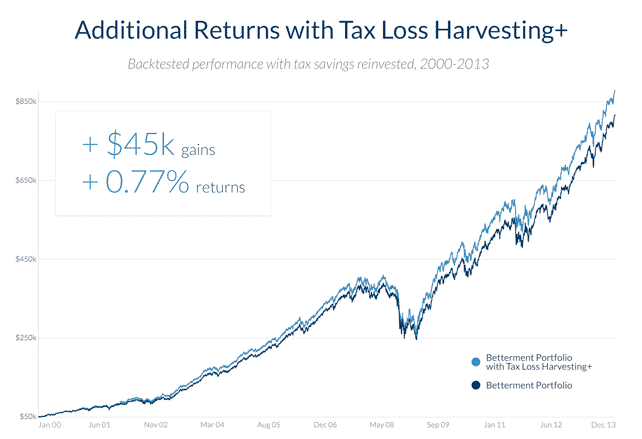
    betterment tax loss harvesting results 2000 to 2013

    >> Related: What You Need To Know About Betterment Securities

    Betterment Tax Coordinated Portfolios

    Tax loss harvesting is a way to boost after tax returns but it only applies to taxable accounts. For retirement accounts, such as an IRA or 401(k), tax loss harvesting doesn’t help because these qualified accounts already enjoy a tax-advantaged status. That’s where tax coordinated portfolios come into play.

    Betterment tax coordinated portfolios optimizes the strategy of asset allocation by placing assets that will be highly taxed into qualified retirement accounts that enjoy tax breaks and putting lower-taxed assets into taxable accounts.

    Betterment claims from historical studies that employing tax coordinated portfolios to optimize asset allocation can improve returns by an average 0.48% annually, resulting in a potential additional gain of up to 15% over 30 years.

    >> Related: What Is A Betterment Tax Coordinated Portfolio?

    Betterment TaxMin Lot Selling

    Betterment uses a method called TaxMin Lot Selling to improve the tax impact (when compared to FIFO) of most transactions.

    When securities are sold, Betterment algorithms choose which lots to sell by following a set of rules which they call TaxMin.

    The way it works is that Betterment algorithms examine the date of purchase and the cost basis of each lot, realizes losses before gains, and sells lots in a specific order:

    1. Short-term losses
    2. Long-term losses
    3. Long-term gains
    4. Short-term gains

    Before moving from one step to the next, all transactions are completed for a given category with higher cost basis lots getting sold first.

    Because smaller gains accompany higher cost basis holdings, a lower tax burden is felt by clients. For losses, the higher the basis, the larger the loss – which is helpful because it can offset gains.

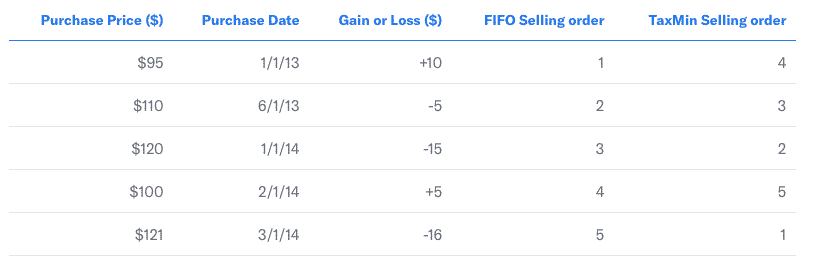
    Take the following example that Betterment provides to highlight how TaxMin Lot Selling works. Let’s say you owned the lots shown below for a single security, and assume just 1 share in each lot.

    The purchase prices are listed so we’re going to fast forward to a time in the future when you want to sell one share.

    If the price of the security were $105, you would pay long term capital gains tax of $10 using FIFO. But with TaxMin Lot Selling, you would realize a short term loss of $16 instead.

    If you were to sell two shares, FIFO would result in a $5 long term gain while TaxMin Lot Selling would result in a $31 short term loss.

    So, while you do still pay taxes on your gains, the losses help to lower your tax bill.
    betterment taxmin algorithm

    Betterment Tax Efficient ETFs

    Many casual investors experience a tax surprise at the end of the year when investing in mutual funds, which are obligated to distribute capital gains to investors by year end – irrespective of when the mutual fund was purchased. These gains are not the same as capital gains, which shareholders realize when selling shares of the mutual fund.

    Theoretically, you could buy shares of a mutual fund in December and suffer from a tax distribution the next day.

    Unlike mutual funds, ETFs have similar tax efficiency advantages as index funds that do not generate internal capital gains from churning.

    Plus, ETF shares trade throughout the day – as opposed to mutual funds which exchange hands once per day at a Net Asset Value – which shields investors from accumulated capital gains within the fund.

    >> Related: How To Invest Money Wisely

    Betterment Investing

    Investing with Betterment includes more features than low-fee, tax-efficient, automated investing service offerings, such as:

    FRACTIONAL INVESTING

    When you invest your money with a traditional financial advisor, or even if you choose to invest autonomously via a self-directed account, such as tastyworks you will generally have some cash sitting idle in your account because you are only permitted to buy individual shares.

    But Betterment makes fractional share investing is possible, so 100% of your money may be invested to avoid a cash drag on your portfolio’s performance.

    Imagine you had $10 of cash uninvested in your Betterment Digital account, you could purchase 0.2 shares of a $50 ETF, which would otherwise be unavailable for purchase in a self-directed brokerage account.

    SMART DEPOSIT

    Betterment lets you sweep excess cash above a certain specified amount from your bank account into your Betterment accounts.

    By regularly investing surplus savings, you get to build a larger nest-egg over time. Or as Warren Buffett’s sidekick, Charlie Munger, famously put it:

    “By periodically investing in an index fund, for example, the know-nothing investor can actually outperform most investment professionals. Paradoxically, when ‘dumb’ money acknowledges its limitations, it ceases to be dumb”
    – Charlie Munger

    >> Related: 21 Legendary Investing Quotes

    TOP NOTCH CUSTOMER SERVICE

    Customer support is available 7 days a week by phone, email and live chat. We found employees to be knowledgeable, helpful and patient in answering a host of queries.

    INTUITIVE INTERFACE

    If you have been around the block in the investing world, you have probably come across your fair share of unintuitive, hard-to-navigate online interfaces.

    At Betterment, you will find just the opposite. The experience is delightful because the interface is highly intuitive, simple to use and navigate, and lets you control and update accounts quickly and easily.

    RETIREMENT ADVICE: RetireGuide

    Betterment offers a service called RetireGuide to construct a diversified portfolio designed to meet your retirement needs. Your personal retirement goals are examined and compared to your income, savings, location, and projected retirement spending.

    With RetireGuide, you can easily view your progress towards your retirement goals and receive nudges on how to realize your financial goals by saving or investing more.

    To learn more about Betterment, including what accounts types are available and the pros and cons of Betterment vs other robo advisors, check out our Betterment review.

    We would love to hear from you. What tips do you have to invest smarter? Share your feedback below.

    >> Discover The Best Robo Advisors

    >> Find Out How Much Should Be In Your 401(k)

    >> Which Robo Advisor Should You Choose: Betterment or Vanguard?
  • What You Need To Know About Betterment Securities

    What You Need To Know About Betterment Securities

    betterment brokers trading system robo adviser

    InvestorMint provides personal finance tools and insights to better inform your financial decisions. Our research is comprehensive, independent and well researched so you can have greater confidence in your financial choices.

    Betterment makes it easy to invest automatically in a diversified portfolio of low-fee index funds. It is also simple to allocate savings to various ‘buckets’ that target financial goals. Whether saving for a new home, a new car, or a vacation, Betterment makes the process of tracking your goals intuitive and straightforward.

    Behind the intuitive interface, Betterment is made up of two entities: Betterment LLC and Betterment Securities.

    Betterment LLC is an SEC registered investment advisor. When you access your Betterment account, the advice and investment platform you see is powered by Betterment LLC.

    Is Betterment A Broker-Dealer?

    Betterment Securities is a broker-dealer that is the custodian of your assets and executes trades on your behalf.

    betterment

    Some robo-advisors use renowned financial institutions, such as Charles Schwab and Fidelity, as custodians for client assets.

    Many online investment management firms are classified as introducing firms, meaning funds are passed to another firm, which acts as custodian, and so the capital requirements on the introducing firm are minimal.

    By contrast, Betterment is a FINRA member broker-dealer and acts as its own custodian.

    This means that Betterment must comply with strict capital requirements and is subject to stringent regulatory oversight.

    Clients of introducing firms may work both with the firm and the custodian whereas Betterment clients only interact with Betterment.

    Is My Money Safe At Betterment?

    Assets held at Betterment are protected by SIPC (Securities Investors Protection Corporation) up to $500,000.

    In practice, a client with assets held at Betterment Securities may end up in a better financial situation than they might expect if Betterment were to end up in insolvency.

    For example, a client with $1,000,000 wouldn’t necessarily be made whole $500,000 by SIPC and lose the other $500,000.

    In its operating history, SIPC has had to distribute assets rarely and, when claims have arisen, most assets distributed have emanated from the insolvent broker-dealer’s estate.

    So, if $500,000 were recovered from the insolvent broker-dealer’s estate and SIPC contributed an additional $500,000, then the client would be not experience any loss whatsoever.

    And what’s even better is if you have a few accounts at Betterment, they all qualify for SIPC protection of up to $500,000.

    Can I Trust Betterment With My Money?

    Betterment focuses on doing one thing well: managing your money. And because Betterment Securities is a custodian, its security is greater than some other rival online robo-advisors.

    You may have heard of some firms engaging in proprietary trading or loaning out customer assets. These practices fall under the category called: commingling funds.

    At Betterment, funds are never commingled, so client assets are placed in segregated accounts which are separated from Betterment operating capital.

    Betterment Spotlight

    BETTERMENT SPOTLIGHT
    betterment

    InvestorMint Rating

    5 out of 5 stars

    • Promo: Up to 1 Year Free Management
    • Management Fee: 0.25% – 0.40%
    • Account Minimum (Betterment Digital): $0
    • Account Minimum (Betterment Premium): $100,000

    via Betterment secure site

    Is Betterment Independently Reviewed?

    It may give you even more peace of mind to know that Betterment is reviewed by FINRA and the SEC regularly to make sure capital requirements are met and customer records are correctly maintained.

    Plus, Betterment’s independent public accountants examine the firm’s financial health, security of clients’ assets held, and operating procedures.

    During each of the three annual audits, the records held by Betterment must match the records of Betterment’s independent clearing firm during each review.

    Does Betterment Make Transaction Mistakes?

    If you have been around the block for a while in the investing world, you may have come across a situation where perhaps a trade was not filled, or a fill price was incorrect, or some other execution issue cropped up.

    A nice feature at Betterment is built-in verification to catch any issues that might crop up. The way it works is that reconciliation takes place first between customers’ transaction amounts and cash transfers and ACH transaction amounts, then with trade amounts, and subsequently with positions and fills.

    By checking and cross-checking, Betterment spots irregularities quickly which its operations team can then resolve.

    Because Betterment LLC and Betterment Securities fall under the same umbrella, you don’t risk the same reporting (in)accuracy issues that may crop up if you were a client at an introducing firm whereby a third party, who acts as custodian for your funds, manages reporting.

    Why Betterment?

    Although Betterment is best known for providing a low-cost, automated portfolio management solution, clients receive other less apparent benefits when peeking behind the veil, such as:

    • Record keeping is conducted by Betterment as opposed to a third-party;
    • A large capital cushion is maintained;
    • Independent reviews are conducted by regulators and public accountants;
    • Customer assets are not commingled; and
    • Fiduciary and ethical standards are prioritized.

    >> Compare Betterment Vs Vanguard

    >> Review Betterment Roboadvisor

    >> Discover The Best Options Trading Strategies: Married Put

  • What Is A Betterment Tax Coordinated Portfolio?

    What Is A Betterment Tax Coordinated Portfolio?

    betterment brokers trading system robo adviser

    InvestorMint provides personal finance tools and insights to better inform your financial decisions. Our research is comprehensive, independent and well researched so you can have greater confidence in your financial choices.

    An extra 0.50% gain in portfolio value each year might not sound like much cause for celebration in the short term but over 30 years it can amount to a 15% increase.

    The Betterment tax-coordinated portfolio cannot guarantee this positive outperformance but rigorous mathematical studies show historical outperformance using this strategy.

    But what is a Betterment tax coordinated portfolio?

    A Betterment tax coordinated portfolio automates the strategy of asset allocation and optimizes it by placing assets that will be highly taxed into qualified retirement accounts that have tax breaks, and placing lower-taxed assets into taxable accounts.

    To better understand the value of a Betterment tax coordinated portfolio, look first to the world of human advisors.

    The Old World Financial Advisor Paradigm

    To understand the value of an automated tax coordinated strategy, consider the “old world” paradigm where traditional financial advisors manage the portfolios of say 100 clients.

    Let’s assume the human financial advisor wants to do a good job for clients, so portfolios are tailored to their unique financial circumstances. The advisor diligently builds portfolios for each client accounting for age, risk, time horizon and so on.

    Now fast forward a year or two, and more often than not, many of the portfolios will experience portfolio drift, whereby some assets make up a disproportionately large portion of the portfolio.

    Many of the portfolios will not be optimized for tax-efficiency either.

    And it’s no wonder why. After all, the human advisor with 100 clients may only have 2-3 working days per year to build, optimize, adjust, and monitor any single client portfolio.

    A client paying a financial advisor $10,000 per year in fees assumes that those fees cover a year’s worth of work. And theoretically they do. But in practice, through no fault of the financial advisor necessarily, it is difficult to spend much more than a few days on any single client portfolio.

    Some clients may pay as much as $5,000 or more per day to their financial advisor without knowing it.

    Human advisors are limited by their own time constraints in serving clients as well as they might wish. And because only so many clients can be served, fees charged to clients are higher in order to make the financial advisory businesses viable.

    These problems are solved by roboadvisors, such as Betterment, who automatically monitor, rebalance and optimize portfolios regularly. By leveraging technology, roboadvisors can serve thousands of clients where human advisors are limited to serving perhaps only 150 clients.

    So, Betterment may have technology advantages over human financial advisors but how do its tax coordinated portfolios actually work?

    How Does A Betterment Tax Coordinated Portfolio Work?

    The way a Betterment tax coordinated portfolio works is that the most tax-efficient assets are placed in accounts taxed least favorably and the least tax-efficient assets are placed in accounts taxed most favorably.

    betterment

    What Betterment has figured out how to do is to dynamically allocate assets across accounts to optimize for tax efficiency, aligned with a client’s risk and reward objectives, and maintain a globally diversified portfolio.

    For investors who don’t have the time, ability or desire to figure out how to create an overall asset allocation strategy, the automated solution from Betterment makes a bunch of sense, especially when considering that the probability is low that a human advisor without Betterment’s technology and scale advantages can replicate similar portfolio performance.

    Betterment estimates that the annualized benefit from tax coordinated portfolios ranges from 0.10% to 0.82% with a typical customer who has taxable, tax-deferred and tax-exempt accounts enjoying an annualized 0.48% portfolio value increase.

    Is A Tax Coordinated Portfolio The Same As Tax Loss Harvesting?

    Tax loss harvesting is compatible with a tax coordinated portfolio, but they are not the same thing.

    Tax loss harvesting is an automated algorithm that Betterment applies to taxable accounts in order to offset taxable gains with taxable losses to maximize after-tax returns.

    HOW TAX LOSS HARVESTING CAN MAKE YOU MONEY

    Imagine you have a taxable portfolio worth $250,000. As time goes by, like any portfolio, some positions will be winners and some will be losers. Let’s assume that tax deductible losses of $25,000 have been harvested over a period of time.

    This $25,000 tax deduction could potentially translate into savings of say $7,500 in income taxes.

    Now, let’s say you earn an average 7% annually on your portfolio. The $7,500 you could invest earns $525 per year on average.

    But your fees on the $250,000 portfolio are $625, assuming a 0.25% management fee charge.

    So, the earnings from tax loss harvesting have the potential to offset a good portion of your management fees.

    As more time goes by and more tax losses accumulate, more income tax savings amounts can be invested to ultimately eclipse what you pay in fees.

    The First Rule Of Asset Allocation

    It is intuitive to think that the best way to allocate assets across multiple accounts is to apply the same division of assets to each portfolio.

    Imagine a taxable portfolio made up of 70% stocks and 30% bonds for example. You might think that your taxable brokerage account as well as your tax-efficient retirement accounts should all have the same division of assets.

    But the mix of assets selected for any given portfolio should not be mirrored in every account. Instead, the goal is to maximize the after-tax returns of the aggregate portfolio.

    For example, placing municipal bonds that have tax advantages into a taxable account makes a lot of sense. But placing them in a 401(k) or IRA makes little sense, because both of these accounts already enjoy a tax-advantaged status so the tax breaks on municipals bonds are not adding a tax benefit.

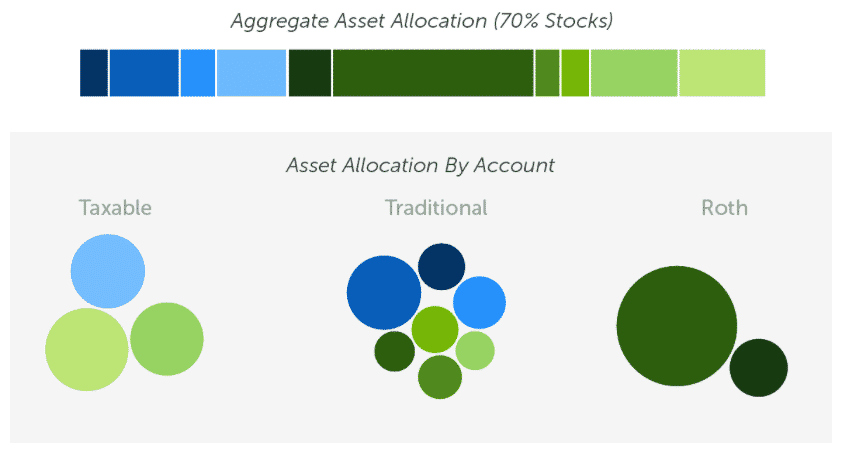
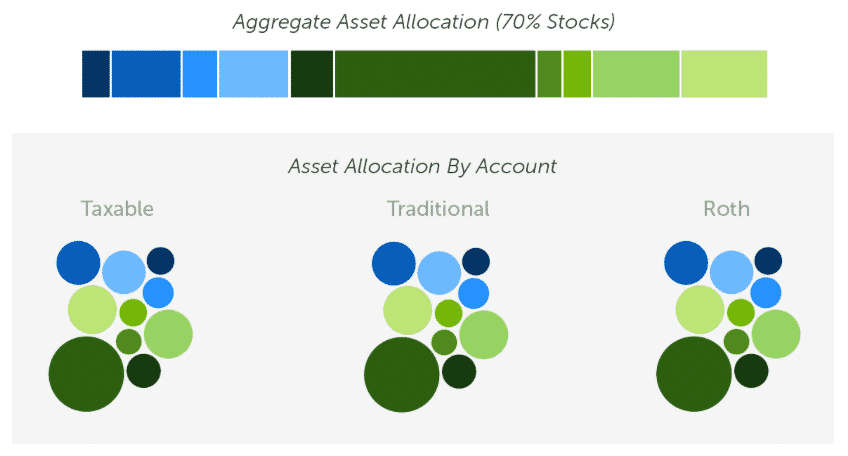
    The way Betterment explains this with these intuitive visual graphics below. The first infographic highlights a portfolio with accounts managed separately – without asset allocation.

    betterment aggregate without asset allocationSource: Betterment

    This second infographic highlights the same overall portfolio with asset allocation.

    Source: Betterment

    Betterment Spotlight

    BETTERMENT SPOTLIGHT
    betterment

    InvestorMint Rating

    5 out of 5 stars

    • Promo: Up to 1 Year Free Management
    • Management Fee: 0.25% – 0.40%
    • Account Minimum (Betterment Digital): $0
    • Account Minimum (Betterment Premium): $100,000

    via Betterment secure site

    Asset Allocation = Free Lunch

    Investing in the stock market is mired with pitfalls. Many investors who beat the market for a few years or even a few decades experience a demise when the holes in their strategies are revealed.

    Even Nobel-prize winners who thought they found the holy grail investing strategy experienced doom. Roger Lowenstein documents this journey in his famous book When Genius Failed: The Rise and Fall Of Long Term Capital Management.

    For these reasons, casual investors generally fare better by investing in index funds that form part of a diversified portfolio.

    Asset allocation takes the concept a step further by executing investment strategies in a more tax-efficient way.

    Asset allocation is sometimes called the only “free lunch” in investing because it can maximize long-term, after-tax returns without increasing risk.

    To convey the benefits of this “free lunch” on a continual basis to clients, Betterment relied on software engineers, tax experts, quantitative analysts and product engineers to build algorithms to monitor and adjust portfolios daily.

    The Cost Of Tax Drag

    Casual investors often focus on pre-tax returns but smart investors know the real key to long term performance is to maximize after-tax returns. To do so requires minimizing the cost of tax drag.

    Tax drag is the part of an investment return which is lost due to tax payments each year.

    A way to reduce tax drag is to put assets that pay dividends into a tax-deferred account, such as an IRA, as opposed to a taxable account.

    Choosing tax efficient assets, which produce most of their returns through gains as opposed to dividends, also minimizes the effect of tax drag.

    But tax efficient assets don’t always help you from a tax perspective when it comes time to sell your assets.

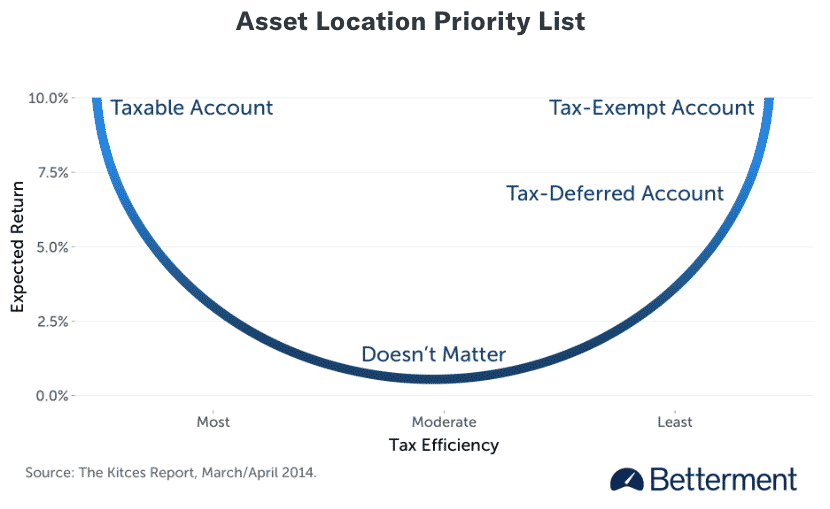
    Sometimes it is best to choose an asset that is less tax-efficient but has a higher expected return than an asset that is more tax-efficient but has a lower expected return.

    If you are starting to think this is a lot of work, it is a good reason to seriously consider a Betterment Tax Coordinated Portfolio. It’s no mean feat trying to puzzle through this alone, especially by hand.

    To help you think visually about the process of optimizing for after-tax returns, and allocating optimally, Betterment provides the following infographic.

    betterment asset location priority list

    How To Build A Simple Tax Coordinated Portfolio

    If you have been in the investing world for some time, you might have heard some old sayings like “munis to taxable accounts, bonds to IRAs.”

    The complexity of building a tax coordinated portfolio is so great that simple rules of thumb, while helpful, are inadequate in maximizing long-term returns.

    If you don’t have the time or desire to roll up your sleeves and break out the spreadsheet to perform some quantitative analysis, Betterment’s tax coordinated portfolio offers a compelling long-term solution.

    Betterment does the work for you automatically so you get to enjoy a hands-off investing experience, which has the added benefit of not succumbing to the temptations to beat the market, an endeavor in which few have succeeded over time.

    OPEN A BETTERMENT ACCOUNT TODAY

    BETTERMENT SPOTLIGHT
    betterment

    InvestorMint Rating

    5 out of 5 stars

    • Promo: Up to 1 Year Free Management
    • Management Fee: 0.25% – 0.40%
    • Account Minimum (Betterment Digital): $0
    • Account Minimum (Betterment Premium): $100,000

    via Betterment secure site

    >> Review Betterment RoboAdvisor

    >> Lessons From Warren Buffett’s Annual Shareholder Letter

    >> View 21 Legendary Investing Quotes

  • Vanguard Review 2020

    Vanguard Review 2020

    financial advisor at computerHigh net worth and retirement investors will find low-cost investing nirvana at Vanguard, or as close as it gets. Over 50 commission-free exchange-traded funds and 2,500+ no-transaction-fee mutual funds are available, expense ratios are low compared to industry averages, overall fund performances are stellar (89% of Vanguard ETFs beat the returns of their peer group averages), and higher net worth investors enjoy even lower costs when selecting Vanguard Admiral Shares.

    Vanguard founder, Jack Bogle, pioneered the index fund, and is a proponent of diversified portfolios, so it’s no surprise that active trading in stocks and options is not as well supported at Vanguard as it is on platforms that cater to self-directed, active traders, such as TastyWorks.

    Low costs at Vanguard are complemented by retirement planning tools, such as retirement calculators, and extensive education to prepare better for retirement. For example, if you want to know how social security timing will affect your income or how medical care could affect your expenses, Vanguard has resources to guide you through the nitty gritty details.

    Vanguard Spotlight

    VANGUARD INVESTMENTS
    vanguard investments

    InvestorMint Rating

    4 out of 5 stars

    • Account Minimum: $0
    • Expense ratios: 0.18% (on average)
    • Commissions: As low as $2

    via Vanguard secure site

    Vanguard Customers

    Vanguard serves fee-sensitive, retirement-oriented investors, and caters especially well to higher net worth individuals. Whether a buy-and-hold, passive investor or a self-directed, active trader, Vanguard has services to meet your needs at low cost.

    Vanguard targets high net worth investors for its brokerage arm and robo-advisor service, Vanguard Personal Advisor Services. In its brokerage, Vanguard passes on fee-savings to purchasers of its Admiral Shares (which have a minimum $10,000 investment hurdle). Vanguard robo-advisor clients must have a minimum $50,000 to be eligible for service, which includes access to a team of live advisors.

    Commissions are tiered to favor high net worth individuals too. For example, clients with account balances under $50,000 are charged $7 per equity trade for the first 25 trades whereas clients with $1,000,000 or more invested enjoy the same number of trades free. For active traders with less than $50,000, commissions rates increase to $20 per trade thereafter, compared to $2 per trade for those with account balances of $1M+.

    Fee-conscious investors will find Vanguard almost impossible to beat. Vanguard made its name as a low-cost provider, and both its brokerage and robo-advisor services charge highly competitive commissions rates.

    Over 50+ commission-free ETFs and 2,500+ no-transaction-fee mutual funds are available. Expense ratios average just 0.18%, which compares favorably to the industry average that is 2-3x higher. And robo-advisor clients are charged a management fee of just 0.30%, which includes access to human advice.

    Investors looking to keep taxes low will find Vanguard does a good job limiting tax liabilities from fund distributions; 83% of all Vanguard ETFs had no capital gains tax distributions in the past 5 years.

    Vanguard is best for investors who are:

    • Fee-conscious
    • Tax-savvy
    • Buy-and-hold
    • Keen to build diversified portfolios
    • Retirement-oriented
    • Have higher net worth

    Vanguard Pros and Cons

    Vanguard has low expense ratios, low commissions (especially for higher net worth clients), an extensive range of NTF mutual funds and commission-free ETFs, plus in depth retirement planning resources. Active traders should compare other platforms for lower fees and better tools.

    Vanguard Pros Vanguard Cons
    Low Expense Ratios: The average Vanguard mutual fund and ETF fund expense ratio is 81% lower than the industry average.

    Small fee differences can add up to hundreds of thousands of dollars over lost portfolio value over the long-term, so Vanguard stands above most of its competitors with its low-cost pricing structure.

    Active Trading: Most brokerage firms reward active traders with lower commissions rates whereas Vanguard penalizes active traders with smaller account balances by charging higher rates – this fee structure aligns philosophically with the firm’s values to promote index investing.

    Commissions increase from $7 to $20 per trade after 25 trades for traders with account balances under $50,000

    Low Commissions For High Net Worth Clients: Clients with high account balances over $500,000 pay just $2 per trade for equities and $2 + $1/contract for options. High Robo Advisor Account Minimum: To get access to Vanguard’s robo-advisor service, a $50,000 account balance must be met. And to be assigned a dedicated financial advisor, a $500,000 minimum must be met – however a team of advisors is accessible to clients with smaller balances.
    Vanguard Robo Advisor: Passive investors who want a hybrid portfolio management solution that combines technology with human advice can select Vanguard Personal Advisor Services, provided they meet the $50,000 account minimum. Tools: Vanguard disincentivizes active trading, and this is reflected in fewer tools compared to platforms that promote self-directed trading, such as TastyWorks or thinkorswim.
    Extensive Range of No-Commission Funds: Over 50+ commission-free exchange-traded funds, and 2,500+ no-transaction-fee (NTF) mutual funds are available.
    Financial and Retirement Planning Portal: Extensive education to help retirement-oriented investors, including content relating to:

    • Saving for retirement
    • Investing during retirement
    • Understanding taxes
    • Calculators and tools
    • Emergency fund planning
    • College tuition savings
    • Inheriting accounts
    • Rolling over retirement accounts
    • Naming beneficiaries
    • Trading online
    • Getting started investing

    Vanguard Securities

    Vanguard makes available the following securities to trade:

    • Stocks
    • Options
    • ETFs
    • Mutual Funds
    • Bonds

    Vanguard Fees

    Vanguard has especially low commissions for higher net worth investors, while penalizing active traders by imposing higher charges.

    Security Fees
    Stocks Up to $50,000: $7 per trade; $20 per trade after 25 trades
    $50,000→$499,999: $7
    $500,000→$999,000: $2
    $1M→$4,999,999: Free; $2 per trade after 25 trades
    $5M+: Free; $2 per trade after 100 trades
    Options Up to $50,000: $20 + $1/contract
    $50,000→$499,999: $7 + $1/contract
    $500,000→$999,000: $2 + $1/contract
    $1M+: Free
    Mutual Funds >2,500+ NTF
    (no-transaction-fee) funds
    Margin Rate Range 5.25% – 7.75%
    NTF Funds Dollar-Cost Averaging Minimum $100
    (2+ trades)
    Account Balance Minimum $0
    Annual Fee $20
    (if account balance < $50,000)

    Vanguard Access Features

    Type Capability
    Desktop N/A (no trading platform)
    Mobile YES (view account)
    Customer support Email Support
    Phone Support 8am-10pm ET Mon-Fri
    Research YES
    Tools Limited: Retirement Planning & Calculators
    Commission-free ETFs 50+
    No-transaction-fee Mutual Funds 2,500+

    Vanguard Summary

    Over $600 billion of client assets are invested in Vanguard ETFs, and it is the go-to fund provider for many robo-advisors with good reasons:

    • average expense ratio is 81% lower than the industry average
    • 93% of Vanguard’s bond funds outperformed their peer group average
    • 50+ commission-free exchange-traded funds are available
    • 2,500+ no-transaction-fee mutual funds are available

    Vanguard is especially enticing to high net worth investors, who are rewarded with even lower commissions and fees than regular clients. And retirement investors have access to a wealth of education resources to guide them through almost every conceivable step of wealth planning, whether for retirement, college tuition or most everything in between.

    Passive investors will find Vanguard Personal Advisor Services, Vanguard’s robo advisor, to be very competitive on rates when factoring in accessibility to human advice as part of its core service. However, active traders should compare other brokers, especially if tools and charts are important when making trading decisions.

  • What Is An ETF?

    What Is An ETF?

    dollar rising chart

    InvestorMint provides personal finance tools and insights to better inform your financial decisions. Our research is comprehensive, independent and well researched so you can have greater confidence in your financial choices.An exchange-traded fund, or ETF, is a collection of securities under a single umbrella that you can buy or sell in a single transaction without having to purchase each individual security separately.

    An ETF may be a basket of stocks from a particular sector, such as healthcare or technology. It can also be a collection of bonds in which case it is a bond ETF. Or it can be an assortment of commodities that forms a commodities ETF. In recent years, ETFs have become very popular and these days, you can even create your own combination of stocks to form a motif, that can be bought, like an ETF, for a single low price.

    The way ETFs are structured is that the ETF provider creates a fund to own the underlying assets. The fund is set up to track the performance of those assets and shares in the fund are sold to investors.

    ETF buyers are called shareholders, and they own a fraction of the ETF, though not the assets held by the ETF. A flow-through system is in place so if dividend paying stocks are held by the ETF, the ETF shareholders receive their respective portions of the dividends.

    ETFs are generally traded daily on a stock exchange much like stocks. But unlike stocks, ETFs have ongoing expenses which are used to manage the funds. They typically have lower fees than mutual funds yet enjoy the same benefits of diversification.

    The reason ETF fees are lower is that ETFs are passively managed whereas mutual funds are actively managed. An ETF simply has the goal to track a benchmark, say the S&P 500, whereas mutual fund managers often seek to beat benchmarks, and are paid a higher amount for so doing.

    ETF Fees

    ETF fees are primarily made up of expense ratios charged at the fund level, but ETF shareholders are generally charged commissions costs when buying and selling in a brokerage account. Vanguard and Schwab are among the leading firms offering wide selections of commission-free exchange-traded funds.

    Exchange-traded funds have gained in popularity compared to higher cost mutual funds. The higher costs of mutual funds, which are actively managed compared to passively managed ETF funds, are largely attributable to higher expense ratios. ETF fees are on average about 70% lower than mutual fund fees.

    However, don’t be fooled into thinking that lower average ETF fees means all ETFs have low fees. ETF fees can vary widely, though most of the large issuers, such as Vanguard, SPDR and iShares, charge industry-standard fees.

    ETFs that track an index may be more easily managed than say an ETF tracking a foreign market, and so higher ETF fees will reflect higher management complexity.

    As ETFs become more popular, they gain more assets under management and the percentage fees charged tends to decrease accordingly because fixed costs can be covered more easily.

    If you are comparing fees of different issuers, the place to begin is usually Vanguard, which has a reputation as a low-cost fund provider.

    When you purchase an ETF, you will most likely pay a commission charge. However, Vanguard makes available over 50 commission-free exchange-traded funds to brokerage clients. Schwab has an even greater selection, and provides brokerage clients with over 200 commission-free exchange traded funds.

    ETFs To Buy

    When interest rates are rising, confidence in government is falling, currencies are fluctuating, and markets are falling, ETFs can be excellent vehicles to hedge risk and make money trading current trends.

    If you are buying ETFs as part of an employer-sponsored plan, you will be limited to the selection range provided by your plan provider. An easy way to compare the quality of ETF funds in your 401(k) plan is to let Blooom compare, analyze and manage funds to ensure lower-fee funds are selected and higher-fee funds are replaced.

    BLOOOM SPOTLIGHT
    blooom logo

    InvestorMint Rating

    4 out of 5 stars

    • Management Fee: $95 – $250
    • Account Minimum: $0

    via Blooom secure site

    On the other hand, if you have a brokerage account, your selection range of ETFs will be much broader. ETFs allow you to build a diversified portfolio inexpensively, but which ETFs should you select?

    The most important first step in selecting ETFs to buy is to find low-fee ETFs because the difference of an additional 0.5% in fees over a 30 year period when starting with a $100,000 can amount to hundreds of thousands of dollars of opportunity cost.

    When markets are falling, you can explore one of the many inverse ETFs listed later on in this article. These ETFs can act as a hedge when your portfolio is moving in line with the rest of the market.

    When interest rates are rising, bond ETFs that include TIPS that keep pace with inflation are worthy of consideration so that you don’t lose purchasing power over time.

    Currency ETFs are also a good hedge against currency risk. For example, if you own some foreign stocks or funds, and want to hedge against swings in the local currency, you can do so by buying a currency ETF.

    When confidence in governments declines, commodities, such as gold and other precious metals, rise in popularity. ETFs to buy in the commodities space range from gold and silver ETFs to broader based precious-metals ETFs.

    Investors with higher risk tolerances may find small cap ETFs to buy that provide opportunities for larger gains than the general market while lowering the risk of holding a single stock position, such as a penny stock. If you prefer to purchase penny stocks, the best penny stock brokers generally have flat commission structures.

    Risk-averse investors will find a wide selection of attractive ETFs to buy, including large cap ETFs, investment grade corporate bond ETFs, index ETFs, as well as sector ETFs and industry ETFs that offer exposure to the healthcare industry, technology industry, and energy sector among others.

    Whichever ETF you choose, you should generally find it is easy to identify the fees charged and assets held by the fund. Plus, a benefit over mutual funds is the tax treatment tends to be better because taxes are due when selling – as opposed to mutual funds which often result in tax liabilities even when still holding the fund.

    ETF Investing Risks

    Investors looking to beat market benchmarks should consider alternatives to ETFs, which are designed to track but not outperform benchmarks. Unless the ETFs are commission-free, churning an account by buying and selling frequently can hurt portfolio value.

    When you purchase an ETF, the fund is passively managed and designed to mirror the performance of a benchmark. If you are striving to beat the market, then a mutual fund or individual stock purchases may be a better bet.

    Frequent traders should also be aware of the risks of churning accounts, which takes place when buying and selling securities regularly and paying commissions each time. These transaction costs can add up in a hurry and eat away at performance gains.

    ETFs may have lower administrative and management costs than mutual funds, but they still require a large amount of assets under management to make them profitable. If you find an ETF that has not been trading long and has few assets under management, it may be worth treading carefully because if the fund closes, you will be forced to sell sooner than you may wish.

    >> Discover The Best Brokers For Free Stock Trading

    Types of ETFs

    Popular exchange-traded funds include Index ETFs, Foreign ETFs, Currency ETFs, Sector ETFs, Industry ETFs, Inverse ETFs, Commodity ETFs, Market Cap ETFs, Bond ETFs and Exchange-traded Notes.

    A vast array of exchange-traded funds have been created to meet the needs of fee-savvy investors. Famed investor, Warren Buffett, advocates that most individuals invest their nest-egg in an index fund, such as the SPY, which is the best known exchange-traded fund that tracks the S&P 500.

    INDEX ETFs

    An ETF is designed to emulate the performance of an index, not produce superior returns. In the US, some popular ETFs include:

    Symbol Name
    SPY SPDR S&P 500 ETF
    IWM iShares Russell 2000 ETF
    QQQ PowerShares QQQ ETF
    DIA SPDR Dow Jones Industrial Average

    FOREIGN MARKET ETFs

    Foreign market ETFs are a simple way to get exposure to international markets. If you are looking for exposure to developing markets or developed markets, there is almost certainly a foreign market ETF to meet your needs.

    Some of the most popular foreign market ETFs include:

    Symbol Name
    EWZ iShares MSCI Brazil Capped ETF
    EWJ iShares MSCI Japan ETF
    INDA iShares MSCI India ETF
    EWG iShares MSCI Germany ETF
    EWW iShares MSCI Mexico Capped ETF
    EWA iShares MSCI Australia Capped ETF
    EWC iShares MSCI Canada ETF
    EWU iShares MSCI United Kingdom ETF
    EWY iShares MSCI South Korea Capped ETF
    EWH iShares MSCI Hong Kong ETF

    CURRENCY ETFs

    If you are looking to track a foreign currency but don’t want the volatility and leverage associated with trading Forex markets directly, a currency ETF can provide you exposure to a foreign currency or even a basket of foreign currencies.

    Currency ETFs include:

    Symbol Name
    UUP PowerShares DB US Dollar Index Bullish ETF
    FXE CurrencyShares Euro Trust ETF
    FXB CurrencyShares British Pound Sterling Trust
    FXY CurrencyShares Japanese Yen Trust
    FXA CurrencyShares Australian Dollar Trust
    FXC CurrencyShares Canadian Dollar Trust
    FXM CurrencyShares Mexican Peso Trust
    FXF CurrencyShares Swiss Franc Trust
    FXSG CurrencyShares Singapore Trust
    INC WisdomTree Dreyfus Indian Rupee ETF

    SECTOR ETFs & INDUSTRY ETFs

    Sector ETFs and industry ETFs are an inexpensive way to get exposure to broad baskets of stocks in a certain sector or industry. These ETFs allow for better diversification than buying specific stocks alone.

    Symbol Name
    IHF iShares Dow Jones US Healthcare Providers Index
    IHE iShares US Pharmaceuticals ETF
    IHI iShares US Medical Devices ETF
    IYW iShares Dow Jones US Technology Sector Index Fund
    IYZ iShares Dow Jones US Telecommunications Sector Index Fund
    IYT iShares Dow Jones US Transportation Average Index Fund
    IYF iShares Dow Jones US Financial Sector Index Fund
    IYE iShares Dow Jones US Energy Sector Index Fund
    FXG First Trust Consumer Staples AlphaDEX Fund
    FBT First Trust NYSE Biotechnology Index Fund
    FDN First Trust Dow Jones Internet Index Fund

    >> What are the best stocks to buy?

    INVERSE ETFs

    Betting against the market can be lucrative at times, especially when economies are weakening and markets moving lower. There are lots of ways to make money from a declining market, such as shorting stock and buying put options. Another way is to buy an inverse ETF that goes up when the market goes down.

    Symbol Name
    SPXU ProShares Ultra Pro Short S&P 500 ETF
    DXD UltraShort Dow 30 ProShares ETF
    RWM Short Russell2000 ProShares ETF
    QID UltraShort QQQ ProShares ETF
    MYY Short MidCap400 ProShares ETF

    COMMODITY ETFs

    As confidence in governments fluctuates, the popularity of commodities ebbs and flows. To gain exposure to gold, silver, and other commodities, without having to buy the underlying physical commodity, ETFs offer an easy and viable alternative.

    Popular commodity ETFs include:

    Symbol Name
    GLD StreetTracks Gold Shares ETF
    SGDM Sprott Gold Miners ETF
    IAU iShares COMEX Gold Trust ETF
    SLV iShares Silver Trust ETF
    DBP PowerShares DB Precious Metals Fund ETF
    XME SPDR S&P Metals & Mining ETF
    PTM E-TRACS UBS Long Platinum ETN
    COPX Global X Copper Miners ETF

    MARKET CAP ETFs

    If you want exposure to small cap stocks, mid-cap stocks, large cap stocks or a composite of value style, growth style or blend style funds, exchange-traded funds have been built to meet your investing goals.

    Small cap ETFs track companies with market capitalizations under $1 billion while mid-cap ETFs track companies with market capitalizations from $1 billion to $10 billion. Companies with market capitalizations over $10 billion are considered to be large caps.

    Examples of small cap ETFs, mid-cap ETFs, large cap ETFs, value ETFs, growth ETFs and blend ETFs include:

    Symbol Name
    VB Vanguard Small Cap ETF
    IJH iShares S&P MidCap 400 Index
    EXT WisdomTree Total Earnings ETF
    JKF iShares Morningstar Large Value Index
    IWP iShares Russell MidCap Growth Index ETF
    IWM iShares Russell 2000 Index ETF

    >> Looking to buy penny stocks, view the best penny stock brokers

    BOND ETFs

    Bond ETFs can be used to bet on interest rate directions, hedge against inflation and gain international exposure. Lots of bond ETFs exist to allow you gain exposure over different time durations, enjoy tax advantages at the municipal level (one of the best municipal bond ETFs is symbol MUB) and earn a return from corporate debt issuances.

    Symbol Name
    MUB iShares S&P National Municipal ETF
    LQD iShares iBoxx $ Investment Grade Corporate Bond ETF
    SHY iShares 1-3 Year Treasury Bond ETF
    VGLT Vanguard Long-Term Government Bond ETF
    SIPE SPDR Barclays 0-5 Year TIPS ETF
    ITE SPDR Barclays Intermediate Term Treasury ETF
    AGG iShares Barclays Aggregate Bond ETF
    ILB Global Advantage Inflation Linked Bond Strategy ETF
    PST ProShares UltraShort Lehman 7-10 Year Treasury ETF
    CWB SPDR Barclays Capital Convertible Bond ETF
    MBB iShares Lehman MBS Fixed-Rate Bond Fund
    HYG iShares iBoxx $ High Yield Corporate Bond ETF

    EXCHANGE TRADED NOTES

    Exchange-traded notes are not the same as exchange-traded funds, but are often confused with them.

    Exchange-traded notes, or ETNs, are issued by banks with high credit ratings as senior debt notes. When you purchase an ETN, you are buying a debt instrument similar to a bond.

    Symbol Name
    GSC GS Connect S&P GSCI Enhanced Commodity Total Return Strategy Index ETN
    ERO iPath EUR/USD Exchange Rate ETN
    AYT Barclays Global Emerging Market Strategy Asia 8 Index

    >> Prefer Hands-Off Investing, Discover The Best Robo-Advisors

    >> Is This The Best Stock Market App For Free ETF Trading?

    >> You Might Also Like This Article: 51 Crude Oil ETFs and ETNs

  • Betterment Vs Wealthfront: Review 2020

    Betterment Vs Wealthfront: Review 2020

    robo-advisor computation

    InvestorMint provides personal finance tools and insights to better inform your financial decisions. Our research is comprehensive, independent and well researched so you can have greater confidence in your financial choices.

    Betterment vs Wealthfront is the proverbial clash of the robo-advisor titans. Both companies emerged in 2008 to provide technology-powered financial management with minimum human involvement at lower fees than those charged by traditional human advisors. Years later, Betterment and Wealthfront continue to lead the robo-advisor industry and have acquired billions of dollars each in managed assets. They have enjoyed so much success that major financial powerhouses, such as Schwab and Fidelity, have launched their own competing robo-advisor services.

    Both Betterment and Wealthfront have remained true to their origins in providing low-fee automated portfolio management services but they have diverged a bit in other areas, namely tax and human advice. Wealthfront offers perhaps the best tax-optimized service in the robo-advisor industry while Betterment has added human advice to its service offerings.

    When comparing Wealthfront vs Betterment, the devil is in the details, and the answer of which is best depends somewhat on the factors that matter most to you.

    Wealthfront vs Betterment

    wealthfront brokerage trading system robo advisor

    betterment

    Betterment and Wealthfront are very evenly matched across many key features. Both have low account minimums, offer free portfolio rebalancing, a wide range of account types, and automatic tax-loss harvesting. Each robo-advisor manages billions of dollars in client assets and charges a management fee of 0.25% for basic service levels.

    Wealthfront shines when it comes to tax-optimized portfolios and the range of asset classes provided to create diversified portfolios while Betterment has the edge when it comes to providing access to human advisors and financial goal setting.

    Betterment Fees
    vs Wealthfront Fees

    High net worth individuals receive a break on fees above $2,000,000 of managed assets at Betterment. No Wealthfront fees are charged to manage the first $10,000 but thereafter a flat-fee of 0.25% is charged to clients.

    When investors compare robo-advisor fees, the focus tends to be on management fees, which are important, but they don’t tell the full story of costs. Another important fee to keep an eye on is the expense ratio, the annual fee that all ETFs and funds charge to their shareholders.

    Thankfully for customers, Betterment and Wealthfront lean towards exchange-traded funds that have lower fees than actively managed mutual funds. Because expense ratios are low at both robo-advisors, management fees are the most important consideration when evaluating total fees.

    Robo-Advisor $5,000 $10,000 $50,000 $100,000 Open Account
    wealthfront brokerage trading system robo advisorREVIEW

    0.0% 0.0% 0.25% 0.25%
    bettermentREVIEW

    0.25% 0.25% 0.25% 0.25%

    Up to $10,000, Wealthfront manages your money at no cost and charges 0.25% thereafter. If you are just getting started investing or not keen to take the plunge with a larger investment amount, Wealthfront has more appeal. Betterment offers no equivalent fee break, so clients will be charged 0.25% for its basic service, Betterment Digital, from the first dollar invested. The fee break on the first $10,000 at Wealthfront means clients save $25 annually with Wealthfront compared to Betterment, so while it’s nice to keep the extra cash in your own pocket, it’s not a make-or-break reason to choose one advisor over the other.

    Higher net worth clients receive a fee break at Betterment on amounts over $2,000,000. Above that threshold, Betterment charges no fees but fees are still charged on invested amounts up to that level. By charging no fees above $2,000,000 of managed assets, a high net worth client enjoys meaningful fee savings. For example, fees are almost 50% higher at Wealthfront compared to Betterment on a $3,000,000 portfolio.

    Robo-Advisor $10,000 $100,000 $1,000,000 $3,000,000 Open Account
    wealthfront brokerage trading system robo advisorMANAGEMENT FEES

    $0 $225 $2,475 $7,475
    bettermentMANAGEMENT FEES

    $25 $250 $2,500 $5,000

    Betterment Fees or Wealthfront Fees: Which Robo-Advisor Wins? High net worth investors will find Betterment more appealing because Betterment fees are waived on amounts over $2,000.000. Wealthfront is more attractive to investors depositing up to $10,000 because management fees are waived. Between $10,000 and $2,000,000, Wealthfront has slightly lower fees on account of waiving fees on the first $10,000 but it is pretty much a coin toss.

    Human Financial Advisors

    Wealthfront vs Betterment

    Clients seeking a personal touch in their investing experience should look to Betterment, which provides a higher tier of service, Betterment Premium. The account minimum is $100,000 to avail of both of this service. Betterment Premium customers enjoy unlimited phone and email access to advisors. Wealthfront does not make available a team of human advisors.

    When it comes to matters relating to the investment of your nest-egg, it is often nice to have the option to speak with a real person from time to time. On this feature, Betterment shines when compared to Wealthfront, which does not make financial advisors accessible to clients.

    Betterment Premium is a step up from its purely automated investment management service, Betterment Digital. Clients of the Betterment Premium service are eligible for unlimited email and phone access to CFP professionals. Betterment Premium is only available to clients who meet the minimum account balance requirement of $100,000. And the personal touch comes at a slightly higher annual cost of 0.40% of managed assets.

    Wealthfront Vs Betterment: Which is Better for Human Financial Advisors? Betterment is the only choice for clients who want access to human advice. Wealthfront does not offer a live advisors service.

    wealthfront brokerage trading system robo advisor

    betterment

    Retirement Planning
    & Financial Goals

    Wealthfront vs Betterment

    Betterment lets clients sweep unused cash into investment accounts to meet specific financial goals using a feature called Smart Deposit. It also offers a tool called RetireGuide to help with your retirement planning and financial goal setting by calculating the gap between your savings and retirement lifestyle needs. Wealthfront also offers a retirement planning tool called Path that calculates how much in savings you need to meet your retirement goals, and automatically adjusts the financial advice you receive.

    Whether saving for retirement, tuition expenses, a home or a car, financial goals keep you focused on how much you need to save and help keep you on track. Betterment helps you to create financial goals right from the start when you sign up and answer some questions. Betterment will recommend financial goals for you and you can choose to add your own financial goals. For example, you may wish to create accounts that focus on retirement planning, saving for a new home or buying a car.

    To help you meet your financial goals, Betterment makes a free tool available called Smart Deposit. You decide how much money you need to pay your bills and, above a certain threshold, excess cash is invested into the Betterment account you choose.

    Another nice retirement planning feature that Betterment offers is called RetireGuide. This tool lets you see the shortfall or surplus savings needed to meet your retirement goals. You can easily link to outside financial accounts and RetireGuide does the calculations for you.

    Wealthfront also offers a financial planning tool called Path. Path helps you to identify your projected net worth in retirement, whether you can live your current lifestyle in retirement and how much you should be saving today to meet your financial goals.

    The way Path works is it looks at your transaction history and calculates a rolling 12-month average of how much you have been spending and saving. If you end up saving less because you are spending more on tuition costs for your kids, for example, Path identifies your spending pattern and automatically adjusts the financial advice it gives you.

    Retirement Planning & Financial Goals: Should You Choose Wealthfront Or Betterment? Both Wealthfront and Betterment offer excellent financial tools to help your retirement planning and set financial goals. Betterment has a slight edge by automatically investing unused funds via its optional Smart Deposit feature.

    Tax Loss Harvesting

    Betterment vs Wealthfront

    Wealthfront and Betterment include automatic tax loss harvesting as part of their core service offerings. However, Wealthfront provides the superior tax-optimized investing service through its Direct Indexing feature that it claims can amplify after-tax annual returns by as much as 2.03%.

    You don’t have to worry about optimizing for taxes when investing in an IRA or 401(k) because earnings grow tax-deferred until distributions are made in retirement years. But if you buy and sell at the wrong time in a taxable account, you may end up paying higher taxes needlessly. Both Betterment and Wealthfront offer automatic tax-loss harvesting services, but Wealthfront shines a little brighter thanks to its tax-optimized direct indexing service.

    Direct Indexing makes it easier to harvest tax losses because individual securities are held which mirror an index fund. If an index fund was held by a client it wouldn’t be possible to sell individual holdings within the fund to harvest tax losses. But through Direct Indexing, the diversification benefits of holding a collection of securities that mirror a fund are enjoyed and still tax loss harvesting opportunities can be cultivated to boost returns by as much as 2.03% annually according to Wealthfront. The feature is free on accounts at Wealthfront over $100,000.

    Wealthfront vs Betterment: Tax Loss Harvesting? Betterment and Wealthfront include tax loss harvesting as part of their core services, but Wealthfront has the edge in providing tax-optimized portfolio management to taxable accounts through its Direct Indexing feature.

    Account Types

    Betterment vs Wealthfront

    Wealthfront and Betterment both support an extensive range of taxable and retirement account types, including Trusts, IRAs, rollover IRAs, SEP IRAs, and Roth IRAs.

    Wealthfront and Betterment offer an extensive range of account types, both taxable and retirement. Whether you are looking to set up an individual or joint non-retirement account or a Trust, both robo-advisors cater to your needs. Both support IRA, Roth IRA, rollover IRA, and SEP IRA accounts. Wealthfront has the slight edge in supporting 529 Plans which Betterment does not support.

    Account Type betterment wealthfront brokerage trading system robo advisor
    Individual Non-retirement YES YES
    Joint Non-retirement YES YES
    Roth IRA YES YES
    Traditional IRA YES YES
    Rollover IRA YES YES
    Trusts YES YES
    Custodial Accounts YES YES
    SEP IRA YES YES
    529 Plans NO YES
    401(k) NO (but, will advise) NO (rollovers supported)

    Asset Classes

    Betterment vs Wealthfront

    Wealthfront can support portfolio diversification across a slightly broader range of asset classes than Betterment offers.

    The investment method underpinning portfolio construction at Betterment and Wealthfront is Modern Portfolio Theory, which is rooted in Nobel-prize winning financial research from Dr. Harry Markowitz.

    The research shows that investors can build portfolios to optimize expected returns based on levels of risk. Invested monies are allocated across various asset classes to create diversified portfolios. Both Betterment and Wealthfront feature numerous asset classes but Wealthfront has a slightly broader range.

    Betterment features US and foreign stocks, emerging markets, and TIPS as well as US, corporate, municipal, emerging market and international bonds. Wealthfront offers all these asset classes plus natural resources, real estate and dividend stocks.

    Both invest client monies in exchange-traded funds, though Wealthfront will additionally mirror index funds through its Direct Indexing service to create more tax-efficient portfolios.


    Asset Class Type betterment wealthfront brokerage trading system robo advisor
    US stocks YES YES
    Foreign stocks YES YES
    Dividend stocks NO YES
    US bonds YES YES
    Corporate bonds YES YES
    Municipal bonds YES YES
    Emerging market bonds YES YES
    Real estate NO YES
    Natural resources NO YES
    Emerging markets YES YES
    TIPS YES YES

    Overall Winner

    Betterment vs Wealthfront

    Management fees and expense ratios are almost identical at Betterment and Wealthfront. Wealthfront has the edge in building tax-optimized portfolios while Betterment is superior when it comes to human advice. Both feature good retirement planning tools, though Betterment goes a step further in offering goal setting features.

    Wealthfront Wins Betterment Wins
    Portfolio Management Fees: Wealthfront management fees are lower for clients who are investing smaller amounts. Fees on the first $10,000 managed are waived. Above $10,000 and up to $2,000,000 Wealthfront fees are slightly lower. Portfolio Management Fees: Higher net worth clients should look to Betterment, especially for amounts over $2,000,000, at which point Betterment fees quickly become a lot more competitive than those at Wealthfront.
    Tax Loss Harvesting: Both Wealthfront and Betterment offer tax-loss harvesting though Wealthfront provides clients with over $100,000 free access to Direct Indexing, which is designed to mirror the performance of an index fund but allows for greater tax-loss harvesting opportunities to boost after-tax returns. Human Advisors: Betterment offers clients access to human advisors as part of its higher tier service, Betterment Premium. Wealthfront does not include a human advice service.
    Retirement Planning: Wealthfront offers a tool called Path, which automatically adjusts the advice you receive based on your spending and savings  habits to better help you meet your retirement planning objectives. Goal Setting: Behavioral investing is a core tenet at Betterment and this philosophy shines through in its financial goals setting tools – you have the option to sweep unused cash into accounts dedicated to specific financial goals, such as saving to buy a new home or a car.
    Asset Classes: Wealthfront offers a broader range of asset classes than Betterment. Real estate, natural resources and dividend stocks are featured in addition to those provided by Betterment. Retirement Planning: Betterment provides RetireGuide, a tool that links to outside accounts and calculates how your savings levels match your financial goals to make sure you’re on track.
    Expense Ratios: Wealthfront expense ratios average 0.12% Expense Ratios: Betterment expense ratios range both higher and lower than Wealthfront’s from 0.09% to 0.17%
    Account Types: Wealthfront and Betterment both feature an extensive range of non-retirement and retirement account types as well as Trusts, though Wealthfront gets the extra brownie point for catering to 529 Plans. Fractional Shares: Betterment supports fractional shares which ensures all your cash is allocated to investing and none is left idle. Wealthfront does not include this feature.

    Which Robo-Advisor Is Best For You?

    Wealthfront or Betterment

    Betterment and Wealthfront stand virtually toe-to-toe across the board. Differences in management fees and expense ratios are minimal. Both support automatic portfolio rebalancing and tax-loss harvesting. And both robo-advisors cater to retirement planning needs.

    Wealthfront has a slightly wider range of asset classes to allow for broader diversification while Betterment supports fractional shares to ensure cash is not left to sit idle.

    To pick between them depends largely on what matters most to you. If you wish to optimize for after-tax returns, Wealthfront gets the nod. If you want the comfort of human advice, Betterment is the preferred choice.

  • How To Pick The Best Robo-Advisor

    How To Pick The Best Robo-Advisor

    InvestorMint provides personal finance tools and insights to better inform your financial decisions. Our research is comprehensive, independent and well researched so you can have greater confidence in your financial choices.

    Famed investor Warren Buffett has frequently advocated that most investors should not strive to beat the market but instead should select an index fund, ignore the day-to-day fluctuations of the market and over the long-term they will likely enjoy better portfolio returns than those generated by actively managed funds.

    The reason he advises in favor of this investment method is that few investment managers can beat the market over the long-term. One way to follow his guidance is to manage your nest-egg in a brokerage account. Another option if you don’t wish to be so hands-on is to select a robo-advisor, who can automatically invest your portfolio on your behalf, but how do you pick the best robo-advisor for you?

    Compare Robo-Advisor Fees

    Robo-advisors charge lower fees on average than traditional financial advisors. Among the most competitive robo-advisors on fees are WiseBanyan and Schwab Intelligent Portfolios who charge no management fees for basic automated investment management service offerings.

    Robo-advisors are virtually synonymous with low-fee automated portfolio management. Compared to a traditional financial advisor, who will charge a fee on managed assets of over 1% on average, management fees charged by robo-advisors are generally a lot lower.

    WiseBanyan has set the standard for low fees by charging no management fees for its basic service. It will however charge fees for additional services, such as tax-loss harvesting.

    Schwab has a robo-advisor service called Schwab Intelligent Portfolios that also offers a compelling zero-management fee structure. Schwab is unusual among robo-advisors in its capability to offer a no-fee portfolio management service because it makes money from the expense ratios of its funds which make up client portfolios.

    After Schwab Intelligent Portfolios, which has over $10 billion in managed assets, Betterment has accumulated the next largest amount of assets and charges just 0.25% for its basic service, Betterment Digital. Higher tier service levels at Betterment which provides access to human advice for 0.40%.

    BETTERMENT SPOTLIGHT
    betterment

    InvestorMint Rating

    5 out of 5 stars

    • Promo: Up to 1 Year Free Management
    • Management Fee: 0.25% – 0.40%
    • Account Minimum (Betterment Digital): $0
    • Account Minimum (Betterment Premium): $100,000

    via Betterment secure site

    Like Betterment, Wealthfront and SoFi, a more recent robo-advisor entrant, both charge 0.25% in management fees. Wealthfront was founded by Andy Rachleff and he and his team have ensured that the investment management service provided by Wealthfront remains aligned with the original idea of pure automation while SoFi is a hybrid service that combines technology-powered investment management with client access to live advisors.

    At the higher end of the fee spectrum is Personal Capital, which charges management fees of anywhere between 0.49% and 0.89% depending on the amount of assets invested. Personal Capital charges the higher fee level because every client is assigned to a dedicated financial advisor, so it’s more of a white-glove robo-advisor service.

    Compare Automated Vs. Hybrid Robo-Advisors

    Investors who want the best of both worlds: advanced technology and human connectivity can select among hybrid robo-advisors who provide access to human financial advisors along with automated portfolio management.

    Beyond fees, robo-advisors compete on value-added services, such as automatic rebalancing, tax-loss harvesting, and connecting clients to live financial advisors.

    Hybrid robo-advisors will connect clients to either dedicated financial advisors or teams of live advisors in addition to providing automated investment management services. Investors who want a more personal touch or the option to speak with a financial expert should consider Betterment, Personal Capital, SoFi and Vanguard Personal Advisory Services, all of whom provide access to human financial experts.

    Vanguard, Personal Capital and Betterment (Plus and Premium) have high account balance minimums compared to SoFi.

    Robo-Advisor Account Balance Minimum
    Vanguard $50,000
    Personal Capital $100,000
    Betterment Premium $100,000
    SoFi $0

    SOFI SPOTLIGHT
    sofi logo 2019

    InvestorMint Rating

    5 out of 5 stars

    • Management Fees: 0.0% of assets invested
    • Account Balance Minimum: $100

    Compare Investment Methods

    Investors looking to protect principal during downturns as opposed to remaining fully invested should consider Hedgeable, a robo-advisor that looks to mitigate risk during market corrections.

    Most robo-advisors leverage nobel-prize winning academic research called Modern Portfolio Theory to create balanced portfolios. This research is based on the idea that risk-averse investors can build portfolios to maximize expected returns for a given level of risk. The idea is that the risk of holding a diversified portfolio will be lower than that of a concentrated portfolio.

    By applying Modern Portfolio Theory, an investor with a portfolio that includes multiple asset classes, such as fixed income, equities, and commodities, will be exposed to less risk than an investor holding a portfolio of stocks alone.

    Not every robo-advisor embraces Modern Portfolio Theory exclusively in its investment methodology. Hedgeable looks to go a step further to better protect clients during market downturns via a feature it calls Downside Risk Protection. The idea is to overlay each account with proprietary risk management to help minimize large losses that can hurt portfolio growth.

    An added benefit Hedgeable offers clients is access to invest in bitcoin, start-ups and make socially responsible investments to gain exposure to categories, such as Low Carbon Emissions and Alternative Energy.

    HEDGEABLE SPOTLIGHT
    hedgeable logo

    InvestorMint Rating

    4.5 out of 5 stars

    • Management Fee: 0.30%-0.75%
    • Account Minimum: $0

    Compare Account Types

    Investors with straightforward financial situations will be well served by most robo-advisor firms while those with more complex financial circumstances will be best served by established robo-advisors, such as Betterment and Personal Capital, who cater to a broad range of account types.

    Most robo-advisors offer a broad range of account types, catering to taxable and retirement accounts. Virtually all offer individual taxable and IRA accounts but few cater to 529 Plans – though some, like Vanguard, will advise on 529 Plans even when they won’t manage them.

    Investors with complex financial circumstances who need multiple accounts, such as IRA, taxable, and Trust accounts will find established robo-advisors, such as Betterment and Personal Capital, offer a broad range of account types.

    Clients who want their 401(k) analyzed and managed should start their search at Blooom, which specializes in 401(k) management.

    BLOOOM SPOTLIGHT
    blooom logo

    InvestorMint Rating

    4 out of 5 stars

    • Management Fee: $95 – $250
    • Account Minimum: $0

    via Blooom secure site

    When you are choosing between opening a taxable or retirement account, consider first maxing out your contributions to retirement accounts, such as your 401(k) or IRA, with pre-tax dollars and thereafter contributing after-tax dollars in a Roth IRA or taxable account.

    Compare Investment Costs

    At a quick glance, Fidelity Go seems like it has higher fees than some other robo-advisors but upon closer examination its overall fees quoted include the cost of investment expenses, a charge usually passed on to clients.

    When comparing financial advisors, most investors focus on management fees first. But beneath the service is another fee worthy of serious consideration, the expense ratio. Most traditional financial advisors and robo-advisors pass along the expense ratio cost to clients. These costs are charged at the fund level and are not broken out as a separate charge to clients, so they can easily be missed.

    While most robo-advisors pass along the cost of investment expenses, one robo-advisor stands out by including these in the overall fee quoted: Fidelity Go. The management fee Fidelity Go charges is 0.35% on retirement accounts, including investment expenses. For taxable accounts, the fee inclusive of investment expenses is 0.45% of managed assets.

    FIDELITY GO
    fidelity go

    InvestorMint Rating

    4 out of 5 stars

    • Management Fee (retirement portfolios): 0.35% (including Investment expenses)
    • Management Fee (taxable accounts): 0.40% (including Investment expenses)
    • Account Minimum: $10

    via Fidelity secure site

    Other robo-advisors look to keep these fees as low as possible by investing in passively managed exchange-traded funds versus mutual funds, which are actively managed. Small differences in expense ratios of just 0.5% annually can translate to hundreds of thousands of dollars of opportunity cost over a 30 year time horizon, so it’s well worth paying close attention to these underlying costs.

    Compare Account Balance Minimums

    Account balance minimums range from $0 to $100,000 at robo-advisors, and generally vary based on the level of service offered from automated to dedicated financial advisors.

    The minimum account balance required to open an account varies from $0 to as high as $100,000 depending on which robo-advisor you choose and the level of service you choose.

    Fully automated portfolio management services from Betterment, WiseBanyan and Schwab have no minimum account balance requirements. At the higher end of the spectrum, Personal Capital requires at least $100,000 to open an account and Rebalance IRA stipulates a $100,000 minimum.

    Robo-Advisor Account Minimum Open Account
    charles schwabREVIEW

    $0
    wisebanyan logoREVIEW

    $0
    bettermentREVIEW

    $0
    acorns investing robo advisor logoREVIEW

    $5
    wealthfront brokerage trading system robo advisorREVIEW

    $500
    sofi brokerage trading system investingREVIEW

    $500
    fidelity goREVIEW

    $5,000
    future advisor logoREVIEW

    $10,000
    personal capitalREVIEW

    $100,000
    vanguard investmentsREVIEW

    $50,000
    rebalance ira logoREVIEW

    $100,000

    bettermentBetterment Premium
    REVIEW

    $100,000

    Choose The Right Robo-Advisor For You

    Select the robo-advisor that best meets your needs based on the criteria that are most important to you, whether fees, selection of account types, investment costs, access to experts or account balance minimums.

    Some robo-advisors, such as WiseBanyan, compete heavily on fees while others, such as Personal Capital, focus on a white-glove service with dedicated financial advisors. Depending on how much capital you may have available, account balance minimums may exclude certain robo-advisors from consideration.

    Regardless of which robo-advisor you select, ask them some additional questions for peace of mind, such as where your money will be held and with which custodian as well as who has discretionary authority over your account.

    After comparing different robo-advisors against the factors that are most important to you, you will have greater peace of mind that your hard-earned nest-egg is in the right hands to meet your investment goals.

    >> View The Top 5 Best Robo-Advisor CEOs

    >> Who Are The Best Online Stock Brokers For Stock Traders

  • Best Robo Advisors 2020

    Best Robo Advisors 2020

    best robo advisors

    InvestorMint provides personal finance tools and insights to better inform your financial decisions. Our research is comprehensive, independent and well researched so you can have greater confidence in your financial choices.

    The top tier robo-advisor firms, Personal Capital, Betterment, and Wealthfront, did so well pioneering diversified, tax-efficient portfolios regularly rebalanced by technology-powered algorithms at low cost that a slew of copycats quickly emerged. Renowned firms like Schwab and Vanguard launched their own robo-advisory spinoffs, Schwab Intelligent Portfolios and Vanguard Personal Advisor Services, respectively.

    Even firms that traditionally focused elsewhere have joined the fray. SoFi, for example, established its reputation as a top tier lender, and launched a wealth management division to compete with robo-advisor firms. WiseBanyan innovated with a business model that provide automated portfolio management at no cost. Among the many robo-advisors, which offer the most competitive fees, best service, and best access to human advisors? We conducted independent research and share our findings below.

    Best Robo-Advisors For Fees

    Schwab Intelligent Portfolios and SoFi offer free and very low management fees, respectively, because their core businesses allow them make money in ways that pure robo-advisory firms cannot; SoFi is primarily a lender and so can offer low-cost, high-touch wealth management because its core business generates the bulk of revenues while Schwab makes money from the investment expenses charged by Schwab funds that make up client portfolios.

    charles schwab
    sofi logo 2019

    Although Betterment and Wealthfront pioneered the robo-advisory business model and offer compelling value propositions with low fees, tax-loss harvesting, and automatic rebalancing, Schwab has run away as the leader among consumers when it comes to assets under management; it was the first robo-advisor to manage over $10 billion. Schwab charges no management fees, offers the most extensive range of asset classes resulting in perhaps the most diversified portfolios among robo-advisory firms, and has a mobile app that is about as good as it gets.

    SoFi may not yet be a household name when it comes to robo-advisory firms but if it applies its community-oriented, customer-focused model as well to wealth management as it has to lending, it soon will be. SoFi has a low $500 account minimum, and charges just 0.25% for a high level of service that includes more than just technology-powered portfolio management but access to live advisors too.

    Schwab and SoFi both make money in innovative ways that allow them to compete fiercely on price with rivals, creating a win for consumers. Unlike pure robo-advisors that make money exclusively from managing portfolios, Schwab makes money from investment expenses charged to clients on funds held, a feature few robo-advisory firms can offer, other than perhaps Vanguard. And SoFi makes money from lending to borrowers, so it can offer wealth management with a highly personalized service with access to human financial advisors at low cost.

    Best Robo-Advisors For Live Financial Advisors

    Investors looking for a more personal touch beyond pure robo-advisory solutions may consider Personal Capital and Vanguard Personal Advisory Services, both of whom connect clients to human financial advisors.

    personal capital logo
    vanguard investments

    Personal Capital offers the best combination of robo-advisory services with dedicated financial advisors in our view because unlike most robo-advisors who provide clients no access to financial advisors, Personal Capital assigns a dedicated human financial advisor to each client. Clients investing over $100,000 are assigned two dedicated financial advisors.</p?

    Although the minimum account balance of $100,000 at Personal Capital is higher than many robo-advisory firms, it’s low relative to the $500,000 account balance needed to get access to a dedicated financial advisor at Vanguard.

    Vanguard does provide clients access to a team of financial advisors for amounts invested over $50,000, which is its account minimum.

    Best Robo-Advisors For IRA Retirement Accounts

    Fidelity Go and Betterment earn top marks for servicing IRA account holders. Fidelity makes it easy to rollover 401(k) accounts into IRA accounts and Betterment facilitates linking to third-party accounts to provide a holistic view of all financial accounts, which allows for more informed decision-making on IRA portfolio composition.

    fidelity go
    betterment

    Fidelity brokerage arm oversees more than $2 Trillion. Fidelity’s deep expertise overseeing retirement plans translates to Fidelity Go where rolling over assets from a 401(k) to an IRA is made simple.

    Betterment serves IRA retirement account investors by providing them a holistic view of their entire financial situation. Rather than analyzing an isolated IRA portfolio independent of other assets, Betterment allows users to link third-party financial accounts as part of its RetireGuide service; this nudges clients to save more and provides a holistic view of all accounts together which allows for more insightful and informed investment decision-making.

    Best Robo-Advisors For Tax-Loss Harvesting

    Tax-loss harvesting is a feature offered by many robo-advisors that identifies assets that are in the red and can be sold to offset assets that are in the black, which if otherwise sold alone could increase tax liabilities.

    wealthfront brokerage trading system robo advisor
    personal capital logo

    Many investors hire a financial advisor to invest savings and hire a tax preparer for year-end tax filings and tax optimization. Financial advisors will often focus on maximizing portfolio returns without due consideration to tax consequences of buy and sell transactions, so investors often discover too late that their portfolios are not optimized for tax-efficient growth and returns.

    Wealthfront strives to maximize not simply returns but the all-important after-tax returns. Wealthfront distinguishes itself many other robo-advisors by offering a tax-loss harvesting service called Direct Indexing whereby individual securities as opposed to exchange-traded funds are purchased. By purchasing up to 1,001 individual securities versus a single ETF or an index fund, Wealthfront can deliver tax-optimized portfolios better than many rivals.

    Personal Capital has a best-in-class mobile app that allows users, even those who have not signed up for its financial advisory service, to connect non-Personal Capital bank, credit card and investment accounts to view budgeting, spending, cash flow and net worth. For advisory clients, Personal Capital’s robo-advisory service automatically optimizes for tax considerations via a tax-loss harvesting strategy.

    Best Overall Best Robo-Advisors

    Robo-Advisor Management Fee Account Minimum Rating Best for Open Account
    betterment 0.25%-0.40% $0 IRAs & Retirement Goals Tracking
    personal capital 0.49%-0.89% $100,000 Dedicated Financial Advisors
    wealthfront brokerage trading system robo advisor 0.25% $500 Tax-optimized Investing
    charles schwab Free $5,000 No Management Fee
    fidelity go 0.35% (incl. Investment expenses) $5,000 Retirement Focused Investors
    vanguard investments 0.30% $50,000 Access to Live Advisors
    future advisor logo 0.50% $10,000 401(k)s
    sofi brokerage trading system investing 0.25% $500 Low Cost & Live Advisors

  • Vanguard Personal Advisor Services Review 2020

    Vanguard Personal Advisor Services Review 2020

    vanguard personal advisor services
    InvestorMint provides personal finance tools and insights to better inform your financial decisions. Our research is comprehensive, independent and well researched so you can have greater confidence in your financial choices.

    Vanguard is best known as the largest mutual fund manager and second largest ETF provider in the world with over $3 trillion of assets under management. Low expense ratios are a hallmark of Vanguard, which is why many robo-advisors rely on Vanguard’s funds when constructing portfolios.

    Vanguard Personal Advisor Services can be thought of as the robo-advisor arm of Vanguard, though in reality it is much more. Live financial advisors are accessible to clients with over $50,000 and dedicated financial advisors are assigned to investors with more than $500,000 – an amount that can be spread across multiple accounts. By combining live advisors with a technology-powered robo-advisory service, Vanguard offers the best of both worlds: human touch and advanced technology.

    Vanguard Personal Advisor Services Spotlight

    VANGUARD PERSONAL ADVISOR SERVICES
    vanguard investments

    InvestorMint Rating

    4.5 out of 5 stars

    • Management Fee: 0.30%
    • Account Minimum: $50,000

    via Vanguard secure site

    Vanguard Personal Advisor Services Customers

    Vanguard Personal Advisor Services is best for higher net worth individuals capable of meeting the $50,000 minimum account balance as well as fee-conscious investors who are keen to benefit from the low fees of a robo-advisor yet want access to live advisors too.

    Vanguard Personal Advisor Services combines some of the best features of robo-advisors and human financial advisors into a compelling offering for higher net worth investors. With its account balance minimum of $50,000, beginner investors should consider robo-advisory services with lower minimums, such as WiseBanyan or Wealthfront.

    Investors with $500,000 or more will be assigned a dedicated financial advisor but clients with investment amounts falling under that threshold get access to a team of advisors, so no single advisor is specifically assigned to any individual investor.

    Investors with many account types are supported at Vanguard Personal Advisor Services, a benefit few robo-advisors offer. Many robo-advisors cater to IRA and individual/joint non-retirement accounts only but Vanguard will serve basic account types as well as Trusts and will advise in depth on accounts that it doesn’t directly manage, including 401(k)s and 529 Plans.

    Vanguard Personal Advisor Services is best for:

    • Fee-conscious investors
    • Higher net worth investors
    • Hands-off investors
    • Investors seeking a more personal touch than a pure robo-advisory service
    • Investors with many account types: IRAs, 401(k)s, 529 Plans, qualified and taxable accounts

    Vanguard Personal Advisor Services Management Fees

    Vanguard Personal Advisor Services charges competitive management fees but, unlike other robo-advisory services, Vanguard also earns revenues from investment expenses of underlying funds as the provider of those funds.

    • 0.30% on amounts over $50,000
    • No sliding scale on amounts below $5,000,000 (above $5M, 0.20% is charged and 0.10% above $10M).

    Most robo-advisory services charge a management fee and pass on the costs of investment expenses, the fees charged by funds, to clients. Vanguard Personal Advisor Services also passes on to clients these investment expenses but essentially gets to ‘double dip’ by earning revenues not just from management fees but also from those investment expenses as the provider of those funds.

    Investment expense ratios range from 0.05% to 0.19% which means the gross fees incurred by clients for management and investment expenses combined are between 0.35% and 0.49%. Keep in mind that Vanguard also passes on transaction fees, such as trade commissions, sales charges and loads on mutual funds. These fees are typically small because ETFs and index funds are primarily used but Vanguard does include other, higher-cost funds from time to time and it’s worth noting that most robo-advisors do not pass these costs on to clients.

    Vanguard Personal Advisor Services Investment Method

    Vanguard offers a personalized financial planning experienced tailored to the needs of the client whereby portfolios are constructed in partnership with clients.

    The Vanguard Personal Advisor Services investment method starts by getting to know you, your unique financial circumstances and your goals. Then a Vanguard financial advisor will create a custom-tailored financial plan in partnership with you. Unlike many other robo-advisory services, Vanguard allows you to be as involved or as hands-off as you wish and works with you to monitor and track your progress towards your goals. Portfolio rebalancing is typically done quarterly, which is less frequent than many robo-advisors who offer daily rebalancing.

    The stated goal of Vanguard Personal Advisor Services is to build portfolios with low cost funds, serve as a client’s investing coach and minimize taxes. When it comes to taxes, Vanguard Personal Advisor Services falls somewhat short of the mark compared to other robo-advisory services. Vanguard does optimize for taxes by placing tax-efficient investments in non-qualified, taxable accounts and investments with tax consequences into qualified, retirement accounts that shield the tax impact. However, Vanguard does not offer an automated, one-size fits all tax-loss harvesting service as other robo-advisors do. Clients looking for daily tax-loss harvesting would be better served elsewhere, such as at Wealthfront.

    Portfolio compositions at Vanguard typically include municipal bonds, domestic and international stock market index funds, international bond market index funds, tax-exempt funds, long-term funds, and intermediate-term funds.

    Vanguard Personal Advisor Services Tools

    Some robo-advisors, such as Personal Capital, offer extensive personal finance tools, similar to Mint.com, that are accessible via a mobile app linking bank, investment and credit card accounts to provide a holistic financial view but Vanguard Personal Advisor Services is more restricted in the scope of tools offered, which primarily focus on retirement goal setting.

    Vanguard employs what it calls the Vanguard Capital Markets Model to forecast returns. This is a proprietary, financial simulation tool developed by the Vanguard Investment Strategy Group to apply statistical analysis of historical data, including interest rates and inflation, for global equities, commodities, and fixed income in order to produce expected long-term returns.

    Clients can work with financial advisors to set retirement goals and work towards them in partnership with an advisor, so that portfolio investment selections are not simply left to the discretion of a technology-powered robot as is the case with some pure robo-advisory firms.

    Vanguard Personal Advisor Services Pros and Cons

    Vanguard Personal Advisor Services offers comprehensive, low-fee management of a broad range of accounts and include a personal touch not typically associated with robo-advisory firms. Drawbacks of Vanguard’s offering are primarily related to the high initial hurdle of $50,000 to get started.

    Vanguard Personal Advisor Services Pros Vanguard Personal Advisor Services Cons
    Low Management Fees: Vanguard management fees are highly competitive, especially when factoring in the access to live advisors. While the 0.30% management fee is higher than Betterment’s pure robo-advisory service, it is substantially lower than what Betterment and Personal Capital charge for premium services that combine their robo-advisory services with financial advisors. Transaction Costs and Investment Expenses Passed Onto Clients: Most robo-advisors pass on investment expenses to clients (Fidelity Go is a stand out exception) but most do not pass on transaction costs, which Vanguard does and, even though these can be small because ETFs and index funds are frequently used, it still counts against the service.
    Live Advisors: Clients can access a team of live advisors once they have met the minimum account balance of $50,000.
    For higher net worth investors who meet the $500,000 threshold, a dedicated advisor is assigned.
    Limited Tax-Loss Harvesting: Many robo-advisors, such as Wealthfront, offer automated, daily tax-loss harvesting. Vanguard also offers tax-loss harvesting but it’s done on a client-by-client basis and typically spaced out quarterly.
    Rebalancing: Portfolios are rebalanced quarterly in partnership with clients, as opposed to a pure robo-advisory service that automatically rebalances at more regular intervals frequently. High Account Minimum: By far the biggest blotch against Vanguard is its high account minimum of $50,000. Even Personal Capital’s $25,000 minimum doesn’t come close to Vanguard’s high hurdle. Personal Capital offers dedicated financial advisors to investors with $100,000 or more whereas Vanguard requires $500,000 before assigning to clients a dedicated financial advisor.
    Low Expense Funds: Vanguard has a reputation as a low cost leader in mutual funds and it includes in client portfolios its own funds that have low expense ratios, typically between 0.05% and 0.19%.
    Extensive Management: Vanguard caters to a broad range of account types, including non-retirement and IRA accounts as well as Trusts; Vanguard earns high marks is the extensive advisory services it provides on non-managed accounts, such as 401(k)s and 529 Plans.
    Personal Touch: Vanguard offers a personal touch not necessarily associated with robo-advisors. By providing access to live advisors, clients can easily modify a tailored investment plan that needs to be adapted for life circumstances, such as the birth of a child, a marriage or other life events.

    Vanguard Personal Advisor Services Fees & Minimums

    Vanguard doesn’t offer much of a sliding scale in terms of lower fees as account balances increase; only above $5M does the first break in management fees come but the 0.30% basic rate is highly competitive when factoring in accessibility clients have to live advisors.

    Category Fees
    Account Management Fees 0.30% up to $5,000,000
    0.20% above $5M up to $10M
    0.10% above $10M up to $25M
    Tax-loss Harvesting YES
    (but not automatic; performed on a client-by-client basis)
    Investment Expense Ratio 0.05% – 0.19%
    Account Minimum $50,000
    Automatic Rebalancing YES
    (quarterly)
    Annual, Transfer, Closing Fees Passed on to clients

    Vanguard Personal Advisor Services Accounts

    Vanguard Personal Advisor Services offers comprehensive management, including extensive advisory services on accounts that are not supported, such as 401(k)s and 529 Plans.

    Type Capability
    Individual Non-retirement YES
    Joint Non-retirement YES
    Roth IRA YES
    Traditional IRA YES
    SEP IRA YES
    Rollover IRA YES
    Trusts YES
    401(k) NO
    (will advise)
    529 Plans NO
    (will advise)

    Vanguard Personal Advisor Services Tax Strategy

    Automatic tax-loss harvesting is not a featured offered by Vanguard but rather it’s provided on a client-by-client basis.

    Type Capability
    Tax Loss Harvesting YES
    (but not automated)
    Free Account Rebalancing YES
    (quarterly or as agreed with client)

    Vanguard Personal Advisor Services Summary

    For investors who can overcome Vanguard’s $50,000 account minimum, low fees, comprehensive management, accessibility to live advisors, tailored portfolio solutions and low investment expenses await them. Compared to other robo-advisors, Vanguard Personal Advisor Services offers one of the most competitive fee schedules, particularly when factoring in accessibility clients have to a team of financial advisors.

    And for even higher net worth clients willing to pony up an investment amount of $500,000, Vanguard offers an even more personalized experience with a dedicated financial advisor.

  • Wealthfront Review 2020

    Wealthfront Review 2020

    wealthfront review

    InvestorMint provides personal finance tools and insights to better inform your financial decisions. Our research is comprehensive, independent and well researched so you can have greater confidence in your financial choices.

    Wealthfront does not offer some of the bells and whistles that other robo-advisors provide but in three very key areas Wealthfront makes a compelling case to earn your business.

    1. Where Betterment and Personal Capital offer dedicated financial advisors for their premium offerings, Wealthfront has remained a pure robo-advisor. But where Wealthfront shines is its focus on tax-optimized investing, an underappreciated yet very important consideration that can enhance after-tax portfolio performance by up to 2% annually according to Wealthfront.
    2. Wealthfront also distinguishes itself as the only robo-advisor in our review sample that offers a 529 Plan, which is a tax-advantaged savings plan designed to encourage saving for future college tuition costs.
    3. When it comes to fees, Wealthfront is nearly impossible to beat. It has a highly competitive fee schedule and one of the best introductory offers of any robo-advisor: zero fees for the first $10,000 of assets under management.

    Wealthfront Spotlight

    WEALTHFRONT SPOTLIGHT
    wealthfront brokerage trading system robo advisor

    InvestorMint Rating

    4 out of 5 stars

    • Management Fee: $0 for first $10,000
    • An additional $5,000 managed free for each friend invited who signs up
    • Management Fees thereafter: 0.25%
    • Account Minimum: $500

    via Wealthfront secure site

    Wealthfront Customers

    Wealthfront targets fee-conscious investors who prefer a hands-off investment experience that is highly automated and who have no need or desire to connect with a dedicated human financial advisor. It’s also designed for investors who value the benefits of tax-optimized investing as well as those who may have or be guardians to children and wish to start saving for college tuition expenses.

    Wealthfront has always offered a low-fee robo-advisory service and, unlike Betterment which added dedicated human financial advisors in 2016, remains a pure robo-advisory service.

    For investors who desire the hybrid of a human financial advisor and the low fees associated with robo-advisory firms, Personal Capital and Betterment may be better choices. But for investors who need less hand-holding or have simpler financial situations that don’t warrant portfolio oversight or analysis from a dedicated advisor, Wealthfront has ample features to recommend it.

    Wealthfront does have fast response times to answer customer phone calls but surprisingly does not offer a Live Chat feature, which is virtually standard across robo-advisory and brokerage firms. Email support is available but customers should choose phone communication for urgent issues.

    Wealthfront serves Millennials, beginner investors, retirees, and hands-off investors well. With a pure robo-advisory service, Wealthfront provides the intuitive, easy-to-use website interface and simple navigability expected of a company that wants customers to spend time on its website.

    Wealthfront is best for:

    • Millennials
    • Hands-off investors
    • Retirees
    • Fee-conscious investors
    • Tax-aware investors

    Wealthfront Management Fees

    Wealthfront has perhaps the most competitive fees in the industry.

    • 0.0% for the first $10,000 of assets under management
    • 0.25% thereafter

    In addition to higher long-term client portfolio returns from lower fees, Wealthfront claims that its tax-loss harvesting service enhances returns by up to 2% annually. Balances over $100,000 are required to avail of the tax-loss harvesting service.

    Wealthfront Investment Method

    Similar to Personal Capital and Betterment, Wealthfront stacked its team with renowned financial veterans who lend credibility to its investment philosophy and methods. Dr. Burton Malkiel is the Chief Investment Officer for Wealthfront and author of the renowned book A Random Walk Down Wall Street.

    Wealthfront seeks to optimize risk-adjusted returns by allocating assets to a diverse group of sectors, including domestic and foreign stocks, emerging markets, bonds and natural resources. Low expense ratio exchange-traded funds are used to keep costs low though these costs are passed onto clients as is the industry norm.

    Customers should be aware that Wealthfront does not perform the same level of in depth due diligence via its short questionnaire as a human financial advisor might when evaluating risk tolerance and setting an investment allocation. Plus, fractional shares are not supported meaning that some cash is left uninvested, which creates a drag on portfolio performance.

    Wealthfront employs a tax-optimized investment method called Direct Indexing. This approach is applied to accounts over $100,000 and works by purchasing up to 1,001 individual securities versus a single ETF of an Index Fund and identifying individual tax-loss harvesting opportunities.

    Wealthfront Tools

    Wealthfront launched Path to compete with Personal Capital’s Retirement Planner Tool and Betterment’s RetireGuide, allowing clients assess spending capacity in retirement and savings adjustments needed to realize retirement objectives.

    Wealthfront provides a financial planning tool called Path that is designed to identify where a client sits relative to retirement goals. Path allows clients better understand the impact of saving more monthly as well as the probability of maintaining their current lifestyle in their retirement years.

    Like retirement tools offered by other robo-advisors, such as Betterment’s RetireGuide, Wealthfront links third party accounts that are subsequently analyzed to assess retirement spending capacity.

    Wealthfront Pros and Cons

    Wealthfront is a low-fee leader among robo-advisory firms. It’s also the only robo-advisory firm in our sample company list that offers 529 Plans. Its focus on tax-optimized investing via tax-loss harvesting is in our view an underrated advantage that the company claims increases annual returns by 2%. Investors looking for more human interaction via a dedicated financial advisor would be best served elsewhere, such as Personal Capital or Betterment.

    Wealthfront Pros Wealthfront Cons
    Management Fees: No fees are applied for the first $10,000.
    After that, the fees are just 0.25%. So for a $100,000 portfolio, the fees are just north of a couple of hundred dollars annually.
    No Dedicated Financial Advisors: Unlike Betterment and Personal Capital, Wealthfront has no human advisors available for consultations however its rivals also charge higher fees for those higher touch point services.
    Tax-optimized Portfolios: Wealthfront claims client portfolio returns are enhanced by up to 2% annually by applying tax-loss harvesting strategies to individual stocks. No Live Chat: Most brokerage firms and robo-advisory firms offer a Live Chat feature but Wealthfront surprisingly is not one of them given its target demographic audience is known to prefer digital communications to phone calls.
    529 Plans: Wealthfront distinguishes itself from its peers by offering 529 Plans which are primarily designed for parents and guardians wishing to save for children’s college tuition expenses. Wealthfront’s 529 Plan is sponsored by Nevada so clients should evaluate their own State plans also. Cash Drag: Wealthfront does not purchase fractional shares of exchage-traded funds, creating a balance of uninvested cash that leads to a slight cash drag on overall portfolio performance.
    Tools: Wealthfront provides a retirement tool called Path which helps customers determine savings goals needed to meet retirement lifestyle objectives.

    Wealthfront Fees & Minimums

    Wealthfront has competitive fee charges compared to other robo-advisors and substantially lower fees than most traditional personal financial advisors.

    Category Fees
    Account Management Fees 0.0% for first $10,000
    0.25% on amounts > $10,000
    Investment Expense Ratio 0.12%
    Account Minimum $500
    Annual, Transfer, Closing Fees None

    Wealthfront Accounts

    Wealthfront distinguishes itself in supporting not just individual and joint non-retirement accounts, Roth IRAs, Traditional IRAs, SEP IRAs, Rollover IRAs, and Trusts but also 529 Plans – unlike other robo-advisory firms.

    Type Capability
    Individual Non-retirement YES
    Joint Non-retirement YES
    Roth IRA YES
    Traditional IRA YES
    SEP IRA YES
    Rollover IRA YES
    Trusts YES
    529 Plans YES

    Wealthfront Tax Strategy

    Wealthfront’s Direct Indexing investment method on accounts over $100,000 is a tax-optimized strategy that purchases up to 1,001 individual securities versus a single ETF of an Index Fund to improve tax-loss harvesting.

    Type Capability
    Tax Loss Harvesting YES
    (daily on all taxable accounts)
    Direct Indexing YES
    (on accounts over $100,000)
    Account Rebalancing YES

    Wealthfront Summary

    Wealthfront focuses on tax-optimized investment methods that optimize for the all-important after-tax returns. With exceptionally low fees, but no dedicated financial advisors, Wealthfront is an ideal solution for hands-off investors who are seeking an automated investment solution.

    Parents and guardians will be attracted to Wealthfront as the sole robo-advisory firm in our sample set offering 529 Plans.

    Wealthfront also has the tools to support visualizing and analyzing retirement objectives and recommend actions needed to best achieve them.