
Live a richer life. Independent financial guidance for smarter decisions.

Advertiser Disclosure

Search results for: “index fund”

  • Forex Trading 101

    Forex Trading 101

    InvestorMint provides personal finance tools and insights to better inform your financial decisions. Our research is comprehensive, independent and well researched so you can have greater confidence in your financial choices.

    Forex trading is not for the faint of heart. This 24 hour-a-day market is the largest in the world yet most casual investors have not dabbled in it and for good reasons. The risks are high – even small currency moves can swing portfolio values up and down by large amounts – and the terminology is different to the general stock market.

    But for the more adventurous investor who wants to add a speculative component to an existing portfolio, forex trading offers as many thrills as a rollercoaster ride and perhaps even more!

    What Is Forex Trading?

    Forex trading is different from stock market trading in many ways, including the hours the market is open, the trading counterparty, and the leverage involved.

    foreign currency forexYou don’t need a huge amount of capital to get started in Forex trading. With a few hundred dollars, you can make a wager on whether a currency will rise or fall.

    And while you don’t need a whole lot of cash to get started, FX trading is by no means a shortcut to riches.

    The slow and steady path of buying the best index funds and dividend paying stocks, and not putting all your eggs in one basket are a better choice for most.

    Nevertheless, the allure of forex trading is obvious. Small cash outlays can lead to quick wins (and losses). If you have come from the world of equities investing or options trading, you will need to know how forex differs.

    HOW FOREX IS DIFFERENT FROM STOCK MARKET TRADING

    Forex trading is different to stock trading in lots of ways:

    Stock Market Forex Market
    What Is Traded? Shares of stock Currency pairs
    Trading Hours 9.30am – 4pm ET 24 Hours
    (from market open Sunday to market close Friday)
    Traded With Cash
    (& margin up to 4x)
    Margin
    (up to 50x)
    Where Are
    Trades Placed?
    Central Stock Exchange Trader To Trader

    Perhaps the biggest difference between forex trading and stock trading is that currencies are traded in pairs.

    This simply means that when you trade a currency, such as the U.S. dollar, you always exchange it for another currency, so trading takes place in pairs.

    The major currency pairs are tied to the U.S. dollar:

    Pair Description Label
    EUR/USD Euro/U.S. Dollar Euro
    USD/JPY U.S. Dollar/Japanese Yen Gopher
    GBP/USD British Pound/U.S. Dollar Cable
    USD/CHF U.S. Dollar/Swiss Franc Swissie

    The “four majors” above make up the bulk of FX trading along with three lesser pairs below:

    Pair Description Label
    AUD/USD Australian Dollar/U.S. Dollar Aussie
    USD/CAD U.S. Dollar/Canadian Dollar Loonie
    NZD/USD New Zealand Dollar/U.S. Dollar Kiwi

    How To Read Forex Quotes

    Forex quotes are displayed as exchange rates. For example, Cable may be quoted as:

    GBP/USD 1.30145

    The currency listed first, GBP, is equal to one unit of the currency, so in this case it is one pound sterling.

    The currency listed second, USD, represents how many units of that currency can be bought for one unit of the first currency.

    In this example, one pound sterling buys 1.30145 U.S. dollars.

    The first currency is called the “base” currency while the second currency listed is the quote currency, also called the counter.

    Pair Base Quote or Counter
    EUR/USD Euro U.S. Dollar
    USD/JPY U.S. Dollar Japanese Yen
    GBP/USD Pound Sterling U.S. Dollar
    USD/CHF U.S. Dollar Swiss Franc
    AUD/USD Australian Dollar U.S. Dollar
    USD/CAD U.S. Dollar Canadian Dollar
    NZD/USD New Zealand Dollar U.S. Dollar

    When the quote rises, the base currency has gained in value. For example, if the quote changed from:

    GBP/USD 1.30145  → GBP/USD 1.33157

    It means that the Pound Sterling has strengthened because one pound sterling buys more U.S. dollars than it did before.

    The order of the pairs is fixed, so “cable” is always listed with the pound sterling shown first as the base currency and the U.S. dollar always as the quote or counter: GBP/USD.

    When you buy one currency, you are always selling another. So, if you want to buy the Pound Sterling and sell the U.S. dollar, you would buy GBP/USD.

    And if you wanted to sell the Pound Sterling and buy the U.S. dollar, you would sell GBP/USD.

    How To Read Forex Spreads, Bids and Asks

    If you ever exchanged money at an airport, you can call yourself an FX trader. And if you are familiar with buying and selling stocks, you may have looked quizzically at the exchange rate board at the airport currency exchange kiosk. That’s because Forex quotes are displayed from the dealer’s perspective.

    Bid Price Equals how much of counter currency you can buy when selling a unit of base currency.
    Ask Price Equals how much of counter currency needed to sell one unit of base currency.
    Spread Equals difference between Ask price and Bid price

    >> Travel Tip: If you ever spotted a “No commissions” sign at a foreign exchange desk at an airport, the “catch” is the exchange desk makes money from the “spread” which can be large.

    Take our example above for cable and we’ll assume the following bid-ask prices.

    Bid Price (GBP/USD) Ask Price (GBP/USD)
    1.30145 1.30157

    So you could buy 1 pound sterling for $1.30157 (the Ask price) and you could sell 1 pound sterling for $1.30145.

    You will often see Ask prices quoted as the last two digits only. For example, if you saw the following quote:

    1.30145/57

    It means that the Bid price is 1.30145 and the Ask price is 1.30157.

    How Is Forex Traded?

    Unlike companies trading on stock market exchanges, such as the New York Stock Exchange or NASDAQ, currencies are traded globally on a decentralized market.

    In the stock market, shares exchange hands whereas on the Forex market, lots exchange hands.

    Lot Type Units Of Currency
    Micro 1,000
    Mini 10,000
    Standard 100,000

    Risk and reward increase when you move from micro lots to standard lots. Beginner Forex traders should be cautious about trading standard lots because the portfolio swings can be enormous.

    Another difference with stock trading is that Forex pairs move by amounts called pips. Where share prices go up by pennies or points, Forex pips are used to denote when a currency pair has changed value – it’s the smallest unit by which a currency pair changes value.

    And here’s where it gets tricky, a pip means something different depending on whether you are trading micro, mini or standard lots!

    Lot Type Pip
    Micro $0.10
    Mini $1
    Standard $10

    In our example, the difference between the Ask price of 1.30157 and the Bid price of 1.30145 is 0.00012.

    The second last digit usually represents the smallest price movement, so the spread is 1.2 pips, or $0.12 on a micro lot, $1.20 on a mini lot and $12 on a standard lot.

    >> More: How To Invest In The Stock Market For Beginners

    Portfolio Margin Vs Forex Leverage

    When you invest in the stock market, your broker may permit you to use portfolio margin.

    For example, if you have $100,000 in a brokerage account at thinkorswim you may be able to purchase as much as $200,000 in stock.

    Margin is a way for you to borrow funds to buy stock, thereby amplifying gains and losses.

    If a stock rises 10% and you are using 100% of your portfolio margin, you will enjoy a 20% return on your cash minus the margin interest cost.

    It works in reverse too, so if a stock declines by 10% and you are using 100% of the portfolio margin made available to you then you will lose 20% of your cash plus you still must pay margin interest.

    If you think that’s scary, then Forex is downright frightening!

    Forex brokers typically permit you to borrow 10x, 20x and even up to 50x the cash you have in your account. So very small swings in price can lead to very large gains and losses in your account.

    >> Related: How To Diversify Your Portfolio

    Forex Trading Example

    Now let’s take the example where you want to buy GBP/USD at 1.30145/57.

    Bid Price (GBP/USD) Ask Price (GBP/USD)
    1.30145 1.30157

    A micro lot of 1,000 units would cost you $1,301.45 for 1,000 pounds sterling.

    A mini lot would cost you $13,014.50 for 10,000 pounds sterling and a standard lot would cost you $130,145 for 100,000 pounds sterling.

    The numbers become dazzlingly high in a hurry, so to lower your cash outlay, you could look to tap into the leverage your broker offers.

    For the mini lot (of $13,014.50), 10:1 leverage would mean ponying up $1,301.45.

    If you used 50:1 leverage, you would only need to come up with $260.29 out of pocket.

    Currencies tend not to move by much on any given day so leverage allows you partake in FX trading with less cash.

    But when currencies do move, watch out! When Brexit was announced, the pound sterling crashed overnight.

    Due to the amplifying factor of leverage, large currency moves in the wrong direction can wipe out an account in no time.

    Currency Pegs

    As you become more familiar with FX trading, you will discover that some countries employ a fixed exchange rate, called a currency peg, whereby a currency’s value is fixed to the value of another currency or a basket of currencies, or even to gold.

    The idea behind a currency peg is to stabilize a currency by fixing its value to a specific ratio. Currency pegs often succeed for long time periods but market forces often win in the end, breaking the peg.

    During these periods, volatility spikes and currency traders are often subject to enormous swings in account balances.

    While famous examples in history of currency traders winning, such as George Soros and Jim Rogers “breaking the Bank of England” in the 1980s, few casual traders are so lucky.

    So, if you are keen to try Forex trading, start with a paper trading account or virtual trading demo account, and above all, be wary of using excess leverage.

    Have you traded forex? What were the pros and cons. Share your trading stories with us, we would love to hear from you.

    >> Discover How To Research Stocks

    >> How Did Warren Buffett Get So Rich?

    >> What Are The Top 5 Investing Lessons?

  • What Is The Fiduciary Rule?

    What Is The Fiduciary Rule?

    InvestorMint provides personal finance tools and insights to better inform your financial decisions. Our research is comprehensive, independent and well researched so you can have greater confidence in your financial choices.

    If you ever had a niggling thought in the back of your mind that perhaps your financial advisor was charging you too much, or worse, not acting in your best interests, the Fiduciary Rule is designed to better protect you.

    The idea behind the Fiduciary Rule is simple: advisors should act in the best interests of clients.

    You might naturally assume it is the duty of your financial advisor to act in your best interests already but the reality is financial advisors can, if they wish, conceal commissions and fees from clients, leading to conflicts of interest.

    The Suitability Standard
    For Financial Advisors

    Previously, financial advisors, insurance agents and brokers had to abide by the suitability standard which did not preclude them from pocketing hefty commissions. The Fiduciary Rule requires financial professionals to put clients’ best interests first.

    Before the fiduciary rule took effect on June 9, 2017 financial advisors were required to meet the suitability standard, a lower level of accountability.

    financial advisor meetingAs long as clients’ needs and objectives were being met, financial planners, insurance agents and brokers could declare that the suitability standard for clients had been met.

    With the new ruling, financial professionals serving clients must now abide by a higher standard that legally requires them to put their clients’ best interests first.

    As opposed to simply finding “suitable” investments that could still earn advisors, brokers or agents sizeable commissions, financial professionals must now choose the best investments for clients – not simply suitable ones that could secretly line their pockets.

    Any financial professional who wishes to still earn a commission will be required to disclose to clients any conflicts of interests via an agreement called the Best Interest Contract Exemption, or BICE.

    How Financial Advisors
    Could Act In The Past

    Financial advisors could previously recommend products that met clients needs while simultaneously pocketing large commissions and still remain compliant to the suitability standard. With the Department of Labor’s fiduciary rule, financial advisors must disclose commissions received on financial products, such as annuities and IRA rollovers.

    The suitability standard and the new fiduciary rule seem to be similar at first glance. If an investment is suitable for you, surely your financial advisor is acting in your best interest?

    They very well might be. But when they had to comply only with the suitability standard they might also be acting largely in their own best interest.

    Take the example of a retiree who seeks predictable income forever more. The retiree’s financial advisor recommends an annuity that pays an ongoing fixed monthly amount to the client.

    According to the suitability standard, the financial advisor has met the needs and objectives of the client, so why is the fiduciary rule needed?

    What the retiree may not have known is that the financial advisor may be taking a large commission and lining his or her own pockets.

    A financial advisor who puts a client in a $1,000,000 annuity may pocket as much as $50,000 in sales commissions without the client knowing it.

    According to the fiduciary rule, the financial advisor will need to disclose the $50,000 commission prior to the sale of the annuity product.

    The financial advisor will be forced to think twice about commission-based products because acting in the best interest of clients is a matter of law.

    >> Related: Retirement Planning For Dummies

    Which Accounts Does
    The Fiduciary Rule Cover?

    Retirement accounts are subject to the fiduciary rule but brokerage accounts, even those intended for retirement, are not.

    If you have a brokerage and a retirement account managed by a financial advisor, only the retirement account is subject to the fiduciary rule.

    The accounts covered by the fiduciary rule, include:

    • Individual Retirement Accounts (IRA)
    • 401(k) Retirement Plans
    • Simplified Employee Pension Plans
    • 403(b) Plans
    • Simple IRA Plans
    • Employee Stock Ownership Plans
    • Defined Benefit Pension Plans

    If you request that your financial advisor invests in a specific product on your behalf, the investment selection is not covered by the fiduciary rule.

    Any brokerage accounts that you plan to dip into for your retirement are not covered by the fiduciary rule; savings for retirement must be in an actual retirement account to be eligible for fiduciary rule coverage.

    Plus, if you happen to call your financial advisor to request information or the advisor educates you on different investments, securities or products, such general advice is not categorized as financial advice subject to the fiduciary rule.

    >> More: What Are The Best Brokers For Beginners?

    Why The Fiduciary Rule
    Is So Important

    The fiduciary rule is important in spotlighting obscure fees in addition to transparent fees, such as management fees.

    The fiduciary rule shines a light on fees and commissions that may otherwise be concealed from clients.

    Most clients pay attention to management fees paid to financial advisors. These fees are generally well disclosed and easy to spot on monthly or quarterly financial reports.

    Less apparent to clients are the hidden fees they incur on an ongoing basis. Mutual funds charge fees to fund investors but these fees are taken out at the fund level.

    Because the fees are not visible on regular financial statements, it’s easy to miss them. Yet over time, they do stack up.

    For example, a client starting with a $100,000 paying total fees of 0.5% on a portfolio earning on average 8% annually will amass over $300,000 more than if they were paying 2% fees annually.

    Expense Ratio
    Year Annual Gain (8%) 0.50% 1.00% 1.50% 2.00%
    0 $100,000 $100,000 $100,000 $100,000 $100,000
    1 $108,000 $107,500 $107,000 $106,500 $106,000
    2 $116,640 $115,560 $114,485 $113,415 $112,350
    3 $125,971 $124,222 $122,488 $120,771 $119,070
    4 $136,049 $133,529 $131,045 $128,595 $126,180
    5 $146,933 $143,532 $140,193 $136,917 $133,702
    6 $158,687 $154,279 $149,974 $145,768 $141,660
    7 $171,382 $165,828 $160,429 $155,180 $150,078
    8 $185,093 $178,238 $171,605 $165,187 $158,980
    9 $199,900 $191,571 $183,551 $175,828 $168,395
    10 $215,892 $205,897 $196,319 $187,141 $178,350
    11 $233,164 $221,290 $209,965 $199,168 $188,875
    12 $251,817 $237,827 $224,550 $211,952 $200,002
    13 $271,962 $255,594 $240,136 $225,540 $211,763
    14 $293,719 $274,682 $256,790 $239,981 $224,193
    15 $317,217 $295,188 $274,587 $255,328 $237,329
    16 $342,594 $317,217 $293,602 $271,635 $251,209
    17 $370,002 $340,881 $313,918 $288,962 $265,873
    18 $399,602 $366,302 $335,622 $307,370 $281,363
    19 $431,570 $393,608 $358,809 $326,925 $297,725
    20 $466,096 $422,939 $383,578 $347,697 $315,004
    21 $503,383 $454,443 $410,035 $369,759 $333,251
    22 $543,654 $488,282 $438,293 $393,189 $352,516
    23 $587,146 $524,626 $468,474 $418,070 $372,853
    24 $634,118 $563,661 $500,705 $444,489 $394,320
    25 $684,848 $605,583 $535,125 $472,537 $416,976
    26 $739,635 $650,605 $571,879 $502,313 $440,883
    27 $798,806 $698,955 $611,124 $533,920 $466,108
    28 $862,711 $750,878 $653,024 $567,467 $492,718
    29 $931,727 $806,634 $697,757 $603,069 $520,786
    30 $1,006,266 $866,507 $745,511 $640,848 $550,388

    So, what seems like a small hike in annual fees can amount to a substantial loss in portfolio wealth over time due to the power of compounding.

    Indeed, the Economic Policy Institute claimed that a 60 day delay in enacting the fiduciary rule would cost retirement savers $3,700,000,000 over a thirty year period.

    What The Fiduciary Rule Means
    For Financial Advisors

    Financial advisors must make appropriate disclosures and be especially vigilant to avoid misleading statements.

    A temptation for financial advisors is to nudge fees charged to clients a little higher. The magic of compounding means every extra 0.1% charged to clients annually adds up to a large amount over a long time time period. However, such fee hikes directly hurt clients’ investment returns (and have spawned a robo advisor industry intended on disrupting them).

    Financial advisors who charge higher fee schedules and deliver low investment returns to clients are at risk of losing retirement accounts and being confined to managing only brokerage accounts.

    Financial advisors who have historically enjoyed hefty commissions from rolling over IRAs, selecting high fee mutual funds or selling annuities are especially at risk.

    Financial advisors must be especially careful going forward to make appropriate disclosures, such as the Best Interest Contract Exemption, and avoid making misleading statements.

    The fiduciary rule is still under scrutiny but since its enactment, financial advisors must comply with the “reasonable compensation” conduct standard.

    What The Fiduciary Rule
    Means For Clients

    The fiduciary rule holds financial advisors, brokers and insurance agents to a higher legal standard, but is no substitute for your own due diligence.

    By January 1, 2018, any fiduciary rule exemptions are expected to end. When they do, clients should still be careful when evaluating financial advisors.

    Financial advisors generally have different specialties and preferences in how they serve clients.

    Some will invest your money in a limited number of model portfolios while others will customize investment portfolios to your needs. Others, such as Betterment, offer you an automated, hands-off approach.

    Certified insurance agents may invest client funds in insurance products, while others will lean towards options hedging on stock portfolios.

    As a client, you can take comfort in the extra layer of consumer protection afforded by the fiduciary rule but should still be diligent when evaluating financial advisors to ensure their services and specialties match your own financial needs and goals.

    Just because the fiduciary rule holds financial professionals to a higher standard does not mean opportunities to earn sales commissions have disappeared. Unscrupulous financial advisors will always be around to capitalize on the naivete of unsuspecting clients, so while the legal provision raises the standard for advisors, it is no substitute for your own due diligence.

    If you are not sure where to begin, check out the best robo advisors, who generally have low management fees and choose low-fee index funds.

    Have you experienced any fee or commissions conflicts with a financial advisor? How did they resolve themselves? We would love to hear from you in the comments below.

    >> Find Out How Much Should Be In Your 401(k)

    >> Discover How To Diversify Your Portfolio Investing In Bonds

    >> What Are The Rules For Roth IRA Withdrawals?

  • How Did Warren Buffett Get So Rich?

    How Did Warren Buffett Get So Rich?

    warren buffett ku visitSourceMark Hirschey

    InvestorMint provides personal finance tools and insights to better inform your financial decisions. Our research is comprehensive, independent and well researched so you can have greater confidence in your financial choices.

    A lot has been written about how Warren Buffett picks value stocks, but much less is  known about how he got started. What are the principles he uses to compound portfolio returns at a faster pace than almost anyone in history?

    Did Buffett reveal an insight to his strategy for building wealth in 1994 when he stated that Berkshire Hathaway would have been worth half as much if one crucial decision had not been made?

    Banks and insurance companies apply the same principle as Warren Buffett to build enormous wealth. So, what is this powerful concept that few know about and even fewer apply well to get rich?

    The Secret To Wealth
    That “Rich Dad Poor Dad” Popularized

    In his New York Times bestselling book, Rich Dad Poor Dad, Robert Kiyosaki popularized the idea of using other people’s money to build wealth.

    If you can use or borrow other people’s money, known as OPM, at low cost, and invest those proceeds at higher rates of return, it may be possible to turbo boost your wealth.

    What could be better than borrowing at low cost and investing the money into higher yielding assets?

    Warren Buffett discovered the answer is to get paid to use other people’s money.

    By reducing his borrowing cost in some areas to zero or even negative, and knowing how to earn positive rates of return, Buffett found the virtual holy grail of wealth building.

    The strategy of borrowing to invest works similar to this example:

    • Borrow money, say $100, from a bank
    • Invest in a high yield bond that guarantees you a fixed payment, say 7% annually

    After 5 years, you repay the bank its $100 or, if you get paid to use the funds like Buffett, a lesser amount, say $95.

    So, the bank effectively paid you $5 to borrow the money for 5 years, and the bond interest earned you another 7% each year.

    You end up with $40 ($35 from the bond interest plus $5 from the bank) plus your original $100.

    >> Related: What Is A Bond?

    How To Use Other People’s Money To Get Rich

    Real estate is one of the most common vehicles used to build wealth using other people’s money.

    So, let’s imagine two identical homes that cost $500,000 each next to each other.

    You decide to buy home A with $500,000 in cash. While your neighbor buys home B with $250,000 of cash and a $250,000 mortgage.

    large salinas house

    A year later, home prices in the area have gone up 10%, and each of you owns a home worth $550,000 now.

    Your $50,000 gain on the $500,000 invested corresponds to a 10% profit.

    But how much does your neighbor make by taking out a mortgage costing 3% in interest annually?

    He can sell the home for $550,000 and pay back the bank $250,000 plus 3% interest, which amounts to $7,500.

    So, his net proceeds are $550,000 – $250,000 – $7,500 = $292,500

    All in all, he invested $250,000 and got back $292,500, resulting in a profit of $42,500.

    At first glance, you might think that is not so attractive. After all, you made a full $50,000, which is more than your neighbor made.

    But for the extra $7,500 you profited, you had to invest an additional $250,000!

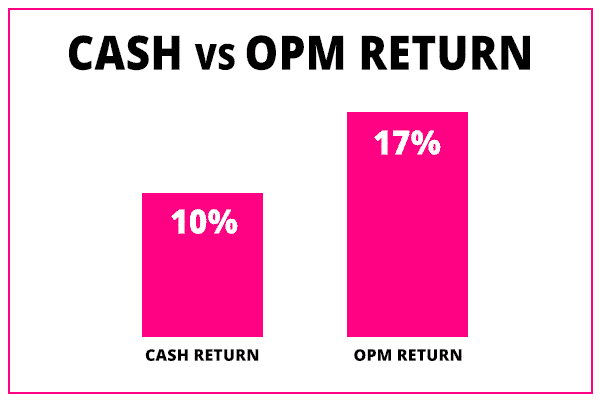
    Your neighbor made $42,500 on a $250,000 investment, corresponding to a 17% return.

    cash vs other peoples money return opm

    If both you and your neighbor began with $500,000 of cash, and he used $250,000 to buy the home next to you (with the help of a $250,000 bank mortgage) and another $250,000 to buy a home elsewhere also with a mortgage, then all else being equal at the end of the year his $500,000 would have produced $85,000 in profit after paying mortgage costs whereas by paying for your home in cash, your profits would be just $50,000.

    More>> What Property Tax Deduction Can You Claim?

    Quickly, you can see that wealth can grow faster by borrowing other people’s money at low rates and investing it at higher rates.

    In this example, your neighbor had to pay an interest rate to the bank to borrow funds to invest. But where does Buffett go to get paid to use other people’s money?

    How Does Warren Buffett Get Paid
    To Invest Other People’s Money?

    You can’t walk into a bank and ask for a loan and expect to get paid for the privilege. And neither can Warren Buffett. So, how does he get access to other people’s money?

    He revealed the answer in 1994 when he stated:

    “Had we not made this acquisition, Berkshire
    would be lucky to be worth half of what it is today.”

    The acquisition he was referring to was an insurance company, called National Indemnity Company, or NICO, which he purchased for $8.6 million in 1967.

    In the insurance business, Buffett’s Berkshire Hathaway collects premiums from policyholders. By paying out fewer claims than Berkshire collects in premium payments, Buffett’s company gets paid to use other people’s money.

    The key to success is knowing how to underwrite successfully. If insurers pays out more in claims than they collect in premiums, the opportunity to use other people’s money is zilch!

    The Risks Of Investing Other People’s Money

    When you use other people’s money to grow your wealth, it is called leverage. The upside of leverage is you can boost returns when an asset, like the home above, rises in price. But when assets fall in price, negative returns are amplified too.

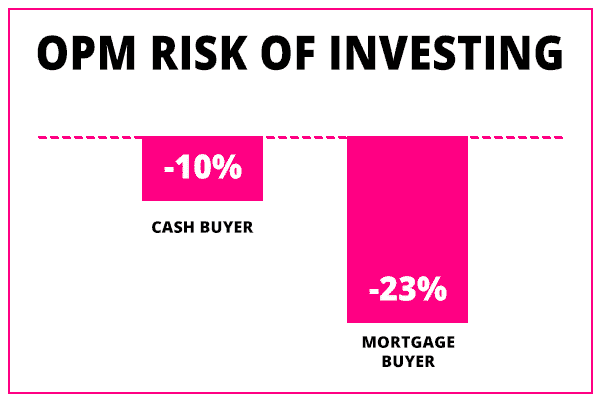
    For example, if the house had instead fallen from $500,000 in value to $450,000, then you would experience a 10% loss as a cash buyer. But how would your neighbor have fared?

    If he sells the home for $450,000, he must still pay back the bank its $250,000 plus $7,500 in interest owed.

    So, he now gets back $450,000 – $250,000 – $7,500 = $192,500.

    other peoples money risk of investing opm

    Overall, he ends up losing $57,500 of his original $250,000, corresponding to a loss of 23%.

    You can see that when investments go in the wrong direction, you can lose out not only on the asset declining in price but also on the interest owed to the bank.

    EXCESSIVE LEVERAGE

    Buffett has said in the past that the way a rich person can go poor in a hurry is by borrowing excessively.

    Said another way, borrowing too much and investing in an asset that declines in price can destroy wealth fast.

    For example, your neighbor borrowed 50% of the value of the home previously. But what if he had borrowed 90% of the value of the home?

    If he borrowed $450,000 and invested just $50,000 of his own cash to buy the home then a 10% decline in value would be catastrophic.

    A 10% decline from $500,000 to $450,000 in the value of the home would mean paying back the bank its $450,000 loan in addition to paying interest owed, and losing the full $50,000 invested.

    So, an asset only needs to fall 10% in value to wipe out 100% of your equity when you borrow 90% of the money to pay for the asset upfront.

    NO PREDICTABLE GROWTH VEHICLE

    The reason Buffett is confident in using other people’s money is because he invests conservatively and can predictably estimate what he will earn from the borrowed funds.

    He buys value stocks that have high upside potential and low risk. And his expectation is the returns over time will far exceed any costs from using other people’s money.

    If you are not sure whether a company is overvalued or undervalued, using leverage or margin to buy more than you have in cash is not wise.

    To help you understand the value of companies, financial tools are available to quickly see how much possible upside or downside in share price a company has.

    In summary, you should only consider leverage when you can confidently generate higher returns than you pay in costs on borrowed money.

    Summary Of Buffett’s
    Strategy To Get Rich

    The secret to Buffett’s success is to use other people’s money at low cost and invest those cheap funds in long term investments that most investors don’t have the patience to hold onto.

    Buffett doesn’t worry about a Fed rate hike or even whether the stock market is open.

    He encourages investors to buy companies not stocks. Focusing on a stock can distract you as you eye share price movements as opposed to a business model.

    Extra, Extra!

    Although Warren Buffett came up with a creative way to access other people’s money at low cost and invest it at higher rates of return to build enormous wealth, he advocates that most people select low fee index funds to grow their nest egg.

    If you are not sure where to begin or prefer a hands-off approach, consider a robo advisor with low fees that can manage your savings automatically.

    Once you answer some questions related to your time horizon, risk profile, and lifestyle expenditures, a robo advisor, such as Betterment, will invest your money in a diversified portfolio and optimize it for tax efficiency.

    What investment tips do you have for growing wealth? Share your money making tips with us. We would love to hear from you.

    >> View 21 Legendary Investing Quotes

    >> Find Out Why Retiring Baby Boomers Are A Big Deal

    >> Who Are The Top 5 Best Robo Advisor CEOs

  • Don’t Put All Your Eggs In One Basket

    Don’t Put All Your Eggs In One Basket

    eggs in a basket

    InvestorMint provides personal finance tools and insights to better inform your financial decisions. Our research is comprehensive, independent and well researched so you can have greater confidence in your financial choices.

    No doubt, you have heard the old saying:

    “Don’t put all your eggs in one basket”

    You know it is a high stakes game when you put all your eggs, meaning all your hard-earned savings, into a single basket, or asset class. And still the temptation to ignore the sage advice remains.

    Financial news networks blast headlines about stocks to buy now, and the urge to make a trade increases as the feeling of missing out on a money-making opportunity grows.

    But when stock markets crash, having all your eggs in one basket can lead to financial ruin. It’s one thing to get a little too greedy when the economic climate is rosy but when it is cloudy, it is best to have your eggs spread among many baskets.

    Smart Asset Allocation:
    Which Eggs Go Into Which Baskets?

    Asset allocation is the process of choosing which eggs to place into which baskets.

    But how much savings should you allocate to each category? Should you choose stocks or bonds? Commodities or money market funds?

    Depending on your risk profile, time horizon to retirement and living expenses, your allocation will favor a higher percentage of equities or bonds.

    EQUITIES ASSET CLASS

    Generally, younger investors with longer time horizons put more eggs into the equities basket while retirees seeking income over growth favor a higher percentage of bonds and money market funds.

    A rule of thumb is to have at least a 50:50 split of bonds and stocks when approaching retirement. You want to avoid a situation where you are heavily invested in equities and retiring just when the market has peaked and may be on the verge of a big fall.

    As tempting as it may be to find the next Facebook or Twitter, keeping some powder dry  by allocating to income-generating investments, such as bonds, is prudent.

    Within the equities basket, consider diversifying your stock holdings by purchasing the best index funds rather than holding a concentrated portfolio of just a handful of stocks.

    The odd gamble from time to time with a small amount of disposable money may not break the bank, but it would certainly be a mistake as a long term strategy.

    If you are tempted to trade a concentrated portfolio of fewer stocks, explore ways to generate income from covered calls and limit risk by applying married put options strategies.

    >> Related: Find Out How To Invest In The Market For Beginners

    BONDS ASSET CLASS

    When you buy stocks, your portfolio will rise and fall based on the combined performance of the stocks you hold, which in turn is related to the profitability of the companies in your portfolio.

    Bonds are an attractive way to generate a predictable income because they pay a predictable yield at regular intervals. For retirees depending on a fixed income to pay the bills day-to-day, this feature makes bonds more attractive than stocks.

    Within the bonds asset class, you can select among three categories:

    Government bonds are widely believed to be the safest asset class because the likelihood of the U.S. government defaulting on its debt is perceived to be low.

    Still, bond investing is not without risks. Some countries have defaulted on their debt – Argentina is the poster child for frequent sovereign debt defaults.

    Municipal bonds are the next least risky bet and are attractive because interest earned on munis are often exempt from state taxes when you live in the state that issues them.

    Municipals are not without some risk either so, before diving in, make sure the state’s finances are in good shape and no pension crisis is looming as has been the case with states like Illinois.

    It is best to diversify your bond holdings also by spreading risk among government, municipal and corporate bonds.

    You can often find corporate bonds paying reasonable yields that have low default risk, like those issued by solid companies such as Apple.

    >> Investing Tip: How Does A Fed Rate Hike Affect Your Bond Investments?

    CASH ASSET CLASS

    Money market funds fall under the umbrella of the Cash asset class. Along with savings accounts and certificates of deposit, these are among the most conservative places to store your money, but equally they tend to pay the lowest yields.

    Cash is useful to have on hand when you need to put a downpayment on a home or you need to pay for life events, such as weddings, as well as college tuition costs and so on. But keeping all your eggs in a cash basket won’t do you favors over the long-term to grow your wealth.

    The rate of interest you can earn is so low that inflation often exceeds your savings rate, meaning your purchasing power diminishes over time.

    Just think back to the cost of a bag of chips from your childhood and compare its cost today. Inflation creeps up slowly but steadily and is a powerful force that impacts nominal wealth.

    The rule of thumb is that every 20 years or so, purchasing power is cut in half. So, the dollars you need to live a good life now will need to double to enjoy a similar lifestyle then.

    >> Related: Retirement Planning For Dummies

    COMMODITIES ASSET CLASS

    Commodities are well known as a volatile asset class, so they generally form only a small portion of most investors’ portfolios. Historically, the price of oil, gold, precious metals and other commodities have been known to soar and plummet quickly as the winds of economic fortune change direction.

    How Should You Allocate
    Savings Across Asset Classes?

    The first step in figuring out how to allocate your savings to various asset classes is to calculate how much you need to save.

    Once you have an idea of how much you need to save each month to reach retirement, you can start to think about how to invest your savings across asset classes. Which eggs should you put in which baskets? And how many eggs should go into each basket?

    HANDS OFF INVESTING

    The simplest way of allocating your money is to sign up with a robo advisor who will ask you some questions relating to your age, risk tolerance, financial goals, and lifestyle expenditures.

    Leading robo advisors, such as Betterment and Wealthfront, automatically invest your money across various asset classes in alignment with your risk and reward objectives. You don’t have to lift a finger.

    They automatically perform tax loss harvesting on your portfolio to minimize the tax impact from capital gains. And many have financial tools and calculators to help you reach retirement comfortably.

    >> Find Low Fee Robo Advisors

    HANDS ON INVESTING

    If you choose to take charge of your own investing in a brokerage account or retirement account, the first step will be to set a time horizon.

    When do you realistically believe retirement is possible?

    Does retirement mean owning a nice home, having a family, and living off of a sizeable nest-egg? If you don’t yet own a home, take a candid look at how long it will take to buy one.

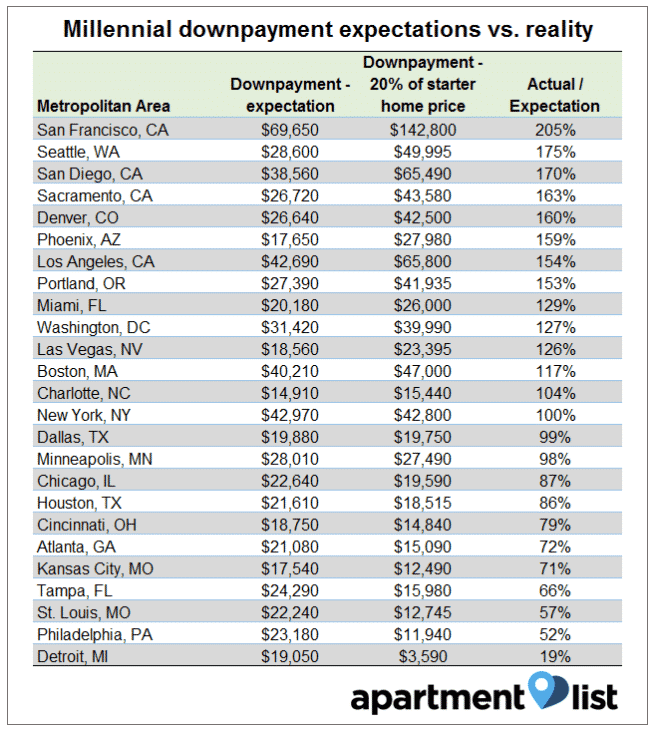
    A study by ApartmentList showed how expectations and reality are starkly different among Millennials with respect to how much savings are needed to buy a home.

    millennial downpayment expectations vs reality

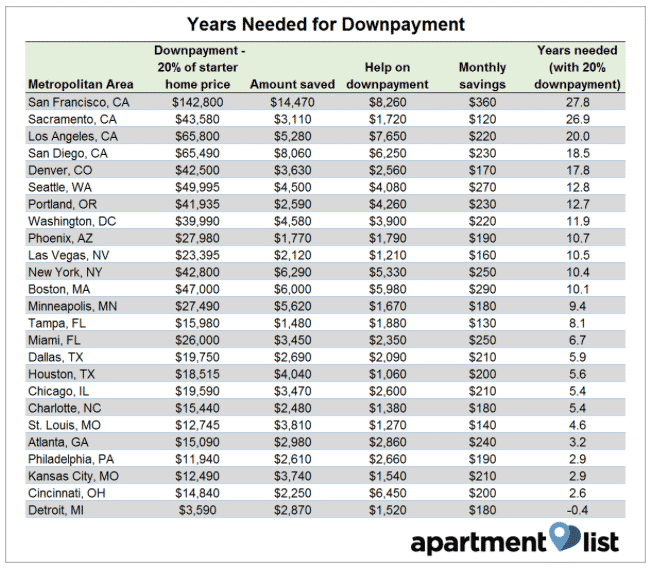
    When you take an honest look at the numbers, the length of time needed to save for a new home is often longer than expected.

    Many millennials will need more than a decade to save the 20% needed for a home downpayment.

    years needed for downpayment

    If you already own a home, and are supporting a family, squirreling away a monthly amount for retirement is crucial to realizing your financial goals.

    If you have time on your side, you can ride out the market swings and can look to a higher percentage of equities.

    If you’re in your early twenties, thirties, forties, fifties or beyond how much should you invest in equities?

    This simple formula is just a rule of thumb but it’s a helpful one.

    100 – Your Age = How Much To Invest In Equities

    The balance you should invest in bonds.

    So if you are 25, then an allocation of 75% equities and 25% bonds would be appropriate.

    A 65 year old retiree should look to a balance of 35% equities and 65% bonds.

    More aggressive investors may prefer to use a modified version of the formula, so that:

    110 – Your Age = How Much To Invest In Equities

    A 35 year old would then invest 75% in equities and 25% in bonds.

    With your equity and bond percentage allocation selected, you might be wondering how much to allocate to cash.

    A good rule of thumb is to have at least six months of cash on hand. So, if your monthly expenses are $4,000 then you probably want around $50,000 on hand to dip into in case of emergency.

    How have you spread your money across asset classes? Are you on track to hit your retirement goals? Share your investing experiences with us, we would love to hear from you in the comments below.

    >> Find Out Why Retiring Baby Boomers Are A Big Deal

    >> Discover How To Pick The Best Robo Advisor

    >> Who Are The Top 5 Best Robo Advisor CEOs

  • What Is A Living Trust?

    What Is A Living Trust?

    what is a living trust

    A living trust, also known as a revocable trust, is a legal document that facilitates the smooth transition of your assets to your beneficiaries upon death or mental incapacitation.

    Along with a will, a living trust forms part of a smart estate planning strategy to sidestep the legal hassles and costs that could otherwise be suffered.

    When you care about your privacy, incapacitation, or want to avoid probate, a living trust can help you to achieve your estate planning goals but it does not allow you to reduce your estate taxes and is not a substitute for a will.

    Do I Need A Living Trust?

    A living trust is valuable when you want to avoid probate, maintain privacy, or are likely to be incapacitated. It is not a useful tool to lower estate taxes.

    Whether you need a living trust depends on your financial situation and estate planning goals. In certain circumstances, a living trust can save you time and avoid legal hassles that would otherwise crop up.

    AVOID PROBATE WITH A LIVING TRUST

    If you own property, a living trust can be especially valuable to avoid probate court hassles.

    You can deed your property into your living trust. And because the living trust is revocable, you still have full control over the property assets.

    nolo quicken willmaker plus 2018Without a living trust, property that you own is generally subject to a legal process called probate upon your death.

    During probate, the executor of your will is instructed by a court to divide your estate among your beneficiaries per your wishes after you will has been authenticated.

    Without a will, the probate court divides your property among your beneficiaries as the court sees fit.

    If you are in the fortunate position of owning property in more than one state, a living trust is even more valuable. Without the living trust, property held in your personal estate is subject to probate in multiple states.

    The legal costs, time and hassle of probate can be avoided by setting up a living trust and deeding your property into it.

    CREATE A LIVING TRUST TO MAINTAIN PRIVACY

    To avoid snooping neighbors or relatives from seeing what personal assets you are transferring to your beneficiaries, consider setting up a living trust.

    Because a living trust makes it possible to sidestep the probate process, your assets can transfer to your beneficiaries privately; the probate process is public so, without a living trust, asset transfers are open to public scrutiny.

    Keep in mind, however, that a will is part of the public record. A living trust is not a substitute for a will, but rather the two legal documents are complementary.

    SET UP A LIVING TRUST WHEN INCAPACITY IS EXPECTED

    Some health conditions lead to a slow deterioration of mental capacity that can be anticipated over time.

    If a parent is suffering from the onset of dementia for example, a living trust can form part of an estate planning process that allows for a smoother transition of assets upon death or when legally incapacitated.

    The living trust cannot be set up when a person is already mentally incapacitated, so the person must be in compis mentis (in full control of their mind) at the time of signing.

    The way it works is that you retitle assets you own into the name of the trust. While you are alive, you act as the (co-)trustee and a successor trustee becomes responsible upon death or when deemed legally incapacitated.

    CREATE A LIVING TRUST IF YOU EXPECT YOUR ASSETS TO BE CONTESTED

    When you expect someone might contest your assets, you should strongly consider setting up a living trust.

    A living trust holds up better than a will when the distribution of assets to beneficiaries is contested.

    How To Set Up A Living Trust

    A living trust must not only be written but funded. Your living trust is not established by simply creating a legal document. You must also fund the trust by transferring assets to the trust.

    nolo living trustA living trust is a more complex legal document than a will. It is not sufficient to simply draft a living trust. You must “fund” the trust by transferring assets, including:

    • Bank accounts
    • Brokerage accounts
    • Any stocks, bonds, mutual funds, index funds, and certificates of deposit
    • Personal property
    • Retirement accounts, such as 401(k), IRA and Roth IRA accounts

    You may also need to transfer the beneficiary name to the trust on any life insurance policies.

    If you acquire any assets after setting up your living trust, and want to ensure they are automatically transferred to the trust also, you can set up a “pour-over will” that covers any assets which might otherwise have been inadvertently excluded.

    Is A Living Trust Right For You?

    Younger individuals and couples with no children and few assets may not necessarily benefit from a living trust.

    As a general rule of thumb, if you fall into any of the following categories, you probably do not need a living trust:

    • Young married couples with no children
    • Young married couples or individuals with few assets

    Living trusts are somewhat costly to set up and it takes a considerable amount of time to establish, maintain and modify them.

    If you are young and have acquired a high net worth, or you own a successful business, you may want to set up a living trust earlier than most in order to provide for the smooth transfer of your assets, even if the chances of dying anytime soon are slim.

    Does A Living Trust Lower Taxes?

    If your estate value is greater than the Federal threshold, you will be obligated to pay estate taxes to Uncle Sam. You should look at your state estate tax threshold to see whether state taxes need to be paid also.

    Tax savings are generally possible when you set up an irrevocable trust or bypass trust (though you should consult a tax attorney to explore your individual financial situation).

    nolo executors guideBecause a living trust is a revocable trust, the assets of the trust remain in your estate and so it is not an efficient legal means of reducing your estate’s tax burden.

    Federal taxes of 40% are applied to estates worth over $5,490,000 in 2017, otherwise a tax exemption applies. When you examine how much the top 1% make, you can see that few Americans fall into this category of wealth so most people enjoy a tax exemption.

    Estate and inheritance taxes in certain states often have lower thresholds, so if reducing estate taxes is your top priority then it is best to consult with a tax attorney in your state.

    Do I Need A Will
    If I Have A Living Trust?

    A living trust is complementary to a will not a substitute for it. To ensure none of your assets are inadvertently excluded, a will or a pour-over will is an important part of estate planning.

    A living trust is no substitute for a will. Instead, the two are complementary and serve different purposes.

    Think of a will as an all-encompassing expression of your wishes and a living trust as a more specific legal document that covers certain assets.

    If you happen to inadvertently exclude a specific asset from your living trust, your will can act as a catch-all to ensure your wishes are fulfilled.

    What retirement planning tips do you have that you can share? We would love to hear your retirement plans in the comments below.

    >> How To Make A Will?

    >> Your Retirement Planning For Dummies Guide

    >> How Much Does The Top 1% Make?

  • Diversify Your Portfolio Investing In Bonds

    Diversify Your Portfolio Investing In Bonds

    abraham lincoln memorial

    InvestorMint provides personal finance tools and insights to better inform your financial decisions. Our research is comprehensive, independent and well researched so you can have greater confidence in your financial choices.

    When you invest with a traditional financial advisor or a robo advisor, your money will generally be allocated to a combination of stocks and bonds to form a balanced portfolio.

    The division of stocks versus bonds depends on all sorts of factors including your time horizon to retirement, how much you spend, your risk profile and so on. The younger you are and the more money you have, the higher your allocation to bonds generally.

    The idea behind putting more of your nest egg into bonds than stocks as you close in on retirement is that bonds are regarded as a safer investment than stocks.

    But bond investing is not without risks and you should know what you are buying before investing your hard earned savings.

    How Bond Investing Works

    For most of your life, you have probably been on the side of the fence where you borrow money to pay for a car, a home, or perhaps your tuition expenses. With each loan you may have taken out, you committed to a repayment period at a certain interest rate, whether variable or fixed.

    When you buy bonds, you are on the other side of the fence. Instead of paying back interest to a lender, you now become the lender and earn interest. It is the responsibility of the borrower to fulfill their obligations to you over a specific time period and pay your principal back at an agreed upon interest rate.

    When you step into the shoes of the lender, your mindset flips from wanting the interest rate to be as low as possible to wanting it to be as high as possible while keeping the risk low. So, you want your borrower to be creditworthy and the risk of default to be minimal.

    If you were to think about the safest borrower to whom you could lend, the U.S. government would probably come top of your list. U.S. government debt is considered to be as safe as it gets.

    The ranking of the safest bonds in order are generally regarded to be as follows:

    1. Government bonds
    2. Municipal bonds
    3. Corporate bonds

    GOVERNMENT BONDS

    Government bonds fall into three categories:

    Bond Type Maturity
    Short-term Treasury Bills Up to 1 Year
    Intermediate-term Treasury Notes 2-10 Years
    Long-term Treasury Bonds 10+ Years

    When your goal is to save for the short-term, Treasury bills may be appropriate but the interest earned on them is generally low. For example, if you needed to park money that you had slated for the down payment of a home into an interest-earning account for a short time period before completing escrow, Treasury bills may be a good option.

    If you have a longer term time horizon, Treasury notes and bonds with longer maturities may be a better fit for your portfolio, and will pay a higher yield.

    MUNICIPAL BONDS

    Municipal bonds are issued by city and state governments. If you live in a state that issues bonds, interest payments earned are often exempt from state taxes.

    These bonds are used to finance city and state project spending, such as the construction of schools, roads, dams, and bridges.

    CORPORATE BONDS

    Corporate bonds generally pay the highest yields but also have higher risk than government bonds and munis.

    There are exceptions to the rule from time to time. Very large companies, such as Apple, with large amounts of cash reserves and highly successful business models can often issue debt at very low interest rates because the likelihood that they will default is low.

    In rare cases, corporate bond yields can be so low that the interest payments owed by sovereign nations are higher!

    >> More: View Stocks To Buy Now

    PRIMARY RISKS OF BOND INVESTING

    Default Risk: The primary risk when investing in bonds is default risk. When the borrower fails to meet or honor its obligations to pay back the principal it received when the bond was issued plus interest payments, the lender risks not receiving their loaned money and interest due.

    Interest Rate Risk: When interest rates rise, bond prices fall. The reason for the decline is that new bonds issued on the market pay higher interest rates so the old bonds are less attractive to bond investors.

    Rising interest rates are bad when you own bonds because their prices fall, but falling interest rates have their own drawbacks. If you own a bond paying a high interest rate and the Federal Reserve lowers interest rates then when the bond comes to maturity, you will be unable to earn the same high interest rate you had been enjoying because market yields for equivalent bonds are lower.

    For this reason, when interest rates are very high as they were in the 1980s, locking in a high long-term government bond interest payment is a smart investment strategy. Imagine locking in a 15% yield for 30 years – guaranteed by the full faith and credit of the U.S. government!

    Be Wary Of High Yield Bonds

    The risks of bond investing are not confined to default risk and interest rate risk. Sometimes, the most attractive bond on the surface is the one to shy away from. Novice bond investors often swoon when they come across a high yield bond that pays a high interest rate.

    But these bonds often have high yields for a reason – and it’s not usually a good one! Remember higher interest payments reflect higher risk. So, when yields are high, it means that risks to investors are commensurately high.

    If in doubt, look to the ratings assigned to bonds by major ratings agencies, such as Moody’s or Standard and Poor’s.

    Bonds rated by Standard and Poor’s above BBB or those rated by Moody’s above Baa are generally regarded as appropriate for consideration by casual investors.

    There are no guarantees however that ratings agencies will hit the nail on the head when it comes to evaluating bonds properly. During the 2007-09 stock market crash, securitized loans were notoriously difficult to analyze and even major ratings agencies found it difficult to properly ascertain creditworthiness and default risk of bond issuers.

    So, the takeaway is: if in doubt, steer clear. Better to stick with a lower yield bond than a high yield bond that keeps you awake at night.

    >> More: Retirement Planning For Dummies

    How To Buy Bonds In
    A Retirement Portfolio

    When you buy stocks and bonds, you don’t need to pour over research reports to pick the very best ones. Exchange-traded funds and index funds offer a way for stock and bond investors to diversify risk across stock and bond holdings.

    If you work for an employer who has a 401(k) plan set up, you will be restricted in the choices of funds available. The bond funds made available to you will generally include a diverse group of bonds of varying maturities.

    If you are curious how bond funds in your retirement accounts stack up, Blooom offers you an easy way to evaluate your 401(k) holdings and even offers to manage your allocation automatically so it is optimized.

    BLOOOM SPOTLIGHT
    blooom logo

    InvestorMint Rating

    4 out of 5 stars

    • Management Fee: $95 – $250
    • Account Minimum: $0

    via Blooom secure site

    HIGH INTEREST RATE ENVIRONMENTS

    If you are selecting bond investments by yourself in a brokerage or IRA account when interest rates are high, purchasing longer maturity bonds is a smart move. You get to lock in a high yield for a long duration even if interest rates decline.

    LOW INTEREST RATE ENVIRONMENTS

    Conversely, when interest rates are low, it is better to choose short-term and intermediate-term bonds because rising interest rates will cause bond prices to fall, which could hurt your portfolio value.

    Regardless of the maturity of the bond you purchase, you don’t need to hold it all the way through to maturity. So, if interest rates are low but you expect them to rise, you can exit your bond position on the secondary market and find another bond paying a higher yield when rates rise.

    If you are buying individual bonds but new to the market, err on the side of caution. You may wish to consider government Treasury bills and notes before buying municipal bonds unless you are confident your city and state are not in financial distress as Illinois has been with its pension crisis.

    What Taxes Do Bond Investors Pay?

    When it comes to investing, what matters most is not your gross portfolio return but your after-tax return – the amount you actually get to keep after paying Uncle Sam.

    Smart bond investing allocates tax-efficient bonds to taxable accounts and tax-inefficient bonds to tax-deferred accounts.

    The golden rule for new bond investors is: do not buy municipal bonds in a tax-deferred account, such as IRA or 401(k). Tax-deferred accounts are by definition not taxed, so there is no reason to buy munis, which are generally exempt from state tax if you live in the state.

    Conversely, tax-inefficient bonds are bonds that require you to pay taxes on interest earned. Corporate bonds fall into this category and so, to maximize your after-tax returns, it is best to buy these bonds in a tax-deferred account, such as an IRA.

    Bond Type Tax Status Best Account
    Municipal Bonds Tax-efficient Taxable
    Corporate Bonds Tax-inefficient Tax-deferred

    High net worth individuals may also favor municipal bonds because of their tax-exempt status.

    >> More: Retirement Planning For Dummies

    Your Bond Investing Takeaway

    When you buy bonds, examine the key factors that can affect your returns:

    • Taxes
    • Interest rates
    • Creditworthiness
    • Maturities

    As you get closer to retirement, a higher portion of your portfolio should generally be allocated to bonds over stocks.

    The combination of equities and bonds forms a balanced portfolio that reduces the volatility of holding equities alone so you can sleep more peacefully at night without worrying so much about the effects of a stock market crash on your portfolio.

    What bonds have you found to be good investments? Share your investment experiences in the comments below, we love hearing from you.

    >> Read The 7 Deadly Causes Of The Illinois Pension Crisis

    >> What Are The Best Index Funds?

    >> Discover Ways To Make Money Trading Options

  • How Does A Fed Rate Hike Affect You?

    How Does A Fed Rate Hike Affect You?

    federal reserve bank of cleveland

    InvestorMint provides personal finance tools and insights to better inform your financial decisions. Our research is comprehensive, independent and well researched so you can have greater confidence in your financial choices.

    When you borrow money to buy a home, a car, or to pay for tuition expenses, your monthly repayment amount may be affected when interest rates go up.

    Even if you have no loans but simply own a portfolio of stocks and bonds, interest rate hikes can affect your net worth.

    And if you have banks savings accounts or certificates of deposit, rate hikes may positively affect the interest you earn monthly.

    What Is A Fed Rate Hike?

    When interest rates rise or fall, it is the Federal Reserve, the central bank of the U.S., that controls their level.

    The idea behind the Federal Reserve System when it was established in 1913 was to create central control of the monetary system in order to avoid future crises following the panic of 1907.

    When the economy is weak, the Fed will lower rates and when the economy is strong, the Fed hikes rates to slow it down.

    When interest rates are low, companies borrow more because they believe they can generate higher returns on capital from investing borrowed money in their businesses than they pay in interest costs.

    Low interest rates generally stimulate individuals to borrow more too, which results in spikes in purchases of homes, autos, and other consumer goods.

    The investment by companies and spending by consumers when interest rates are low stimulates economic growth and expansion, which the Federal Reserve board of governors monitors carefully.

    If the economy is perceived to be overheating, the Fed will look to cool it down by increasing borrowing costs through a Fed rate hike, which increases the federal funds rate – the interest rate that banks and credit unions lend reserve balances to each other overnight.

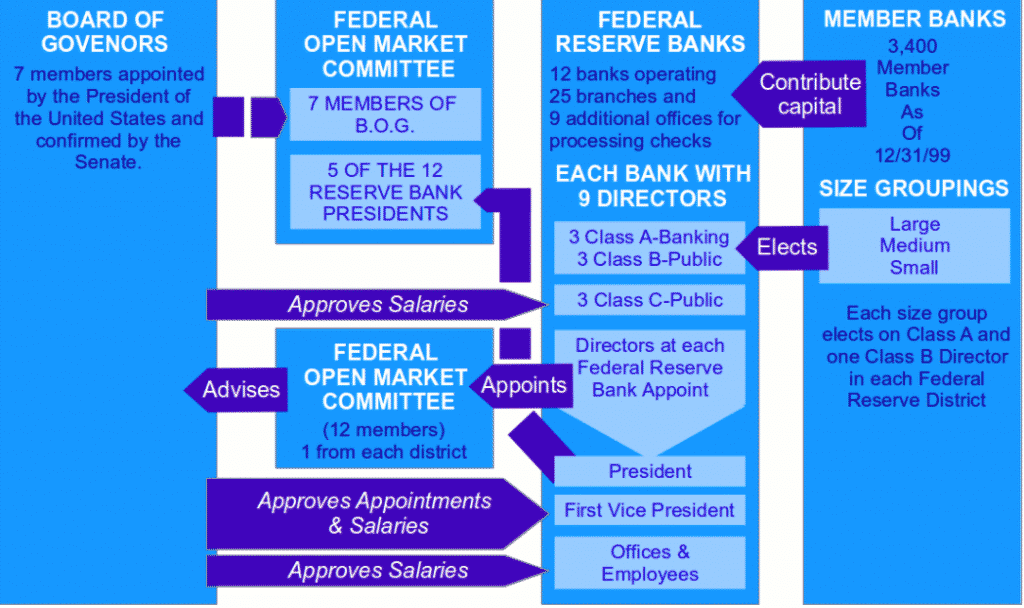
    organization of the federal reserve system

    Source: Board of Governors of The Federal Reserve System

    >> Related: How To Invest In The Stock Market For Beginners

    How Does A Fed Rate Hike
    Affect Your Portfolio?

    The general consensus is that rising interest rates are bad for your portfolio. A common stock market saying is:

    “Don’t fight the Fed”

    It is widely believed that this means when a Fed rate hike occurs, it is best to adopt a cautious economic outlook because the Fed is trying to slow the economy down.

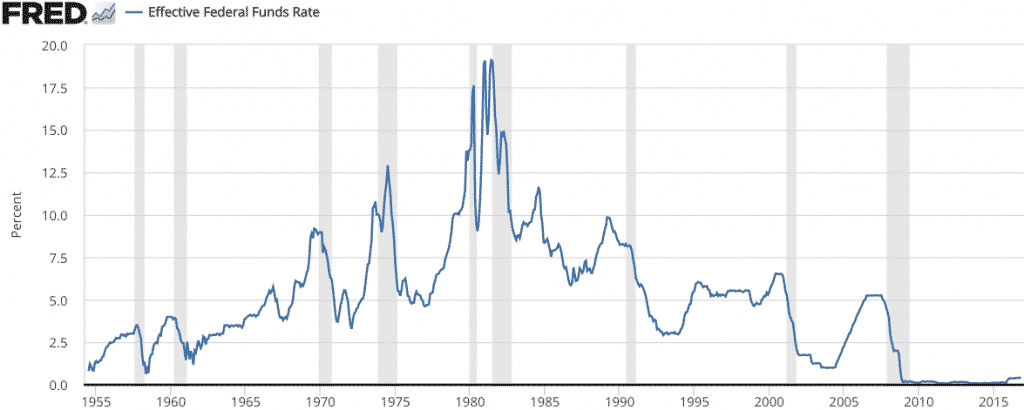
    Federal Funds Rate History and Recessions

    Federal Funds Rate History and Recessions

    Source: St. Louis Fed

    The general rule of thumb is that the stock market rises when interest rates fall and the stock market falls when interest rates rise.

    But research studies have shown that many exceptions to this rule have occurred over the course of history. Sometimes, the stock market has fallen when interest rates have fallen and sometimes the stock market has risen when interest rates have risen.

    In the short-term, the generally accepted belief that rising interest rates is bad for the stock market often causes jitters. But over the intermediate term, different sectors react differently.

    For example, foreign stocks will react not only to interest rate hikes but also to currency exchange rate swings. Dividend paying stocks may react differently to small cap stocks, and blue chips may react differently to index funds.

    >> View Stocks To Buy Now

    Should I Change My Asset Allocation After A Fed Rate Hike?

    History is filled with examples of the market moving in one direction short-term only to reverse the opposite way in the intermediate term, so it is generally wise not to react impulsively to any immediate stock market movements after a Fed rate hike.

    Keep Focused On The Long Term

    Stock market volatility can trigger investors to react irrationally short-term. Fear of loss causes many investors to panic and sell their holdings when staying the course and holding for the long-term has historically may be a more profitable path.

    To highlight the power of a buy-and-hold strategy, think about two portfolios that are growing at 15% annually for 60 years. Both portfolios are subject to taxation of 30% for short-term gains and 20% for long-term capital gains.

    At the end of the 60 year period, a buy-and-hold investor who doesn’t sell along the way makes over 6x more than an investor who sells every year to “bank” the 15% annual gains.

    That 6x differential may not sound like a big difference until you perform the calculations and discover that the investor selling annually to lock in gains turns $1,000 into $615,757 whereas the buy-and-hold investor, who only sells at the end of the 60 year period, turns the same $1,000 into $3,812,172.

    Take Advantage When The Stock Market Is Cheap

    If you have a longer time horizon, and stock market volatility is not a concern, a stock market crash could be an opportunity to buy stocks at a discount.

    As billionaire investor Warren Buffett has said in the past, if you were to walk into a department store and see Sale signs posted, you would view them positively as an opportunity to buy goods for less.

    When the stock market goes “on sale”, investors tend to react oppositely and often panic. But a patient investor with a long time horizon can use the opportunity to buy value stocks at even better prices for even greater long term gains.

    Change Bonds Vs Equities vs Cash Allocation

    The “sleep test” is an anecdotal personal benchmark you can use if you are concerned about stock market volatility.

    If you are finding it hard to sleep peacefully because you are concerned about losing value in your retirement accounts, such as 401(k)s or Roth IRAs, then switching your allocation up to favor more bonds is a way to reduce your overall portfolio’s fluctuations.

    Bonds generally decline in price when interest rates rise but bonds are generally regarded as a less volatile asset class than equities, so even if bond prices decline the amount may be less than the amount equities fall by.

    If you need the money to pay for living expenses in the next 5-10 years, and the swings in bond prices also feel scary, then allocating to cash is not a bad idea. The returns will be lower than equities or bonds, but so too will the risks be lower.

    >> What Are The Best Stocks To Buy?

    How Does A Fed Rate Hike Affect My Mortgage?

    FIXED RATE MORTGAGE

    If you have a fixed rate mortgage, you don’t have to worry about a Fed rate hike because your mortgage payment and rate won’t change.

    VARIABLE RATE MORTGAGE

    A nice feature of variable rate mortgages is that the interest rate initially offered to home buyers is lower than it is for fixed rate mortgages, but the downside is when interest rates rise, monthly payments goes up and could exceed the original fixed rate level offered.

    It may not seem like something to be concerned about if the interest you were charged increases by 1% from say 4% to 5%, but that corresponds to a 25% increase!

    Variable rate mortgage holders often enjoy teaser rates for fixed periods of time, but when they expire, the new payment can come as a shock – especially if interest rates have increased in the intervening period.

    If you expect rates to increase and you have a variable rate mortgage, consider switching to a fixed rate mortgage.

    HOME EQUITY LINE OF CREDIT

    Any increases in short-term interest rates are passed on directly to borrowers who have home equity lines of credit.

    Like variable rate mortgage holders, home equity lines of credit borrowers should evaluate the costs and benefits of converting mortgage balances to fixed rate home equity loans when Fed rate hikes are expected.

    >> How Much Does The Top 1% Make?

    How Does A Fed Rate Hike Affect My Bank Savings Accounts?

    When a Fed rate hike occurs, bank savings accounts and certificates of deposit generally pay more interest.

    Unlike a home equity line of credit which is affected right away by a Fed rate hike, a savings account doesn’t necessarily pay out more to depositors when interest rates rise.

    Banks will happily charge you higher rates right away when you borrow from them but they won’t pay you right away when you deposit savings with them.

    Eventually marketplace competition forces banks to pay depositors more when rivals increase rates on depositor savings accounts, but don’t hold your breath waiting for bigger monthly payouts.

    If you have squirreled away some of your nest-egg in certificates of deposit (CDs), you will have a similar experience as to the one you have in your savings account – rates will generally rise over time but not by a lot.

    >> Money Tip: Online banks with lower fixed costs generally pay higher CD rates than brick-and-mortar banks do.

    How Does A Fed Rate Hike Affect My Credit Card Payments?

    Credit card rates will almost certainly increase when a Fed rate hike takes place. The Fed controls the prime rate, which is the benchmark rate that credit card issuers use to set their rates.

    Credit card companies will inform you when your credit card APR is due to increase, and typically provide you with about 6 weeks notice.

    >> Watch out: Credit card debt can increase quickly because of the power of compounding interest, so where possible try to lower it by switching to a 0% interest credit card.

    The business of charging interest on credit card debt is so lucrative that billionaire investors, such as Warren Buffett, hold shares in established credit card companies, including American Express.


    As shareholders of credit card companies, they benefit from consumer repayments of credit card debt, and you can too.

    If you own shares of companies like Visa or Mastercard in your investment portfolio, you get to stake a claim of ownership that enables you to benefit – as opposed to suffer from – interest rate hikes passed on to consumers.

    While credit card companies are directly affected by rising interest rates, other companies, such as Facebook and Twitter, may only be indirectly affected.

    If you are worried about holding shares in a company when a Fed rate hike is expected, you can look to protect your downside risk by hedging your portfolio with a married put options strategy.

    Options trading platforms, such as TastyWorks and thinkorswim, make it easy to execute orders to buy married puts that protect stock you own. Plus, if you expect share prices will decline much further, you can even look to short stock.

    Have you made any changes to your savings, investment or credit card accounts when interest rates changed? Share your financial tips with us below. We would love to hear from you.

    >> How To Rollover A 401(k) To An IRA

    >> How To Diversify Intelligently

    >> How To Invest Money Wisely

  • How To Trade An Options Straddle

    How To Trade An Options Straddle

    how to trade options straddle

    InvestorMint provides personal finance tools and insights to better inform your financial decisions. Our research is comprehensive, independent and well researched so you can have greater confidence in your financial choices.

    If you ever had the sinking feeling of betting the market would go up only to see it fall soon after you place your trade then the straddle options strategy might be what you need.

    A straddle is designed to make money no matter which way the market moves. If it rises, you can earn a profit. And if it falls, you can make money too.

    The key to making money with the options straddle is for the security you are betting on to move by a big amount in a small time frame.

    When volatility does occur, the options straddle can be highly lucrative. But if the underlying security you place a straddle on doesn’t move much, your options position can fall underwater.

    How To Capitalize On Volatility:
    The Options Straddle

    Many casual investors make money when markets rise by passively investing in index funds over the long term.

    But how do you trade when you know a company is reporting earnings soon and you expect the share price could be volatile?

    How do you profit when a pharmaceutical company is due announce whether a new blockbuster drug has been approved or denied by the FDA?

    Are there ways to make money when you expect significant share price movement in a stock based on a new product release, a change in management or some other fundamental reason?

    Markets move up and down so why limit yourself to making money only when stocks rise?

    While some options trading strategies, such as the covered call, make money regularly for shareholders, others limit risk, such as the married put. But the options straddle is different because it can make money whether share prices rise or fall.

    The secret to making money with the straddle is for the share price to rise or fall by a large amount. If it doesn’t, the straddle can lose money in a hurry.

    >> Related: How To Trade Options

    Options Straddle Basics

    When you place a straddle, you will be buying both call and put options.

    Buying call options is a bullish strategy, betting on share prices rising. While buying put options is a bearish bet that prices will fall.

    Type Buy Sell
    Call Bullish Bearish
    Put Bearish Bullish

    By purchasing both call and put options, you can make money when the underlying share price rises or falls.

    Seems like an easy way to make money? After all, share prices go up or down, so it seems like you can make money no matter which way they go?

    Well, not so fast.

    It is true that you can make money if the stock price rises or falls, but a better way to think about this options strategy is that the stock price needs to soar or plummet.

    To profit from an options straddle, volatility is needed. It is generally not sufficient for the share price of the stock you place the straddle on to meander higher or lower. It needs to move higher with some gusto or collapse lower in a hurry.

    The reason sharp price movement needs to happen fast is that looming up ahead is expiration, the date when the call and put options cease trading.

    And each day the options lose a little bit of value due to time-decay (which you can learn more about in this options trading basics article).

    When you sell options, you can make money from this slow decay in options value due to time decay. But when you buy options, time decay becomes your enemy as it erodes value a little every day until options expiration.

    How To Buy An Options Straddle

    The way to structure an options straddle is to buy both call and put options at the same strike price for the same expiration month.

    Imagine a stock was trading at $100 per share, you would buy the strike 100 call and strike 100 put options for the same expiration month.

    When you buy both call and put options to form a straddle, the options strategy is called a long straddle.

    (It is possible to sell both call and put options at the same strike price for the same expiration month to create a short straddle. The risk in a short straddle is high so we won’t explore it further).

    The cost of the long straddle is the risk in the trade. It is the most you can lose, no matter which way the underlying stock moves.

    So, if you paid $3 for the call option and $3 for the put option, the most you could lose is $6 per share.

    Options are traded in contracts so if you purchase 1 call contract and 1 put contract whereby a contract corresponds to 100 shares, then the total cost would be $300 to buy the call and $300 to buy the put, for a total cost of $600.

    When you place the trade, you will pay commissions so the total cost would be $600 plus commissions costs.

    At most brokers, you will also need to pay commissions when you exit the trade, or sell the call and put options. But as competition has increased among brokers, so too have commissions costs declined. And these days, you can close out long options without paying a dime in commissions costs at TastyWorks.

    tastytrade SPOTLIGHT
    tastytrade (previously known as tastyworks)

    Investormint Rating

    4.5 out of 5 stars

    • Commissions: Closing trades for Stocks & ETFs and Options are commission-free
    • Account Balance Minimum: $0
    • Commissions: $0 flat rate for stocks

    via tastytrade secure site

    What Is The Risk and Reward
    Trading Options Straddles?

    OPTIONS STRADDLE RISK

    The cost of buying a straddle is also equal to the risk, or the most you can lose.

    Cost Basis = Purchase Price of Call Option + Purchase Price of Put Option

    Cost Basis = $3 + $3 = $6 = Maximum Risk

    But what are the conditions that can lead to a trading loss when you own a long straddle?

    The short answer is when volatility doesn’t materialize, you can end up underwater in a hurry trading options straddles.

    Both call and put options will have no value if the stock stays at $100 through to the expiration date.

    So you would end up losing $3 on the call option and $3 on the put option for a maximum loss of $6.

    This is the worst case scenario.

    If the stock ended up at $101 on the expiration date, the call would have $1 of value so it would show a $2 loss, and the put would lose all $3.

    Similarly, if the stock declined to $98 by expiration, the put would have $2 of value while the call would expire worthless.

    OPTIONS STRADDLE PROFIT

    You can quickly see that no matter which way the stock moves, one of the options will be worth zero at expiration – guaranteed!

    As a result, the share price must move a lot either up or down for the straddle to profit.

    In this example, you paid $6 to buy the straddle so you need the stock to move $6 above the call strike price of $100 or $6 below the put strike price of $100 in order to end up at breakeven.

    Any share price movement greater than $6 will result in a profit.

    A $6 share price movement corresponds to a 6% movement in the share price of the $100 stock.

    It is common for stocks to move by 6% over the course of a few months or a year but it is not an insignificant movement. And remember, the share price must move by at least 6% to begin profiting.

    Once the share price moves by more than 6%, each additional $1 is gravy when it comes to making money.

    If the share price rose to $115, the call would be worth $15 at expiration, so the profit would be $15 minus the cost of the straddle, $6, which is $9 per share.

    Buying 1 call option and 1 put option for $600 would then lead to a $1,500 payout, and $900 of profit – a 150% return!

    It is these high percentage payouts that make straddles so alluring to options traders.

    The higher the stock goes, the more money you can make – with theoretically no limits.

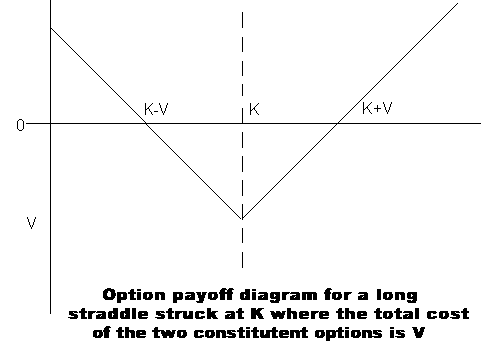
    You can see visually how the straddle performs in this risk graph.

    options trading long straddle

    Image Credit: Wikipedia

    If the stock were to fall, a limit does exist to your profit potential because the stock cannot fall below zero. Still, you can make money on the put option with each dollar the share price declines all the way to zero.

    When Should You Trade
    A Long Straddle?

    A long straddle is inherently a speculative bet on future volatility.

    The share price will need to move a lot in order to make money but the uncertainty is high that it will do so.

    As a result, the straddle is not part of a core investment strategy for most casual traders but should be thought of more akin to a gamble that could pay off in a big way or lose out in a big way.

    If you cannot afford to lose the money it costs you to enter the straddle, then think twice about entering it. It is best to consult with a financial advisor or pass on the trade if you have any doubts at all.

    If the prospect of losing all your money on such a speculative options trading strategy seems perilously concerning, a passive investing approach might be a better fit for your risk tolerance and financial goals.

    Many robo advisors offer a hands off, automated investing approach so you don’t have to “get your hands dirty” so to speak.

    For example, one of the larger robo advisors, Betterment, will automatically invest your money on your behalf, conduct tax loss harvesting to minimize your tax liability, and help you set financial goals to reach retirement.

    BETTERMENT SPOTLIGHT
    betterment

    InvestorMint Rating

    5 out of 5 stars

    • Promo: Up to 1 Year Free Management
    • Management Fee: 0.25% – 0.40%
    • Account Minimum (Betterment Digital): $0
    • Account Minimum (Betterment Premium): $100,000

    via Betterment secure site

    Which Stocks Work Best For Straddles?

    Stocks that work best for straddles are ones that tend to move a lot after big news events.

    But how do you know when a big news event is occurring or whether it will lead to substantial share price movement?

    Perhaps the most predictable news event that leads to volatility is a company’s quarterly earnings announcement.

    If a stock has a history of moving up or down a lot over time when quarterly earnings are announced, you could reasonably assume that volatility will continue in the future.

    But there are no guarantees. It is possible a share price that historically has displayed lots of volatility after earnings announcements displays almost no volatility after you place a straddle.

    It is a speculative options strategy after all, so you must be prepared for lots of price movement or no movement at all.

    After earnings, the implied volatility will seep away from the options and they will lose value quickly, especially if the stock doesn’t move by much.

    Certain stocks like Twitter, Autozone and Facebook have historically been volatile but there are no guarantees they will remain so.

    And there’s another factor to consider…

    How To Decide Whether
    To Buy A Straddle

    It is not enough to simply buy a straddle on a volatile stock and hope for the best.

    The key to making money with a straddle is not only that the share price moves a lot but also that it moves by more than the cost of the straddle.

    So if our $100 stock historically had a history of moving $10 after earnings, and it cost us $6 to buy the straddle, then another $10 movement would lead to a profitable outcome.

    But if the stock historically moves by 5%, which is still a big move following a single news announcement, the size of the move is still not enough to justify buying the straddle – because it costs $6 to buy the straddle, which requires a 6% movement in the share price to break-even in the example above.

    So you need to look not only at how volatile the stock tends to be but also make sure the amount of volatility exceeds the cost of the straddle.

    How do you trade stock market volatility? Share your trading stories with us below. We would love to hear from you.

    >> Get Started With Options Trading For Dummies

    >> Is Facebook Stock A Buy Or Sell?

    >> Discover The Best Online Options Trading Brokers

  • How Much Does The Top 1% Make?

    How Much Does The Top 1% Make?

    A popular talking point on business news channels and in politics is the “top 1%” but what does a 1 percenter actually take home each year in income?

    Wage statistics show Americans report over $7 trillion dollars in earned income annually, which boils down to an average wage of $46,119.

    But what do you need to earn to put yourself in the top 1%, top 2%, top 5% or even top 10% of salary earners in the USA?

    The Top 200 U.S. Wage Earners

    Before sharing the income needed to put you in the top 1% of all wage earners, here’s a little trivia on how much the top 200 wage earners bring in each year in the USA.

    Drumroll, and the amount is… a whopping $50,000,000+.

    That’s right, 202 Americans brought in over $50,000,000 in wages over the course of the year.

    And 979 Americans pocketed an astounding $20,000,000 or more.

    To put that in perspective, the top 979 wage earners in the USA according to recent tax filings pocketed at least 433x the salary of the average income earner over the course of year.

    top one thousand wage earners vs average wage earners

    Source: SSA

    How Much Income
    Puts You In The Top 1%?

    You don’t need an 8-figure or even a 7-figure income to make it into the top 1% of earners, but you will still need to pull in at least 6-figures.

    To count yourself among the elite 1% of wage earners, you will need to pocket over $250,000 annually.

    So, the super-elite top 979 wage earners make 80x more than the top 1%!

    top one percent wage earners vs top one thousand wage earners

    Source: SSA

    How Much Do You Have
    To Earn To Be In The Top 2%?

    Wage earners bringing in more than $195,000 can count themselves among the top 2% in the USA.

    When you compare what the top 2% make compared to what the median wage earner takes home, the differential is vast.

    The median wage earner takes home $29,930 annually, so the top 2% make over 6x more.

    median wage earner vs top two percent wage earners vs average wage earners

    Source: SSA

    What Income Is Required
    To Be In The Top 5% and Top 10%?

    To count yourself among the top 5% of wage earners in the USA, you need to bring in an annual salary of at least $130,000.

    Of the 160 million wage earners in the USA, the top 10% earn an annual salary of at least $90,000.

    >> You Might Also Like: How Much Should Be In My 401(k)?

    How Many Wage Earners
    Make More Than $1,000,000?

    Comparatively few Americans earn over $1,000,000 in salary annually.

    In fact, if you are one of the 137,545 salary earners who makes more than $1 million each year, you can count yourself among the top 0.085% of taxpayers.

    If you are in that elite group it means when you walk down the street, approximately 999 people out of every 1,000 earn less than you do!

    What Are The Ways
    To Make More Money?

    As you can see, very few wage earners make the big bucks. But that doesn’t mean there aren’t ways to boost your adjusted gross income annually.

    One way to grow your wealth over the long term is to follow the advice of billionaire investors, such as Warren Buffett, who advocates investing on a consistent basis in the S&P 500.

    Very few professional investors, let alone casual investors, beat the market consistently but regular deposits into index funds that track the general market have been shown to perform better than most professional money managers.

    The reason for the outperformance is not always because money managers perform badly, though this is definitely one of the primary factors. The gorilla in the room when it comes to underperformance stems largely from high fees too, such as expense ratios, charged by mutual funds.

    AUTOMATED INVESTING

    One way to invest easily and automatically in index funds is through robo advisors, such as Betterment and Personal Capital, who handle all aspects of managing your portfolio.

    Some added benefits include tax loss harvesting to lower your tax bill and retirement calculators, financial goal setting tools, and mobile apps to track budgeting, spending, and net worth.

    Both will connect you to human advice too if you would like a little extra hand-holding, though the thresholds are higher than automated investing services.

    Another way to invest automatically is through the Acorns mobile app, which rounds up loose change from each transaction and invests the money automatically.

    betterment

    acorns investing robo advisor logo

    >> Is Facebook Stock a Buy or Sell?

    >> How To Invest In The Stock Market For Beginners

    >> What Is The Betterment Minimum?

  • Retirement Planning For Dummies 2020

    Retirement Planning For Dummies 2020

    retirement grandparents

    InvestorMint provides personal finance tools and insights to better inform your financial decisions. Our research is comprehensive, independent and well researched so you can have greater confidence in your financial choices.

    If you are like most people, the size of your retirement nest-egg is probably some hazy number that you don’t have a precise handle on.

    Looking far out to the future it can be hard to picture what amount you need to retire comfortably. After all, how do you build up a retirement account large enough to support your golden years when it feels like a struggle day-to-day to squirrel away a few nuts for a rainy day?

    It turns out you can take some simple steps to automatically build up your retirement accounts so that you can be confident you will have enough and still not have to give up your daily coffee.

    Save Today, Spend Tomorrow

    The good news about retirement planning is that you might not need quite as much as you think you do.

    One reason for this is that when you earn an income, you pay taxes that will generally be lower in retirement years.

    You probably also allocate money to savings for retirement, which you no longer need to put aside for the future.

    Plus, many costly expenses, such as paying for kids or education, tend to be in the past.

    So, when you think about how much you need to live on in retirement to enjoy a similar lifestyle, it’s probably not the same amount you earn annually today.

    A good rule of thumb is that you will need 75-85% of your annual salary to keep your quality of life similar.

    SAVINGS GOAL

    Just because you might not need the same amount in your retirement years to live a similar lifestyle as you do today doesn’t mean you should rest on your laurels when it comes to savings.

    The most important step is to create a retirement savings goal. You want a number to aim at which you can target as part of your smart retirement planning strategy.

    If you are not sure how to do that, this article on how much you should have in your 401(k) is a good primer.

    When you arrive at a savings goal number, you might have the sinking feeling that it seems out of reach because it is so large, but hang tight!

    This retirement planning for dummies guide is designed to find easy ways to build up a nest egg, so you don’t have to fret (at least not yet!).

    When you break down the savings goal into monthly savings targets, retirement planning becomes a whole lot easier.

    Pay Yourself First

    An unavoidable fact of life as a hardworking employee is the government pays itself first. Perhaps the largest “expense” you pay out of pocket each year is payroll taxes.

    But after the government has taken its “pound of flesh”, you control how you allocate the remainder of your money.

    The simpler way to allocate money is to first start with your bills: rent or mortgage, food, phone bills, utilities and so on.

    At the bottom of most people’s lists is: save for retirement. But what if you reversed the order?

    What if saving for retirement became the first thing you allocated money to each month, and everything else came afterwards?

    A common objection from most people is that there is not enough money to pay for bills and fund retirement.

    But what if you had no choice? By forcing yourself to commit to saving for retirement first, your mind is obligated to think of creative ways to pay the other bills if your current salary is not sufficient.

    To make sure you are growing your retirement nest egg monthly, you have two choices:

    1. Grow your income
    2. Cut your costs

    GROW YOUR INCOME

    Some ways to make money over and above your salary include:

    • Take a job in the sharing economy – think Uber, Lyft, Fiverr
    • Grab a weekend or part-time job to save an extra few bucks for retirement
    • Start a part-time business selling goods on Amazon or Ebay, or any other home business that you can do after work
    • Rent out the spare bedroom on AirBnb to make a little extra income
    • Sell unused goods around the home on Craigslist or LetGo

    CUT YOUR COSTS

    Increasing your income takes some ongoing effort usually but cutting costs can be done quickly and easily. Here are some ways to save money right away.

    • Negotiate lower bills with cable, phone, insurance and utility companies
    • Make smart rather than dumb purchases – get the new phone when you need one, not when the latest version is released
    • Use Google Maps to scan your local area for the cheapest gas prices when needing to refill
    • Lower your credit card costs by transferring balances
    • Unplug unused electrical devices
    • Get rid of the club memberships you don’t use actively
    • Eat at home more often and indulge less in eating out

    Growing your income and cutting your costs may not make a big difference in any single month but over time the small changes compound into a large amount.

    If increasing your income and cutting costs seems like uphill sledding, you should seriously consider companies that make automatic savings and investing easy.

    Save And Invest Automatically

    One of the easiest ways to pocket a little extra money each month is to save on every purchase you make.

    How do you do that?

    Simple. Link your credit cards to companies that specialize in automatically rounding-up purchases you make to the next dollar and then auto-deposit the loose change in an investing account.

    SAVE AUTOMATICALLY

    Among the most successful companies who allow you to squirrel away money without having to hardly lift a finger after setup is Acorns.

    ACORNS SPOTLIGHT
    acorns investing robo advisor logo

    InvestorMint Rating

    4.5 out of 5 stars

    • Management Fee (up to first $5,000): $1 monthly
    • Management Fee (above $5,000): 0.25%
    • Acorns Deal: Free to college students for up to 4 years

    via Acorns secure site

    Acorns is free for college students, no deposit is required to set up an account, savings are made automatically and if you want to add to your nest-egg through lump sum deposits you can. Plus, fees are generally low and in line with what many robo advisors charge.

    INVEST AUTOMATICALLY

    Squirreling away loose change will add money to your retirement nest egg that may otherwise have been spent elsewhere on goods and services without you even noticing. But you will probably need to invest more each month to have enough for retirement.

    In this retirement planning for dummies guide, easy wins are our goal and one that makes a lot of sense is called Smart Deposit from one of the leading robo advisors, Betterment.

    BETTERMENT SPOTLIGHT
    betterment

    InvestorMint Rating

    5 out of 5 stars

    • Promo: Up to 1 Year Free Management
    • Management Fee: 0.25% – 0.40%
    • Account Minimum (Betterment Digital): $0
    • Account Minimum (Betterment Premium): $100,000

    via Betterment secure site

    The Smart Deposit feature allows you to sweep unused cash from your bank account into an investing account that targets a financial goal.

    The way it works is that you specify how much you need to pay for monthly expenses and unused cash above that threshold is automatically invested on your behalf.

    Betterment has accumulated billions of dollars in assets as a leading robo advisor, and offers customers lots of benefits designed to pay off over the long term too, such as:

    Max Out Your 401(k) And IRA

    If you are not putting money into a 401(k) or IRA, the best advice for the long term is to start right away!

    The reasons are simple. You get to lower your tax bill and you get to build your nest egg right away.

    For example, if you put $10,000 into an IRA or 401(k) account, you get to lower your adjusted gross income by that same amount.

    If you were taxed on $100,000 in earnings beforehand, now you will be taxed on $90,000.

    ANALYZE YOUR 401(k) PLAN FREE

    401(k) plans are often restrictive in limiting your investment options. Sometimes you can only invest your money in a select range of mutual funds or index funds as opposed to a broader range of securities.

    IRA plans generally allow you more flexibility to invest your money as you might wish. A universe of lower fee index funds and stocks can be chosen to avoid the high expense ratios that often come along with mutual funds.

    To figure out what fees you are paying in your 401(k) plan, Blooom can help you.

    Blooom automates investment management for employer sponsored retirement plans. For a low monthly fee, Blooom assesses your 401(k), rebalances it automatically, and manages your nest egg on your behalf.

    BLOOOM SPOTLIGHT
    blooom logo

    InvestorMint Rating

    4 out of 5 stars

    • Management Fee: $95 – $250
    • Account Minimum: $0

    via Blooom secure site

    If you have the flexibility to rollover your 401(k) to an IRA, it’s well worth your time to explore that option.

    But even if you cannot rollover your 401(k), ask your employer’s HR department whether you can split up your direct deposit so that some portion goes to your IRA and some goes to your bank account – the net result is to mirror your 401(k) contribution.

    What savings tips do you have to prepare for retirement better? Share your tips below, we would love to hear from you.

    >> Find Out How To Rollover A 401(k) To An IRA

    >> How Much Should Be In Your 401(k)?

    >> What Are The Best Retirement Plan For Independent Contractors?