Live a richer life. Independent financial guidance for smarter decisions.

Advertiser Disclosure

Search results for: “index fund”

  • How to Invest a $10,000 Windfall in 2026

    How to Invest a $10,000 Windfall in 2026

    How to Invest a $10,000 Windfall in 2026: A Beginner’s Plan for Debt, Cash, and Index Funds

    A $10,000 windfall can improve your finances, but it does not need to be invested all at once—or entirely in the stock market. For many beginners, the strongest plan combines three moves: eliminating expensive debt, establishing accessible cash reserves, and investing the long-term portion through tax-advantaged accounts and diversified index funds.

    The right allocation depends on your debt interest rates, existing savings, job stability, taxes, and when you expect to need the money. The following step-by-step framework can help you make those tradeoffs without relying on market predictions.

    This article provides general educational information, not individualized financial, tax, or legal advice. tax rules and account eligibility requirements can change, so verify current details or consult a qualified professional before acting.

    Start With a 48-Hour Windfall Checklist

    Before buying investments or making a large payment, move the windfall somewhere secure and give yourself time to build a plan. A short pause can prevent an emotional decision from becoming a permanent one.

    1. Place the money in an insured savings account

    Temporarily deposit the $10,000 in a savings account at an FDIC-insured bank or a federally insured credit union. Confirm that your total deposits remain within applicable insurance limits. A competitive high-yield savings account may earn interest while you decide how to divide the money.

    2. Determine whether the windfall is taxable

    The source of the money matters. An inheritance generally receives different federal tax treatment from a work bonus, investment gain, gambling prize, forgiven debt, or payment for contract work. A gift may also create reporting considerations for the giver rather than the recipient.

    Do not assume that the full $10,000 is available to spend. Review supporting documents and, when necessary, reserve cash for federal, state, or local taxes.

    3. Take a financial snapshot

    Write down the numbers that will drive your decision:

    • Each debt balance, annual percentage rate, and minimum payment
    • Monthly essential expenses, including housing, food, utilities, transportation, insurance, and minimum debt payments
    • Current checking, savings, and retirement balances
    • Employer retirement-plan matching rules
    • Major expenses expected during the next five years
    • Long-term goals such as retirement or financial independence

    4. Separate short-term and long-term money

    Money needed within approximately five years generally should not depend on stock-market performance. A market decline could occur shortly before a home purchase, tuition payment, or vehicle replacement. Keep near-term funds in instruments designed for liquidity and principal stability.

    Money intended for retirement several decades away can usually accept more short-term volatility. That longer time horizon makes diversified stock and bond funds more practical.

    5. Avoid speculative purchases while planning

    Do not feel pressured to put the windfall immediately into individual stocks, cryptocurrencies, options, or other concentrated assets. Their potential gains may be attractive, but their losses can also be substantial. First decide how much of the $10,000 is genuinely available for long-term risk.

    Step 1: Pay Off High-Interest Debt First

    Credit cards and other debts charging roughly 15% to 25% or more are usually the first priority. Paying off a balance with a 22% annual rate produces a guaranteed reduction in interest expense. A stock investment might earn more during a strong year, but that return is uncertain and could instead be negative.

    Suppose you have a $6,000 credit-card balance at 22% APR. Ignoring compounding and changes in the balance, that rate represents approximately $1,320 of annual interest. Eliminating the balance can improve monthly cash flow without exposing the money to market risk.

    Use the debt-avalanche method

    1. List debts from highest to lowest APR.
    2. Keep making at least the minimum payment on every account.
    3. Apply the windfall to the highest-rate balance first.
    4. Move to the next-highest rate if money remains.

    The avalanche method generally minimizes interest costs. Paying the smallest balance first can provide a psychological win, but it may cost more when that balance has a lower rate.

    Low-rate debt requires more judgment. Paying down a 4% fixed-rate mortgage does not offer the same savings as eliminating a 22% credit-card balance. Consider the guaranteed interest savings, tax treatment, liquidity needs, and your willingness to accept investment losses.

    Do not use every dollar for debt if doing so would leave you unable to cover an emergency. Without a cash buffer, the next car repair or medical bill may return to a credit card. A practical compromise might be keeping $1,000 to $3,000 in cash while directing the rest toward expensive balances.

    Step 2: Build an Emergency Fund in Cash

    An emergency fund protects your investment plan from unexpected expenses and income disruptions. A common target is three to six months of essential expenses, although the appropriate amount varies.

    A household with stable dual incomes may be comfortable near the lower end. A self-employed worker, single-income household, homeowner, or person with variable commissions may need six months or more.

    If essential expenses are $3,000 per month, the target range would be approximately $9,000 to $18,000. You do not necessarily need to reach that goal immediately. The windfall can establish a starter reserve while automatic transfers complete the fund over time.

    Where to keep short-term cash

    • High-yield savings account: Appropriate for emergency money that must remain accessible. Bank deposit rates are variable, so recheck the APY and account requirements during 2026.
    • Treasury bills: Short-term U.S. government securities that can suit money needed on a defined schedule. Selling before maturity can introduce price risk.
    • Certificates of deposit: Useful when the maturity date matches a planned expense, but early withdrawals may trigger penalties.
    • Money market mutual funds: Often convenient inside brokerage accounts, but they are investments rather than FDIC-insured bank deposits. Review the fund’s holdings, expenses, and protections.

    Consider maintaining separate savings categories for insurance deductibles, vehicle repairs, annual premiums, home maintenance, and other irregular but predictable bills. These are not necessarily emergencies; they are expenses that occur less frequently than monthly bills.

    Step 3: Capture Retirement Account Tax Benefits

    Once expensive debt and essential cash needs are under control, examine tax-advantaged retirement accounts before using a regular brokerage account.

    Start with the full employer match

    If your employer matches workplace retirement contributions, contribute enough to receive the complete match, subject to the plan’s rules. Failing to capture it means leaving part of your compensation unused.

    You generally cannot deposit a windfall directly into a 401(k) as though it were an IRA contribution. Instead, increase the percentage withheld from your paychecks and use the windfall to replace the temporary reduction in take-home pay.

    For example, you could keep $3,000 of the windfall in savings, raise payroll contributions by $500 per month, and use the saved money to support your regular expenses for six months. Check payroll deadlines, annual contribution limits, employer-match calculations, and whether your plan has a year-end true-up.

    Consider an IRA next

    For 2026, the IRA contribution limit is $7,500, or $8,600 for eligible investors age 50 or older. This is a combined limit across traditional and Roth IRAs, not a separate limit for each account. Contributions also require eligible compensation and remain subject to applicable income and tax rules.

    • Traditional IRA: A contribution may be deductible, depending on income, filing status, and access to an employer retirement plan. Withdrawals are generally taxable.
    • Roth IRA: Contributions are made with after-tax money. Qualified withdrawals can be tax-free, but income limits may restrict direct contributions.

    A Roth IRA may appeal to someone who expects to face a higher tax rate later. A deductible traditional contribution may be more attractive when the current deduction has substantial value. The decision should reflect eligibility and tax circumstances rather than a general rule.

    Step 4: Invest the Long-Term Portion in Broad Index Funds

    After deciding how much belongs in retirement or taxable investment accounts, select the investments inside those accounts. An IRA or brokerage account is only a container; uninvested deposits may remain in cash until you place an order.

    Broad index funds provide exposure to many securities through one mutual fund or exchange-traded fund. Common portfolio building blocks include:

    • Total U.S. stock market index fund: Holds large, midsize, and small U.S. companies.
    • S&P 500 index fund: Tracks approximately 500 large U.S. companies but does not provide complete exposure to smaller companies.
    • Total international stock index fund: Adds companies outside the United States and reduces dependence on one national market.
    • Total bond market index fund: Adds income and can reduce overall portfolio volatility, although bond prices can decline when rates or credit conditions change.

    A beginner might use one diversified target-date retirement fund or a simple combination of U.S. stocks, international stocks, and bonds. The appropriate mix depends primarily on the time horizon and capacity to tolerate losses—not on predictions about which market will lead in 2026.

    What to check before selecting a fund

    • Expense ratio: The annual operating cost deducted from fund assets.
    • Diversification: The number, size, location, and type of securities held.
    • Tracking difference: How closely the fund’s results follow its stated index after costs.
    • Bid-ask spread: The difference between ETF buying and selling prices, which can increase trading costs.
    • Minimum investment: Some mutual funds require a minimum initial purchase, while many ETFs can be bought by the share or as fractional shares.
    • Tax efficiency: Relevant when holding funds in a taxable brokerage account.

    Low cost does not mean no risk. Stock index funds can suffer large temporary losses, and bond funds are not guaranteed. Do not invest money in market-based funds if a decline would force you to sell before your goal date.

    Three Ways to Allocate a $10,000 Windfall

    These examples are starting points, not personalized recommendations.

    Debt-heavy allocation

    • $6,000 toward high-interest debt
    • $3,000 in emergency savings
    • $1,000 in an IRA

    This approach may fit someone carrying credit-card debt and holding little cash. Eliminating the expensive balance takes priority because its interest cost may greatly exceed reasonable expected investment returns.

    Balanced allocation

    • $3,000 toward debt
    • $3,000 in emergency savings
    • $4,000 in diversified index funds through an IRA, 401(k), or brokerage account

    This split may suit a person with manageable debt, a partially funded cash reserve, stable employment, and a long investment horizon.

    Investing-focused allocation

    • $1,000 added to emergency cash
    • $2,000 reserved for goals within five years
    • $7,000 directed to retirement or long-term brokerage investments

    This allocation is more appropriate when high-interest debt is absent, the emergency fund is already healthy, and the investor can leave the money invested through market declines.

    Adjust any example for job security, debt APRs, insurance deductibles, existing savings, retirement-plan benefits, and goal dates. If investing the long-term portion at once would cause anxiety, divide it into equal purchases over three to six months. This dollar-cost-averaging schedule may reduce emotional stress, although holding cash longer can underperform an immediate investment when markets rise.

    Step 5: Automate, Monitor, and Avoid Common Mistakes

    A windfall creates the greatest long-term value when it improves your ongoing system. Use it to establish habits that continue after the original $10,000 has been allocated.

    • Schedule automatic transfers to emergency savings and goal-specific accounts.
    • Set recurring retirement or brokerage contributions after each payday.
    • Choose a stock-and-bond allocation based on when the money will be needed.
    • Review progress quarterly instead of reacting to daily market movements.
    • Rebalance when allocations materially depart from their targets, using new contributions when possible.
    • Update beneficiaries, account recovery information, passwords, and tax records.

    Avoid market timing, frequent trading, high-fee products you do not understand, and concentrated bets disguised as diversification. Owning several funds does not help if all of them hold nearly the same large technology companies. Review the underlying holdings and the role each fund plays.

    Also avoid investing emergency cash simply because markets are performing well. The emergency fund’s job is reliability, not maximum return.

    What to Do Next

    1. Move the $10,000 to an insured savings account while you plan.
    2. Confirm the windfall’s potential tax treatment.
    3. List debts, APRs, essential expenses, current savings, and goal dates.
    4. Keep a starter cash reserve and eliminate the highest-interest debt.
    5. Build emergency savings toward three to six months of essential expenses.
    6. Capture the full available employer retirement match.
    7. Consider an IRA and select diversified, low-cost investments appropriate for your timeline.
    8. Automate future contributions and review the plan quarterly.

    The best way to invest a $10,000 windfall in 2026 may involve investing only part of it. Paying off costly debt produces certain savings, cash reserves protect against financial shocks, and diversified index funds provide a practical vehicle for long-term growth. Combining those tools according to your own timeline can turn a one-time payment into a stronger financial foundation.


  • Is There A Passive Investing Bubble?

    Is There A Passive Investing Bubble?

    passive investing bubble

    One of the biggest debates among investors is the question of active investing versus passive investing. Most people have strong opinions on the topic, and they are passionate about the merits of their preferred method of building wealth.

    As the name suggests, active investing is a hands-on approach to portfolio management. Those who prefer this method constantly analyze the market, examine and predict the future trajectory of any given asset.

    They trade more frequently in an effort to maximize gains on changes in market conditions, and the goal is to beat overall market returns by profiting from price fluctuations.

    Passive investors, on the other hand, are fully hands-off. Secure in the knowledge that financial markets have always generated returns over the long-term, they park their investments in broad spectrum assets like index funds.

    They ignore the regular ups and downs of the stock market, preferring instead to take a long view. Trading activity is minimal, and when they do trade, they are generally buying additional shares to grow existing positions.

    One of the arguments against a passive investment strategy is that there is an expanding bubble that could burst at any moment. Investors who rely on a passive investment approach want to know, does a passive investing bubble exist?

    Is There a Passive Investing Bubble?

    The concept of a passive investing bubble gained traction in 2019 as more and more investors started buying into index funds.

    After all, less work, lower fees, and average returns are an appealing mix for many, so investors moved large amounts of wealth from actively managed funds to passive alternatives.

    ELLEVEST SPOTLIGHT
    ellevest logo

    InvestorMint Rating

    4.5 out of 5 stars

    • Ellevest Essential: $1/mo
    • Ellevest Plus: $5/mo
    • Ellevest Executive: $9/mo

    via Ellevest secure site

    This presents something of an existential threat to active fund managers – the same folks who are opposed to the passive investment strategy. This group tends to be most vocal about the potential for a passive investing bubble, so their contributions to the discussion must be considered in context.

    One of most outspoken proponents of the passive investment bubble theory is hedge fund manager Michael Burry.

    In general, Burry has been quite successful in forecasting market bubbles. He made a fortune short-selling when he predicted the subprime mortgage crisis.

    In fact, the story of his masterful prediction of and profiting from the subprime mortgage crisis made it to the big screen, where he was portrayed by Christian Bale in The Big Short.

    The argument is essentially this:

    In 2009, active funds managed approximately three times more assets than passive funds. 

    In 2019, assets managed in passive funds surpassed those in active funds, topping $4.2 trillion. This dramatically reduces the number of investors examining the pricing of individual assets.

    Active investors look into individual companies, commodities, and industries deeply, analyzing a variety of factors to determine whether prices are appropriate.

    More simply put, they examine where supply and demand meet, and in many cases, they generate profits by purchasing assets that are undervalued. When the market catches up, they profit.

    Without true price discovery, Burry says:

    “This is very much like the bubble in synthetic asset-backed CDOs before the great financial crisis in that price-setting in that market was not done by fundamental security-level analysis, but by massive capital flows.”

    In other words, passive investing relies on others doing the hard work of price discovery, and if too many investors choose the so-called “free ride” that comes with low-fee passive investing, theoretically assets could be priced inaccurately.

    However, Burry’s bubble prediction misses an important point. With fewer people engaged in price discovery, the rewards of identifying undervalued assets increases. That means plenty of people will continue to engage in the hard work of analyzing individual securities, and they will enjoy large profits as a result.

    Does that make index investing a bubble? No. It simply means that well-managed index funds – that is to say, those with appropriate liquidity – will do just what they are supposed to do: track the underlying indexes while active investors take the risks and rewards that come with greater involvement in trading.

    Few Investors Beat The Major Market Indexes

    Passive investing has a lot of advantages, particularly for those who can’t devote huge amounts of time to market analysis and timing trades. The most obvious plus is that it is nearly impossible to predict market movement with any sort of accuracy.

    Some investors are better at forecasting than others, and a few superstars get it right more often than not. However, superstars like Warren Buffett, John Templeton, George Soros, and Carl Icahn are the exception rather than the rule.

    A majority of those who choose active investing have a strong year or two, but they are unable to consistently beat the market over time. In fact, as of June 30, 2019, 78.5% of large-cap funds underperformed the S&P 500 over the preceding five-year period.

    Jack Bogle, founder of the Vanguard Group, was one of world’s biggest investment success stories. He knew that making a fortune predicting the market was relatively unlikely.

    In response, he created what is thought to be the first index fund. He credited his massive financial success to the disciplined buy-and-hold strategy that forms the foundation of passive investing.

    Why Passive Investing Makes Sense

    Passive investing typically relies on baskets of assets that represent the larger market.

    One of the most popular ways to achieve the necessary exposure is through index funds. These sorts of funds benefit passive investors, because their portfolios are diversified automatically.

    That saves time by eliminating the need for researching and choosing specific equities to balance portfolios, while still achieving the goal of spreading investments over a diverse mix of companies, industries, and regions.

    For many investors, one of the most important advantages of passive investing is related to tax liability. A strategy centered around buying and holding shares doesn’t generally result in large capital gains, which means limited capital gains taxes.

    Finally, the biggest benefit to passive investing may very well be the low fees, expenses, and commissions. Because, by definition, index funds don’t require a lot of active management, the amount you pay to participate is minimal.

    When added to the savings realized from limited trades, the reduction in fees, expenses, and commissions can have a substantial impact on total returns.

    Of course, as with any investment, there are drawbacks and risks. The biggest issue with passive investing is that if the market crashes, your portfolio will take a hit.

    However, trusting the process and leaving your portfolio alone to ride out the downturn and eventual recovery is likely to be successful.

    Better yet, you have the opportunity to purchase shares at a lower-than-average price during downturns, which means greater profits in the long-term.

    How To Get Started Passive Investing

    Getting started with passive investing is simple, especially now that low-fee and no-fee online brokerages are widely available. These platforms typically offer digital account setup, along with a suite of automated tools that support you in making the right investment decisions to meet your financial goals.

    Betterment is a leading name in self-directed investing, because it is designed with a focus on user experience.

    New investors register and answer a few questions about their current financial situation, as well as short-term and long-term goals, and the technology builds out a customized recommendation that considers risk tolerance, asset balance, diversification, and financial objectives.

    BETTERMENT SPOTLIGHT
    betterment

    InvestorMint Rating

    5 out of 5 stars

    • Promo: Up to 1 Year Free Management
    • Management Fee: 0.25% – 0.40%
    • Account Minimum (Betterment Digital): $0
    • Account Minimum (Betterment Premium): $100,000

    via Betterment secure site

    The platform develops detailed recommendations for when and how much to invest, and it automates basic tasks like rebalancing, reinvesting dividends, and tax loss harvesting. However, you won’t find yourself facing large fees for these services.

    Rather than charging fees on transactions, commissions, and transfers, Betterment has a flat annual fee structure of 0.25 percent of your portfolio balance. That comes out to approximately $25 per year for every $10,000 you invest.

    Another popular platform, Personal Capital, is specifically designed for those who find managing their investments stressful. The technology is built to be especially user-friendly.

    PERSONAL CAPITAL SPOTLIGHT

    personal capital logo
    InvestorMint Rating

    4.5 out of 5 stars

    • Management Fee: 0.49% – 0.89%
    • Account Minimum: $100,000
    • Brownie Points: Free tools to track spending; human advisors paired with clients

    via Personal Capital secure site

    For example, the Personal Capital dashboard offers a comprehensive view of all banking and investment accounts, and users can access an extensive collection of educational resources to build investment prowess.

    Many users like Personal Capital for its budgeting tools. Because it brings all of your financial information together, it can analyze and illustrate what is coming in versus how much is going out. That’s an important resource when it comes to budgeting and saving, and users tend to rely on this tool to maximize the funds available for investing.

    Is There A Passive Investing Bubble?

    There are benefits to being an active investor. The most obvious is the possibility of outsized profits when high-risk investments are successful.

    However, most investors don’t enjoy those sorts of profits – at least not consistently – which makes passive investing a smart choice in most cases.

    Historically, economic markets have had plenty of ups and downs, but they have always returned a profit long-term.

    Simply buying and holding funds that rely on these underlying indexes offers a more secure way to diversify portfolios, mitigate risk, and reduce fees, ultimately building wealth.

  • How To Earn More From A Lazy Portfolio

    How To Earn More From A Lazy Portfolio

    lazy cat

    InvestorMint provides personal finance tools and insights to better inform your financial decisions. Our research is comprehensive, independent and well researched so you can have greater confidence in your financial choices.

    If you were to listen to Warren Buffett, the best way for an ordinary Joe or Jane to invest is to allocate a fixed amount of savings to an index fund each month.

    The market ups and downs may make you feel on top of the world sometimes and down in the dumps at other times. But if you can ride the stock market swings without selling any holdings in your lazy portfolio, your regular contributions may produce a handsome nest-egg in the long run.

    The passive investing approach is appealing to hands-off investors who are happy with a fixed dividend yield and the upside from rising share prices. But is there a way for investors who want a little extra cash flow to make even more money?

    How To Earn Extra Income
    From Stocks You Own

    Just like an investment property owner who makes money from tenant payments, so too can shareholders earn a regular yield from owning stocks.

    And we’re not talking about dividend yield, although that would be a bonus!

    To make extra money from stocks you already own, you can do what investing maestros do: sell covered calls.

    If you have never bought or sold options before, you may not be familiar with a covered call but it is one of the most powerful stock and options strategies any investor can employ.

    Here’s how it works.

    Imagine you own shares of a company that have risen in price. You don’t want to sell the shares because they may go higher. But equally you don’t feel especially confident the shares will move much higher.

    In this situation, you can sell call options against your shareholding.

    The strategy locks you into a simple agreement. If the share price were to rise above a certain price level by a fixed date, you agree to sell your shares at that level.

    However, if the share price doesn’t end up above that level by a certain date, you are not obligated to sell your shares.

    How To Use Covered Calls
    In A Lazy Portfolio

    Seems like a bum deal.

    Why agree to sell your shares at a fixed price by a certain date?

    After all, if you don’t make the agreement, you can continue to make money as the share price goes ever higher.

    The short answer is you get paid when you make the agreement. And sometimes, you can pocket a handsome amount.

    In fact, selling calls against stocks you own may not lead to a mountain of riches in one month or two, or even three. But over the course of one year, or two or three years, regular income from selling calls can add up to much more than just pocket change.

    A short-sighted investor may spurn the idea trading covered calls by enquiring:

    Why make only 0.5% → 1% per month from selling call premiums when I could make 10% this month if the stock rallies higher?

    If the stock were to rally a lot in a short time period, you might indeed be worse off by locking yourself into a deal where you are forced to sell your shares at a lower price point.

    But what are the chances the share price will increase by 10% each month?

    The reality is even stocks like Amazon, Facebook, and Alphabet will have roller-coaster rides in share price over time.

    So rather than evaluate the merits of the strategy over the short-term, it is best to crunch the numbers over the long term.

    How Much Can You Make
    Trading Covered Calls?

    When you calculate the premiums you can earn from selling covered calls against your shares on any given month, they may seem flimsy.

    You may not be able to make much more than 0.5% on any given month.

    But hang on a moment.

    If you could earn 0.5% every month for a year that’s a 6% annual return… which beats the savings rates available at most banks.

    Generally, more volatile stocks will pay higher covered call premiums. So, selling call options on a stock like Netflix may offer higher premiums than those on a stock like Microsoft.

    Nevertheless, it is usually not a smart idea to buy a stock just for the premium you can earn from selling calls.

    After all, if you are looking to sell calls for extra cash flow, you are probably searching for income. And so you may wish to avoid a wild ride of share price gyrations on a volatile stock.

    But that’s okay, you may still be able to earn a handsome annual yield selling calls on so-called “boring” blue-chip stocks.

    Add in a quarterly dividend payment from these stodgy stalworths and you’re talking about some potentially lucrative cash flow by year’s end.

    Now your lazy portfolio can make money from call premiums and dividend payments.

    What Covered Calls
    Make Most Money?

    Selling calls for cash flow requires you to balance greed and fear.

    If you agree to sell your shares near their current price point, you will enjoy a higher call premium.

    On the other hand, if you are only willing to commit to offloading your shares when the price rises significantly, you will earn a smaller call premium.

    Conservative investors may be willing to agree to sell shares at prices closer to the current price so they can lock in higher premiums while risk-seeking investors may be willing to gamble on higher share prices at the expense of lower call premiums.

    A financial advisor might be the best person to advise you on which calls to select while a comedian might advise you to sell calls at the price level where fear intersects with greed!

    What You Need To Know
    Selling Call Options

    When you sell call options against your shareholding, you need to pay attention to two big “gotchas” that may otherwise cause your trading strategy to come undone.

    The biggest one is to not sell too many calls.

    If you own 100 shares of stock, you should generally not sell more than 1 call contract.

    Selling more call contracts would mean that you significantly increase your overall risk exposure because 1 options contract usually corresponds to 100 shares.

    Just imagine what would happen if you sold lots of calls and your broker informed you that you had to sell stock to meet your obligations.

    What would you do?

    You would have to buy shares at whatever price they are currently trading at in the market.

    And that might be quite a bit higher than the price at which you agreed to sell them, meaning you are buying high and selling lower – never a good strategy!

    The second big “gotcha” is forgetting about Uncle Sam.

    When your shares are sold, you have to pay capital gains taxes. And if you owned the shares for less than a year, you will pay a higher rate of taxes than if you held your shares for more than a year.

    Don’t forget that Uncle Sam will get his share of your gains either way. So, if you have been holding onto your shares for many years, you may want to think twice before selling covered calls.

    After all, covered calls are contracts that obligate you to sell shares if the call options are assigned, meaning if the share price rises above the call strike price.

    What Brokers Facilitate
    Covered Call Selling?

    When options trading first became popular, you had to travel far and wide to find a broker who could facilitate inexpensive covered call selling.

    These days, you are spoiled for choice because transactions costs are significantly lower than just a decade ago.

    Among the best options brokers are thinkorswim and tastyworks.

    Both companies were influenced by renowned options trader, Tom Sosnoff. So, it’s not a surprise that they both have top notch trading platforms and a wealth of features to help make better trading decisions.

    And while both are excellent solutions for active options traders, they are equally good for investors with lazy portfolios who don’t want to do anything more than sell calls from time to time against existing shareholdings.

    As with any good options broker, tastyworks and thinkorswim are renowned for fast order execution and support teams who understand options strategies well. So, if you want to get adventurous and place more advanced strategies, you won’t stump either broker.

    Is Selling Call Options
    Right For You?

    If you are a hands-off investor who doesn’t want to do any work whatsoever then a robo-advisor like Betterment may be a good place to park your money.

    For investors who are willing to log into a brokerage account once in a while, selling calls against a lazy portfolio of stocks or even index funds is a great way to generate some additional monthly cash flow.

    If you are not convinced of the merits of the trading strategy, think about a real world analogy where you buy an investment property.

    Would you buy the property and not place a tenant in it to help offset the cost of purchasing it?

    Of course not, because so doing would mean relying 100% on property appreciation to make money.

    Similarly, when you own stock but don’t sell calls you rely primarily on share price appreciation to profit.

    Sure, you can make some extra income from dividends. But the amount and frequency of dividends is determined by the company.

    By contrast, when you sell call options, the amount and frequency is largely determined by you.

    Like a tenant who pays you a rent monthly, covered calls can pay you an income regularly.

    Yet unlike an investment property that requires you to maintain a property, collect rent, and find new tenants from time to time, selling calls requires some stock research, a few clicks of your mouse and perhaps a call to your financial advisor.

    Where else can you bank hundreds or thousands of dollars a month from an asset you already own – stocks or index funds – with little more than a few clicks?

    What Is The Risk Of
    Covered Call Trading?

    Perhaps one of the worst outcomes when you sell calls against your shareholding occurs when the stock rallies big time and you miss out on share price gains.

    But even then you can still earn a profit from both the shares you own and the calls you sell against those shares.

    The absolute worst thing that can happen is the stock declines all the way to zero, meaning the company, for all intents and purposes, goes bankrupt.

    And even in that situation you end up better off than had you not sold call options against your shareholding because you still get to keep the premium from the calls you sold.

    The bottom line is covered call trading is one of the best ways to produce extra cash flow on a lazy portfolio of stocks or index funds.


  • Rebalance IRA Review, Performance & Fees

    Rebalance IRA Review, Performance & Fees

    rebalance ira review

    InvestorMint provides personal finance tools and insights to better inform your financial decisions. Our research is comprehensive, independent and well researched so you can have greater confidence in your financial choices.

    Rebalance IRA is a robo-advisor that leverages technology to build customized, low-cost, globally diversified portfolios that match client risk profiles.

    The digital money manager claims to save clients an average 68% on annual fees. Some studies have shown that a fee reduction of just 1% annually can translate to as much as half a million extra dollars in retirement for millennials, so chopping fees by approximately two thirds is a big deal to your nest-egg over the long term.

    rebalance ira interview process, determine allocation, your portfolio

    What most advisors don’t tell you is that seemingly small annual mutual fund fees of 1.27% can cost you as much as 30% of your investment return over 10 years.

    Rebalance IRA keeps management fees in check by charging just 0.50% annually and average expense ratios are approximately 0.20%.

    Compared to the total fees paid to traditional financial advisors, which are north of 1%, in addition to over 1% in expense ratios frequently, Rebalance IRA is a deal on cost.

    But how does it compare on the dimensions of investment strategy, performance, and account minimums?

    Rebalance IRA Spotlight

    REBALANCE IRA SPOTLIGHT
    rebalance ira logo

    InvestorMint Rating

    4 out of 5 stars

    • Management Fee (annual): 0.50%
    • Expense Ratio on ETFs (not higher than): 0.20%
    • Total Cost: 0.70%

    Rebalance IRA Investment Strategy

    Rebalance IRA relies on Modern Portfolio Theory to build portfolios designed to match market returns that correspond to investors’ risk profiles.

    The investment methodology of Rebalance IRA is based on a process called passive investing.

    The theory behind this investment approach, Modern Portfolio Theory, resulted in Nobel prizes for its researchers, and is used extensively by most robo-advisors and traditional financial advisors.

    While the nitty gritty of the theory is complex, the idea is simple: build portfolios that maximize returns for given levels of risk, and try to match the returns of the market.

    This might seem intuitive but when Jack Bogle, who founded the Vanguard Group, first introduced the concept of low-fee index funds to achieve these objectives, he was mocked by so-called Wall Street “experts” who believed that beating the market through stock picking was a better way to invest.

    Over time, Bogle was proven right. Beating the market is exceptionally difficult, and few investors achieve the goal.

    For those reasons, Rebalance IRA builds globally diversified portfolios that feature low-cost index funds.

    While the average mutual fund has an expense ratio of 1.27% according to Rebalance IRA, the cost of the average ETF in client portfolios is just 0.20%.

    Rebalance IRA Performance Returns

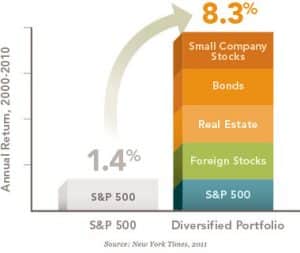
    Rebalance IRA backtested simulations using a globally diversified portfolio of low-cost index funds show superior performance when compared against the S&P 500 over the testing period.

    rebalance ira global diversification

    The investment philosophy practiced by Rebalance IRA has led to stellar returns in backtested simulations.

    By using globally diversified low-cost ETF funds, the annual return at Rebalance IRA was 8.3% between 2000-2010 compared to just 1.4% for the S&P 500.

    In the simulation, ETF dividends were reinvested and portfolio rebalancing was practiced, so capital gains from rebalancing were reinvested.

    The ETF and benchmark indices used in the simulations included a diversified list of ETFs with global exposure across numerous asset classes.

    Asset Class Description Symbol
    U.S. Stocks Russell 3000 Index & CRSP Total Stock Market Index VTI
    U.S. Small Cap Russell 2000 Index & MSCI USA Small Cap Index IJR
    All World Foreign MSCI ACWI ex-US Index VEU
    Foreign Developed MSCI EAFE ex-US Index VEA
    Emerging Markets MSCI Emerging Markets Index VWO
    Foreign Small Cap MSCI ACWI ex-US Small Cap Index VSS
    Real Estate MSCI US REIT Index VNQ
    U.S. High Dividend Stocks MSCI USA High Dividend Yield Index & MSCI USA IMI High Dividend Yield Index VYM
    U.S. Investment Grade Corporate Bonds 50% weighting of Bank of America Merrill Lynch US Corporate 5-7 year Index & 50% weighting of Bank of America Merrill Lynch US Corporate 7-10 year Index VCIT and BND
    U.S. High Yield Corporate Bonds Bank of America Merrill Lynch US High Yield Master II Index HYG
    Emerging Market Bonds J.P. Morgan EMBI Global Index EMB
    Preferred Stock Bank of America Merrill Lynch Fixed Rate Preferred Security Index & S&P US Preferred Stock Index PFF

    Source: Rebalance-IRA

    Rebalance IRA Fees & Minimums

    Rebalance IRA charges 0.50% annually in management fees and has an average expense ratio of 0.20%.

    FEES

    When you compare fees of financial advisors and robo-advisors, it is easy to look only at management fees but your real focus should be on total fees.

    A traditional financial advisor may charge over 1% in management fees but when you dig a little deeper you may find you are paying another 1% in expense ratios, or even more sometimes.

    Combine management fees, expense ratios charges, transaction costs and other hidden fees, and you can quickly find your retirement account gets nickeled and dimed so much that, over the long-term, the costs add up to tens or even hundreds of thousands of dollars.

    At Rebalance IRA, fees are transparent so you know precisely how much you are paying.

    Fee Type Amount
    Management Fee 0.50%
    Average Expense Ratio 0.20%

    Total fees of 0.70% represent a significantly lower number than many clients pay traditional financial advisors, so Rebalance IRA lives up to its claim to deliver a low-cost diversified portfolio that matches your risk profile and financial goals.

    ACCOUNT MINIMUM

    The one blot on the copybook at Rebalance IRA is the high account minimum.

    You need $100,000 to get started investing at Rebalance IRA.

    If you meet the threshold, the company has a lot to offer, but compared to other robo-advisors, it is at the higher end of the range.

    How Rebalance IRA Works

    Rebalance IRA analyzes your pre-existing portfolio, allocates your assets to a new portfolio, monitors it regularly using custom software and live human advisors and regularly rebalances your portfolio.

    When you get started at Rebalance IRA, you will be guided through a 4-step process: Advise, Transform, Grow, Relax.

    ADVISE

    The first step is to examine your existing holdings, including brokerage statements, employer-held 401(k) accounts, and any IRA accounts you may have rolled over.

    rebalance ira review docs

    All your assets are examined with an eye on how they align with your retirement objectives.

    A consultant will listen to you to better understand your risk tolerance, retirement goals and life aspirations.

    With that context, your financial picture will be analyzed to assess where improvements can be made.

    Your holdings are measured to see how diversified they are compared to benchmarks.

    And a comprehensive IRA checklist is used to compare your current holdings so you get the most from your retirement accounts.

    From there, Rebalance IRA will build you a custom investment portfolio specifically designed to ensure you reach your retirement goals.

    Each portfolio is made up of carefully selected allocations and index funds, featuring a global selection of bonds and stocks.

    TRANSFORM

    After your accounts have been reviewed, you will transfer your assets to your new Rebalance IRA account.

    The custodian of your assets will be Schwab or Fidelity, who will send you monthly account statements. You can choose the custodian you prefer and both have stellar industry reputations.

    To limit market risk during the transfer process, Rebalance IRA uses Simultrade technology to transfer your assets into your new portfolio almost immediately.

    GROW

    Once your assets have been transferred to and invested in your new portfolio, custom software tracks your investments daily.

    A core focus at Rebalance IRA is asset allocation because some studies show that 90% of the difference in returns among investors stems from how assets are allocated.

    A human advisor also looks over your portfolio to make sure the allocation is not “out of whack” compared to where it should be.

    One method used to make sure you are on track relative to your original goal is rebalancing.

    You can view portfolio rebalancing as a “tune up” where asset allocations that deviate from your original plan are brought back into line.

    Anytime your portfolio is rebalanced you will be notified so you don’t have to worry about when or why changes are being made.

    RELAX

    Passive investing is the core philosophy practiced by Rebalance IRA and, in line with this approach, the goal of the company is to give you the comfort of knowing that your assets are invested for the long-term and designed to match the returns of the market that correspond to your risk profile.

    Rebalance IRA Team

    Rebalance IRA has a world class team on its investment committee, including Princeton University’s Professor Burton Malkiel.

    The investment committee is made up of Professor Burton G. Malkiel, Dr. Charles D. Ellis and Jay Vivian.

    Professor Malkiel is a Senior Economist at Princeton University and author of the renowned book A Random Walk Down Wall Street.

    Has has a B.A. in economics and an M.B.A. from Harvard plus a ph.D from Princeton University.

    Dr. Charles Ellis is a Board member of The Vanguard Group and has taught at both Harvard Business School and Yale.

    Jay Vivian is another luminary who formerly oversaw over $100 billion in IBM investment funds.

    Rebalance IRA Summary

    Rebalance IRA earns brownie points for building customized portfolios that are tailored to your unique risk profile, financial goals and life aspirations.

    While the company uses custom software, human oversight is included as part of your portfolio monitoring to make sure your asset allocation is on track with your original plan.

    Management fees of 0.50% are higher than some robo-advisors charge for pure robo-advice but, when factoring in the human component you benefit from at Rebalance IRA, fees are in line with industry norms.

    A blot on the copybook at Rebalance IRA is the high account minimum of $100,000 which will be a hurdle too high for some investors who might otherwise benefit from a customized, low-cost, globally diversified portfolio.

    If you can meet the threshold and want your existing retirement accounts examined by human financial experts and then automatically invested and rebalanced with human oversight, Rebalance IRA is a top notch robo-advisor worthy of your consideration.

  • How To Become Financially Independent

    How To Become Financially Independent

    InvestorMint provides personal finance tools and insights to better inform your financial decisions. Our research is comprehensive, independent and well researched so you can have greater confidence in your financial choices.

    For most people, making money means working hard every day and consistently squirreling away a few nuts for retirement. But to become financially independent, you need to do more than exchange your hours of labor for dollars. You need your dollars to make money for you, even when you are not working hard.

    Making money through your own efforts is limited by how many hours you can work. Financially independent people don’t have to work at all to pay for expenses because their money works for them, even when they are sleeping.

    But how do you build more income from the yield you receive by investing your savings than from your hard work?

    1: Make Rational Decisions About Your Wealth

    If I made you an offer to accept $100 now or $150 in a year, which would you choose?

    Research shows that most people would choose $100 now than wait for $150 a year from now.

    If we humans were rational, we would choose $150 next year over $100 immediately because most people cannot generate a reliable 50% return annually.

    Some traders have certainly generated 50% gains for short time periods, maybe even over a few years. But over the long term, it has never been consistently done.

    So, the likelihood is by accepting $100 today, you will have less money a year from now than if you selected the $150 choice today.

    Rationally, it makes no sense to virtually guarantee that you will have less money in the future yet most people still make that choice.

    When you hear about saving a few bucks on a coffee each day, the decision to not make the purchase is much less about the few dollars on any given day as it is about consciously deciding to focus on building wealth over time.

    You need to make the rational decision to be more wealthy in the future even though it may feel better short term to choose otherwise.

    It feels better in the moment to choose the one hundred dollar bill or grab the coffee, but over time the sum of all the small decisions that give you short-term satisfaction will cost you a much larger nest-egg.

    2: Create Financial Goals You Believe You Can Achieve

    How did mixed-martial artist fighter Conor McGregor go from collecting welfare checks to fighting one of the most successful boxers of all time, Floyd Mayweather, in a fight billed as the first billion dollar fight?

    Conor McGregor UFC 189 World Tour London

    He shared the secret in a press conference when he was asked about how he manifests his visualizations into reality:

    “I see it in my head, I speak it out loud, I believe it, then it will happen”

    When you look to the future, what do you visualize? Are you on a yacht in the Mediterranean? Are you living in the house of your dreams?

    Do you have the confidence to say to your family and friends that you will be on that boat or living in that home within a certain time period?

    strawberry hill house from garden 2012

    Conor McGregor has the braggadocio to tell the world his goals, do you?

    A Fortune 500 CEO needs to publicly state each quarter how the company he/she leads will hit financial targets in the next quarter and year.

    The CEO is accountable to shareholders. And when you speak your goals out loud to your friends or family, you too become accountable.

    It takes courage to share your goals because, if you are like most people, you don’t want to be seen to fail publicly.

    And that’s why it is crucial to believe in your financial goals before you share them.

    If you set a goal to buy a mansion in the Hollywood Hills but you don’t truly believe it can manifest into reality, then set a goal you realistically believe you can achieve.

    Once you have set a financial goal you truly believe in, select a time period in which you can achieve your goal that is also feasible.

    Be very specific with your financial goals. Break them down so they are achievable in small time increments.

    If you want to own the mansion in the hills, how much will you need? How much will you need to save each month? How much will you need to earn?

    When you specify your goals, you will have greater clarity about how to achieve your financial dreams.

    Then summon the courage to share your goals publicly so you are accountable to them.

    Each month, keep track of where you are compared to your targets. If you fall short one month, don’t dwell on it. Keep in mind the journey is long. Don’t let any single month throw you off track.

    Stay focused and committed to your savings and earnings goals. This is your financial future after all. Nobody will care about it as much as you, not even your financial advisor.

    >> Related: Retirement Planning For Dummies

    3: Make Yourself Rich, Not Your Financial Advisor

    When athletes compete at the highest level, they say the same thing as Paris fashion designers: success comes from paying attention to details.

    To become financially independent, you need to pay attention to the little details too.

    Perhaps the most important “small detail” is fees. What do you pay your financial advisor, how much do you pay in expense ratios, and what transaction costs do you pay each year?

    Fees are easily ignored because the magic of compounding is hidden from view.

    Take an investor with a million dollar portfolio who meets a financial advisor charging 1.5% in annual fees.

    The advisor shows the investor a historical chart of market performance over time. It seems like a compelling pitch because a 7-8% annual return outpaces the “paltry” 1.5% paid in fees.

    The investor signs a contract to let the financial advisor manage their money. Naturally, the investor’s mind drifts to the happy place making $70,000 → $80,000 in possible future annual gains and neglects to pay as much attention to the $15,000 in guaranteed costs.

    But stop a minute and think about that 1.5%. It seems like such a small percentage and yet it translates to $15,000 a year.

    That’s almost enough to buy a new car.

    How easily would you hand over $15,000 in any other walk of life? If any other sale were being made, you would probably spend a lot more time figuring out what value you were receiving from the vendor.

    But it’s easy to sign over the management of your nest egg to a financial advisor without calculating the long-term fee costs.

    And what’s more, management fees aren’t the only costs that can bite you later on.

    When your financial advisor invests your money, it will most likely be in mutual funds that charge ongoing expense ratios to operate the fund.

    If you pay 0.5% in fees to the mutual fund company plus 1.5% to your financial advisor, your total annual fees will amount to 2.0% annually.

    And that’s not counting commissions costs or any other hidden fees that may surprise you.

    In fact, an investor with $100,000 who earns on average 8% over a 30 year period paying 2% in fees each year will amass a portfolio worth just over $550,000 whereas an investor paying just 0.50% in fees annually will see portfolio growth of $866,000+.

    Expense Ratio
    Year Annual Gain (8%) 0.50% 1.00% 1.50% 2.00%
    0 $100,000 $100,000 $100,000 $100,000 $100,000
    1 $108,000 $107,500 $107,000 $106,500 $106,000
    2 $116,640 $115,560 $114,485 $113,415 $112,350
    3 $125,971 $124,222 $122,488 $120,771 $119,070
    4 $136,049 $133,529 $131,045 $128,595 $126,180
    5 $146,933 $143,532 $140,193 $136,917 $133,702
    6 $158,687 $154,279 $149,974 $145,768 $141,660
    7 $171,382 $165,828 $160,429 $155,180 $150,078
    8 $185,093 $178,238 $171,605 $165,187 $158,980
    9 $199,900 $191,571 $183,551 $175,828 $168,395
    10 $215,892 $205,897 $196,319 $187,141 $178,350
    11 $233,164 $221,290 $209,965 $199,168 $188,875
    12 $251,817 $237,827 $224,550 $211,952 $200,002
    13 $271,962 $255,594 $240,136 $225,540 $211,763
    14 $293,719 $274,682 $256,790 $239,981 $224,193
    15 $317,217 $295,188 $274,587 $255,328 $237,329
    16 $342,594 $317,217 $293,602 $271,635 $251,209
    17 $370,002 $340,881 $313,918 $288,962 $265,873
    18 $399,602 $366,302 $335,622 $307,370 $281,363
    19 $431,570 $393,608 $358,809 $326,925 $297,725
    20 $466,096 $422,939 $383,578 $347,697 $315,004
    21 $503,383 $454,443 $410,035 $369,759 $333,251
    22 $543,654 $488,282 $438,293 $393,189 $352,516
    23 $587,146 $524,626 $468,474 $418,070 $372,853
    24 $634,118 $563,661 $500,705 $444,489 $394,320
    25 $684,848 $605,583 $535,125 $472,537 $416,976
    26 $739,635 $650,605 $571,879 $502,313 $440,883
    27 $798,806 $698,955 $611,124 $533,920 $466,108
    28 $862,711 $750,878 $653,024 $567,467 $492,718
    29 $931,727 $806,634 $697,757 $603,069 $520,786
    30 $1,006,266 $866,507 $745,511 $640,848 $550,388

    So, small fee differences make a big difference over time to your net worth.

    The bottom line is pay very close attention to the fees you pay financial advisors and in mutual fund expense ratios.

    >> Related: Which Robo Advisors Have Low Fees?

    4: Buy-And-Hold Vs. Buy-And-Sell?

    Philosophers such as Friedrich Wilhelm Nietzsche have written volumes about how humans are their own worst enemies at times.

    One way we can sabotage ourselves is when we succumb to action bias as we try to become financially independent.

    Life teaches us that taking action generally leads to progress:

    • Study hard and graduate from school
    • Work hard and get promoted
    • Hit the gym and get in shape

    In most areas of life, action equals progress, and progress leads to success. But when it comes to building wealth for the long-term, action can stifle growth and limit wealth.

    Take for example a buy-and-hold investor earning 15% annually. Admittedly, this is a high figure, so let’s pretend it’s a billionaire, like Warren Buffett, generating those returns.

    Why does Warren Buffett advocate holding for the long-term?

    The reason is obvious when you look at the table below comparing the portfolio growth of a buy-and-hold investor with the wealth accumulated by an investor who locks in gains each year and pays short-term taxes of 30%.

    Year Buy-and-hold Tax Liability Buy-and-sell Tax Liability
    1 100 0 100
    10 352 0 272 8.4
    20 1,423 0 804 24.8
    30 5,758 0 2,380 73.4
    40 23,292 0 7,038 217.0
    50 94,231 0 20,818 641.9
    60 381,217 0 61,576 1,898.5

    The buy-and-hold investor who we’ll assume pays 20% in long-term capital gains taxes overall at the end of a 60 year period, amasses over 6x more than the “buy-and-sell” investor who pays taxes along the way.

    Even though both investors enjoy the same portfolio growth annually, the result of taking action to lock in gains every step of the way is to severely hurt a portfolio long-term.

    By choosing not to succumb to an action bias that makes you feel better short term (because it locks in gains), you have a better shot at becoming financially independent.

    But sometimes this is easier said than done. So, how do you commit to the long-term, take less action, and transact less in order to pay fewer taxes, commissions and fees, and build greater wealth?

    Simple. Trade less frequently. Or, find a broker with low commissions costs so you don’t churn your account.

    For example, TastyWorks permits options traders to close positions without paying any commissions costs.

    tastytrade SPOTLIGHT
    tastytrade (previously known as tastyworks)

    Investormint Rating

    4.5 out of 5 stars

    • Commissions: Closing trades for Stocks & ETFs and Options are commission-free
    • Account Balance Minimum: $0
    • Commissions: $0 flat rate for stocks

    via tastytrade secure site

    These days you can find brokers who charge no commissions for stock trading too, such as Robinhood.

    >> Related: What Are The Best Options Trading Platforms?

    >> Related: Trade Options? Here Are Some Options Tips

    5: Become Financially Independent Automatically

    If you do not have the time or inclination to learn how to research stocks, or manage your portfolio by diversifying in stocks and bonds through low-fee index funds, then a hands-off approach might be a better fit.

    One avenue is to select a robo advisor, who manages your wealth automatically on your behalf.

    To get started, answer questions pertaining to your risk profile, time horizon and financial goals, and the robo advisor will allocate your money to a portfolio that aligns with your preferences.

    The best robo advisors, such as Betterment and Wealthfront, can harvest tax losses for you too.

    wealthfront brokerage trading system robo advisor
    betterment

    Tax loss harvesting can be so powerful over time that it even has the potential to cover the management fees you pay to a robo advisor.

    And by relying on an automated investment management solution, you get to enjoy a hands-off approach to becoming financially independent that eliminates the temptation to succumb to an action bias.

    Some robo advisors, such as Personal Capital, offer excellent mobile apps that let you track your spending and net worth by linking to your bank and brokerage accounts, as well as your credit cards.

    Others, including Betterment, offer retirement calculators and financial calculators to help you figure out how fast you can grow your money and how much you need to retire comfortably and live the same lifestyle as you do during your working years.

    What tips have you learned to become financially independent? Share your stories with us below. We would love to hear from you.

    >> What Are The Best Retirement Plans For Independent Contractors?

    >> Find Out How To Research Stocks Like A Pro

    >> Do You Need A Living Trust?

  • How To Invest Money Wisely

    How To Invest Money Wisely

    girl looking at tree house

    InvestorMint provides personal finance tools and insights to better inform your financial decisions. Our research is comprehensive, independent and well researched so you can have greater confidence in your financial choices.

    Before figuring out how to invest money wisely, it’s important to first remove financial costs that are holding you back.

    It is generally best to get rid of high-interest rate charges, lower your taxes and build up a rainy day fund before investing in the stock market.

    But what is the first step in maximizing your nest-egg savings and what are the ways to make money investing in the stock market that few people know about?

    Pay Down Debt

    Before investing in the stock market, pay down debt that has a high interest rate.

    If you are like most people, some portion of your monthly earnings are allocated to paying principal and interest on at least one loan.

    Perhaps it’s a student loan or a mortgage or a car loan or a credit card payment that needs to be made.

    No matter what it is, examine the interest rate you owe before taking the plunge to invest in the stock market.

    If you are paying an interest rate of 10% on a loan but earning 8% in the stock market, you are worse off investing than paying down debt.

    It’s nice to see a brokerage statement return profits at the end of the year, but don’t be fooled by those earnings. If your interest payments were costing you more than your rate of return, investing isn’t a game you want to play just yet.

    Smart money management starts with paying off debt intelligently. Sometimes it makes sense to both invest and pay down debt simultaneously.

    For example, you might enjoy tax-breaks on interest mortgage payments so a portion of the upfront payments are credited back to you around tax time. Or maybe you are paying a very low interest rate on a student loan. But more times than not – unless you can earn more by investing than what you are paying in interest on debt – it is better to first pay down debt.

    Build Your Savings Nest-Egg

    Once you have paid down high-interest debt, look to build up a cash savings nest-egg that can act as your rainy day fund.

    For most individuals, building a savings nest-egg is the smartest next step after paying down high-interest rate debt. A rainy day fund gives you the peace of mind that you can dip into savings whenever you need cash most.

    In an ideal world, you could jump straight from paying down debt to investing. But the moment you invest in the stock market, you take on some risk.

    If the stock market has reached a plateau following the tail end of an economic cycle, the risk of a stock market correction might be higher than normal.

    The last thing you want is to invest your savings into the stock market just at the moment when it is on the verge of falling.

    Yet timing the market is notoriously difficult. Even professionals who are paid huge sums of money find it challenging to beat the market.

    betterment

    In fact, it is so difficult to outperform the market that Warren Buffett famously bet professional hedge fund managers that over a 10 year period they would not beat the S&P 500, and he won!

    If the so-called smartest investors in the world find it hard to beat the market, then casual investors should tread carefully before trying to do so. Classic investing approaches shared below are a much better bet for most.

    Once you have built up cash savings, you can look to allocate money to various buckets. For example, some roboadvisors, such as Betterment, offer customers a way to allocate money to buckets that are invested to reach financial goals. You might be saving for a new home, a new car, a wedding or a vacation.

    Allocating money to various financial buckets is a smart way to save, but before you grow any of these buckets, first grow your savings nest-egg so your rainy day fund is never in jeopardy.

    Lower Your Income Taxes

    When you are ready to invest, choose tax-deferred retirement accounts so that your earnings can grow tax free until withdrawals are taken in retirement years.

    With high-interest rate debt paid down and a cash savings or a rainy day fund in place that you can dip into in case of emergencies, you can feel more confident to invest in the stock market.

    The first dollars you invest in the stock market should be aimed at lowering your taxes. And one of the best ways to lower your taxes when investing in the stock market is to allocate money to a tax-deferred retirement account, such as an IRA or 401(k).

    For example, an employee investing $10,000 into a 401(k) account will enjoy a tax-shield of $10,000 on contributions. That means if the employee earns $100,000 annually, only $90,000 of income is taxable.

    Taxes are deferred until retirement years, allowing earnings grow tax-free in the interim.

    >> 401(k) or IRA: Which Is Better?

    Choose Index Funds

    Index exchange-traded funds have low fees compared to actively managed mutual funds.

    The Vanguard Total Index fund, ticker symbol VTI, is one of the highest rated index funds available to retail investors. One reason it wins high marks is its fees are low. But how important are fees really when it comes to investing?

    A small difference in fees can add up over time way more than most investors can imagine.

    A casual investor might think that an extra 0.5% annually is no big deal. After all, if your portfolio was growing 7-8% a year, paying 0.5% in fees doesn’t seem too costly. But over time, it becomes very expensive due to the hidden power of compounding.

    To highlight the negative effect of fees on portfolio growth, compare the costs of mutual funds to those of exchange-traded funds.

    Actively managed mutual funds generally have higher fee schedules than passively managed exchange-traded funds.

    The expense ratios incurred by mutual fund holders can be 2x, 3x, 4x or more what ETF shareholders pay.

    And the power of compound interest transforms what seems like a small differential each year into a huge sum of money over the span of 30 years.

    Over that time frame, here is the difference in portfolio growth when $100,000 is invested.

    Expense Ratio
    Year Annual Gain (8%) 0.50% 1.00% 1.50% 2.00%
    0 $100,000 $100,000 $100,000 $100,000 $100,000
    1 $108,000 $107,500 $107,000 $106,500 $106,000
    2 $116,640 $115,560 $114,485 $113,415 $112,350
    3 $125,971 $124,222 $122,488 $120,771 $119,070
    4 $136,049 $133,529 $131,045 $128,595 $126,180
    5 $146,933 $143,532 $140,193 $136,917 $133,702
    6 $158,687 $154,279 $149,974 $145,768 $141,660
    7 $171,382 $165,828 $160,429 $155,180 $150,078
    8 $185,093 $178,238 $171,605 $165,187 $158,980
    9 $199,900 $191,571 $183,551 $175,828 $168,395
    10 $215,892 $205,897 $196,319 $187,141 $178,350
    11 $233,164 $221,290 $209,965 $199,168 $188,875
    12 $251,817 $237,827 $224,550 $211,952 $200,002
    13 $271,962 $255,594 $240,136 $225,540 $211,763
    14 $293,719 $274,682 $256,790 $239,981 $224,193
    15 $317,217 $295,188 $274,587 $255,328 $237,329
    16 $342,594 $317,217 $293,602 $271,635 $251,209
    17 $370,002 $340,881 $313,918 $288,962 $265,873
    18 $399,602 $366,302 $335,622 $307,370 $281,363
    19 $431,570 $393,608 $358,809 $326,925 $297,725
    20 $466,096 $422,939 $383,578 $347,697 $315,004
    21 $503,383 $454,443 $410,035 $369,759 $333,251
    22 $543,654 $488,282 $438,293 $393,189 $352,516
    23 $587,146 $524,626 $468,474 $418,070 $372,853
    24 $634,118 $563,661 $500,705 $444,489 $394,320
    25 $684,848 $605,583 $535,125 $472,537 $416,976
    26 $739,635 $650,605 $571,879 $502,313 $440,883
    27 $798,806 $698,955 $611,124 $533,920 $466,108
    28 $862,711 $750,878 $653,024 $567,467 $492,718
    29 $931,727 $806,634 $697,757 $603,069 $520,786
    30 $1,006,266 $866,507 $745,511 $640,848 $550,388

    You can see that over a 30 year time horizon, an investor paying fees of 0.50% annually saves approximately $300,000 more than an investor paying fees of 2.0%!

    Robo Advisor Investing

    Roboadvisors generally charge low management fees, use low-cost ETFs, and many offer free automated rebalancing and tax-loss harvesting services to maximize after-tax returns.

    If you are trying to figure out how to invest money wisely, you can save yourself a lot of hassle by selecting a robo-advisor who does the hard work for you.

    Some of the leading robo-advisors, such as Betterment and Wealthfront, came on the scene back in 2008. They have become so successful since then that they have gathered billions of dollars in managed assets.

    The value robo-advisors offer is compelling to the casual investor because:

    1. Portfolio management fees are comparatively low;
    2. Expense ratios are low because low-fee ETFs are generally used;
    3. Portfolio management is automated so you can be hands-off;
    4. Tax-loss harvesting is employed (by many robo-advisors) to maximize after-tax returns;
    5. Automatic portfolio rebalancing is widely used to prevent portfolio drift so no single position has too much weight in a portfolio;
    6. Hybrid robo-advisor solutions are increasingly popular; this is where human advice is combined with technology-powered portfolio management;
    7. Competition is increasing among robo-advisors, so costs are low – so much so, Schwab even has a zero management fee offering via its robo-advisor, Schwab Intelligent Portfolios.

    Some robo-advisors, such as Hedgeable, even offer a twist on the standard money management approach. Hedgeable strives to limit downside risk during market declines.

    The biggest value-add robo-advisors offer is lower fees compared to most traditional financial advisors, who often charge north of 1% in management fees annually.

    When you compare to robo-advisors, such as Betterment, which charges just 0.25% for its basic offering, Betterment Digital, the savings are substantial over time.

    For hands-off investors who want to outsource the responsibilities of money management to a financial advisor, but don’t want to pay the higher fees associated with human financial advisors, low-cost robo-advisors are a great investing alternative.

    Invest in Value Stocks

    Value stocks are favored by many of the wealthiest investors in the world because they have high upside and limited downside risk. Often, they pay stable dividends, have growing earnings, and fair values much greater than their current share prices.

    If you prefer a more active investing approach, you can open a self-directed brokerage account at a top tier company.

    THINKORSWIM® SPOTLIGHT

    thinkorswim®

    InvestorMint Rating

    5 out of 5 stars

    • Commissions: $0 per trade
    • Account Minimum: $0
    • Promotion: Trade free for 60 days, based on $3,000 deposit

    via thinkorswim secure site

    As a self-directed investor, you will need to do a little homework before pulling the trigger and buying stocks.

    Start by examining the best value stocks. These are stocks that may be out of favor currently but have intrinsic values greater than their market capitalizations.

    Value stocks are favored by some of the wealthiest investors in the world because the downside risk is limited due to strong underlying factors, such as:

    • Stable dividends;
    • Predictable, growing earnings;
    • Low default risk;
    • High levels of cash on the balance sheet;
    • Fair value greater than current price

    >> Find Stocks To Buy Now

    Make Money With Options

    Covered Calls and married puts are among the best options trading strategies to produce income and limit downside portfolio risk.

    COVERED CALLS

    Buy-and-hold investing has its merits, but did you know that you don’t have to rely on quarterly dividends issued by a company to get paid an income from stocks you own?

    Self-directed traders who are keen to produce additional income should explore one of the best options trading strategies: the covered call.

    When you own a stock, you can sell a call option to produce a fixed income amount. For example, you could decide that over the next week, month, quarter or even year that you want to get paid an income from your shareholding.

    Covered calls allow you to generate additional cash flow from stocks you already own. So what’s the catch?

    When you sell call options against shares you own, you are entering a contract whereby you agree to sell your stock at a fixed price over a specific time period.

    For most investors trying to figure out how to invest money wisely, the covered call is an excellent strategy, but you can use options to achieve other financial goals too.

    MARRIED PUTS

    When markets fall, it’s easy to become fearful. Wise investors have legendary quotes about how to take advantage of market sentiment when it reaches extremes.

    Warren Buffett’s quote be fearful when others are greedy and be greedy when others are fearful sums up rational decision-making needed to win long-term.

    But staying rational when markets are falling is easier said than done. And that’s where options can play a role in your investing approach.

    When you own stocks and wish to limit portfolio risk, you can buy protective put options that act as a hedge in case your stocks fall in price. The combination of owning stocks and buying puts is called a married put strategy.

    Like any insurance you might buy, stock insurance in the form of protective puts requires you to dip into your pockets and pay a sum of money for peace of mind. But it can be cheap when considering the alternative of simply owning stock.

    For example, if a $50 stock were to fall to $30, you would lose $20 per share if you had no protective puts in place.

    If you were to purchase a put option at strike 50, you would have to pony up some money to buy the insurance, but if the stock were to fall below $50 you would have the right to sell the stock at $50 per share – no matter how low the stock fell.

    This peace of mind can make it a lot easier for you to act rationally as Warren Buffett and other wealthy investors advocate, so that you capitalize from market sentiment rather than succumb to it.

    Have you got other tips on how to invest money wisely? Share them in the comments below.

    >> Is Twitter Stock a Buy or Sell?

    >> Discover Lessons From Warren Buffett’s Annual Shareholder Letter

    >> What Are The Best Stocks To Buy?

  • Wealthfront Review 2026: Fees, Features, and Who It’s For

    Wealthfront Review 2026: Fees, Features, and Who It’s For

    Wealthfront Review 2026: Fees, Cash Management, Tax-Loss Harvesting, and Who It’s Best For

    Wealthfront combines automated investing, tax-management tools, financial planning software, and a high-yield cash account in one digital platform. Its core Automated Investing Account charges a 0.25% annual advisory fee and has a stated $500 minimum, making it accessible to many beginner and intermediate investors.

    The platform is most compelling for U.S. investors who want a hands-off taxable portfolio. Automatic rebalancing and tax-loss harvesting can reduce the work involved in managing investments, while Wealthfront’s Cash Account provides a place for short-term savings. However, Wealthfront is not a full-service bank, does not provide ongoing access to a dedicated human advisor, and offers less trading control than a traditional brokerage account.

    Bottom line: Wealthfront can be worth considering if you value automation and expect to use its tax features. Investors who are comfortable building a simple index-fund portfolio themselves may be able to pay less elsewhere.

    Wealthfront at a Glance: Is It Worth It in 2026?

    Feature Wealthfront offering
    Automated Investing fee 0.25% annually
    Automated Investing minimum $500
    Portfolio management Automated allocation, deposits, reinvestment, and rebalancing
    Tax-loss harvesting Available for eligible taxable Automated Investing Accounts
    U.S. Direct Indexing Available at $100,000 or more, subject to current eligibility rules
    Cash Account yield Variable APY; confirm the current rate directly with Wealthfront
    Cash FDIC coverage Up to a stated $8 million through participating program banks, subject to conditions
    Human financial advisor No dedicated advisor service
    Primary limitation Limited human guidance, banking services, and portfolio control

    Wealthfront’s value depends on which features a customer will actually use. A taxable investor who benefits from automated tax-loss harvesting may find the 0.25% fee reasonable. An IRA investor who only needs a basic stock-and-bond allocation may prefer to buy low-cost index funds directly and avoid an additional management fee.

    Cash Account rates can change whenever market conditions or Wealthfront’s program terms change. Any APY displayed in an older review should therefore be treated as historical, not as a rate guaranteed for 2026.

    Who Wealthfront Is Best For—and Who Should Avoid It

    Wealthfront may be a good fit for:

    • Hands-off investors: The platform handles portfolio selection, recurring deposits, dividend reinvestment, and rebalancing.
    • Taxable-account investors: Eligible customers receive automated tax-loss harvesting, which may help manage realized capital gains.
    • Busy professionals: Investing, cash management, and goal projections are available through one dashboard.
    • Beginning and intermediate investors: The risk questionnaire and recommended portfolio provide a straightforward starting point.
    • Goal-focused savers: Wealthfront’s Path planning tools can model retirement, education, and home-purchase goals.

    Wealthfront may not be a good fit for:

    • Active traders: Automated portfolios are not designed for frequent trading, market timing, or detailed order control.
    • Experienced DIY investors: Someone comfortable maintaining a simple index portfolio can potentially avoid the advisory fee.
    • People seeking a financial planner: Software-based recommendations are not a substitute for ongoing advice from a professional who understands a household’s full financial situation.
    • Customers who need branch banking: Wealthfront does not offer physical branches or normal cash-deposit services.
    • Non-U.S. investors: Eligibility is generally focused on qualified U.S. customers and may depend on residency and tax status.

    Wealthfront Fees, Minimums, and Account Costs

    Wealthfront charges 0.25% per year for its standard Automated Investing service. The fee is calculated from assets under management and generally deducted periodically from the account.

    For example, a steady $10,000 balance would generate an advisory fee of approximately $25 per year:

    $10,000 × 0.0025 = $25

    The actual charge can differ because account values fluctuate and deposits or withdrawals change the amount being managed. At $50,000, the approximate annual fee would be $125; at $100,000, it would be $250.

    Investment minimums and additional costs

    The stated minimum for an Automated Investing Account is $500. Customers using only Wealthfront’s Cash Account generally do not need to meet the automated-investing minimum, although current account-opening requirements should be checked before applying.

    The advisory fee is not the only possible cost. Investors should also review:

    • ETF expense ratios: The funds inside a portfolio charge their own operating expenses. These costs are deducted at the fund level and are separate from Wealthfront’s advisory fee.
    • Specialized fund costs: Certain alternative, socially responsible, or customized funds may cost more than broad-market index ETFs.
    • Transfer charges: A full or partial account transfer to another brokerage may carry an outgoing transfer fee under the current fee schedule.
    • Trading and market costs: Bid-ask spreads, taxes, and small tracking differences can affect results even when commissions are not charged.
    • Cash-access costs: Out-of-network ATM operators or other service providers may impose fees.

    How Wealthfront’s cost compares

    Provider or approach General pricing model Important tradeoff
    Wealthfront 0.25% annual advisory fee Strong automation and taxable-account tools, but no dedicated human advisor
    Betterment Percentage-based or subscription pricing depending on balance and eligibility Human-advice options may be available on qualifying plans
    Fidelity Managed-account pricing varies; DIY brokerage accounts can avoid an advisory fee Broader brokerage services but more decisions for DIY investors
    Vanguard Low-cost funds plus optional digital or human-advice programs Potentially lower costs, depending on the selected service
    Schwab Intelligent Portfolios No stated advisory fee for the standard automated service Required cash allocations create an indirect opportunity cost
    DIY index funds No robo-advisory fee; fund expenses still apply The investor must select, rebalance, and manage taxes independently

    Competitor pricing and minimums change, so investors should compare current disclosures rather than relying solely on headline fees. A service advertised with no advisory fee may earn revenue in another way, while a low percentage fee can become substantial as an account grows.

    Tax-loss harvesting could offset part or all of Wealthfront’s fee for some taxable investors, but that result is not guaranteed. The benefit depends on market movements, tax rates, realized gains, holding periods, outside accounts, and whether harvested losses are eventually offset by a lower cost basis.

    Cash Management: APY, FDIC Coverage, and Banking Features

    Wealthfront’s Cash Account is a brokerage cash-management product rather than a conventional checking or savings account held directly at a single bank. Wealthfront places eligible deposits with participating program banks, where the money may receive pass-through FDIC insurance if program requirements are satisfied.

    Wealthfront states that qualifying cash can receive up to $8 million in FDIC coverage through its network of partner banks. That figure is much higher than the standard $250,000 insurance limit at one bank because funds may be distributed across multiple institutions.

    Coverage is not automatic in every situation. Money already held by the customer at a participating bank can reduce available coverage at that institution. Funds may also experience a brief transition while being moved. Customers with large balances should review the current program bank list, sweep mechanics, exclusions, and account disclosures.

    Cash Account features

    Depending on current eligibility and account configuration, cash-management features may include:

    • Direct deposit
    • Electronic bill payments and ACH transfers
    • Debit-card access
    • Mobile check deposit
    • Person-to-person payment compatibility
    • Access to participating ATMs
    • Transfers between Wealthfront cash and investment accounts

    The advertised APY is variable. Wealthfront may raise or lower it in response to Federal Reserve policy, partner-bank arrangements, or business decisions. Before moving money, compare the live APY with high-yield savings accounts, money market deposit accounts, Treasury bills, and government money market funds.

    The Cash Account is not a complete substitute for every checking account. Wealthfront has no branch network, generally does not support cash deposits, and may not offer all the checks, wires, cashier’s checks, lending products, or customer-service access available at a full-service bank. ATM access and fee treatment can also depend on the network and the machine operator.

    Automated Investing and Portfolio Construction

    Wealthfront begins by asking questions about financial goals, investment experience, time horizon, income, and tolerance for losses. Its software then recommends a diversified allocation with a risk score. The portfolio typically uses ETFs covering several asset classes, which may include U.S. stocks, foreign stocks, bonds, and real estate-related securities.

    Customers can accept the recommendation or customize eligible asset classes and funds. Wealthfront uses fractional ETF investing where available, helping keep more of the account invested rather than leaving small amounts of idle cash.

    Ongoing management can include:

    • Automatic recurring deposits
    • Dividend reinvestment
    • Portfolio rebalancing
    • Tax-sensitive deposit allocation
    • Tax-loss harvesting in eligible taxable accounts

    Common account options include individual taxable brokerage accounts, joint accounts, trusts, traditional IRAs, Roth IRAs, rollover IRAs, and SEP IRAs. Wealthfront may also offer additional products, such as education or bond-focused accounts, under separate terms. Availability should be confirmed for the investor’s state and circumstances.

    Customization and specialized strategies

    Wealthfront offers portfolio choices beyond its standard allocation. Depending on account type and balance, these may include socially responsible investing, selected thematic or sector exposures, smart-beta strategies, and customization of asset classes. Adding specialized investments can change diversification, volatility, taxes, and fund expenses.

    Path, Wealthfront’s planning software, connects account data with projected goals. Users can model scenarios such as retiring at a different age, buying a home, taking time away from work, or paying education expenses. These projections are planning estimates—not promises. Results depend heavily on assumptions about earnings, spending, inflation, taxes, and investment returns.

    All Wealthfront portfolios remain exposed to market risk. Automation can maintain a strategy consistently, but it cannot prevent losses or guarantee that a portfolio will reach its target.

    Tax-Loss Harvesting and Direct Indexing Explained

    Tax-loss harvesting attempts to sell an investment that has declined below its purchase price and replace it with another investment providing similar market exposure. The realized loss can be used to offset eligible capital gains. If losses exceed gains, current federal rules generally permit a limited amount to offset ordinary income, with unused losses potentially carried forward. Tax rules and individual eligibility can change.

    Consider an investor who realizes a $3,000 gain from one investment and a $2,000 loss from another. Subject to tax rules, the loss could reduce the investor’s net realized capital gain to $1,000. This example does not account for holding periods, state taxes, other transactions, or future gains caused by a reduced cost basis.

    Tax-loss harvesting is principally useful in taxable accounts. Selling at a loss inside a traditional or Roth IRA generally does not create the same deductible capital loss because trades within those accounts are not taxed transaction by transaction.

    Wash-sale risk and replacement investments

    The IRS wash-sale rule can disallow a loss if the investor buys the same or a substantially identical security within the restricted period surrounding the sale. A robo-advisor may use a replacement ETF intended to provide similar exposure without being substantially identical.

    Automation cannot see every transaction unless all relevant accounts are included in its monitoring. A purchase by the investor, a spouse, an IRA, or another brokerage account may create a wash sale. Dividend reinvestment can also complicate the analysis. Investors with multiple accounts should coordinate trades carefully and consult a qualified tax professional when needed.

    Harvesting also lowers the replacement investment’s cost basis. That may defer taxes instead of permanently eliminating them. The eventual benefit depends on future sales, future tax rates, charitable giving, estate planning, and the investor’s ability to use the losses.

    U.S. Direct Indexing

    Wealthfront’s U.S. Direct Indexing strategy is available for eligible Automated Investing Accounts with at least $100,000, subject to current requirements. Instead of obtaining all U.S. stock exposure through a single ETF, the strategy may hold many individual stocks. More individual positions can create additional opportunities to harvest losses while attempting to track a broad index.

    Direct indexing also introduces complexity. It can generate numerous tax lots, tracking differences, and restrictions when transferring the portfolio. Any estimate of improved after-tax performance should be treated as a projection rather than a guaranteed return.

    Wealthfront Pros and Cons

    Pros

    • Simple 0.25% Automated Investing fee
    • Relatively accessible $500 investment minimum
    • Automatic deposits, reinvestment, and rebalancing
    • Tax-loss harvesting for eligible taxable accounts
    • Direct indexing for qualifying higher-balance accounts
    • Integrated financial-planning and cash-management tools
    • Potentially high FDIC coverage through program banks

    Cons

    • No dedicated human financial advisor
    • Ongoing advisory fee that grows with the portfolio
    • Cash Account APY can change
    • Limited control compared with a traditional trading account
    • No physical branches or routine cash-deposit service
    • Tax strategies may add complexity and do not guarantee savings
    • Customer support may be more limited than at a full-service bank or brokerage, including weekday-focused availability for some channels

    Wealthfront Alternatives

    Betterment is the closest general-purpose alternative. It offers automated portfolios and tax tools, while certain service levels may provide access to human financial professionals. Compare current plan requirements because smaller accounts may face a subscription-style charge.

    Fidelity or Vanguard may be better for investors who want a conventional brokerage, broad fund selection, and the option to invest independently. A DIY portfolio of diversified index funds can be inexpensive, but the investor must handle allocation, rebalancing, and tax decisions.

    Schwab Intelligent Portfolios does not advertise an advisory fee for its standard service, but portfolios include a cash allocation. Investors should consider the yield and opportunity cost of that cash when comparing total costs with Wealthfront’s explicit 0.25% fee.

    Final Verdict: Is Wealthfront Worth It?

    Wealthfront is best for U.S. investors who want automated portfolio management, have at least $500 to invest, and are comfortable receiving guidance primarily through software. Its strongest use case is an eligible taxable account where automatic rebalancing and tax-loss harvesting provide meaningful convenience.

    It is less persuasive for an investor who only needs an IRA invested in a few index funds, wants to trade actively, or expects regular conversations with a financial advisor. The right choice depends on portfolio size, account type, tax situation, desired level of control, and willingness to pay an annual fee for automation.

    What to Do Next

    1. Confirm Wealthfront’s current Cash Account APY, advisory fee, minimums, and transfer charges.
    2. Review the proposed portfolio and compare its allocation and fund expenses with alternatives.
    3. Estimate the annual fee using the balance you expect to maintain.
    4. Consider whether tax-loss harvesting is relevant to your taxable gains and overall tax situation.
    5. Check program-bank coverage if your cash balance could exceed standard FDIC limits.
    6. Review transfer, withdrawal, debit-card, and ATM procedures before treating the Cash Account as a primary spending account.
    7. Consult a qualified financial or tax professional if you have multiple investment accounts, concentrated stock, substantial taxable gains, or complex planning needs.

    This article is for informational purposes only and does not provide personalized investment, tax, or legal advice. Investment values can decline, tax benefits are not guaranteed, and product terms may change.

  • Charles Schwab vs Fidelity: Best Roth IRA Broker?

    Charles Schwab vs Fidelity: Best Roth IRA Broker?

    Charles Schwab vs Fidelity for Roth IRA Investors: Fees, Fund Access, and Account Features Compared

    Choosing between Charles Schwab and Fidelity for a Roth IRA is less about finding a bad broker and more about identifying which platform better fits your investment plan. Both firms offer commission-free online stock and ETF trades, no minimum deposit to open a standard self-directed Roth IRA, and extensive selections of funds and retirement tools.

    Fidelity is often the stronger choice for long-term, cost-sensitive investors because of its zero-expense-ratio index funds, fractional-share capabilities, retirement-planning workflow, and generally more competitive treatment of uninvested cash. Schwab may be more attractive if you value third-party mutual fund access, extensive research, or the advanced charting and trading tools available through thinkorswim.

    Fees, interest rates, fund networks, and platform policies can change. Confirm current terms on each broker’s official website before opening or transferring an account.

    Quick Verdict: Which Broker Is Better for a Roth IRA?

    Fidelity is the better default choice for many Roth IRA investors. Its combination of no account minimum, no annual IRA maintenance fee, proprietary ZERO index funds, recurring investment features, and strong retirement-planning tools makes it particularly suitable for beginners and long-term investors.

    Charles Schwab is a compelling alternative for investors who want more trading functionality. Schwab provides extensive research, a broad mutual fund marketplace, and access to thinkorswim for advanced charting, options analysis, and paper trading.

    Investor priority Likely better fit Why
    Lowest-cost proprietary index funds Fidelity Offers eligible ZERO index funds with 0.00% expense ratios
    Yield on uninvested cash Fidelity Core-position choices have generally been more competitive, depending on current rates
    Broad third-party mutual fund shopping Schwab Frequently reports a larger no-transaction-fee mutual fund network
    Advanced charting and active trading Schwab Includes access to the thinkorswim platform
    Simple retirement-focused workflow Fidelity Strong planning dashboard, calculators, and contribution tools
    Basic stock and ETF investing Either Both offer $0 online commissions and $0 account minimums

    The final decision should depend on the investments you intend to buy, how you want idle cash handled, whether you need fractional shares, and how much value you place on active-trading tools.

    Who Charles Schwab and Fidelity Are Best For

    Fidelity is best for:

    • Beginning investors who want a straightforward Roth IRA setup.
    • Index-fund investors seeking extremely low ongoing fund expenses.
    • Retirement-focused savers who want calculators, goal tracking, and portfolio analysis in one dashboard.
    • Investors who regularly leave a portion of their account in cash.
    • People who want to invest small dollar amounts through eligible fractional shares.
    • Households that also want access to products such as a health savings account.

    Charles Schwab is best for:

    • Investors comparing a large selection of third-party mutual funds.
    • Active investors who want sophisticated charting and research.
    • Options traders who can use the analysis tools available through thinkorswim.
    • Investors who want access to Schwab branches, education, managed portfolios, and a wide range of account types.
    • Customers who prefer Schwab’s website, service model, or broader trading ecosystem.

    Both brokers can support someone contributing to a Roth IRA every month for decades. Neither platform eliminates market risk, however. Your results will depend much more on asset allocation, diversification, expenses, contribution consistency, and investor behavior than on the broker’s brand.

    Charles Schwab vs Fidelity Roth IRA Fees

    The basic cost structure is similar. Investors can generally open a self-directed Roth IRA at either firm without an opening deposit or annual maintenance fee. Online trades of U.S.-listed stocks and ETFs generally carry no commission.

    Cost or requirement Charles Schwab Fidelity
    Roth IRA opening minimum Generally $0 Generally $0
    Annual self-directed IRA fee Generally $0 Generally $0
    Online U.S. stock and ETF trades $0 commission $0 commission
    Options base commission Generally $0 Generally $0
    Options contract fee Generally $0.65 per contract Generally $0.65 per contract
    Full account transfer-out fee Often reported at approximately $50 Generally $0
    Mutual fund transaction fees May apply to funds outside eligible networks May apply to funds outside eligible networks

    Fidelity has a modest advantage in incidental fees because it generally does not charge a transfer-out fee. Schwab’s reported full-transfer fee matters primarily if you later move the entire IRA to another institution. Partial-transfer rules and fees can differ, so check the current schedule before initiating a transfer.

    A commission-free investment is not necessarily a free investment. An ETF or mutual fund can still have an expense ratio deducted from fund assets. A $100,000 investment in a fund with a 0.25% expense ratio, for example, has an estimated annual fund cost of $250. The same balance in a fund charging 0.05% would cost approximately $50 per year, excluding other expenses and differences in performance.

    Broker-assisted trades may also carry service charges. Calling customer support to ask a question is not the same as directing a representative to place a trade, so review each firm’s assisted-trade pricing if you expect to trade by phone.

    Fund Access: Index Funds, Mutual Funds, and ETFs

    Fidelity’s ZERO index funds

    Fidelity offers several proprietary index mutual funds with 0.00% expense ratios. Examples include the Fidelity ZERO Total Market Index Fund, Fidelity ZERO Large Cap Index Fund, Fidelity ZERO Extended Market Index Fund, and Fidelity ZERO International Index Fund.

    These funds can be useful for investors building a simple, low-cost Roth IRA. However, they track Fidelity-designed indexes rather than the exact benchmarks used by some competing funds. They are also proprietary investments that generally cannot be transferred in-kind to another brokerage. If you leave Fidelity, you may have to sell the shares and transfer cash.

    Selling inside a Roth IRA generally does not create a current capital-gains tax bill, but being forced to sell can temporarily take the money out of the market and may complicate a transfer. Investors who prioritize portability may prefer widely traded ETFs or mutual funds that multiple brokers can hold.

    Schwab’s low-cost index lineup

    Schwab does not directly mirror Fidelity’s ZERO-fund structure, but it offers low-cost proprietary index funds. Popular examples include the Schwab Total Stock Market Index Fund, or SWTSX, and the Schwab S&P 500 Index Fund, or SWPPX. Their expense ratios are low, although not zero.

    Schwab has also frequently reported a larger selection of no-transaction-fee mutual funds. Published totals vary substantially by source, counting method, share class, and date. The raw number is therefore less useful than checking whether the specific funds you want are available without purchase fees.

    A practical fund comparison

    Suppose you want a three-fund Roth IRA containing a U.S. stock index fund, an international stock index fund, and a bond index fund. Compare the following at each broker:

    • The expense ratio for each fund.
    • Any minimum initial investment.
    • Purchase, redemption, or short-term trading fees.
    • Whether recurring dollar-based purchases are supported.
    • Whether the fund can transfer in-kind to another broker.
    • Tracking methodology and portfolio coverage.

    Both firms also provide access to thousands of ETFs, stocks, bonds, and mutual funds. If an appropriate low-cost ETF is available at both brokers, the practical difference in fund access may be small.

    Roth IRA Features That Matter for Long-Term Investors

    Recurring contributions and investments

    Automation can be more valuable than a minor difference in trading tools. Look for the ability to transfer money from a bank account, schedule recurring contributions, and automatically invest that cash in your chosen securities.

    Do not assume that scheduling a deposit also schedules an investment. Some workflows transfer money into the IRA but leave it in the account’s cash position. Confirm that your recurring plan purchases the intended fund, stock, or ETF after the contribution arrives.

    Fractional shares

    Fractional-share investing lets you purchase by dollar amount instead of buying a full share. Fidelity generally supports dollar-based fractional purchases across a broad selection of eligible U.S. stocks and ETFs.

    Schwab offers Stock Slices for eligible S&P 500 companies, but its fractional-share program is more limited and does not provide the same broad ETF coverage. Eligibility, order types, and IRA availability should be verified before relying on this feature.

    Planning and portfolio tools

    Fidelity provides retirement calculators, goal tracking, portfolio analysis, and a consolidated planning dashboard. It also offers health savings accounts outside the Roth IRA, which may appeal to households managing multiple tax-advantaged accounts.

    Schwab provides extensive research, education, account choices, branch access, and managed-investing services. Its ecosystem may be more attractive to investors who combine long-term retirement holdings with more active analysis.

    Cash Management, Research, and Trading Platforms

    Fidelity generally has an advantage for uninvested cash. Depending on the account and selected core position, idle money may be placed in an interest-bearing money market fund with a yield that is more competitive than a typical brokerage bank sweep.

    At Schwab, the default cash sweep may pay considerably less than separately purchased Schwab money market funds. Investors can potentially move cash into a higher-yielding fund, but this may require an additional transaction and is not identical to an automatic sweep.

    Always compare the current seven-day yield, bank sweep rate, expense ratio, settlement rules, and liquidity of the exact cash option. Interest rates change, and a past yield advantage is not guaranteed to continue.

    Schwab’s major platform advantage is thinkorswim. It offers advanced charting, technical indicators, options tools, paper trading, and customizable layouts. These capabilities may be valuable to experienced investors, although frequent trading is not necessary for a successful Roth IRA strategy. Options activity in an IRA also requires approval, and retirement accounts restrict certain strategies because investors generally cannot borrow on margin in the same way as a taxable margin account.

    Pros and Cons

    Fidelity Roth IRA pros

    • No minimum to open a standard self-directed account.
    • No annual IRA maintenance fee.
    • ZERO index funds with 0.00% expense ratios.
    • Strong retirement-planning and recurring investment tools.
    • Broad fractional-share availability for eligible stocks and ETFs.
    • Generally competitive options for uninvested cash.
    • No standard account transfer-out fee.

    Fidelity Roth IRA cons

    • Smaller reported no-transaction-fee mutual fund network than Schwab.
    • ZERO funds generally cannot be transferred in-kind to another broker.
    • Active traders may prefer Schwab’s thinkorswim platform.

    Charles Schwab Roth IRA pros

    • No minimum to open a standard self-directed account.
    • No annual IRA maintenance fee.
    • Large mutual fund marketplace and low-cost proprietary index funds.
    • Extensive research and investor education.
    • Advanced charting and trading through thinkorswim.
    • Broad selection of accounts, advisory services, and physical branches.

    Charles Schwab Roth IRA cons

    • No direct equivalent to Fidelity’s ZERO index fund lineup.
    • Default cash sweep yields may be less competitive.
    • A fee may apply when transferring the full account to another broker.
    • Fractional-share investing is more limited.

    Risks and Tradeoffs to Check Before Opening an Account

    A larger investment menu is not automatically better. If you need only one total-market index fund and one bond fund, thousands of additional choices provide little practical benefit. What matters is whether your preferred investments are available at a reasonable total cost.

    Review these issues before funding or transferring a Roth IRA:

    • Fund expenses: Compare expense ratios in addition to commissions.
    • Transfer compatibility: Confirm whether existing investments can move in-kind or must be sold.
    • Cash treatment: Identify the default position and its current yield.
    • Automation: Verify that recurring deposits will be invested rather than left in cash.
    • Trading permissions: Options and other advanced products require approval and may be restricted in IRAs.
    • Roth eligibility: Review current IRS contribution limits, income phaseouts, and withdrawal rules.
    • Tax treatment: Roth contributions are generally not deductible, while qualified withdrawals can be tax-free if IRS requirements are satisfied.

    Schwab provides futures access in eligible accounts, while Fidelity generally does not. That can matter to sophisticated traders, but availability at the brokerage level does not mean every futures strategy is permitted in a Roth IRA. Confirm account eligibility and consider the substantial risks before using leveraged products.

    Alternatives to Schwab and Fidelity

    Vanguard may suit investors who primarily want low-cost Vanguard funds and a traditional long-term investing experience. E*TRADE and Interactive Brokers may appeal to investors seeking different trading tools or product access. Robo-advisors can also build and rebalance a diversified Roth IRA portfolio automatically, although advisory fees may apply.

    Before choosing an alternative, compare the same factors: annual account fees, fund expenses, cash yields, automation, transfer charges, customer support, and the portability of your investments.

    Bottom Line

    Fidelity is often the better Roth IRA choice for beginners, index investors, and retirement savers focused on minimizing costs. Its ZERO funds, fractional-share support, cash options, and retirement dashboard create a strong package for long-term investing.

    Charles Schwab is likely the better fit for investors who prioritize third-party mutual fund selection, advanced research, branch access, or the thinkorswim trading platform. Its low-cost index funds remain competitive even though they do not have 0.00% expense ratios.

    For a straightforward portfolio of diversified, low-cost ETFs, either broker can work well. In that situation, consistent contributions and an appropriate asset allocation are likely to matter more than small platform differences.

    What to Do Next

    1. Write down the specific funds, ETFs, or stocks you plan to hold.
    2. Check each investment’s expense ratio, minimum, and transaction fee at both brokers.
    3. Compare the current yield on each account’s default cash position.
    4. Confirm that recurring contributions and automatic investments support your preferred securities.
    5. Review fractional-share rules if you plan to invest small dollar amounts.
    6. Check transfer-out fees and whether your investments can move in-kind.
    7. Verify current Roth IRA contribution limits and income eligibility with the IRS or a qualified tax professional.

    This article is for general educational purposes and is not individualized investment, tax, or legal advice. Brokerage pricing, fund availability, yields, and policies can change.

  • How to Invest $25,000–$100,000: A Step-by-Step Plan

    How to Invest $25,000–$100,000: A Step-by-Step Plan

    Should You Invest a Large Cash Balance All at Once? A Step-by-Step Plan for Deploying $25,000 to $100,000

    A large cash balance creates a valuable opportunity—and a difficult decision. Should you invest the entire amount today, or spread your purchases across several months to reduce the risk of investing immediately before a market decline?

    For money intended to remain invested over many years, investing sooner generally offers a higher expected return because more of the money spends more time in the market. That does not guarantee a better result. Stocks can fall immediately after you invest, and a phased approach may be more practical if a sudden loss would cause you to abandon your plan.

    The right strategy depends on more than market forecasts. Before investing $25,000, $50,000, or $100,000, confirm that the money is genuinely available for long-term investing, select suitable accounts, establish an asset allocation, and write down a deployment schedule you can follow during volatile markets.

    This article provides general educational information, not personalized financial, tax, or legal advice. Investment returns are uncertain, and investments can lose value.

    Before You Invest a Large Cash Balance All at Once

    Do not assume that every dollar sitting in your bank account is investable. First, separate long-term capital from money that protects your household or funds upcoming expenses.

    Protect your emergency savings

    Keep approximately three to six months of essential expenses in a liquid, accessible account. Essential expenses may include:

    • Housing payments
    • Utilities
    • Groceries and necessary transportation
    • Insurance premiums
    • Minimum debt payments
    • Essential medical and family expenses

    A household with $5,000 in essential monthly expenses might therefore maintain $15,000 to $30,000 as an emergency fund. Someone with irregular income, limited job security, significant medical needs, or a single-income household may prefer a larger reserve.

    Address expensive debt

    Paying off high-interest credit card or personal loan debt can provide a certain financial benefit equal to the interest you no longer owe. If a credit card charges 22% annually, eliminating that balance is usually more compelling than pursuing an uncertain investment return.

    Low-rate debt requires a more nuanced comparison. Paying off a mortgage with a fixed, relatively low interest rate is different from eliminating revolving credit card debt. Consider the loan rate, tax consequences, liquidity needs, and expected investment horizon before making that decision.

    Reserve money for near-term goals

    Money needed within the next one to five years generally should not depend on stock-market performance. Before investing, identify expected costs such as:

    • Income or estimated tax payments
    • College tuition
    • A home purchase or down payment
    • A vehicle replacement
    • Major home repairs
    • Medical expenses
    • A planned career break or business launch

    Cash for these goals may be better suited to a high-yield savings account, money market fund, certificate of deposit, or short-term U.S. Treasury security. These choices can reduce market risk, although their liquidity, fees, rates, and federal deposit-insurance treatment differ.

    Lump-Sum Investing vs. Dollar-Cost Averaging

    Lump-sum investing means putting all available investment capital into your target portfolio at approximately the same time. Dollar-cost averaging means dividing the money into predetermined installments and investing them on a fixed schedule, such as monthly or quarterly.

    Lump-sum investing has a straightforward mathematical advantage: the entire balance begins participating in market gains immediately. Because broad stock markets have historically risen over long periods more often than they have declined, delaying investment has generally reduced expected returns. Historical tendencies, however, cannot predict what will happen after a particular investment date.

    Dollar-cost averaging reduces timing risk around the initial purchase. If prices fall during the deployment period, later installments buy more shares. Its cost is that part of the portfolio remains in cash if prices rise while the schedule is underway.

    A simple rising-market example

    Assume an investor has $100,000 and a diversified fund trades at $100 per share. A lump-sum purchase buys 1,000 shares immediately. If the price rises to $110 by year-end, those shares are worth $110,000.

    Now assume another investor places four equal $25,000 orders at prices of $100, $103, $106, and $110. That investor acquires approximately 955 shares, worth roughly $105,000 at the final $110 price. The precise result depends on purchase dates and distributions, but the principle is clear: when prices rise, earlier investment generally performs better.

    A simple falling-market example

    Reverse the sequence. If the fund falls from $100 to $90 over the year, the lump-sum investor’s 1,000 shares are worth $90,000.

    An investor purchasing $25,000 at $100, $97, $94, and $90 acquires approximately 1,051 shares. At $90 per share, the position is worth about $94,600. Phased investing produces a better result in this specific declining market because later purchases occur at lower prices.

    These examples are illustrations, not forecasts. No one knows in advance which price path will occur.

    How long should phased investing take?

    Common schedules last six, 12, or 18 months. A shorter schedule limits the time money remains uninvested, while a longer schedule reduces the amount exposed on any single date. Avoid an open-ended plan that allows fear or headlines to determine each purchase.

    The most practical method is the one you can complete without panic-selling after a decline. If investing everything today would cause you to sell after a 15% drop, a written six- or 12-month schedule may produce a better real-world outcome—even if lump-sum investing offers the higher expected return.

    Step 1: Choose the Right Account and Tax Location

    The account holding an investment can be nearly as important as the investment itself. Taxes, withdrawal rules, contribution limits, and employer benefits affect the final result.

    Capture an available employer match

    If your employer matches 401(k) contributions, consider contributing enough to receive the full available match before funding a taxable brokerage account. Review the plan’s formula, vesting schedule, investment menu, and fees.

    You generally cannot deposit a large cash windfall directly into a 401(k) as an ordinary brokerage transfer. Contributions usually come through payroll. One practical approach is to raise payroll contributions and use part of the cash balance to replace the temporarily lower take-home pay.

    Compare the available account types

    • Traditional 401(k) or traditional IRA: May provide tax benefits on eligible contributions, while qualified withdrawals are generally taxable.
    • Roth 401(k) or Roth IRA: Contributions are made with after-tax dollars, and qualified withdrawals can be tax-free.
    • Health savings account: Available only with an eligible health plan and can offer substantial tax advantages when used for qualified medical expenses.
    • Taxable brokerage account: Has no retirement-age restriction on accessing the money, but dividends, interest, and realized capital gains may create taxes.

    Annual contribution limits, income restrictions, and eligibility rules can change. Verify current rules with the IRS, your benefits administrator, and a qualified tax professional before transferring money.

    Use asset location deliberately

    Asset location refers to matching investments with appropriate account types. Tax-inefficient assets—such as taxable bond funds or investments that distribute substantial ordinary income—may be better suited to tax-advantaged accounts. Broad stock index funds can be relatively tax-efficient in taxable accounts, although they can still distribute dividends and capital gains.

    Tax considerations should support the portfolio rather than override diversification, risk tolerance, liquidity, or account-access requirements.

    Step 2: Build a Simple Portfolio Allocation

    Your asset allocation determines how much of the portfolio goes to stocks, bonds, and cash. Base it on your time horizon, ability to absorb losses, income stability, other assets, and willingness to remain invested during a downturn.

    Broadly diversified, low-cost index mutual funds or exchange-traded funds can provide a practical foundation. Instead of concentrating the new money in one industry, country, or market theme, consider exposure to U.S. stocks, international stocks, and high-quality bonds.

    Example allocation U.S. stocks International stocks Bonds Cash
    Conservative 25% 10% 55% 10%
    Moderate 45% 20% 30% 5%
    Aggressive 60% 30% 10% 0%

    These are illustrations, not recommendations. An investor’s total allocation should include all investment accounts rather than treating the new cash as an isolated portfolio.

    Estimate the effect of a stock-market decline

    Suppose global stocks decline 30%, bonds remain unchanged, and cash retains its nominal value. Ignoring fund expenses, taxes, and rebalancing, the approximate portfolio declines would be:

    • Conservative allocation with 35% in stocks: About 10.5%
    • Moderate allocation with 65% in stocks: About 19.5%
    • Aggressive allocation with 90% in stocks: About 27%

    In practice, bonds and stocks can rise or fall together, and different stock markets will not produce identical returns. Still, this stress test makes risk concrete. A 19.5% decline would reduce a $100,000 portfolio to approximately $80,500. If that outcome would trigger panic-selling, choose a less volatile allocation before investing.

    Step 3: Deploy $25,000, $50,000, or $100,000

    Option A: One-day deployment

    An investor with a long horizon, a complete emergency fund, no immediate need for the money, and a demonstrated ability to tolerate volatility could invest the full amount according to the target allocation in one day.

    For example, a moderate 65% stock, 30% bond, and 5% cash allocation would divide $50,000 as follows:

    • $22,500 in a broad U.S. stock index fund
    • $10,000 in a broad international stock index fund
    • $15,000 in a diversified, high-quality bond fund
    • $2,500 in cash or a cash-equivalent holding

    This method avoids an extended period of cash drag, but it also exposes the full portfolio to an immediate decline.

    Option B: Four-quarter deployment

    Investors who prefer a phased approach can divide the money into four equal quarterly installments:

    Starting balance Quarterly installment Example schedule
    $25,000 $6,250 January, April, July, October
    $50,000 $12,500 January, April, July, October
    $100,000 $25,000 January, April, July, October

    Apply the same target allocation to every installment. For example, each $6,250 installment in a 65% stock, 30% bond, and 5% cash portfolio would direct approximately $4,063 to stocks, $1,875 to bonds, and $312 to cash. Small rounding differences are not likely to materially change the outcome.

    Schedule automatic transfers and purchases when the brokerage platform permits them. Automation prevents a frightening headline, election, earnings report, or market decline from quietly turning a 12-month plan into several years of indecision.

    Step 4: Manage Cash Drag, Taxes, and Trading Costs

    Measure the cost of waiting

    Cash drag is the potential return forfeited while investable money remains in cash. Compare the current cash yield with your portfolio’s expected long-term return, while recognizing that the portfolio return is uncertain and cash may offer principal stability.

    For example, suppose $100,000 earns 4% in a savings account while a diversified portfolio earns 7% during the same year. The difference is approximately $3,000 before taxes and fees. If the portfolio instead falls 15%, cash would have performed much better over that period. The purpose of the comparison is to understand the tradeoff—not to treat an expected return as guaranteed.

    During a phased schedule, keep the uninvested balance in an appropriate interest-bearing vehicle rather than a non-interest-bearing checking account. Compare yields, withdrawal restrictions, maturity dates, and insurance coverage. Money market mutual funds and Treasury securities are investments and do not have the same FDIC protection as eligible bank deposits.

    Review taxes before selling existing holdings

    If the deployment plan involves selling appreciated securities, estimate the capital gain first. Review the cost basis, holding period, federal tax treatment, state taxes, and any capital losses that may offset gains. Selling an appreciated position held for one year or less may have different tax consequences than selling a long-term holding.

    Control investment costs

    Before placing an order, review:

    • The fund’s expense ratio
    • Brokerage commissions or transaction fees
    • Bid-ask spreads on exchange-traded funds
    • Account maintenance or advisory fees
    • Short-term redemption or trading restrictions
    • Tax consequences of fund distributions

    Use limit orders when appropriate for less-liquid securities, and avoid trading solely because prices moved during the day. Frequent trading, hot-stock chasing, and attempts to identify the exact market bottom can increase costs and taxes while undermining a long-term plan.

    What to Do Next After Investing the Cash

    Deploying the money is only the beginning. A written investment policy can help you stay consistent when markets become uncomfortable.

    1. Record the target allocation. State the desired percentages for U.S. stocks, international stocks, bonds, and cash.
    2. Define rebalancing rules. Consider reviewing once or twice a year or when an asset class moves materially away from its target—for example, by five percentage points.
    3. Review quarterly, not constantly. Confirm that contributions, transfers, and account settings are correct without reacting to daily price changes.
    4. Continue regular contributions. Maintain payroll contributions to a 401(k) and scheduled deposits to eligible IRA, HSA, or brokerage accounts.
    5. Update the plan after major life changes. Reassess the allocation following retirement, a home purchase, a career change, a major inheritance, or a meaningful change in income.
    6. Get professional guidance when needed. A qualified financial planner, tax professional, or estate attorney may be useful when the cash comes from an inheritance, business sale, concentrated stock position, legal settlement, or other complex event.

    Bottom Line: Should You Invest the Money All at Once?

    If the cash is truly intended for long-term investing, your emergency fund is secure, expensive debt is under control, and your portfolio matches your risk capacity, investing the money immediately usually offers the higher expected return. It gives the full balance more time in the market.

    However, expected return is not the only consideration. A fixed six- to 12-month schedule can be reasonable if it prevents panic, regret, or an emotional decision to sell after a decline. An 18-month schedule may be appropriate for a particularly cautious investor, although it leaves more money uninvested for longer.

    Whether you deploy $25,000, $50,000, or $100,000 in one day or four installments, the essential steps remain the same: protect near-term cash needs, choose suitable accounts, build a diversified allocation, automate the plan, control costs, and establish rebalancing rules before markets test your resolve.

  • Robinhood IRA Review 2026: Fees, Match & Transfer Limits

    Robinhood IRA Review 2026: Fees, Match & Transfer Limits

    Robinhood IRA Review 2026: Match Rules, Fees, Transfer Limits, and Whether It Fits Long-Term Retirement Savers

    Robinhood’s IRA pairs potentially valuable contribution and rollover matches with a relatively simple retirement-investing platform. The headline offer is a 3% match on eligible annual IRA contributions for Robinhood Gold subscribers, compared with 1% for eligible self-directed contributions without Gold.

    The tradeoff is a narrower investment menu and fewer retirement-planning tools than investors typically receive from full-service brokers such as Fidelity, Vanguard, or Charles Schwab. Robinhood can work well for disciplined investors who primarily use exchange-traded funds, but it is less compelling for people who want mutual funds, target-date funds, extensive planning support, or the flexibility to transfer their account again within a few years.

    Match rates, subscription prices, eligibility rules, and promotional terms can change. Confirm the current offer and review the applicable agreements before contributing or transferring retirement assets. This review provides general information, not individualized investment, tax, or legal advice.

    Robinhood IRA Review 2026: Quick Verdict and Who It Is Best For

    Robinhood IRA is best viewed as a low-cost, mobile-first account for investors comfortable building and maintaining their own retirement portfolios. Its contribution match can provide a useful head start, but the benefit depends on following Robinhood’s Gold membership and match-holding rules.

    Robinhood IRA may be a good fit if you:

    • Prefer diversified ETFs, individual stocks, and fractional shares.
    • Want to automate recurring contributions and investments.
    • Already use Robinhood and value a streamlined mobile experience.
    • Can maintain an appropriate asset allocation without extensive guidance.
    • Expect to leave matched retirement assets at Robinhood for at least five years.
    • Will contribute enough for the additional Gold match to exceed the subscription cost.

    Consider another provider if you:

    • Want mutual funds or a conventional target-date retirement fund.
    • Need detailed retirement-income projections and planning calculators.
    • Prefer access to a branch network or regular human guidance.
    • Frequently transfer accounts to capture new promotions.
    • Do not want to pay for Robinhood Gold or monitor promotional conditions.

    Bottom line: Robinhood can be attractive for a long-term ETF investor who understands the restrictions attached to the match. The incentive should not outweigh portfolio quality, tax treatment, service needs, or the flexibility to change brokers.

    Robinhood IRA Match Rules in 2026

    Robinhood offers different match rates for annual contributions and incoming retirement-account transfers. Understanding which rate applies is important because a contribution, IRA transfer, and workplace-plan rollover are not interchangeable.

    Activity Standard Match Main Conditions
    Eligible self-directed IRA contribution without Gold 1% Subject to IRA contribution eligibility and Robinhood’s current match terms
    Eligible self-directed IRA contribution with Gold 3% Gold subscription and a one-year membership requirement apply
    Eligible IRA transfer or old 401(k) rollover 1% under the standard program No stated match cap, but holding requirements and other terms apply
    Robinhood Strategies managed IRA contribution Not eligible for the self-directed contribution match Managed-account pricing and eligibility rules apply separately

    The 1% and 3% contribution matches

    A self-directed Robinhood IRA generally receives a 1% match on eligible annual contributions without a Gold subscription. Robinhood Gold members can receive a 3% contribution match. Gold costs $5 per month when paid monthly, equivalent to $60 over 12 months. Robinhood also offers a discounted annual subscription for $50 per year.

    The match is deposited into the IRA and does not count against the investor’s IRS contribution limit. The investor’s own contribution still must satisfy the normal compensation, income, and annual-limit rules.

    For 2026, the general combined contribution limit for Traditional and Roth IRAs is $7,500, with an additional $1,100 catch-up contribution for people age 50 or older. A person’s permitted contribution may be lower because of compensation, Roth IRA income restrictions, or other eligibility rules.

    At a $7,500 contribution, a 1% match would equal $75 and a 3% match would equal $225. The additional benefit attributable to Gold would be $150. If Gold were purchased solely for the enhanced IRA match, the incremental first-year value would be approximately $90 after paying $60 through monthly billing, or $100 after paying the $50 annual subscription price.

    The Gold break-even point

    Gold increases the contribution match by two percentage points. The approximate break-even contribution depends on how the subscription is billed:

    • Monthly billing: $60 annual cost divided by 2% equals a $3,000 contribution.
    • Annual billing: $50 annual cost divided by 2% equals a $2,500 contribution.

    Someone contributing less than the applicable break-even amount may pay more for Gold than the additional IRA match provides, unless that person also uses other Gold benefits. Subscription timing, price changes, eligibility, and promotional terms can affect the calculation.

    One-year Gold requirement

    To retain the full Gold-enhanced contribution match, an investor generally must remain a Gold member for at least one year from the date of the first eligible deposit that earned the Gold match. Canceling before that anniversary may cause Robinhood to remove the additional two percentage points associated with Gold. The investor may still retain the standard 1% portion if all applicable conditions are satisfied.

    Five-year holding requirement and match-removal fees

    Robinhood’s matches are structured to reward long-term account ownership. If an investor withdraws matched assets or transfers the account before the applicable five-year period ends, Robinhood may assess an early IRA match removal fee.

    The result can depend on the withdrawal amount, prior match received, and value remaining in the account. A withdrawal does not necessarily trigger a fee in every situation, but investors should assume that removing assets early could reduce or eliminate part of the promotional benefit. Robinhood also notes that the fee may apply to required minimum distributions in some circumstances.

    Fees, Minimums, and Transfer Limits

    Robinhood has a $0 IRA account minimum and generally charges no commission for online stock and ETF trades. Commission-free trading does not mean that every investment, contract, subscription, or account activity is free.

    • Account minimum: $0.
    • Online stock and ETF commissions: Generally $0.
    • Robinhood Gold: $5 per month or $50 when purchased through the discounted annual subscription option.
    • Robinhood Strategies: An annual management fee of 0.25% of net portfolio value generally applies. For eligible Gold subscribers, the fee is capped at $250 annually because no management fee is charged on the portion of managed-account value above $100,000.
    • Fund expenses: ETFs charge their own expense ratios, which are deducted within the funds.
    • Other possible costs: Options contract charges, regulatory fees, outgoing account-transfer fees, and service-specific charges may apply.

    Transfer-fee reimbursement

    Robinhood has offered reimbursement of up to $75 for transfer fees when an investor moves at least $7,500 into a Robinhood IRA. Eligibility, documentation, and timing conditions apply. Confirm that the reimbursement remains available before initiating a transfer.

    Contribution limits are not transfer limits

    An annual IRA contribution is new retirement money and counts toward the IRS contribution limit. A properly executed IRA transfer or eligible workplace-plan rollover moves existing retirement assets and generally does not count toward that annual cap.

    That distinction is why an investor may be able to roll a six-figure workplace account into an IRA while separately contributing only the permitted annual amount. An improperly completed rollover, missed deadline, distribution with tax withholding, or movement between incompatible account types can create tax consequences.

    The limited 2026 transfer promotion

    Robinhood offered Gold subscribers a limited 2% bonus on eligible IRA transfers and 401(k) rollovers from January 8 through April 30, 2026. Only qualifying self-directed IRAs were eligible, and the customer had to be a Gold subscriber when the transfer settled.

    The promotion has ended according to its published dates. Investors should not assume that the 2% transfer bonus remains available. Check whether Robinhood has introduced a replacement offer and compare its eligibility and holding rules with the standard 1% transfer and rollover match.

    Traditional IRA vs. Roth IRA: Tax Rules to Understand

    Robinhood offers both Traditional and Roth IRAs. The account type determines when taxes may be due, but neither account avoids the normal IRS contribution and eligibility rules.

    Feature Traditional IRA Roth IRA
    Contributions May be deductible, depending on income and workplace-plan coverage Made with after-tax money and not deductible
    Investment growth Tax-deferred Potentially tax-free
    Qualified retirement withdrawals Generally taxable as ordinary income Generally tax-free when qualification rules are met
    Income restrictions Deduction eligibility can be restricted Direct contribution eligibility phases out at higher incomes

    IRA contributions generally require eligible compensation. The annual limit applies across all of a person’s Traditional and Roth IRAs combined, rather than separately to each account or brokerage.

    Distributions before age 59½ may be taxable and may face an additional 10% federal tax, although exceptions exist. Roth IRA contributions and earnings follow separate ordering and qualification rules. Tax-free treatment of Roth earnings generally requires meeting both age and holding-period requirements.

    A direct trustee-to-trustee transfer is usually the cleanest way to move an IRA. Indirect rollovers, tax withholding, Roth conversions, and excess contributions can create consequences that depend on the investor’s circumstances. Consider consulting a qualified tax professional when a transaction is not straightforward.

    Investments, Features, and Everyday Usability

    Self-directed Robinhood IRAs provide access to stocks, ETFs, fractional shares, recurring contributions, dividend reinvestment, and options trading for qualified traders. The stock and ETF features are sufficient to construct a diversified retirement portfolio using broad-market equity and bond ETFs.

    For example, an investor could schedule a monthly contribution and divide it among a total U.S. stock-market ETF, an international-stock ETF, and a bond ETF. Fractional investing makes it possible to allocate exact dollar amounts instead of waiting until enough cash is available to purchase a full share.

    Options require additional approval and involve risks that may be unsuitable for retirement savings. Access to options should not be interpreted as a reason to use complex or leveraged strategies inside an IRA.

    Mobile-first account management

    Robinhood’s app makes opening an account, linking a bank, depositing money, monitoring holdings, and establishing recurring investments relatively direct. That simplicity may help investors maintain a consistent contribution habit.

    The same streamlined design can be limiting for someone who needs detailed retirement-income modeling. Robinhood’s research, education, and retirement-planning tools are less comprehensive than the broader resources commonly available from established full-service retirement providers.

    No mutual funds or conventional target-date funds

    Robinhood does not offer mutual funds. This matters when rolling over a 401(k) or 403(b) that currently holds a target-date mutual fund. The existing fund generally cannot be held and purchased in a self-directed Robinhood IRA in the same form.

    An investor may need to sell the workplace-plan fund and recreate its allocation with ETFs. That approach is workable, but the investor becomes responsible for selecting investments, setting an asset allocation, and rebalancing over time. A traditional target-date mutual fund normally handles those duties and gradually becomes more conservative as its target retirement year approaches.

    Self-directed IRA vs. Robinhood Strategies

    A self-directed IRA leaves investment selection and portfolio maintenance to the account owner. This is the account structure eligible for Robinhood’s standard contribution match.

    Robinhood Strategies is a managed-portfolio service with a separate 0.25% annual management fee. Eligible Gold subscribers have that fee capped at $250 per year for balances above $100,000. Accounts managed through Robinhood Strategies are not eligible for the self-directed IRA contribution match.

    Investors comparing the two approaches should weigh the value of professional portfolio management against the advisory fee and the contribution match that a managed account would not receive.

    Pros, Cons, and Risks for Long-Term Retirement Savers

    Pros

    • $0 account minimum and generally commission-free stock and ETF trading.
    • Fractional shares make diversified investing possible with smaller deposits.
    • Recurring contributions and purchases support consistent investing.
    • A streamlined interface may be approachable for newer self-directed investors.
    • The 1% or 3% contribution match can add meaningful value over time.
    • The standard 1% transfer match may be valuable on larger eligible rollovers.
    • Qualified investors can trade options within a self-directed IRA.

    Cons

    • No mutual funds, including many popular target-date retirement funds.
    • Gold requires a paid subscription to receive the 3% contribution match.
    • Gold members must satisfy the one-year membership rule to retain the full enhanced match.
    • Matched assets can be subject to a five-year holding condition.
    • Retirement calculators, research, and guidance are less extensive than at some full-service brokers.
    • Moving the account early may result in a match-removal fee and an outgoing transfer fee.

    Risks to consider

    A match is not the same as a guaranteed investment return. Once deposited, matched money invested in stocks or ETFs can gain or lose value. An unsuitable or highly concentrated portfolio can lose substantially more than the promotional match provided.

    The match may also be less valuable than it first appears if the investor cancels Gold too early, withdraws money, or changes providers before completing the applicable holding period. A larger upfront incentive does not necessarily compensate for an account that lacks the investments, planning tools, or service the investor needs.

    Robinhood Financial is a SIPC member. SIPC protection addresses certain missing-cash and missing-security situations if a brokerage fails, subject to statutory limits. It does not protect investors from market losses, poor investment decisions, or declines in the value of stocks, ETFs, or options.

    Investors must track eligibility and annual contributions across every IRA they own. Robinhood’s match does not count against the contribution limit, but the investor’s deposits do. Funding IRAs at multiple providers can produce an excess contribution if the combined amount exceeds the applicable limit.

    Robinhood IRA Alternatives

    Provider Potential Strength Potential Limitation
    Robinhood IRA matches, fractional shares, recurring ETF purchases, and a simple app No mutual funds and fewer comprehensive planning tools
    Fidelity Broad mutual-fund selection, research, retirement tools, automation, and customer support The platform may feel more complex than a mobile-first brokerage
    Vanguard Low-cost index funds, target-date funds, and retirement-oriented products The interface and active-trading features may feel less streamlined
    Charles Schwab Mutual funds, research, planning resources, automated options, and branch support Its current IRA incentives may not match Robinhood’s standard offer
    SoFi Invest Simple investing, automation, and periodically available IRA incentives Investment selection and current promotional terms require comparison

    Promotions change frequently. Compare each provider’s current match policy, account fees, investment availability, advisory charges, transfer-out fees, automation features, and holding conditions rather than selecting an IRA based on an expired bonus.

    Robinhood is most competitive for a disciplined ETF investor who expects to remain with the provider for at least five years. Fidelity, Vanguard, or Schwab may be more suitable for investors who prioritize target-date funds, extensive research, human support, or broader retirement-planning tools.

    What to Do Next

    1. Choose the appropriate IRA type. Compare the potential current deduction of a Traditional IRA with the possibility of tax-free qualified Roth IRA withdrawals.
    2. Check your contribution room. Include contributions made at every provider and confirm that you satisfy compensation and income requirements.
    3. Calculate the Gold break-even point. Compare the additional 2% match with the $50 annual subscription price or $60 total cost under monthly billing.
    4. Review the exact match agreement. Confirm the current rate, eligible funding method, one-year Gold condition, five-year holding rule, and possible match-removal fee.
    5. Confirm investment availability. Decide how any mutual funds or workplace target-date funds would be replaced before starting a rollover.
    6. Check transfer costs. Review the old provider’s transfer fee, Robinhood’s current reimbursement offer, and any fee that could apply if you later move the account out.
    7. Use a direct transfer when possible. Request a trustee-to-trustee transfer to reduce the risk of withholding, missed rollover deadlines, or an unintended taxable distribution.
    8. Review the IRA annually. Check contributions, beneficiaries, asset allocation, fund expenses, rebalancing needs, fees, and progress toward retirement goals.

    Final verdict: Robinhood IRA can be a cost-effective home for a straightforward ETF portfolio, and its contribution or transfer match may improve the value proposition for investors who follow every condition. It is not the strongest all-purpose retirement platform. Investors who need mutual funds, target-date solutions, sophisticated planning, or greater service depth may receive more lasting value from an established full-service brokerage, even without an upfront match.